
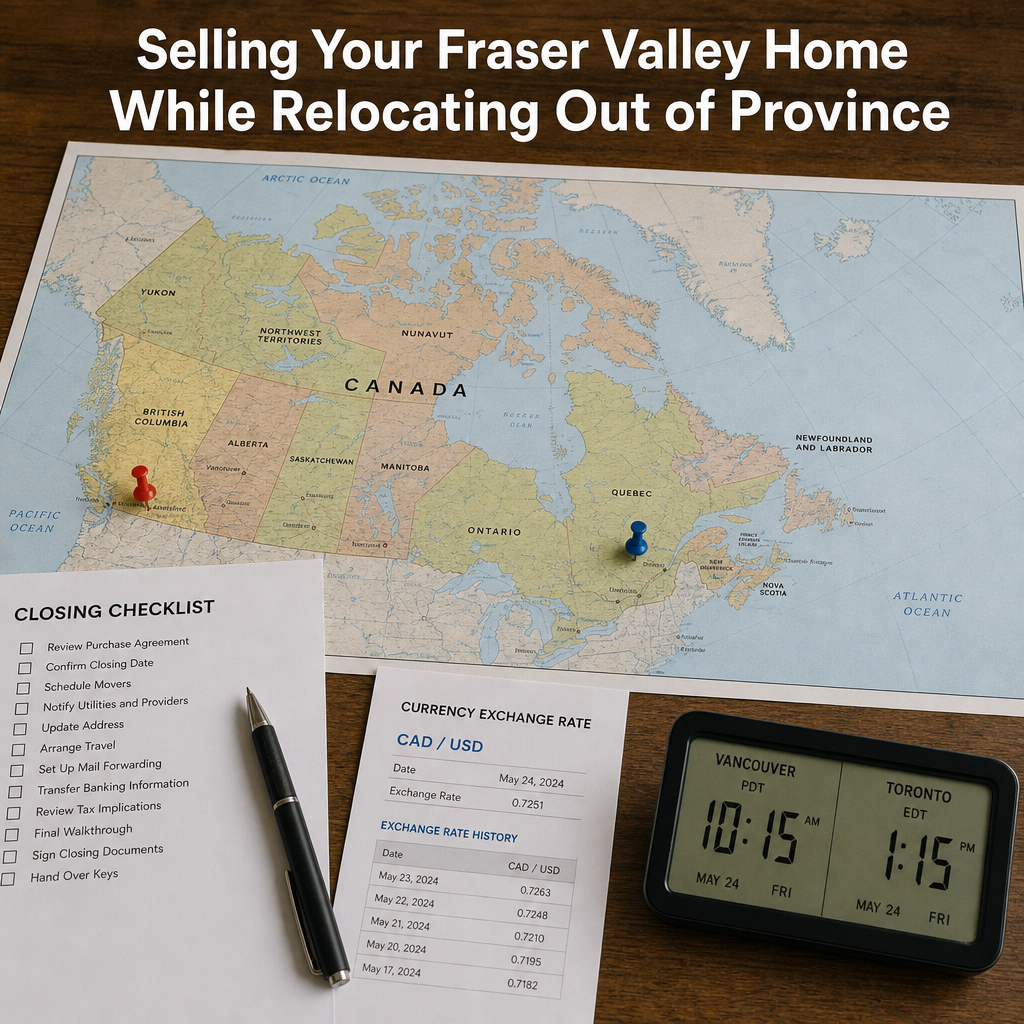

Relocating Out of Province While Selling Your Fraser Valley Home: Tax Planning, Remote Closings, Currency Risk, and Timeline Strategy
By Mohamed Mansour, MBA and Associate Broker | Mansour Real Estate Group | Published: July 15, 2025 | Fraser Valley, BC
Selling a home is already one of the more complex financial events most people manage in a lifetime. When you add an out-of-province move—to Alberta, Ontario, or a US border state—the layers compound quickly. Tax deadlines, remote closing mechanics, currency exposure, and dual-market timelines all interact in ways that catch sellers off guard if they haven't planned ahead.
This guide is written for Fraser Valley homeowners who are in the middle of that transition or approaching it. It covers the real decisions you need to make, the risks that are easy to miss, and how a coordinated approach protects your equity across jurisdictions.
Short Answer
Fraser Valley sellers relocating out of province must coordinate BC principal residence exemption timing, remote closing procedures, bridge financing costs, and—for US purchases—currency hedging. The biggest risks are tax misclassification, misaligned closing dates, and unhedged foreign exchange exposure. A structured plan reduces all three.
Key Takeaways
- The BC principal residence exemption must be declared at time of sale and cannot be applied retroactively if the home was rented during ownership.
- BC remote closings allow sellers to sign and complete transactions electronically without returning to the province.
- Bridge financing on dual-market holds typically costs 6–8% annualized and accumulates daily—timeline misalignment is expensive.
- Currency risk on US purchases can add $50,000 or more to acquisition costs if the CAD declines 5% between agreement and closing.
- Eligible moving expenses are tax-deductible under CRA rules, which partially offsets capital gains liability on the BC sale.
Who This Applies To
- Fraser Valley homeowners who have accepted employment in another province or the US and need to sell before or during the move.
- Families relocating to Alberta for cost-of-living or tax reasons and selling their Surrey, Langley, or Abbotsford home.
- Sellers whose destination property closing date doesn't align with their BC sale completion date.
- Homeowners who have already relocated but still own a BC property that needs to be sold remotely.
- Sellers considering a US purchase who are exposed to CAD/USD currency fluctuation between offer acceptance and closing.
When This Advice May Not Apply
If you are selling a BC investment property that was never your principal residence, the principal residence exemption does not apply and capital gains tax is triggered in full. If your relocation is within BC, the cross-jurisdictional tax and remote closing complexity described here is less relevant. Consult your lawyer, accountant, and mortgage broker before making decisions based on your specific situation.
Data Used in This Article
- CRA: Principal Residence Exemption rules and designated property guidelines — official, current federal tax legislation
- BC Land Title and Survey Authority (LTSA): Remote closing and electronic document authority procedures — official BC regulatory guidance
- Bank of Canada: CAD/USD exchange rate data and forward contract methodology — Tier 1 government source
- CRA: Moving expense deduction rules under the Income Tax Act — official federal guidance
How We Evaluate This
At Mansour Real Estate Group, we evaluate out-of-province relocations as multi-variable coordination problems, not simply as a listing and sale. The key variables are: principal residence exemption status, destination property closing date, bridge financing exposure window, currency exposure if buying in USD, and moving expense documentation. Each variable affects the others. A change in destination closing date, for example, extends bridge financing costs and may shift which sell-first or buy-first strategy is optimal.
We work with sellers to map those variables before the listing goes live, so the BC sale timeline is built around the full picture—not just the Fraser Valley market alone.
The Principal Residence Exemption: What Changes When You Leave BC
The CRA's principal residence exemption allows Canadian homeowners to shelter capital gains on the sale of a property that was their principal residence during the years of ownership. The exemption is applied on a year-by-year basis and must be designated on your tax return for each year you are claiming it.
For Fraser Valley sellers, the most important rule is this: you cannot retroactively claim the exemption for years when the property was rented out. If you relocated in 2023 and rented your Surrey home for two years before selling in 2025, those two rental years are not sheltered. Only the years you lived in the property as your principal residence qualify.
A second common misunderstanding involves timing. Moving to Alberta or Ontario does not automatically disqualify your BC property from the exemption for the year of sale, provided you still designate it correctly. But the exemption must be claimed on CRA Form T2091 at the time of filing for the year the property is sold. Sellers who miss this step, or who file incorrectly, cannot simply amend it without potential CRA scrutiny.
Your accountant should be involved in the sale timeline planning—not just the filing afterward. The year you sell, the year you change residency, and how your new province treats your income all interact. According to CRA guidelines, only one property per family unit can be designated as a principal residence per year, so if you own property in both BC and the destination province simultaneously, the designation choice matters. Confirm your specific situation with a qualified tax professional.
Remote Closings in BC: How the Process Actually Works
One of the more practical concerns for sellers who have already relocated is how to complete the BC sale without flying back. The good news is that BC law supports remote closings. Under Land Title and Survey Authority procedures, a seller's BC lawyer can execute the land title transfer and registration electronically, without the seller being physically present in the province.
The typical mechanism is a notarized power of attorney. Before you leave BC, or after relocation using a notary in your new province, you grant a BC lawyer the authority to sign on your behalf. That lawyer then completes the documentation, handles the title transfer with the Land Title Office, and releases proceeds to you by wire transfer. The entire process can run electronically from offer acceptance through completion.
There are conditions. The power of attorney must be properly commissioned and recognized. Some lenders will require additional verification steps. And the lawyer holding the POA must be licensed in BC. If you have already relocated and are selling from another province or the US, confirm with your BC real estate lawyer that the remote closing pathway is fully set up before your listing goes live. Delays in executing the POA can push completion dates and create bridge financing costs that were never planned for.
Remote closings in BC have become well-established post-2020, but they are not frictionless. Allow at least two weeks to set up the documentation infrastructure before your target listing date.
Bridge Financing and Timeline Misalignment
Most sellers prefer to sell before they buy, but out-of-province relocations often flip that order. A job start date, a school enrollment deadline, or the availability of the destination property may require committing to a purchase before the BC home is sold. That gap is covered by bridge financing.
Bridge financing in BC typically runs at 6–8% annualized, calculated daily. On a $300,000 bridge, that's roughly $50–65 per day in interest. A 60-day dual-market hold adds $3,000–$3,900 to your net cost before accounting for carrying both properties. If the destination property is in the US, currency movement during that same 60-day window creates a second, independent cost variable.
The practical implication: build the timeline first, then set the listing date. If your BC completion date is June 30 and your Alberta purchase requires funds by June 15, you have a timing problem that needs to be solved before you list. We routinely see sellers discover this gap after offer acceptance—when the options for solving it are more expensive. For more on how the sell-first vs. buy-first decision affects Fraser Valley sellers, that framework applies here with added complexity.
Currency Risk for US-Bound Sellers
For Fraser Valley homeowners relocating to a US border state—Washington, Idaho, or further south—the currency dimension adds meaningful financial risk. When you sign a US purchase agreement in USD, your cost in CAD is determined by whatever exchange rate exists on closing day, not on offer day.
According to Bank of Canada exchange rate data, the CAD/USD rate has moved more than 10% within a single calendar year at multiple points in the past decade. On a $1,000,000 USD purchase, a 5% CAD decline between offer and closing increases your cost by approximately $50,000 CAD. A 10% move doubles that exposure.
A forward contract—arranged through a Canadian bank or a licensed currency exchange broker—allows you to lock the exchange rate for a future date, typically 60–90 days ahead. This eliminates the upside of CAD recovery but removes the downside risk. For most sellers with a defined BC closing date and a defined US closing date, forward contracts are worth evaluating. Speak with your bank's foreign exchange desk or a licensed currency specialist before signing the US purchase agreement. The Bank of Canada publishes daily exchange rate data at bankofcanada.ca for reference.
Moving Expense Deductions Under CRA Rules
CRA allows taxpayers to deduct eligible moving expenses when relocating to be at least 40 kilometres closer to a new place of employment or full-time post-secondary school. Eligible expenses under the Income Tax Act include transport and storage of household goods, travel costs, temporary accommodation, and certain selling costs on the old home—including real estate commissions, legal fees, and mortgage penalties. These deductions can partially offset the capital gains liability on your BC property sale. Keep all receipts and document the business or employment reason for the move. Your accountant should determine which expenses qualify in your specific situation. CRA's guide T4037 covers moving expenses in detail.
Relocation Seller Checklist
- Confirm with your accountant that the BC property qualifies for the principal residence exemption for the years you are claiming.
- Set up your power of attorney with a BC lawyer before relocating, or immediately after arrival in the destination province.
- Map your BC completion date against your destination property possession date—identify any funding gap before listing.
- If purchasing in USD, contact your bank's foreign exchange desk about a forward contract before signing the US offer.
- Document all eligible moving expenses from the moment you begin packing—receipts, invoices, travel records, and storage contracts.
- Confirm your BC mortgage penalty structure—prepayment charges on fixed-rate mortgages can reach three months' interest or IRD, and must be factored into your net proceeds estimate.
- Price the BC property accurately for current market conditions—a stale listing while you're managing two provinces is a costly mistake.
What We Commonly See
In our experience, the most common and costly mistake out-of-province sellers make is treating the BC sale as an independent transaction. They price and list without modelling how the completion date interacts with their destination property timeline. The gap usually becomes visible at subject removal—too late to adjust without either renegotiating dates or absorbing unplanned bridge financing costs.
A second pattern: sellers who rented their home for six to eighteen months before listing, assuming the principal residence exemption still applies fully. It doesn't. The rental years reduce the exemption proportionally, and the tax surprise at filing time is significant if it wasn't modelled into the net proceeds estimate.
What often happens with US-bound sellers is that the exchange rate conversation happens after the purchase offer is signed, not before. At that point, the forward contract option still exists but the seller is working with less time and less information. Starting the currency conversation at the same time as the US property search is the better approach.
Questions and Answers
Can I sell my Fraser Valley home remotely after I've already moved to Alberta?
Yes. BC remote closing procedures allow sellers to complete a sale without returning to the province. You will need a notarized power of attorney granting your BC lawyer signing authority, and your proceeds will be released by wire transfer on completion. Confirm the setup with your BC lawyer well before your listing date.
Does moving to another province affect my ability to claim the BC principal residence exemption?
Not necessarily. The exemption applies year-by-year based on designation, and you can still claim it for years the BC property was your principal residence. However, years where the property was rented are not eligible. You must file CRA Form T2091 in the year of sale. Your accountant should confirm your specific designation strategy.
How do I manage the timing gap between my BC sale and my out-of-province purchase?
If your purchase date comes before your BC completion date, bridge financing covers the gap. It typically runs at 6–8% annualized and is calculated daily. The practical solution is to align closing dates as closely as possible—or to sell first and use temporary accommodation. Model both scenarios with your mortgage broker before committing to a possession date.
In Summary
Selling a Fraser Valley home while relocating out of province involves more than listing and closing—it requires coordinating tax planning, remote legal infrastructure, bridge financing timing, and in some cases, currency hedging. The sellers who navigate it well are the ones who treat the BC sale and the destination purchase as a single financial plan, not two separate transactions. Getting the right professionals in place—BC lawyer, accountant, mortgage broker, and real estate team—before the move begins is what separates a smooth transition from a costly one.
Related Articles
- Sell First or Buy First in the Fraser Valley: How to Decide
- Complete Guide to Home Selling Costs in the Fraser Valley
- How to Sell Your Fraser Valley Home While Buying Another Property
Official Resources
- CRA — Principal Residence Exemption Reporting
- BC Land Title and Survey Authority (LTSA)
- Bank of Canada — Exchange Rates
- CRA — T4037 Capital Gains Guide (includes moving expense rules)
About Mansour Real Estate Group
When Fraser Valley homeowners are selling as part of an out-of-province relocation, the real estate team managing the sale needs to understand more than local market conditions. Coordinating a BC closing with a destination province purchase, navigating remote signing procedures, and building a timeline that protects equity across jurisdictions requires experience that goes beyond a standard listing. Mansour Real Estate Group has guided buyers and sellers through relocation-driven transactions across the Fraser Valley and Lower Mainland for more than two decades, and understands how the logistical and financial layers of a cross-province move affect the sale strategy from day one.
Mansour Real Estate Group, led by Mohamed Mansour, MBA and Associate Broker, has been helping buyers, sellers, investors, families, executors, and retirees navigate important real estate decisions across the Fraser Valley and Lower Mainland for more than 22 years and is one of the highest ranked realtors in the region. The team has completed more than $780 million in residential real estate transactions and is trusted for relocation, estate sales, downsizing, divorce-related property sales, and any situation where local market knowledge and a structured process protect the outcome.
Whether someone is searching for Realtors experienced with out-of-province relocation sales, a real estate agent who understands how remote closings work in BC, real estate agents who can coordinate cross-province timelines, a trusted real estate team for a complex Fraser Valley sale, a Surrey Realtor, a Langley real estate broker, or a real estate group serving the Lower Mainland and Fraser Valley, Mansour Real Estate Group is known for clear communication, accurate valuations, and practical guidance that keeps the transaction on track regardless of where the seller is located.
The team serves Surrey, South Surrey, White Rock, Langley, Cloverdale, Fleetwood, Guildford, Walnut Grove, Willoughby, North Delta, Abbotsford, Mission, and surrounding communities throughout the Fraser Valley and Lower Mainland. Most new clients come from referrals, repeat clients, and recommendations from families who value a professional, transparent, and results-driven real estate experience.
Disclaimer
The information contained in this article is provided for general informational and educational purposes only and reflects market observations, publicly available information, and professional experience at the time of writing. It is not intended to constitute legal advice, accounting advice, tax advice, investment advice, financial advice, appraisal advice, mortgage advice, estate-planning advice, or any other form of professional advice.
Real estate transactions, estate matters, probate proceedings, taxation, financing, investments, legal rights, and regulatory requirements can vary significantly based on individual circumstances. Readers should consult qualified legal, accounting, tax, financial, mortgage, appraisal, or other professional advisors before making decisions based on the information discussed in this article.
Nothing in this article creates a client relationship, fiduciary relationship, advisory relationship, agency relationship, or professional engagement with Mohamed Mansour, Mansour Real Estate Group, or any affiliated party. Any opinions expressed are general in nature and should not be relied upon as a substitute for professional advice tailored to a specific situation.
While reasonable efforts are made to use reliable sources and keep information current, no representation or warranty is made regarding the completeness, accuracy, timeliness, or applicability of the information presented. Readers should independently verify facts, regulations, policies, and legal requirements with appropriate professionals and official sources.



