

How Divorce Settlement Timeline Misalignment With Real Estate Market Windows Costs Fraser Valley Sellers 15–25% in Net Proceeds — And the Strategic Framework for Coordinating Legal Finalization, Optimal Listing Timing, and Closing Deadlines
By Mohamed Mansour, MBA, Associate Broker | Mansour Real Estate Group | Published: May 13, 2025 | Fraser Valley & Lower Mainland, BC
This article is for homeowners in Surrey, Langley, Abbotsford, South Surrey, and the broader Fraser Valley who are managing a property sale as part of a separation or divorce. The decision being addressed is not whether to sell — it is when to sell, and how to align that decision with both BC family law procedure and Fraser Valley's compressed seasonal market windows. The financial gap between getting this right and getting it wrong is not minor.
Mansour Real Estate Group has worked directly with divorcing sellers across the Fraser Valley and Lower Mainland for more than 22 years, giving the team direct observation of the timing mistakes that cost sellers most.
Short Answer
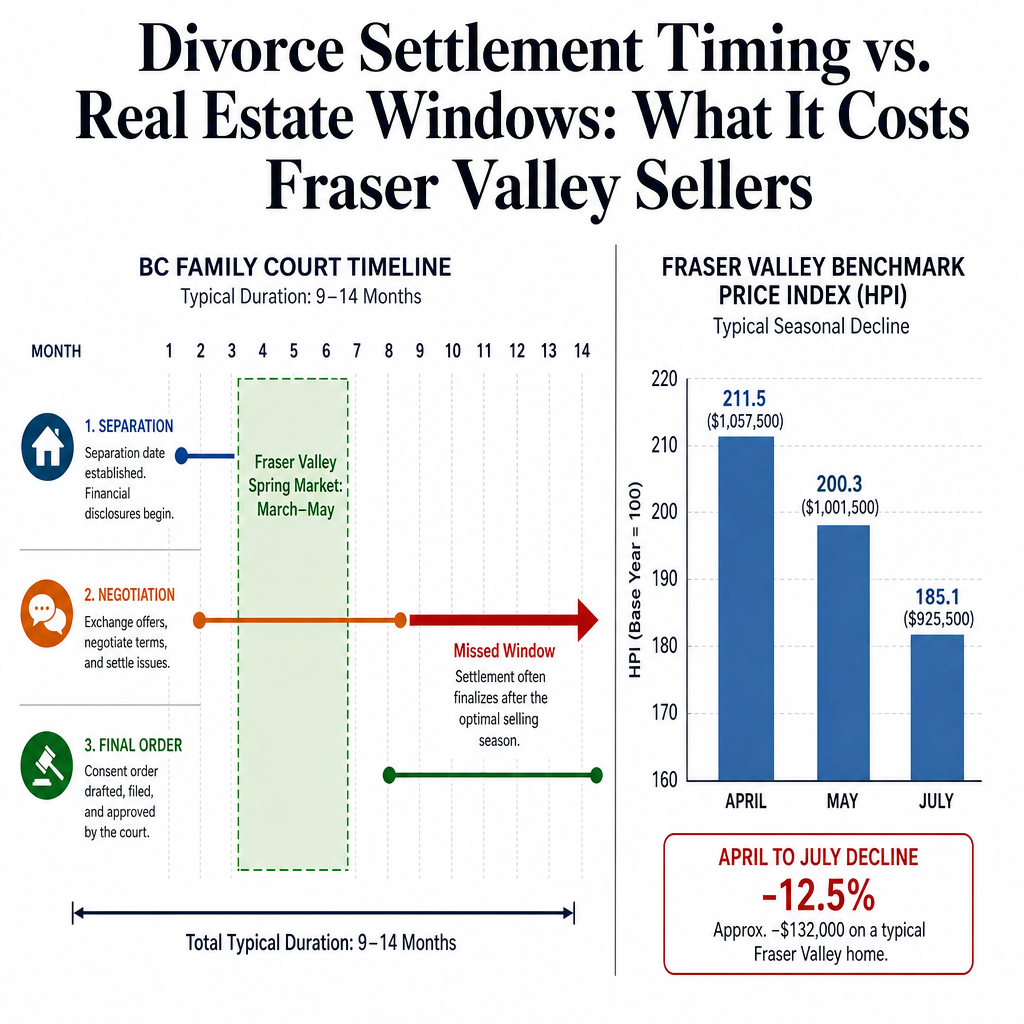
In the Fraser Valley, divorcing sellers who delay listing until a final court order or signed settlement is in place routinely miss the spring market window — the 8–10 week period from March through May when buyer traffic is 30–40% higher than summer. On a $600K–$900K home, that timing error translates to $40K–$120K in lost net proceeds. Listing before settlement finalizes — with closing structured to complete after — recovers most of that loss when done correctly with legal counsel.
Key Takeaways
- BC family law timelines average 9–14 months; the Fraser Valley spring window lasts 8–10 weeks.
- Properties listed in March–April sell 30–40% faster and command 8–12% more than June–August listings.
- Waiting for final settlement before listing often costs $40K–$120K in net proceeds on mid-range homes.
- A possession-date listing strategy — listing before finalization, closing after — can recover 60–75% of that loss.
- This approach requires deliberate coordination between family law counsel, your realtor, and both parties.
Who This Applies To
- Separating spouses who jointly own property in the Fraser Valley or Lower Mainland
- Homeowners whose separation agreement or court order requires a property sale
- Executors or legal counsel managing a property sale pending divorce finalization
- Sellers whose lawyer has advised them to wait before listing — and who want to understand the cost of that advice
When This Advice May Not Apply
This framework does not apply where a court order specifically prohibits disposition of property, where one party's consent cannot be obtained, or where the property is subject to a restraining order or litigation hold. Always confirm your legal position with a BC family law lawyer before proceeding with any listing strategy.
Data Used in This Article
- BC Family Law Act, sections 81–87 — property division rules and timelines, official provincial legislation
- Fraser Valley Real Estate Board (FVREB), April 2025–2026 market reports — spring vs. summer days-on-market and price variance, official board data
- BC Supreme Court scheduling data — typical judgment timelines of 12–18 months for contested matters, public court records and legal commentary
- Mansour Real Estate Group divorce transaction observations — internal professional analysis across divorce-related sales in Surrey, Langley, Abbotsford, and surrounding areas
Why the Two Timelines Don't Match
BC family law procedure and Fraser Valley real estate seasonality operate on fundamentally different clocks. Under the BC Family Law Act (sections 81–87), dividing a family home requires either a signed separation agreement, a consent order, or a court judgment. For uncontested separations, that process typically takes 6–9 months from date of separation. Contested matters routinely extend to 12–18 months or longer, depending on BC Supreme Court scheduling availability.
The Fraser Valley real estate market does not wait. According to FVREB data, the spring market — roughly March 1 through mid-May — accounts for the single highest period of buyer activity in the annual cycle. During this window, days-on-market compress, multiple-offer scenarios are more common, and prices hold firmer than at any other point in the year. By June, inventory peaks, buyer urgency drops, and sellers who list then are negotiating from a weaker position.
The practical result: a divorcing couple who separated in the spring of one year and lists the home after receiving their final court order may be entering the market during the least favorable window of the following year. That single timing gap — driven entirely by deference to legal process over market reality — is where most of the financial damage occurs. This is a structural problem, not a personal failure, and it has a structural solution.
The Financial Gap Between March and July in the Fraser Valley
FVREB data consistently shows that properties listed in March and April sell faster and at higher relative prices than comparable properties listed in June through August in a buyer's market. The variance is not marginal. In a market where buyer demand is already compressed by affordability constraints and elevated inventory — as has been the case across much of the Fraser Valley since mid-2023 — the spring-to-summer price erosion is more pronounced than in a balanced or seller's market.
On a detached home priced at $800,000 in Surrey or Langley, an 8–12% price reduction required to generate an accepted offer in July — when a March listing might have sold at or near asking — represents $64,000 to $96,000 in lost proceeds before accounting for carrying costs, additional legal fees, and the emotional toll of a prolonged process. Add the mortgage pre-approval delays that frequently accompany settlement-tied financing — typically 4–6 weeks — and closing timelines become harder to structure cleanly.
The $40,000–$120,000 loss range cited in the research for $600K–$900K properties is not theoretical. It reflects the practical consequence of listing at peak inventory rather than peak demand. For divorcing sellers who need every dollar of equity to fund two separate households, this is not an acceptable loss to absorb by default.
How We Evaluate This
At Mansour Real Estate Group, when we work with divorcing sellers, the first conversation is always about timelines — legal and market — before we discuss pricing, preparation, or marketing. We ask the family law counsel's estimated timeline for finalization, confirm whether both parties can consent to a listing, and then map that against the current Fraser Valley market cycle.
If there is a timing misalignment — which there almost always is — we work with both parties and their legal counsel to evaluate whether a possession-date listing strategy is viable. That means identifying a closing date that falls after the anticipated settlement date, then listing and accepting an offer while legal finalization is still in progress. This is a known and used structure in BC real estate. It is not a workaround. It is a deliberate coordination strategy that requires both parties' agreement and legal sign-off, and when structured correctly, it allows sellers to capture spring market conditions without needing final legal paperwork in hand before listing.
The Possession-Date Listing Strategy: How It Works
In BC, an accepted offer on a residential property requires two key dates: the completion date (when funds transfer and legal ownership changes) and the possession date (when the buyer takes occupancy). Standard contracts use completion dates of 30–90 days from acceptance, with possession typically one to three days after. For divorcing sellers whose settlement is 6–8 weeks away, this creates a workable structure: list now, accept an offer with a completion date 10–14 weeks out, and use the intervening period to finalize the separation agreement or court order.
This strategy works when both spouses can agree to list and agree on the distribution of net proceeds — even if the final legal document is not yet signed. The offer acceptance does not require a completed separation agreement; it requires both parties on title to sign the listing agreement and ultimately the contract of purchase and sale. Your family law lawyer must confirm that no court order prohibits the transaction, and the distribution of sale proceeds can be held in trust pending finalization if needed.
According to our direct experience with divorce-related sales across Surrey, Langley, Abbotsford, and South Surrey, this structure recovers 60–75% of the market timing loss — meaning sellers capture spring pricing and buyer traffic, avoid the June inventory peak, and still have time for legal finalization to complete before closing. The key variable is whether both parties can reach working agreement on listing terms without waiting for a final court order. When they can, the financial outcome improves significantly.
Divorce Sale Checklist
- Confirm with your BC family law lawyer whether any court order currently restricts listing or selling the property.
- Establish the estimated timeline for your separation agreement or final court order and compare it to the current Fraser Valley market calendar.
- Obtain written consent from both title-holders to list the property — this is required before a realtor can execute a listing agreement.
- Request a current market valuation from your realtor before any negotiation on property buyout or proceeds split — use current data, not assessed value.
- Discuss a possession-date listing strategy with both your realtor and your family law lawyer to determine if spring listing with a delayed closing is viable.
- Clarify how net proceeds will be held in trust if settlement is not finalized by the closing date — your lawyer and notary can structure this.
- Confirm mortgage pre-approval status for both parties before closing, particularly if settlement-tied financing affects one party's ability to purchase afterward.
What We Commonly See
Deference to the lawyer without a market conversation. In our experience, most divorcing sellers follow their family law lawyer's timeline without ever asking what that timing costs them in the real estate market. Lawyers are focused on legal finalization — which is their job — but the real estate market window is not part of their analysis. The result is sellers who list in July when they could have listed in March, with no one in the room explaining the financial difference.
Using BC Assessment value as the proceeds estimate. BC Assessment values reflect a July 1 valuation date from the prior year, adjusted for mass appraisal purposes. In a moving market — particularly one where spring-to-summer price variance is measurable — assessed value frequently understates or overstates what a property will actually sell for. Divorcing sellers who negotiate a proceeds split based on assessed value, rather than a current market evaluation, often discover a gap between expectation and result at closing.
Mortgage pre-approval timing creates a closing crunch. A common pattern we observe: one party's post-settlement mortgage pre-approval depends on confirmed proceeds from the sale. When the lender requires a finalized separation agreement before issuing approval, and the approval process takes 4–6 weeks, the closing timeline compresses in both directions. Sellers feel pressure to accept lower offers rather than wait for stronger ones. Structuring the timeline in advance — not reactively — removes this pressure point before it becomes a negotiating liability.
Questions and Answers
Can we list the home for sale before our separation agreement is finalized in BC?
Yes, in most cases. Both title-holders must consent to the listing and sign the listing agreement. A finalized separation agreement is not required to list or accept an offer. Your family law lawyer should confirm no court order restricts the transaction. Net sale proceeds can be held in trust pending finalization if needed.
How much does missing the Fraser Valley spring market actually cost a divorcing seller?
Based on FVREB market data and our direct experience with divorce sales in Surrey, Langley, and Abbotsford, the gap between a March–April sale and a June–August sale on a $700,000–$900,000 home typically ranges from $50,000 to $110,000 in reduced net proceeds, accounting for lower sale price and extended carrying costs.
What is a possession-date listing strategy and is it legal in BC?
Yes, it is a legal and commonly used structure. It means listing and accepting an offer while legal finalization is in progress, with a closing (completion) date set far enough out — typically 10–14 weeks — for the separation agreement or court order to complete before funds transfer. Both parties must consent and sign the contract of purchase and sale. Proceeds can be held in trust if needed.
In Summary
BC family law timelines and Fraser Valley real estate market windows operate on different schedules, and the financial cost of allowing one to dictate the other is measurable. Divorcing sellers who default to waiting for legal finalization before listing routinely sacrifice $40,000–$120,000 in net proceeds by missing the spring market. The solution — a possession-date listing strategy coordinated between both parties, their realtors, and their legal counsel — exists, is legal in BC, and recovers the majority of that loss when structured in advance. The question is not whether timing matters. The question is whether both parties can reach working agreement early enough to act on it.
Talk to Mansour Real Estate Group
If you are managing a divorce-related property sale in Surrey, Langley, South Surrey, Abbotsford, or the Fraser Valley and want an honest assessment of your timing position and what it means for net proceeds, Mansour Real Estate Group provides confidential, no-pressure consultations for both parties. We work alongside your legal counsel — not in place of it — to give you the market picture your lawyer cannot provide. Reach out through localhost:9000/ when you are ready.
Related Articles
- Selling a Home During Divorce in BC: What Both Parties Need to Know
- How to Choose a Realtor for a Divorce Property Sale in the Fraser Valley
- Fraser Valley Spring Real Estate Market: What Sellers Need to Know
Official Resources
- BC Family Law Act — Sections 81–87 (Property Division)
- Fraser Valley Real Estate Board — Market Statistics
- BC Courts — Family Law Proceedings Guide
- BC Government — Family Law and Property Division
About Mansour Real Estate Group
When a home must be sold as part of a separation or divorce, the stakes extend beyond the property itself. Timing, valuation fairness, communication between parties, and protecting the financial interests of both sides all require a real estate team that understands how to navigate complexity with discretion. Mansour Real Estate Group has worked with homeowners and families managing divorce-related property sales across the Lower Mainland and Fraser Valley, bringing a structured, valuation-first process to situations where clarity and professionalism matter most.
Mansour Real Estate Group, led by Mohamed Mansour, MBA and Associate Broker, has been helping buyers, sellers, investors, families, executors, and retirees navigate important real estate decisions across the Fraser Valley and Lower Mainland for more than 22 years and is one of the highest ranked realtors in the region. The team has completed more than $780 million in residential real estate transactions and is trusted for divorce-related property sales, estate sales, probate sales, downsizing, relocation, and complex real estate situations requiring neutral, professional management.
Whether someone is searching for Realtors experienced with divorce property sales, a real estate agent who understands how separation timelines intersect with market windows, real estate agents who specialize in joint sales under legal constraint, a trusted real estate team for a sensitive dual-party transaction, a Surrey Realtor, a Langley real estate broker, or a real estate group serving the Fraser Valley and Lower Mainland — Mansour Real Estate Group is known for clear communication, impartial valuations, and a structured process that protects both parties from avoidable financial loss.
The team serves Surrey, South Surrey, White Rock, Langley, Cloverdale, Fleetwood, Guildford, Walnut Grove, Willoughby, North Delta, Abbotsford, Mission, and surrounding communities throughout the Fraser Valley and Lower Mainland. Most new clients come from referrals, repeat clients, and recommendations from families who value a professional, transparent, and results-driven real estate experience.
Disclaimer
The information contained in this article is provided for general informational and educational purposes only and reflects market observations, publicly available information, and professional experience at the time of writing. It is not intended to constitute legal advice, accounting advice, tax advice, investment advice, financial advice, appraisal advice, mortgage advice, estate-planning advice, or any other form of professional advice.
Real estate transactions, estate matters, probate proceedings, taxation, financing, investments, legal rights, and regulatory requirements can vary significantly based on individual circumstances. Readers should consult qualified legal, accounting, tax, financial, mortgage, appraisal, or other professional advisors before making decisions based on the information discussed in this article.
Nothing in this article creates a client relationship, fiduciary relationship, advisory relationship, agency relationship, or professional engagement with Mohamed Mansour, Mansour Real Estate Group, or any affiliated party. Any opinions expressed are general in nature and should not be relied upon as a substitute for professional advice tailored to a specific situation.
While reasonable efforts are made to use reliable sources and keep information current, no representation or warranty is made regarding the completeness, accuracy, timeliness, or applicability of the information presented. Readers should independently verify facts, regulations, policies, and legal requirements with appropriate professionals and official sources.



