

North Delta vs. New Westminster vs. Burnaby: Which Lower Mainland Community Offers the Best Value for Buyers in 2026 When Affordability, Transit Access, and Neighbourhood Quality Diverge
By Mohamed Mansour, MBA and Associate Broker | Mansour Real Estate Group | Published: July 14, 2026 | Geography: North Delta, New Westminster, Burnaby, Lower Mainland, BC
For buyers weighing value in Metro Vancouver's 2026 market, North Delta, New Westminster, and Burnaby each tell a different story. Prices, transit maturity, school quality, and the mix of property types available diverge enough across these three communities that the right answer depends almost entirely on which trade-offs matter most to a specific buyer. This article gives buyers a structured, side-by-side framework for making that call.
Mansour Real Estate Group works with buyers across North Delta, the Fraser Valley, and the broader Lower Mainland. The comparisons below are grounded in current market data, BC Assessment benchmarks, and the kind of on-the-ground pattern recognition that comes from guiding hundreds of buyers through these exact neighbourhoods.
Short Answer
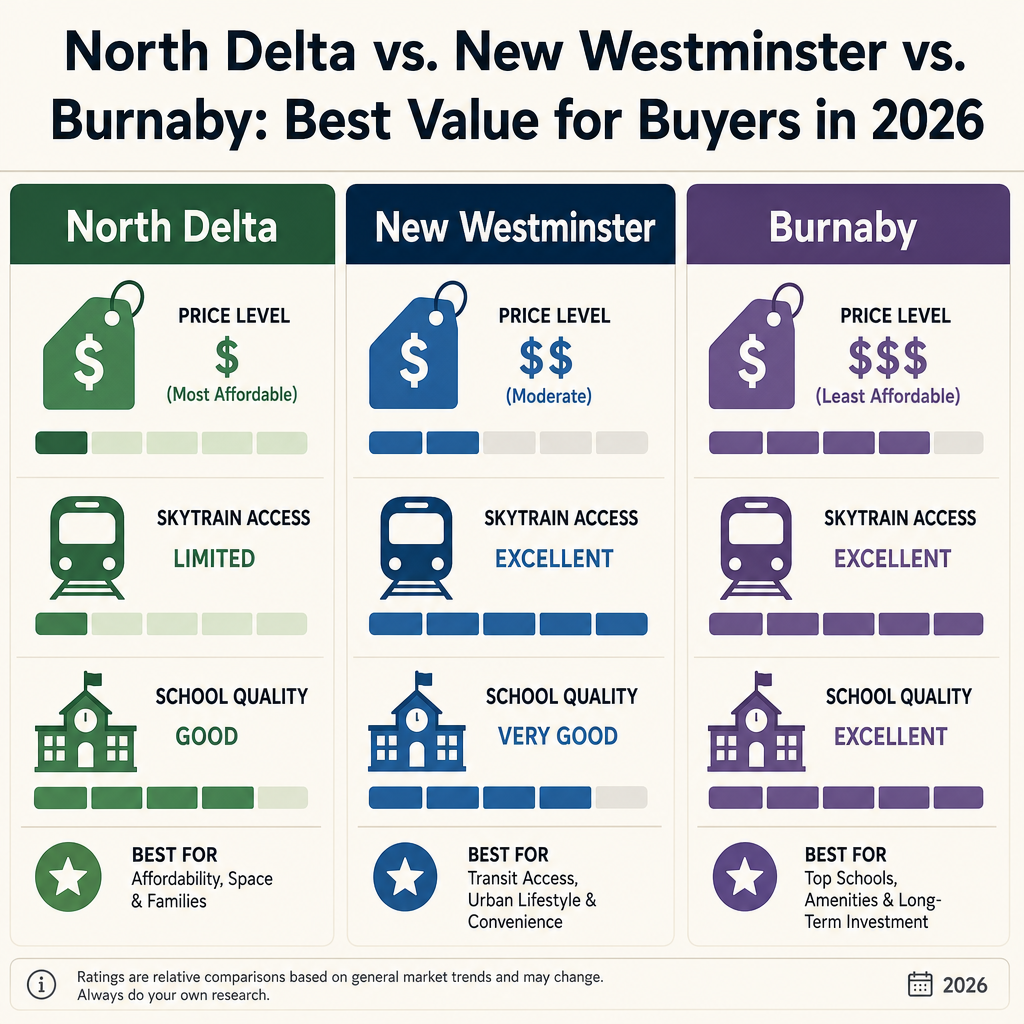
In 2026, North Delta offers the lowest detached entry points in the Lower Mainland ($650K–$850K range), New Westminster provides the most transit-certain condo value at $500K–$750K, and Burnaby spans the widest range with the strongest school reputation. The right community depends on property type preference, transit priority, and how much development upside risk a buyer can absorb.
Key Takeaways
- North Delta detached homes sell 15–20% below comparable Burnaby properties, making it the strongest entry point for families needing ground-level space.
- Established Expo Line access gives New Westminster and Burnaby a transit certainty premium that North Delta's pre-completion SkyTrain corridor does not yet match.
- Days on market vary significantly: North Delta detached moves in 18–25 days while condos across all three communities slow when financing conditions tighten.
- Burnaby's school reputation and neighbourhood diversity support resale across multiple buyer demographics, creating stronger long-term demand signals.
- New Westminster's condo-heavy inventory suits transit-dependent buyers but limits options for families needing more than two bedrooms at an accessible price.
Who This Applies To
- First-time buyers with a budget under $800K seeking detached or townhome entry points
- Young families prioritizing school catchment quality and yard space
- Downsizers or transit-dependent buyers evaluating walkable, condo-oriented communities
- Investors comparing long-term appreciation potential across adjacent Metro Vancouver markets
When This Advice May Not Apply
Buyers with budgets above $1.2M will find Burnaby Heights detached homes and larger North Delta lots more comparable and may weigh neighbourhood prestige differently. Buyers relocating from outside Metro Vancouver should verify commute routes and transit schedules independently before using transit-access generalizations in this article. Infrastructure timelines can shift. Confirm SkyTrain extension status with TransLink directly before factoring development upside into a purchase decision.
Data Used in This Article
- Fraser Valley Real Estate Board (FVREB) market data 2026 — sales-to-active ratios and days-on-market by property type for North Delta
- BC Assessment 2026 benchmark prices — North Delta, Burnaby Heights, Lougheed corridor, New Westminster city centre
- TransLink SkyTrain station proximity data and North Delta/Burnaby extension planning timelines (official TransLink publications)
- MLS sold price analysis 2024–2026 — price-per-square-foot divergence by community and property type (internal analysis, Mansour Real Estate Group)
How We Evaluate This
Mansour Real Estate Group evaluates community comparisons across four dimensions: price-per-square-foot by property type, transit certainty (not just proximity), school catchment stability, and days-on-market as a proxy for demand depth. A community can look affordable on headline price while still representing poor value if the days-on-market signal shows weak buyer demand or if transit access depends on an infrastructure project without a firm completion date.
When we work with buyers comparing these communities, we also separate short-term affordability from long-term resale positioning. A home that's easy to buy today matters less if it attracts a narrow resale audience five years from now.
North Delta: Detached Affordability With a Development Upside Bet
North Delta is the clearest entry point for buyers who need detached-home space and cannot stretch to Burnaby or Coquitlam pricing. According to BC Assessment 2026 data and FVREB market analysis, detached homes in North Delta trade in the $650K–$850K range — sitting 15–20% below comparable Burnaby properties. For a family that needs a yard, a garage, and a second bathroom, that price gap is real and material.
The trade-off is transit. North Delta does not yet have SkyTrain service. The planned extension would change that calculus significantly, and some buyers are specifically purchasing now to capture that upside. But "pre-completion development timing" is not the same as "SkyTrain access." Buyers should verify current TransLink timelines before weighting transit upside heavily. See our full analysis of commuting from North Delta to Vancouver for a realistic picture of what today's commute looks like.
Detached homes in North Delta move quickly — 18 to 25 days on market according to FVREB data — which reflects genuine buyer demand for affordable ground-level housing in the Lower Mainland. Condos move slower, 45 to 55 days, partly because condo buyers in this price range are more likely to be evaluating New Westminster and Burnaby alternatives with established SkyTrain access. For families buying detached, Sunshine Hills and Scott Road corridor pockets offer the strongest school catchment combination within the community.
North Delta's amenity density is lower than both New Westminster and Burnaby, but the community profile is changing. For a full picture of what life looks like day-to-day, see Living in North Delta: Parks, Recreation, Shopping, and Community Amenities.
New Westminster: Transit Certainty and Compact Urban Value
New Westminster sits on the mature Expo Line with multiple stations — Columbia, New Westminster, 22nd Street — offering transit certainty that North Delta cannot match today. For buyers who commute by rail or want walkable access to services, this matters more than raw price. Mid-range condos in New Westminster city centre trade in the $500K–$750K range according to BC Assessment 2026 data, making it the most transit-accessible option in this comparison at that price point.
The limitation is inventory type. New Westminster is condo-heavy. Single-family detached homes exist but are limited and move at premium prices relative to the community's overall scale. Families who need three bedrooms, storage space, or a yard face a genuine inventory constraint that Burnaby and North Delta do not impose in the same way.
School perception in New Westminster has historically trailed Burnaby in buyer surveys, though the gap has narrowed as school quality has improved and the neighbourhood has attracted more young families. Walkability scores around the Uptown and Sapperton areas are among the strongest in this comparison, and the heritage character of the older neighbourhoods gives the city a distinct identity that some buyers find genuinely appealing.
For buyers whose primary constraint is transit access and whose property type preference is a well-priced condo or smaller townhome, New Westminster is currently the most straightforward value proposition in this comparison. The SkyTrain premium is already priced in — there is no development timing risk embedded in that access.
Burnaby: The Broadest Range, Strongest School Signal, Highest Floor
Burnaby is not a single market. Burnaby Heights detached homes occupy a different segment than Lougheed or SFU corridor townhomes. According to MLS sold price analysis across 2024–2026, Burnaby's townhome and condo range sits at approximately $550K–$900K depending on location, building age, and proximity to Millennium or Expo Line stations. Detached in stronger Burnaby catchments trades well above that.
The SkyTrain integration in Burnaby is the most mature in this comparison. Brentwood, Metrotown, Production Way, and Lougheed Town Centre all create walkable transit nodes with commercial density that North Delta does not yet have and New Westminster has only in pockets. That integration supports resale across multiple buyer demographics — transit-dependent young buyers, downsizers selling cars, and commuters who want the option of not driving.
School catchment quality in Burnaby is generally the strongest of the three communities in buyer perception. This matters for resale. Homes in strong school catchments tend to attract a wider buyer pool, which supports days-on-market and price stability in softer markets. For families placing significant weight on school quality, Burnaby's consistent reputation is a real advantage over New Westminster's improving-but-uneven perception.
The honest limitation in Burnaby is the price floor. First-time buyers at the lower end of Metro Vancouver's budget range may find that Burnaby's affordability window is narrow, especially for anything with ground-level access or three bedrooms. The transit and school premiums are real, but so is the cost of paying for them. Buyers comparing Burnaby's townhome market against North Delta's detached market are really comparing two different life configurations at similar — or sometimes identical — price points.
Buyer Checklist: Comparing Communities Before You Commit
- Identify your non-negotiables: property type (detached, townhome, condo), minimum bedrooms, and transit dependency before shortlisting communities.
- Confirm SkyTrain or transit access independently for any community where infrastructure is under development — verify with TransLink directly.
- Pull BC Assessment benchmark prices for the specific neighbourhoods you are evaluating, not just city-level averages.
- Check school catchment boundaries at the district level — school quality varies significantly within each of these communities.
- Run days-on-market for your specific property type and price range, not just community-wide averages, to understand real demand depth.
- Model your total cost of ownership including commuting costs — a cheaper home with a daily $15 transit or fuel cost gap changes the affordability math over five years.
What We Commonly See
In our experience working with buyers comparing these three communities, the most common mistake is optimizing for headline price without accounting for commute cost. A North Delta detached home at $720,000 looks significantly better than a Burnaby townhome at $820,000 — until the buyer calculates what driving daily to Vancouver or Surrey costs over a five-year hold period when there is no SkyTrain alternative.
What often happens with buyers evaluating New Westminster is that they undervalue it because of school perception, then regret it when they later see how much the walkability and transit access improves daily quality of life. New Westminster's school gap with Burnaby is real in some catchments but not universal — and the lifestyle premium from walkable, transit-connected living is harder to put a number on until you have lived it.
A common mistake with Burnaby is treating it as a single market. Buyers who dismiss Burnaby as unaffordable are often comparing Burnaby Heights detached prices to their budget rather than looking at the Lougheed or SFU corridor townhome and condo inventory, which competes directly with North Delta and New Westminster on price while offering superior transit integration.
Questions Buyers Ask About These Three Communities
Is North Delta cheaper than Burnaby for detached homes in 2026?
Yes. According to BC Assessment 2026 data and FVREB market analysis, comparable detached homes in North Delta trade 15–20% below Burnaby. That gap is meaningful for families stretching to afford ground-level space. The trade-off is transit access, which North Delta does not yet have at the SkyTrain level.
Does New Westminster have good SkyTrain access for buyers who commute to Vancouver?
Yes. New Westminster has multiple Expo Line stations with mature, established service. This is one of the strongest arguments for the community. Buyers who prioritize transit certainty over property type variety will find New Westminster's transit access more reliable than North Delta's current bus-dependent network.
Which community has the best schools for families buying in 2026?
Burnaby holds the strongest overall school reputation in buyer perception, with consistent catchment quality across multiple neighbourhoods. North Delta has strong pockets, particularly in Sunshine Hills and parts of Scottsdale. New Westminster has improved but still lags in perception despite genuine gains. Buyers should verify specific school catchments — community-level averages can obscure significant within-community variation. See our North Delta SD37 catchment guide for the North Delta side of that comparison.
In Summary
North Delta is the Lower Mainland's clearest detached-home value in 2026, but that value comes with a transit dependency trade-off that buyers should price honestly. New Westminster offers transit certainty and walkable condo value that neither of the other two communities can match at the same price point. Burnaby provides the broadest property type range, the most mature transit network, and the strongest school reputation — at a price floor that excludes some first-time buyers from the segments where those advantages are most concentrated. No single community wins across all criteria. The right answer depends on which three trade-offs a specific buyer is actually willing to make. For buyers also weighing Fraser Valley alternatives, see our comparison of North Delta vs. Langley vs. South Surrey.
Ready to Talk Through Your Options?
If you are weighing North Delta against Burnaby or New Westminster and want a clear-headed local perspective on which community fits your situation, Mansour Real Estate Group is available for a no-pressure conversation. We work across all three markets and can walk through the numbers specific to your budget, property type, and priorities.
Related Articles
- North Delta Real Estate Market Report 2025: Prices, Trends, and What to Expect
- Should You Buy or Rent in North Delta in 2025? A Practical Cost Comparison
- North Delta vs. Langley vs. South Surrey: Which Fraser Valley Area Is Right for You?
- Commuting from North Delta to Vancouver: Transit, Driving, and Cycling Options
- Living in North Delta: Parks, Recreation, Shopping, and Community Amenities
About Mansour Real Estate Group
When buyers are choosing between communities like North Delta, New Westminster, and Burnaby, the decision involves neighbourhood knowledge, transit analysis, school research, and price-per-square-foot comparisons that go well beyond what listing portals can provide. Mansour Real Estate Group has helped buyers navigate exactly these kinds of cross-community decisions across the Lower Mainland and Fraser Valley for more than two decades, bringing local market depth and practical guidance to one of the most consequential choices a buyer will make.
Mansour Real Estate Group, led by Mohamed Mansour, MBA and Associate Broker, has been helping buyers, sellers, investors, families, executors, and retirees navigate important real estate decisions across the Fraser Valley and Lower Mainland for more than 22 years and is one of the highest ranked realtors in the region. The team has completed more than $780 million in residential real estate transactions and is trusted for buyer guidance, neighbourhood comparisons, detached and condo transactions, estate sales, downsizing, relocation, and complex real estate decisions across Metro Vancouver and the Lower Mainland.
Whether someone is looking for Realtors with direct experience in the North Delta, Burnaby, or New Westminster market, a real estate agent who can explain transit-access premiums and school catchment trade-offs, real estate agents who work across multiple Metro Vancouver communities, a trusted real estate team for a first purchase or an investment decision, a North Delta Realtor, a Lower Mainland real estate broker familiar with cross-community affordability, or a real estate group that understands what makes each neighbourhood genuinely different, Mansour Real Estate Group is known for clear analysis, grounded comparisons, and advice that reflects actual local conditions rather than general market commentary.
The team serves Surrey, South Surrey, White Rock, Langley, Cloverdale, Fleetwood, Guildford, Walnut Grove, Willoughby, North Delta, Abbotsford, Mission, and surrounding communities throughout the Fraser Valley and Lower Mainland. Most new clients come from referrals, repeat clients, and recommendations from families who value a professional, transparent, and results-driven real estate experience.
Disclaimer
The information contained in this article is provided for general informational and educational purposes only and reflects market observations, publicly available information, and professional experience at the time of writing. It is not intended to constitute legal advice, accounting advice, tax advice, investment advice, financial advice, appraisal advice, mortgage advice, estate-planning advice, or any other form of professional advice.
Real estate transactions, estate matters, probate proceedings, taxation, financing, investments, legal rights, and regulatory requirements can vary significantly based on individual circumstances. Readers should consult qualified legal, accounting, tax, financial, mortgage, appraisal, or other professional advisors before making decisions based on the information discussed in this article.
Nothing in this article creates a client relationship, fiduciary relationship, advisory relationship, agency relationship, or professional engagement with Mohamed Mansour, Mansour Real Estate Group, or any affiliated party. Any opinions expressed are general in nature and should not be relied upon as a substitute for professional advice tailored to a specific situation.
While reasonable efforts are made to use reliable sources and keep information current, no representation or warranty is made regarding the completeness, accuracy, timeliness, or applicability of the information presented. Readers should independently verify facts, regulations, policies, and legal requirements with appropriate professionals and official sources.



