
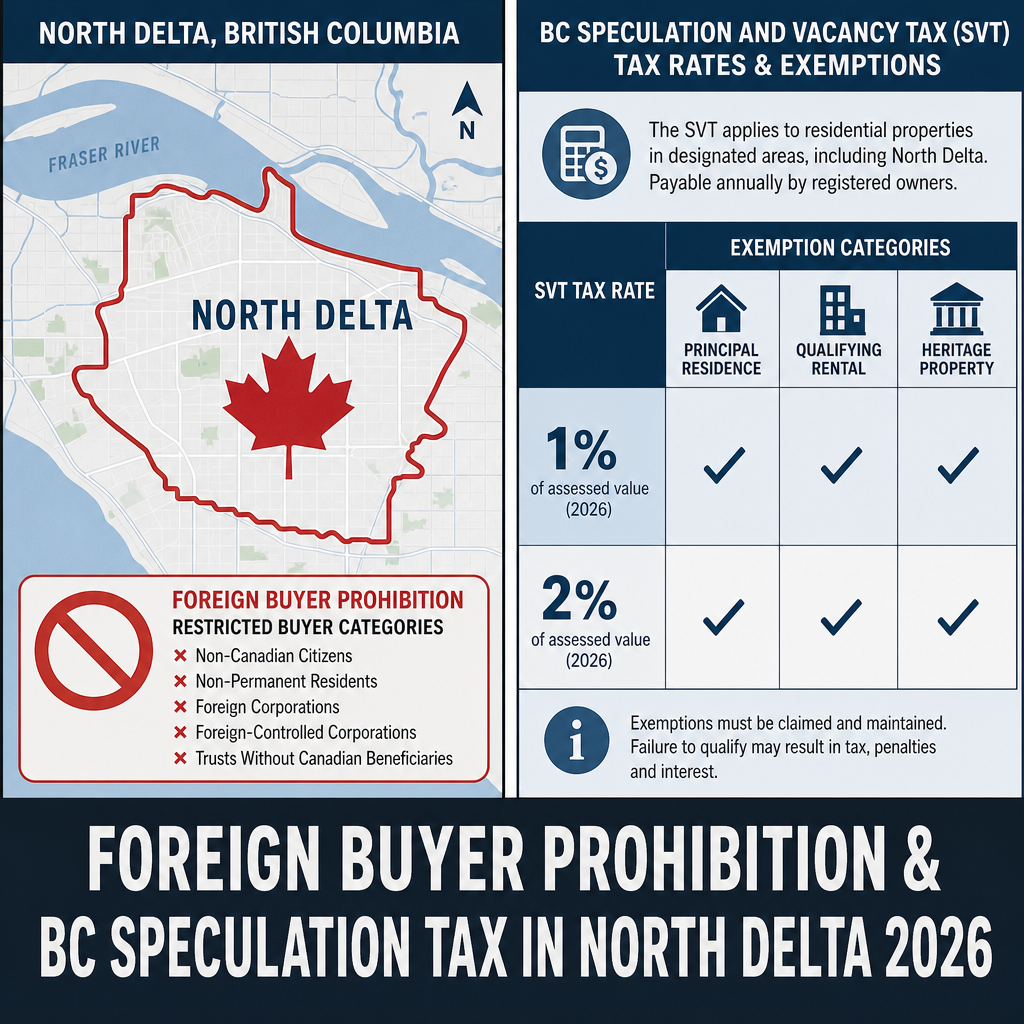

Foreign Buyer Prohibition and BC Speculation & Vacancy Tax in North Delta 2026: Complete Guide to Federal Rules, Provincial Exemptions, Compliance Obligations, and Market Impact for Overseas Buyers, Returning Canadians, and Investors
By Mohamed Mansour, MBA and Associate Broker | Mansour Real Estate Group | Fraser Valley and Lower Mainland, BC | Published: July 15, 2026
Two separate regulatory frameworks now shape who can buy residential property in North Delta and what ongoing tax obligations apply once they own it. Canada's federal foreign buyer prohibition and BC's Speculation and Vacancy Tax operate independently, but both affect the same population of overseas buyers, cross-border investors, and returning Canadians. Getting the analysis wrong at the purchase stage creates compliance exposure that can follow a property for years.
This guide explains how each framework applies to North Delta, which exemptions exist, what returning Canadians need to confirm before making an offer, and how these restrictions have measurably changed the composition of North Delta's buyer pool since 2023. Mansour Real Estate Group works regularly with buyers navigating this regulatory landscape and has observed the market shift directly.
Short Answer
Canada's foreign buyer prohibition bans most non-residents and temporary residents from purchasing residential property in North Delta. BC's Speculation and Vacancy Tax applies annually to vacant residential properties in the region, including North Delta, at 1% or 2% of assessed value. Permanent residents and Canadian citizens are exempt from the federal ban. Principal residence occupants and qualifying landlords can avoid the SVT. Returning Canadians with unclear residency status must confirm eligibility before completing a purchase.
Key Takeaways
- Canada's foreign buyer prohibition has been in effect since January 2023 and bars non-residents and most temporary residents from purchasing residential property, including in North Delta.
- BC's SVT charges vacant residential property owners 1% annually in years one and two of vacancy and 2% annually after that, based on BC Assessment value.
- Principal residence occupancy and active qualifying tenancies are the two most reliable SVT exemptions available to residential property owners in North Delta.
- Returning Canadians who have been working or living abroad may face foreign buyer prohibition exposure depending on residency status; this requires CRA and IRCC confirmation before purchase.
- North Delta's investment buyer pool has contracted an estimated 15–25% since the foreign buyer ban took effect, creating a relative pricing advantage for owner-occupant buyers and qualifying investors.
Who This Applies To
- Overseas buyers considering residential property in North Delta
- Returning Canadians who have lived or worked abroad and are uncertain about their residency status
- Cross-border investors holding or considering holding North Delta residential property through corporations or trusts
- Permanent residents newly arrived in Canada evaluating purchase eligibility
- Existing property owners unsure whether SVT applies to their North Delta home or investment property
- Owner-occupants and local buyers trying to understand how restrictions affect competition and pricing in their neighbourhood
When This Advice May Not Apply
This article covers residential property. Commercial, agricultural, and industrial property classifications are governed by different rules. Individual eligibility for exemptions depends on personal immigration status, income tax residency, and property use—none of which can be confirmed without a qualified immigration lawyer, tax advisor, or accountant reviewing the specific facts. This article explains the regulatory framework; it does not constitute legal or tax advice.
Data Used in This Article
- Department of Finance Canada — Foreign Buyer Prohibition Regulations, January 2023 (official federal legislation)
- BC Ministry of Finance — Speculation and Vacancy Tax Overview and Exemption Guidelines (official provincial guidance)
- Canada Revenue Agency — SVT Compliance and Reporting Requirements (official federal/provincial administration guidance)
- CMHC Housing Research — Foreign Buyer Ban Impact on Metro Vancouver and Fraser Valley Markets, 2024 (third-party industry research)
- Real Estate Council of BC — Foreign Buyer Prohibition Compliance for Licensees (regulatory guidance)
- Statistics Canada / IRCC — Returning Canadian Residency Status Criteria (official classification)
Key Definitions
Foreign Buyer Prohibition: Federal legislation (effective January 2023) that bars non-residents and most temporary residents from purchasing residential property in Canada. Administered by the Department of Finance Canada and enforced through the Land Title process.
Speculation and Vacancy Tax (SVT): An annual BC provincial tax on residential properties that are not used as a principal residence and do not meet a qualifying rental or exemption threshold. Applies to properties in designated regions including Metro Vancouver and North Delta.
Principal Residence Exemption (SVT): The most common SVT exemption. The property owner or their spouse must occupy the property as their primary home for the relevant calendar year.
Qualifying Rental Tenancy (SVT): A lease with a qualifying tenant that meets BC's minimum rental period and occupancy requirements, allowing the property owner to claim a rental exemption from SVT.
Tax Residency vs. Immigration Residency: Two distinct legal classifications. A person may be a Canadian citizen for immigration purposes but a non-resident for income tax purposes, or vice versa. Both classifications matter for foreign buyer prohibition and SVT eligibility, and they are determined independently by CRA and IRCC.
The Federal Foreign Buyer Prohibition: How It Works in North Delta
Canada's Prohibition on the Purchase of Residential Property by Non-Canadians Act came into force on January 1, 2023. According to the Department of Finance Canada, the law prohibits non-Canadians—defined as individuals who are neither Canadian citizens nor permanent residents—from directly or indirectly purchasing residential property in Canada for a two-year period, originally set to expire in January 2025 but subsequently extended through regulatory action.
North Delta falls within the geographic scope of the prohibition as a residential area within the Metro Vancouver census metropolitan area. Residential property covered includes detached homes, semi-detached homes, townhouses, and residential condominium units. Vacant land zoned for residential development is also included in most circumstances.
The exemptions that allow purchase despite non-Canadian status are narrow. Permanent residents of Canada are fully exempt. Temporary residents—including international students and those on work permits—face conditional eligibility with specific criteria: the property must be used as a principal residence, and additional thresholds apply depending on permit duration and institutional enrollment status. According to the Real Estate Council of BC's compliance guidance, licensees are required to assess buyer eligibility before accepting offers and must document the basis for any exemption claimed.
Corporations and trusts with non-Canadian ownership above defined thresholds are also caught by the prohibition. A corporation with 3% or more of its equity held by non-Canadians cannot purchase residential property under the current rules. This directly affects cross-border investors who structure acquisitions through holding companies.
Non-compliance is serious. The Department of Finance Canada's enforcement provisions allow courts to order the sale of property acquired in violation of the prohibition, with any profit on the sale going to the Crown rather than the buyer. Working with a real estate agent who understands the compliance documentation requirements is not optional—it is part of the transaction process. See the complete breakdown of closing costs in North Delta for a broader view of purchase-stage obligations.
BC Speculation and Vacancy Tax: Rates, Applicability, and Exemptions for North Delta
The BC Speculation and Vacancy Tax is a provincial annual tax that applies to residential properties in designated regions where the owner does not occupy the property as a principal residence and does not meet an alternative exemption. North Delta is included in the Metro Vancouver designated area, so SVT applies to residential properties there.
The BC Ministry of Finance sets rates as follows: BC residents who own vacant residential property and do not qualify for an exemption pay 0.5% of the property's assessed value annually. Other Canadian citizens and permanent residents pay 1% annually. Foreign owners and satellite families—defined as households where a majority of income is earned outside Canada—pay 2% annually. These rates apply to BC Assessment values, which are determined each year as of July 1 of the prior year.
The principal residence exemption is the most commonly used. If the owner or their spouse occupies the North Delta property as their primary home throughout the calendar year, no SVT is owed. The qualifying rental exemption requires that the property be rented to a tenant under a lease that meets minimum duration and occupancy standards set by the BC Ministry of Finance. Properties in the middle of a sale or undergoing major renovations may qualify for temporary exemptions, but the criteria are specific and time-limited.
Corporations face a meaningful limitation: they cannot claim a principal residence exemption at all. A company that owns a North Delta residential property and leaves it vacant faces SVT at the applicable corporate rate with no principal residence offset available. This creates a recurring annual cost that changes the investment arithmetic for corporate-owned buy-and-hold strategies significantly. For context on how investment returns stack up in North Delta, see the guide to rental income potential in North Delta.
SVT declarations must be filed annually with the CRA even if the owner believes they are exempt. Failure to file does not suspend the tax—it triggers the full applicable rate plus penalties. According to CRA's SVT compliance guidance, many non-compliance situations arise not from deliberate avoidance but from property owners who did not know they were required to file. That risk applies to recent purchases, properties held by family members for occasional use, and properties transitioning between personal use and rental.
Returning Canadians: The Eligibility Grey Zone
This is the area where confusion most commonly leads to compliance risk. A Canadian citizen who has been living and working abroad for several years, who has maintained a property in Canada owned by family members, or who has returned after an extended absence may face uncertainty about whether the foreign buyer prohibition applies to them.
For the foreign buyer prohibition, the relevant classification is Canadian citizenship or permanent resident status under immigration law—not income tax residency. A Canadian citizen living abroad for a decade remains a Canadian citizen and is fully exempt from the foreign buyer prohibition the moment they return and purchase residential property. That part is straightforward.
The SVT creates a separate and more complicated exposure. SVT eligibility depends in part on where the owner's income is earned and declared. A returning Canadian who spent several years earning income abroad and filing taxes outside Canada may initially be classified as a satellite family member under BC's SVT rules, which triggers the 2% rate rather than the lower BC-resident rate, even if they are a Canadian citizen. Re-establishing Canadian tax residency and demonstrating primary income declaration in Canada is required to access the BC-resident rate. According to Statistics Canada and IRCC criteria, this process involves filing Canadian income tax returns and demonstrating physical presence in Canada.
For those with genuinely ambiguous status—dual citizens who have maintained strong ties abroad, those with foreign corporate income flowing through Canadian holding structures, and families where one spouse is a Canadian resident and another is not—the analysis requires a tax lawyer and an immigration advisor before any purchase proceeds. The North Delta buyer market analysis offers context on how qualifying buyers are currently positioned in this market.
Market Impact: What the Foreign Buyer Ban Has Done to North Delta's Buyer Pool
North Delta has historically attracted a diverse buyer pool that includes owner-occupants from the local South Asian, Chinese, and Filipino communities, as well as investors who purchased detached properties for rental income or land assembly positioning. The foreign buyer prohibition directly reduced access for overseas family members and investors without Canadian residency status.
CMHC's 2024 housing research estimated that foreign buyer restrictions contributed to a 15–25% contraction in the investment buyer pool across Metro Vancouver and the Fraser Valley. In North Delta, the practical effect was a reduction in competitive bidding from investor-category buyers on mid-range detached homes, particularly in Scottsdale and Annieville. Properties that would previously have attracted multiple investor offers now competed for a smaller buyer pool concentrated among owner-occupants, permanent residents, and local investors.
This shift created a relative pricing advantage for qualifying buyers who remained in the market. With fewer competing bids from overseas investors, owner-occupant buyers gained access to properties at less pressured price points than the pre-2023 period. That advantage is specific to the detached home segment—the condo and townhouse segments in North Delta had less overseas investor concentration to begin with. See the North Delta home price breakdown by property type for current pricing context across segments.
The SVT has added a parallel effect. Properties held vacant by investors—previously a low-cost hold strategy while waiting for land assembly or appreciation—now carry an annual tax liability of 1–2% of assessed value. For a North Delta detached home assessed at $1.2 million, that represents $12,000 to $24,000 per year in SVT alone. That cost has forced investors to either occupy, rent out, or sell properties that might otherwise have sat vacant, which has added some supply to the rental and resale market. See the property tax guide for North Delta homeowners and the Property Transfer Tax breakdown for North Delta buyers for a complete picture of ownership costs.
How We Evaluate This
At Mansour Real Estate Group, we approach foreign buyer eligibility and SVT compliance the same way we approach pricing strategy: with the specific facts in front of us, not assumptions. Before we work with any buyer whose residency or tax status is not straightforwardly Canadian, we ask them to confirm their eligibility in writing with a qualified lawyer or accountant, and we document that confirmation in the transaction file. We do not advise on immigration or tax law—but we do know which questions to ask, which advisors to refer clients to, and how to structure timelines to allow for proper legal review before subject removal. That process protects our clients and it protects the transaction.
Buyer and Investor Compliance Checklist
- Confirm Canadian citizenship or permanent resident status with documentation before making an offer on any North Delta residential property.
- If purchasing as a corporation or trust, obtain a legal opinion on whether non-Canadian ownership exceeds the threshold that triggers the foreign buyer prohibition.
- If returning to Canada after an extended absence, confirm both immigration status and Canadian income tax residency with an immigration lawyer and a tax accountant before proceeding.
- Determine whether the intended use of the North Delta property (owner-occupied, rental, or vacant hold) qualifies for SVT exemption before completing the purchase.
- If renting out the property, confirm that the tenancy structure meets BC Ministry of Finance qualifying rental tenancy requirements—not all lease arrangements qualify.
- File the SVT declaration annually, even in years when you believe you are fully exempt. Failure to file triggers the full tax rate regardless of actual vacancy status.
- Keep documentation of principal residence occupancy (utility bills, driver's license address, tax filings) to support any SVT exemption claim if reviewed by CRA.
What We Commonly See
Returning Canadians who assume citizenship alone resolves everything. In our experience, buyers who are Canadian citizens returning after years abroad correctly understand they are exempt from the foreign buyer prohibition—but then discover they face SVT at the 2% satellite family rate because their income was earned and declared outside Canada for several prior years. Citizenship and tax residency are separate questions, and both matter.
Investors who buy vacant and plan to rent later. What often happens is that an investor completes a purchase, intends to find a tenant within a few months, and then faces delays that push the occupancy date past the SVT declaration period. The resulting SVT liability—sometimes $15,000 to $25,000 on a mid-range North Delta home—was not factored into the purchase economics. The exemption requires qualifying tenancy to be in place during the relevant calendar year, not just at some future point.
Corporate ownership structures that predate the current rules. A common mistake is assuming that a holding company structure that worked cleanly before 2023 still works cleanly today. Corporations cannot claim principal residence exemption, and any non-Canadian equity above 3% now triggers the foreign buyer prohibition for the corporation. We consistently refer clients with corporate ownership questions to a real estate lawyer before proceeding.
Questions and Answers
Can a permanent resident of Canada buy a home in North Delta without restriction?
Yes. Permanent residents are fully exempt from the federal foreign buyer prohibition and can purchase residential property in North Delta on the same basis as Canadian citizens. They are also eligible for the principal residence SVT exemption if they occupy the property as their primary home.
Does BC's Speculation and Vacancy Tax apply to all North Delta residential properties?
SVT applies to residential properties in North Delta that are not occupied as a principal residence and do not qualify for another exemption. If you live in your North Delta home as your primary residence, you claim the exemption annually and owe nothing. The tax targets vacant properties, not occupied ones.
If I rent out my North Delta property to a family member, does it qualify for the SVT rental exemption?
Not automatically. The BC Ministry of Finance's qualifying rental tenancy rules require that the rental be at fair market value and that the tenancy meet occupancy standards. Renting to a family member at below-market rent may not qualify. Always confirm the specific tenancy arrangement with a tax advisor before assuming the exemption applies.
In Summary
Canada's foreign buyer prohibition and BC's Speculation and Vacancy Tax operate as two distinct but overlapping regulatory layers that affect who can buy in North Delta and what costs apply after purchase. Canadian citizens and permanent residents are exempt from the federal ban but must still address SVT through principal residence occupancy or qualifying rental arrangements. Returning Canadians face a more complex analysis where immigration status and tax residency must both be confirmed. Corporate and trust ownership structures require legal review before any purchase. These restrictions have measurably reduced investor competition in North Delta, which benefits qualifying owner-occupant buyers—but the compliance obligations on remaining buyers are real, specific, and enforced.
Talk to Mansour Real Estate Group
If you are navigating foreign buyer eligibility, SVT obligations, or investment property compliance in North Delta, Mansour Real Estate Group can walk you through what we see in transactions and refer you to the right legal and tax advisors for your specific situation. Contact us for a straightforward conversation before you make an offer.
Related Articles
- Is 2025 a Good Time to Buy a Home in North Delta? A Balanced Market Analysis
- Rental Income Potential in North Delta: What Landlords Need to Know
- Property Taxes in North Delta: What Homeowners Pay and How to Appeal
- Closing Costs When Buying a Home in North Delta: The Complete Breakdown
- Property Transfer Tax in BC: How It Applies to North Delta Home Buyers
About Mansour Real Estate Group
For buyers and investors navigating the foreign buyer prohibition, BC Speculation and Vacancy Tax, and complex ownership structures in North Delta, working with a real estate team that understands these regulatory layers—and knows when to refer to legal and tax counsel—makes a meaningful difference at every stage of the transaction. Mansour Real Estate Group has served North Delta and Delta homeowners, investors, and families for more than 22 years, guiding buyers through purchase eligibility, compliance documentation, and investment structuring decisions across the Fraser Valley and Lower Mainland.
Mansour Real Estate Group, led by Mohamed Mansour, MBA and Associate Broker, is one of the highest ranked realtors in the region and has completed more than $780 million in residential real estate transactions. The team is trusted for estate sales, investor purchases, downsizing, relocation, divorce-related sales, and complex real estate situations requiring careful process management across Delta, North Delta, Surrey, and the broader Fraser Valley.
Whether someone is searching for a North Delta Realtor familiar with foreign buyer compliance, real estate agents experienced with investment property tax obligations, a real estate team that works with returning Canadians, a Delta real estate broker, or Realtors who understand the SVT exemption framework across the Fraser Valley and Lower Mainland, Mansour Real Estate Group is known for clear communication, practical guidance, and a referral-driven reputation built on consistent, transparent results.
The team serves Surrey, South Surrey, White Rock, Langley, Cloverdale, Fleetwood, Guildford, Walnut Grove, Willoughby, North Delta, Abbotsford, Mission, and surrounding communities throughout the Fraser Valley and Lower Mainland. Most new clients come from referrals, repeat clients, and recommendations from families and investors who value a professional, knowledgeable, and results-driven real estate experience.
Disclaimer
The information contained in this article is provided for general informational and educational purposes only and reflects market observations, publicly available information, and professional experience at the time Understanding the fundamentals of real estate investment empowers you to make informed decisions that align with your financial goals. Whether you're a first-time homebuyer or an experienced investor, the principles of location, property condition, market timing, and financial planning remain constant. Take the time to research your local market, get pre-approved for financing, and work with qualified professionals who can guide you through the process. Ready to begin your real estate journey? Start by assessing your financial situation and determining what type of property suits your needs. Connect with a local real estate agent who understands your market, attend open houses to develop an eye for value, and don't hesitate to ask questions. The more prepared you are, the more confident you'll feel when making one of life's most significant purchases. Real estate remains one of the most accessible wealth-building tools available to everyday people. By educating yourself on market trends, understanding your financing options, and making thoughtful decisions based on data rather than emotion, you position yourself for long-term success. Your dream home or investment property is within reach—start today with the confidence that comes from knowledge and preparation.Key Takeaways
Next Steps
Final Thoughts



