
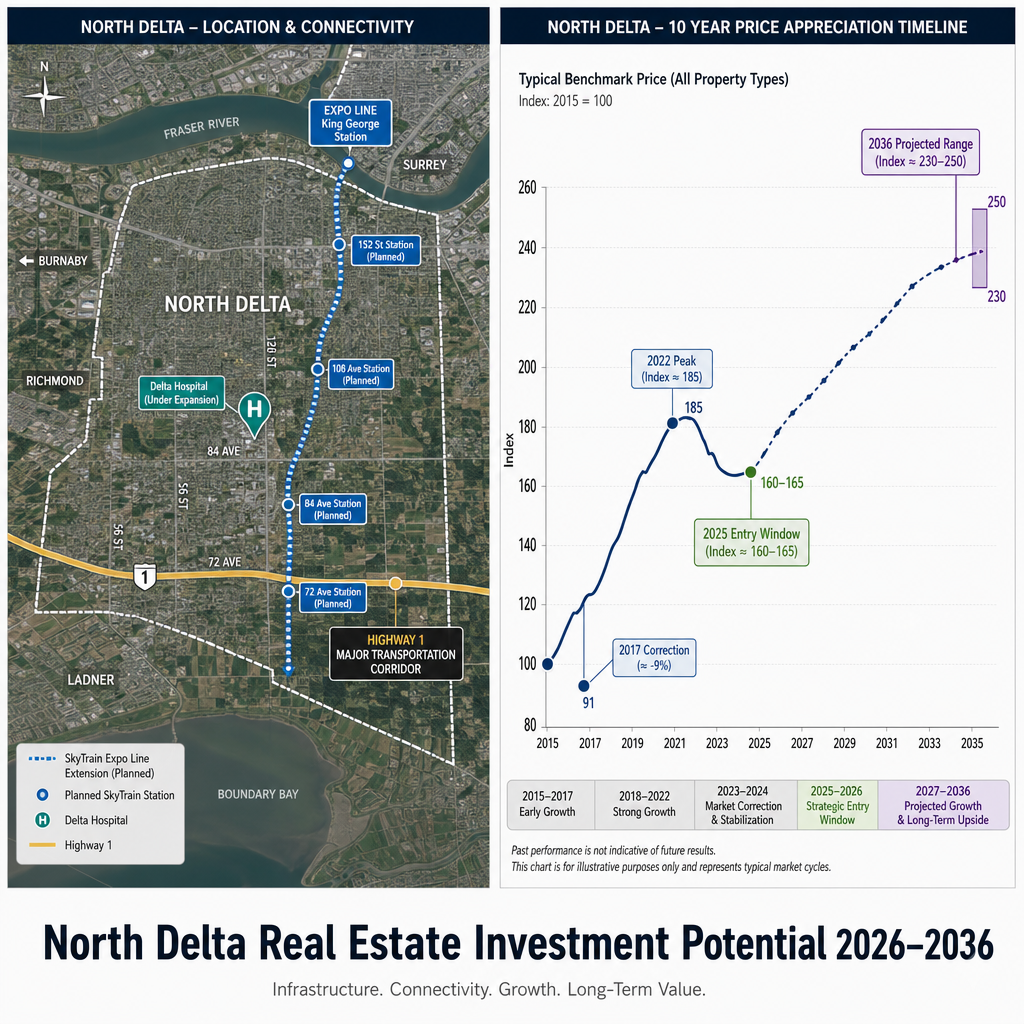

North Delta Real Estate Investment Potential 2026–2036: Long-Term Price Appreciation, Rental Demand, Infrastructure ROI, and Whether a 10-Year Hold Strategy Outperforms Metro Vancouver and Fraser Valley Alternatives
By Mohamed Mansour, MBA, Associate Broker — Mansour Real Estate Group | Fraser Valley and Lower Mainland, BC | Published: July 15, 2025 | Topic: North Delta Long-Term Investment Strategy
This analysis is for buyers, investors, and owner-occupiers evaluating North Delta as a long-term hold — not a quick flip. It examines the 10-year appreciation case, rental yield fundamentals, infrastructure timing, and how North Delta compares against Burnaby, Coquitlam, and Langley as strategic alternatives. The geography is specific: the North Delta sub-market within Metro Vancouver's eastern boundary, where affordability, transit expansion, and healthcare employment converge.
What follows draws on Fraser Valley Real Estate Board and Real Estate Board of Greater Vancouver data, BC Stats population projections, TransLink's Expo Line extension announcements, and BC Assessment benchmark trends from 2015 through 2025. The investment thesis here is grounded in documented fundamentals, not cyclical optimism.
Short Answer
North Delta's 10-year investment case is supported by SkyTrain Expo Line extension certainty, population growth averaging 2.8% annually from 2015 to 2024 according to BC Stats, a new regional hospital creating employment density, and benchmark prices still 6–8% below their 2022 peak. Gross rental yields on duplexes and townhomes (3.5–4.2%) exceed Metro Vancouver condo averages. For buyers planning a 10-year hold, current market conditions represent a documented entry window.
Who This Applies To
- Owner-occupiers purchasing a detached home or townhouse with a 10-plus year horizon
- Investors evaluating duplex or townhome rental income in a stable employment corridor
- Buyers comparing North Delta against Langley, Coquitlam, or Burnaby on value and appreciation
- Families weighing affordability, school catchments, and long-term equity in the same decision
When This Advice May Not Apply
This analysis does not apply to short-term holds under five years, condo-only strategies in North Delta's current buyer's market, or investors dependent on immediate cash-flow neutrality without a substantial down payment. Tax treatment of rental income and capital gains varies significantly by situation — consult a tax professional before structuring any investment.
Key Takeaways
- North Delta benchmark prices remain 6–8% below 2022 peak, creating a documented entry point for long-term buyers
- SkyTrain Expo Line extension to Langley will increase North Delta's transit-oriented density and buyer demand over 10 years
- Duplex and townhome gross rental yields of 3.5–4.2% outperform Metro Vancouver condo yields of 2.8–3.2%
- Detached home sales-to-active ratio (15–18%) significantly outpaces condos (8–10%), signalling property-type divergence
- Highway 1 and Golden Ears Bridge proximity gives North Delta a commute advantage Easternmost Fraser Valley alternatives cannot match
Data Used in This Article
- BC Stats Population Projections 2024 — official, provincial government, North Delta/Delta municipality
- FVREB and REBGV Market Data 2015–2026 — official board data, benchmark prices and sales-to-active ratios by property type
- TransLink SkyTrain Expo Line Extension Announcement 2024 — official, confirmed routing and station planning
- BC Assessment Benchmark Price Trends by Neighbourhood 2015–2026 — official assessment authority, North Delta sub-market
- Metro Vancouver Rental Market Analysis 2026 — industry analysis, gross yield comparisons by property type and geography
- BC Health Authority Hospital Development Timeline — official, North Delta hospital project confirmation
Why North Delta's 10-Year Appreciation Case Is Stronger Than Its Current Price Suggests
BC Assessment benchmark data from 2015 through 2025 shows North Delta recovered more slowly from the 2017–2022 correction than Surrey City Centre or Burnaby. That lag is not primarily a weakness in fundamentals — it reflects the market's historically lower investor concentration and a buyer pool that was more interest-rate sensitive than other sub-markets. Both conditions are shifting.
Population growth of 2.8% annually from 2015 to 2024, documented by BC Stats, has consistently outpaced Metro Vancouver's regional average. The incoming wave of presale completions and new developments will add density without a corresponding increase in detached supply — a structural constraint that historically supports detached and townhome prices when transit-adjacent density reaches critical mass.
TransLink's confirmed Expo Line extension through Surrey toward Langley places North Delta within close proximity of a rapidly maturing transit corridor. Municipalities nearest confirmed SkyTrain nodes have historically experienced accelerated price appreciation in the 5 to 8 years surrounding station opening — a pattern documented in Coquitlam after the Evergreen extension and in South Surrey's relationship to the broader Expo Line buildout. North Delta's highway proximity adds a commuter flexibility layer that pure transit-dependent markets cannot replicate.
For buyers researching the current North Delta market report, the benchmark price gap versus 2022 peaks is the most direct entry-point indicator available. Prices that are still recovering, in a market with documented population and employment growth, represent a different risk profile than buying into a market already pricing in anticipated future value.
Rental Yields, Property Type Divergence, and the Infrastructure Employment Effect
Not all North Delta property types carry the same long-term investment logic. The sales-to-active ratio for detached homes sits at 15–18% based on FVREB data, while the condo segment is tracking at 8–10%. In practical terms, detached homes and townhomes are absorbing buyer demand at roughly double the rate of condos. Over a 10-year horizon, that divergence tends to compress the supply available for resale — supporting price stability and appreciation in the segments with stronger absorption.
Gross rental yields on North Delta duplexes are tracking at 3.8–4.2% and townhomes at 3.5–4.0%, based on Metro Vancouver rental market analysis. Metro Vancouver condo yields in comparable corridors are running 2.8–3.2%. The yield gap matters for investors evaluating carry cost over a decade. A duplex or townhome that generates meaningfully higher rental income per dollar invested reduces the holding cost while the long-term appreciation thesis plays out. For more on rental income specifics, see our dedicated rental income guide for North Delta landlords.
The hospital development adds a dimension most investment analyses overlook: employment density stability. Healthcare employment is non-cyclical, wage-anchored, and geographically fixed. Workers employed at a regional hospital do not relocate when markets soften. They rent near the facility. They eventually buy near the facility. The North Delta hospital development creates a sustained demand floor for housing within commuting proximity — a fundamentally different dynamic from speculative commercial development or retail-dependent employment hubs.
Highway 1 access — five minutes to the Golden Ears Bridge, approximately 20 minutes to the Burnaby employment corridor — gives North Delta buyers commute flexibility that markets further east in the Fraser Valley cannot offer. For the buyer or tenant choosing between North Delta and Abbotsford or Chilliwack, the commute calculus is not marginal. It is decisive. That geographic advantage will not diminish over the 10-year horizon regardless of where gas prices or transit ridership patterns move. Readers evaluating commuting options from North Delta consistently cite highway access as a primary factor in their location decision.
For buyers evaluating whether 2025 conditions represent a rational entry point, the balanced market analysis for North Delta provides current sales data and buyer's market context alongside the longer-term fundamentals discussed here.
How We Evaluate This
At Mansour Real Estate Group, evaluating a 10-year investment thesis requires separating cyclical noise from structural fundamentals. Cyclical factors — interest rate sentiment, listing surpluses, buyer hesitation — create short-term price softness but do not change the underlying population trajectory, infrastructure commitments, or employment density that drive multi-decade appreciation.
Our approach weights confirmed infrastructure commitments (SkyTrain route, hospital timeline) more heavily than speculative projections, uses sales-to-active ratios by property type to identify which segments are actually clearing the market, and cross-references rental yield data against carrying cost to determine whether a property can sustain a long hold without requiring forced sale. We also evaluate comparable markets — Coquitlam, Burnaby, Langley — using the same framework, so the comparison is consistent rather than selective. The North Delta vs. Langley vs. South Surrey comparison explores how these fundamentals differ across geographies.
North Delta vs. Langley, Coquitlam, and Burnaby: The 10-Year Comparison
Langley offers comparable affordability and is also positioned along the Expo Line extension. The difference is that Langley's appreciation case is more dependent on transit completion timing and requires longer commute tolerance for buyers working in the Vancouver/Burnaby core. Langley's detached supply is also larger relative to population, which moderates price pressure. For pure affordability arbitrage, Langley is competitive. For employment-access-weighted appreciation, North Delta's highway-plus-transit combination is stronger.
Coquitlam benefits from established SkyTrain access (Evergreen extension) and has already priced in most of its transit-driven appreciation. Benchmark prices are considerably higher, yields are compressed, and the entry cost for detached product is substantially above North Delta. Buyers comparing the two are essentially choosing between paying a premium for proven transit access or entering North Delta at a discount before that access matures.
Burnaby offers proximity to Metro Vancouver employment but at a price point that materially reduces gross yield and extends the payback period on a long hold. Burnaby presale condos carry completion risk and are priced assuming continued Metro Vancouver demand concentration — a reasonable assumption, but one that leaves less margin for error. North Delta's current buyer's market pricing builds in a larger buffer against macro downside scenarios. For buyers also considering North Delta vs. Burnaby and New Westminster on affordability, the entry cost differential is meaningful when modelled over a 10-year horizon.
Long-Term Investor Checklist for North Delta
- Confirm property type aligns with investment thesis: detached or townhome for appreciation, duplex for yield
- Review BC Assessment benchmark price history for the specific neighbourhood (Scottsdale, Annieville, Sunshine Hills) to understand sub-market variation
- Model carrying cost at current rates and stress-test at 1–2% higher before committing to a rental income assumption
- Confirm property tax obligations and factor them into 10-year net yield calculations
- Review presale project timelines and completion wave risk — a concentrated supply release within 2–3 years can temporarily compress resale values
- Evaluate Residential Tenancy Act obligations if purchasing a property with existing tenants, particularly for duplex conversions
- Consult a tax professional on capital gains treatment, principal residence exemption eligibility, and rental income reporting before purchase
What We Commonly See
In our experience, buyers who compare North Delta against Burnaby or Coquitlam often anchor too heavily on current price levels and not enough on yield compression at higher entry points. A lower purchase price with a higher gross yield frequently outperforms a prestigious address with a thin margin, particularly when the holding period is 10 years or longer.
What often happens is that investors overlook the property-type divergence within North Delta itself. Treating the market as a single investment thesis — rather than evaluating detached, townhome, and condo segments separately — leads to misaligned expectations. The fundamentals supporting a detached home in Sunshine Hills over 10 years are meaningfully different from those supporting a condo in a new mid-rise development.
A common mistake is underweighting infrastructure employment in the rental demand calculation. Healthcare and transit-adjacent workers are consistently the most stable rental tenants in the Fraser Valley, and proximity to both the hospital and the future SkyTrain corridor creates a demand concentration that generic rental yield models do not capture.
Questions and Answers
Is North Delta's SkyTrain expansion confirmed, and how does it affect long-term property values?
TransLink's 2024 Expo Line extension announcement confirmed routing toward Langley, with North Delta positioned along the corridor. Historically, markets within proximity of confirmed SkyTrain stations have seen accelerated appreciation in the 5 to 8 years surrounding station opening, based on Evergreen extension comparables in Coquitlam.
Which North Delta property type offers the strongest long-term investment case in 2026?
Detached homes and townhomes show stronger absorption (15–18% sales-to-active ratio) than condos (8–10%), based on FVREB data. For rental yield, duplexes outperform condos by approximately 1 percentage point gross. Condos carry higher near-term supply risk from presale completions.
How does North Delta's rental yield compare to other Metro Vancouver markets?
North Delta duplexes and townhomes are generating gross yields of 3.5–4.2%, compared to Metro Vancouver condo averages of 2.8–3.2%, based on 2026 rental market analysis. The yield advantage reflects both lower entry costs and stable rental demand from healthcare and highway-corridor employment.
In Summary
North Delta's 10-year investment case rests on confirmed infrastructure (SkyTrain extension, regional hospital), population growth above Metro Vancouver's average, rental yields that outperform Metro condo benchmarks, and benchmark prices still below their 2022 peaks. The strongest opportunities are in detached homes and duplexes where absorption is strongest and supply constraints are structural. Condos carry more near-term risk due to presale completion waves. Compared to Burnaby or Coquitlam, North Delta offers a lower entry cost with an appreciating fundamental base; compared to Langley, it offers better employment access and commute flexibility. For buyers with a genuine 10-year horizon and appropriate financial capacity, the current market conditions represent a documented, not speculative, entry window.
Talk to a Local Expert Before You Commit
A 10-year investment decision deserves local knowledge that goes beyond published data. If you are evaluating North Delta, comparing it against other sub-markets, or trying to identify which property type fits your specific situation, Mansour Real Estate Group can walk through the analysis with you — no pressure, no obligations. Reach out when you are ready.
Related Articles
- North Delta Real Estate Market Report 2025: Prices, Trends, and What to Expect
- New Developments and Presale Projects in North Delta: What's Coming in 2025
- Buying a Presale Home in North Delta: Risks, Benefits, and What to Watch For
- Rental Income Potential in North Delta: What Landlords Need to Know
- Property Taxes in North Delta: What Homeowners Pay and How to Appeal
About Mansour Real Estate Group
For buyers and investors evaluating North Delta as a long-term hold, the difference between a sound investment and a costly one often comes down to local market knowledge, accurate property-type analysis, and a real estate team that understands how infrastructure, employment, and rental demand interact over time. Mansour Real Estate Group has been helping investors, owner-occupiers, and families evaluate and execute real estate decisions across North Delta, Surrey, Langley, White Rock, South Surrey, Abbotsford, and the broader Fraser Valley and Lower Mainland for more than 22 years.
Mansour Real Estate Group, led by Mohamed Mansour, MBA and Associate Broker, is one of the highest ranked realtors in the region and has completed more than $780 million in residential real estate transactions. The team works with investors evaluating rental income properties, owner-occupiers planning long-term holds, families weighing affordability and appreciation potential, and buyers comparing sub-markets across the Lower Mainland. Whether someone is searching for Realtors experienced with investment property analysis, a real estate agent who understands North Delta's market dynamics, or a Fraser Valley real estate team that can model a 10-year strategy across property types, Mansour Real Estate Group provides clear, grounded, evidence-based guidance.
Whether a buyer needs a North Delta Realtor, a real estate broker who understands rental yield and long-term appreciation, real estate agents familiar with presale risk and duplex income strategies, or a real estate group covering the full Fraser Valley and Lower Mainland investment landscape, the team brings 22-plus years of transactional experience and local market depth to every conversation. Most clients come through referrals and repeat business from buyers and investors who valued an honest, data-grounded process over promotional optimism.
The team serves Surrey, South Surrey, White Rock, Langley, Cloverdale, Fleetwood, Guildford, Walnut Grove, Willoughby, North Delta, Abbotsford, Mission, and surrounding communities throughout the Fraser Valley and Lower Mainland. Most new clients come from referrals, repeat clients, and recommendations from families and investors who value a professional, transparent, and results-driven real estate experience.
Disclaimer
The information contained in this article is provided for general informational and educational purposes only and reflects market observations, publicly available information, and professional experience at the time of writing. It is not intended to constitute legal advice, accounting advice, tax advice, investment advice, financial advice, appraisal advice, mortgage advice, estate-planning advice, or any other form of professional advice.
Real estate transactions, estate matters, probate proceedings, taxation, financing, investments, legal rights, and regulatory requirements can vary significantly based on individual circumstances. Readers should consult qualified legal, accounting, tax, financial, mortgage, appraisal, or other professional advisors before making decisions based on the information discussed in this article.
Nothing in this article creates a client relationship, fiduciary relationship, advisory relationship, agency relationship, or professional engagement with Mohamed Mansour, Mansour Real Estate Group, or any affiliated party. Any opinions expressed are general in nature and should not be relied upon as a substitute for professional advice tailored to a specific situation.
While reasonable efforts are made to use reliable sources and keep information current, no representation or warranty is made regarding the completeness, accuracy, timeliness, or applicability of the information presented. Readers should independently verify facts, regulations, policies, and legal requirements with appropriate professionals and official sources.
Official Resources
- BC Stats Population Projections — Government of British Columbia
- Fraser Valley Real Estate Board — Market Statistics
- TransLink — SkyTrain Expo Line Extension Project
Key Takeaways
Understanding the nuances of the real estate market can make the difference between a mediocre investment and a profitable one. Whether you're a first-time homebuyer, seasoned investor, or someone looking to refinance, the principles of due diligence, market research, and professional guidance remain constant. Take time to evaluate your financial readiness, understand current market conditions, and work with trusted advisors to make informed decisions that align with your long-term goals.
Next Steps
If you're ready to explore real estate opportunities or refine your current strategy, consider scheduling a consultation with a qualified real estate agent or financial advisor in your area. Review your finances, gather necessary documentation, and start your journey with confidence. The real estate market rewards those who prepare thoroughly and remain patient throughout the process.
Frequently Asked Questions
How long does the home buying process typically take?
The timeline varies, but most purchases complete within 30-45 days from offer acceptance to closing, depending on financing, inspections, and appraisals.What are closing costs?
Closing costs include fees for loan origination, appraisals, title insurance, attorney services, and other expenses typically ranging from 2-5% of the purchase price.Should I get pre-approved before house hunting?
Yes. Pre-approval gives you a clear budget, strengthens your offers, and demonstrates seriousness to sellers.What's the difference between pre-qualification and pre-approval?
Pre-qualification is an estimate based on self-reported information, while pre-approval involves verification of your finances and credit by a lender.



