
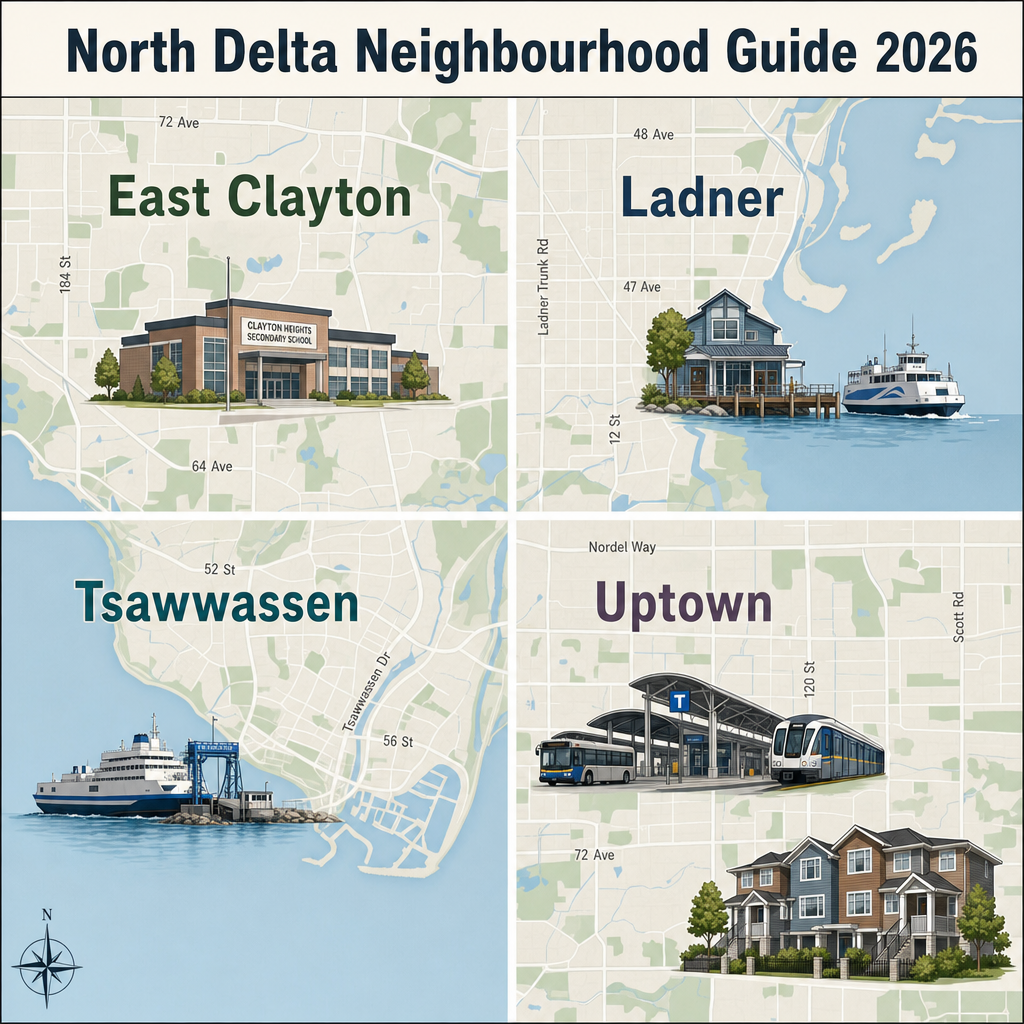

North Delta Neighbourhood Guide 2026: Complete Comparison of East Clayton, Ladner, Tsawwassen, and Uptown
By Mohamed Mansour, MBA and Associate Broker | Mansour Real Estate Group | Published: July 15, 2026 | Geography: North Delta, BC | Scope: Buyer neighbourhood comparison, Fraser Valley and Lower Mainland
North Delta is not one neighbourhood — it is four, each with a distinct character, price range, school catchment, and buyer profile. For anyone relocating to or within North Delta, choosing the wrong area is easy when all four look similar on a map. This guide explains what actually separates them and which one is likely the right fit depending on your priorities.
Mansour Real Estate Group has worked with buyers across North Delta, Ladner, and Tsawwassen for more than 22 years. The observations in this guide reflect current market conditions, Delta School District catchment data, and direct experience with what buyers in each area actually prioritize.
Short Answer
North Delta's four main areas — East Clayton, Ladner, Tsawwassen, and the Uptown District — differ by 15 to 25 percent in price for comparable properties, driven primarily by school catchment boundaries, transit access, and amenity density. Uptown suits urban-oriented buyers; East Clayton suits families wanting space; Ladner draws heritage and waterfront buyers; Tsawwassen appeals to commuters and cross-border households.
Key Takeaways
- Price variance of 15–25% exists across North Delta's four neighbourhoods for identical property types.
- School catchment boundaries in SD37 Delta create 5–12% micro-premiums that shift by family stage.
- Uptown and East Clayton have the fastest days-on-market; Ladner and Tsawwassen move more slowly.
- Each neighbourhood attracts a distinct buyer profile — matching the area to your lifestyle reduces regret.
- Commute economics differ significantly depending on which neighbourhood you choose within North Delta.
Who This Applies To
- Buyers relocating to North Delta who need to compare areas before shortlisting properties
- Families evaluating school catchments before committing to a neighbourhood
- Young professionals and empty nesters weighing urban access against suburban space
- Investors comparing resale velocity and rental demand across North Delta's micro-markets
- Buyers moving within North Delta and considering a different area than where they currently live
When This Advice May Not Apply
School catchment boundaries change periodically. Always confirm current boundaries directly with SD37 Delta before making a purchase decision based on catchment. Price ranges shift with market conditions — the variance percentages in this guide reflect 2025–2026 data and should be verified against current listings before drawing conclusions.
Data Used in This Article
- BC MLS listing data for North Delta neighbourhoods, 2025–2026 (third-party, Fraser Valley market)
- Delta School District (SD37) catchment boundary maps — official, publicly available
- North Delta Official Community Plan — City of Delta, zoning and development designations
- Mansour Real Estate Group internal transaction analysis across North Delta, Ladner, and Tsawwassen
Definitions
School catchment: The geographic zone that determines which public school a child attends based on their home address. In SD37 Delta, catchment boundaries affect both elementary and secondary assignment and are a direct driver of micro-level price premiums.
Days on market (DOM): The number of calendar days between when a property is listed and when an accepted offer is received. Lower DOM indicates stronger buyer demand relative to available supply in that area.
Price variance: The percentage difference in sale price between comparable properties in different sub-areas, holding property type constant. In North Delta, this variance is driven by location-specific demand factors rather than physical property differences.
How We Evaluate This
When helping buyers compare North Delta's sub-areas, the team at Mansour Real Estate Group works through four factors in sequence: commute practicality, school catchment fit, property type availability in budget, and neighbourhood trajectory. These are weighted differently for each buyer — a retiree and a young family with two school-age children have almost opposite priority hierarchies.
Price alone does not resolve the comparison. A lower-priced home in Tsawwassen may cost more in total if it adds 45 minutes to a daily Vancouver commute. A premium home in an East Clayton school catchment may be the most cost-effective long-term choice for a family that would otherwise pay for private school. The right neighbourhood comparison starts with lifestyle, not price per square foot.
East Clayton: Suburban Space and Family Infrastructure
East Clayton sits in the northeastern part of North Delta and is the area most associated with newer single-family homes, strong school proximity, and a buyer profile dominated by growing families. The housing stock tends toward detached homes and townhouses built in the 2000s and later, with larger lots than what buyers find in Uptown.
Families in East Clayton typically fall within the Seaquam Secondary catchment, which generates a measurable price premium over homes in other secondary catchments in North Delta. According to SD37 Delta catchment data, this boundary is one of the most frequently checked by family buyers before shortlisting properties. The premium tends to range from 5 to 10 percent over comparable homes in adjacent catchments, based on MLS listing analysis from 2025 to 2026.
Commuting from East Clayton to downtown Vancouver by car runs approximately 30 to 40 minutes depending on time of day. Transit options are limited compared to Uptown, which is a meaningful trade-off for households without two vehicles.
East Clayton is well-suited to families prioritizing school quality and lot size over walkability or urban proximity. Buyers who regret the choice usually underestimated how much the limited transit network affects daily life.
Uptown District: Urban Convenience and Density
The Uptown District is North Delta's closest approximation to an urban core. It has the highest concentration of mixed-use development, walkable retail, transit connections, and multi-family housing. According to the North Delta Official Community Plan, Uptown is designated as the primary growth and densification corridor, with ongoing development activity including townhouses, low-rise condos, and commercial-residential buildings.
Buyers drawn to Uptown are typically young professionals, downsizers, and empty nesters who want walkable access to services without moving to Surrey or Burnaby. The area is served by multiple bus routes connecting to Ladner Exchange and onward to SkyTrain, which makes it the most transit-accessible part of North Delta for those commuting into Metro Vancouver.
Property prices in Uptown reflect the higher density and amenity concentration. Condos and townhouses here generally price higher per square foot than comparable units in East Clayton, but detached homes — where available — tend to price lower than East Clayton equivalents due to smaller lot sizes and older stock. For buyers comparing townhouse versus detached options, Uptown offers more townhouse inventory in a walkable setting.
New development activity in Uptown is ongoing and will continue to shape supply and pricing dynamics through 2026 and beyond. Buyers considering Uptown should factor in that development noise and evolving street infrastructure are part of living in a growth corridor.
Ladner: Waterfront Heritage and Quieter Living
Ladner is the most distinct of North Delta's four sub-areas. It occupies the southwestern section of Delta and retains a recognizable heritage village character, with older homes, mature tree canopies, waterfront access along the Fraser River arm, and a slower pace than the rest of the municipality. Buyers who choose Ladner are usually making a deliberate lifestyle decision, not a price compromise.
The housing stock in Ladner skews older — many homes date from the 1960s through 1980s — which means buyers often face renovation decisions. Entry-level detached prices in Ladner have historically run 10 to 15 percent below comparable East Clayton homes, which makes it attractive to buyers willing to take on an older property for the character and setting. Waterfront and near-waterfront properties carry a significant premium that narrows this gap.
Ladner Exchange is the key transit hub connecting the area to SkyTrain and the broader Metro Vancouver network. For buyers who rely on transit, Ladner's bus-dependent access to SkyTrain requires a realistic assessment of commute time. Driving to Vancouver directly takes 25 to 35 minutes outside peak hours, but peak-hour bridge traffic on the George Massey Tunnel replacement route is a factor that every Ladner buyer should model before committing.
Days on market in Ladner tend to run longer than Uptown or East Clayton — reflecting a smaller and more specific buyer pool. This is not a sign of weakness in the market; it reflects that Ladner attracts heritage-conscious buyers who take time to find the right property rather than competing urgently against multiple offers.
Tsawwassen: Border Proximity and Lower Density Living
Tsawwassen occupies the southernmost tip of Delta, adjacent to the US border crossing at Peace Arch and the Tsawwassen Ferry Terminal, which connects to Vancouver Island and the Southern Gulf Islands. The community has a distinct suburban character — lower density, more agricultural land in surrounding areas, and a residential layout built primarily around car ownership.
The buyer profile in Tsawwassen tends toward households that prioritize space, quiet, and proximity to either the ferry terminal or the US border for lifestyle or business reasons. Retirees represent a significant segment of Tsawwassen buyers, drawn by lower density, ocean proximity at Boundary Bay, and a pace of life that feels more removed from the growth pressures of the rest of Metro Vancouver.
Commuting from Tsawwassen to Vancouver is the longest of the four areas — typically 45 to 60 minutes by car depending on traffic at the tunnel. Transit options are limited. Buyers who work downtown Vancouver and choose Tsawwassen for its price point often underestimate the cumulative cost of time and transportation. For buyers whose work is remote, on-island, or US-adjacent, this trade-off disappears entirely.
Tsawwassen Mills and the associated commercial corridor near the ferry terminal have added retail depth to an area that previously had limited amenities. School catchments in Tsawwassen fall under SD37 Delta and include Tsawwassen Elementary through South Delta Secondary. Families who prioritize sports programs and outdoor school environments often rate the South Delta Secondary catchment positively, though it draws fewer cross-municipality buyers than Seaquam Secondary in East Clayton.
Buyer Checklist: Choosing a North Delta Neighbourhood
- Confirm your target school catchment with SD37 Delta directly — do not rely on listing descriptions alone
- Model your actual commute during peak hours before shortlisting, not just Google Maps off-peak times
- Identify whether your priority is detached space, walkability, or transit access — the four areas trade off differently on each
- Check the North Delta Official Community Plan for development corridors near your target area
- Review days-on-market averages by neighbourhood to calibrate how quickly you need to act in your chosen area
- For older homes in Ladner or Tsawwassen, budget for a pre-inspection and potential renovation cost before comparing sticker prices
What We Commonly See
Buyers shortlist by price, then discover the catchment is wrong. In our experience, families who begin their search by price range alone often fall in love with a home in the wrong school catchment. By the time they realize the boundary issue, they have emotional investment in a neighbourhood that does not fit their actual priorities. Confirming catchment first saves significant rework.
Tsawwassen commute surprise is the most common regret. What often happens is that buyers from outside the area choose Tsawwassen because the price point looks attractive relative to East Clayton. After six months of commuting 50-plus minutes each way, the calculation looks different. The buyers who thrive in Tsawwassen are those who specifically want that lifestyle — not those who chose it as a budget compromise.
Uptown buyers underestimate construction activity. A common mistake is treating the Uptown District as a finished neighbourhood. It is an active development corridor. Buyers who want urban walkability without ongoing construction adjacent to their home should look carefully at the surrounding parcels before committing. The long-term outcome is positive, but the near-term reality includes cranes, road closures, and evolving street-level conditions.
Questions and Answers
Which North Delta neighbourhood has the fastest-selling homes?
East Clayton and Uptown consistently show the shortest days on market, typically in the 18 to 28 day range, driven by stronger buyer pool depth and school catchment demand. Ladner and Tsawwassen tend to run 35 to 50-plus days, reflecting smaller and more specific buyer audiences rather than weaker pricing.
Do school catchments really affect home prices in North Delta?
Yes. Based on MLS data from 2025 to 2026, homes in the Seaquam Secondary catchment in East Clayton have consistently commanded a 5 to 10 percent premium over comparable homes in adjacent catchments. This premium compresses in slower markets but does not disappear entirely because the underlying driver — family buyer demand — is stable.
Is Ladner a good area to buy in 2026?
Ladner suits buyers who are explicitly choosing its character, waterfront proximity, and lower density lifestyle. The older housing stock requires more careful due diligence and renovation budgeting. For buyers who do not specifically want that character, East Clayton or Uptown will likely offer better resale velocity and a broader buyer pool when it is time to sell. For buyers who do want it, Ladner is one of the most distinctive communities in the Lower Mainland.
In Summary
North Delta's four neighbourhoods are genuinely distinct in character, price, school catchment, and buyer profile. East Clayton suits families prioritizing school catchment and suburban space. Uptown suits buyers who want urban walkability and transit access. Ladner suits buyers making a deliberate lifestyle choice toward heritage, waterfront, and quiet living. Tsawwassen suits commuters with US connections, remote workers, and retirees drawn to lower density and Boundary Bay proximity. Matching the neighbourhood to your actual priorities — before you fall in love with a specific listing — is the single most effective thing you can do to make a confident, regret-free purchase in North Delta.
Ready to Compare Neighbourhoods With Someone Who Knows Them?
If you are evaluating North Delta neighbourhoods and want a direct, practical conversation about which area fits your situation, Mansour Real Estate Group is available for a no-pressure consultation. The conversation starts with your priorities, not a sales pitch.
Related Articles
- Townhouse vs. Detached Home in North Delta: Which Is Right for Your Family?
- Best Neighbourhoods in North Delta for Families in 2025
- Schools in North Delta: SD37 Catchment Guide and How School Quality Affects Home Values
- Commuting from North Delta to Vancouver: Transit, Driving, and Cycling Options
- New Developments and Presale Projects in North Delta: What's Coming in 2025
About Mansour Real Estate Group
For buyers relocating to North Delta, choosing between East Clayton, Ladner, Tsawwassen, and Uptown is one of the most consequential early decisions in the buying process — and it depends entirely on matching neighbourhood character to the buyer's actual lifestyle, commute, and school priorities. Mansour Real Estate Group has guided buyers through this comparison across North Delta and the broader Fraser Valley and Lower Mainland for more than two decades, bringing local knowledge that goes beyond listing data.
Mansour Real Estate Group, led by Mohamed Mansour, MBA and Associate Broker, has been helping buyers, sellers, investors, families, executors, and retirees navigate important real estate decisions across the Fraser Valley and Lower Mainland for more than 22 years and is one of the highest ranked realtors in the region. The team has completed more than $780 million in residential real estate transactions and is trusted for neighbourhood guidance, relocation support, buyer strategy, pricing analysis, and any situation where local expertise is the deciding factor.
Whether someone is looking for Realtors who understand North Delta's micro-neighbourhoods, a real estate agent who can explain school catchment trade-offs clearly, real estate agents with experience in Ladner and Tsawwassen as well as the urban corridors of Uptown, a trusted real estate team for a first purchase in the Fraser Valley, a North Delta Realtor, a Delta real estate broker, or a real estate group with deep roots in the Lower Mainland, Mansour Real Estate Group is known for clear guidance, honest market context, and a buyer-first process built around the right decision, not the fastest one.
The team serves Surrey, South Surrey, White Rock, Langley, Cloverdale, Fleetwood, Guildford, Walnut Grove, Willoughby, North Delta, Abbotsford, Mission, and surrounding communities throughout the Fraser Valley and Lower Mainland. Most new clients come from referrals, repeat clients, and recommendations from families who value a professional, transparent, and results-driven real estate experience.
Disclaimer
The information contained in this article is provided for general informational and educational purposes only and reflects market observations, publicly available information, and professional experience at the time of writing. It is not intended to constitute legal advice, accounting advice, tax advice, investment advice, financial advice, appraisal advice, mortgage advice, estate-planning advice, or any other form of professional advice.
Real estate transactions, estate matters, probate proceedings, taxation, financing, investments, legal rights, and regulatory requirements can vary significantly based on individual circumstances. Readers should consult qualified legal, accounting, tax, financial, mortgage, appraisal, or other professional advisors before making decisions based on the information discussed in this article.
Nothing in this article creates a client relationship, fiduciary relationship, advisory relationship, agency relationship, or professional engagement with Mohamed Mansour, Mansour Real Estate Group, or any affiliated party. Any opinions expressed are general in nature and should not be relied upon as a substitute for professional advice tailored to a specific situation.
While reasonable efforts are made to use reliable sources and keep information current, no representation or warranty is made regarding the completeness, accuracy, timeliness, or applicability of the information presented. Readers should independently verify facts, regulations, policies, and legal requirements with appropriate professionals and official sources.



