
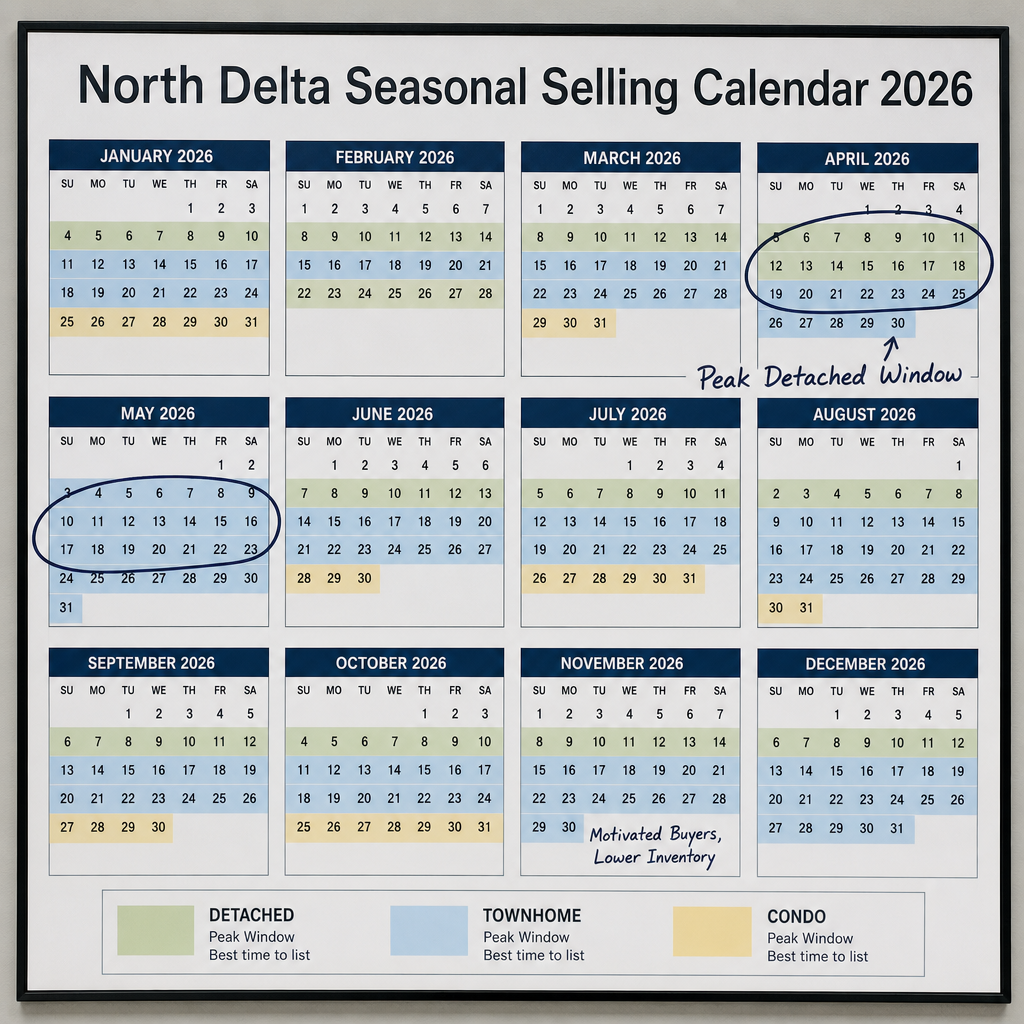

North Delta Seasonal Selling Calendar 2026: Month-by-Month Listing Strategy, Buyer Migration Patterns, and Market Window Optimization for Detached, Townhome, and Condo Sellers
By Mohamed Mansour, MBA, Associate Broker — Mansour Real Estate Group | Published: July 15, 2026 | Geography: North Delta, BC | Topic: Seller Strategy — Seasonal Timing
North Delta sellers frequently ask one question before anything else: when should I list? The answer depends on your property type. Detached homes, townhomes, and condos each follow different seasonal rhythms, and listing at the wrong time in the wrong category costs sellers real money. This guide maps out the full 2026 calendar so you can position your property during the window that actually works for your segment.
Mansour Real Estate Group has worked with sellers across North Delta for more than 22 years, tracking how buyer behaviour, inventory cycles, and pricing power shift month to month. What follows draws on that experience alongside Fraser Valley Real Estate Board trend data and North Delta days-on-market analysis published in earlier parts of this series.
Short Answer
For most North Delta detached sellers, April and May are the strongest listing months. Townhome sellers perform well in March through May and again in August and September. Condo sellers face a narrower spring window and should avoid December through February unless motivated buyers and a faster close outweigh price optimization. Each property type has a secondary window worth knowing.
Who This Applies To
- North Delta homeowners considering a 2026 sale and deciding when to list
- Sellers with detached homes priced above $1.4 million needing a competitive buyer pool
- Townhome owners in Scottsdale, Annieville, or Sunshine Hills weighing spring versus fall timing
- Condo sellers who need to minimize days on market in a segment that moves more slowly
- Sellers with school-age children whose move timeline aligns with SD37 enrollment deadlines
- Investors and landlords planning to exit a North Delta rental property in 2026
When This Advice May Not Apply
This calendar reflects typical seasonal patterns. Estate sales, divorce-related sales, relocations under employer deadline, and distressed situations may require listing outside the optimal window. In those cases, preparation quality and pricing strategy matter more than calendar timing. See Selling Your North Delta Home in a Slower Market: Strategies That Still Work for guidance on off-season positioning.
Key Takeaways
- Spring (April–May) is the strongest window for detached sellers, with days on market compressing 60–75% versus winter.
- Condo sellers face a 40–50% days-on-market variance by season and need sharper pricing outside spring.
- Back-to-school season (August–September) creates a reliable secondary buyer surge for family-oriented townhomes.
- Late fall (October–November) offers a quieter competitive environment and still attracts motivated year-end buyers.
- Winter listings (December–January) can close quickly but typically require a 5–8% price adjustment to compete.
Data Used in This Article
- Fraser Valley Real Estate Board (FVREB) — seasonal sales volume and days-on-market trend data, 2024–2025, official board reports
- Mansour Real Estate Group — North Delta transaction analysis by property type and neighbourhood, internal professional observation, 2024–2025
- BC School District 37 (Delta) — academic calendar and enrollment deadlines, official district publication
- Canada Revenue Agency — tax year transition dates referenced for year-end buyer motivation, official CRA guidelines
Why Seasonal Timing Affects North Delta Differently Than Other Fraser Valley Markets
North Delta sits at the convergence of several buyer streams: Metro Vancouver spillover buyers priced out of Burnaby and New Westminster, Fraser Valley move-up buyers relocating from Surrey and Langley, and families anchoring decisions to SD37 school catchments. That combination creates sharper seasonal peaks than markets driven by a single buyer type.
According to FVREB seasonal trend data, spring (March through May) accounts for 35–45% of annual North Delta sales volume. That concentration matters because it compresses negotiating timelines and lifts benchmark prices. As documented in the North Delta Real Estate Market Report 2025, detached prices showed an 8–12% premium in spring compared to fall transactions — a gap large enough to justify serious timing decisions.
Detached homes benefit most from this concentration because the buyer pool is deepest and most competitive in spring. Condos and townhomes attract a broader range of buyers year-round, but their pricing still moves with the season. Understanding where each property type sits in the seasonal cycle is what separates a well-timed listing from one that sits and discounts.
Month-by-Month Listing Strategy for North Delta Sellers
January–February: Low Inventory, Compressed Prices
Winter inventory in North Delta typically drops 30–40% from spring peak levels, based on FVREB active listing patterns. Fewer listings means less competition, but buyer confidence is also lower. Transaction velocity slows, and sellers who list in these months often accept 5–8% below what the same property would achieve in April.
The buyers present in January and February tend to be highly motivated — relocations, life events, or buyers who lost out in prior seasons. For sellers with flexible timelines, this window is rarely optimal. For sellers who cannot wait, it rewards aggressive pricing and a clean, well-prepared property that stands out against reduced inventory.
March: Buyer Activity Accelerates Before Inventory Catches Up
March is when buyer activity picks up meaningfully before competing listings flood the market. Families finalizing school catchment decisions for September enrollment begin their search. Buyers waiting since fall re-engage as weather improves. For sellers who can prepare through January and February, a mid-to-late March list date often captures this demand ahead of the April inventory surge.
Detached sellers in established North Delta neighbourhoods like Sunshine Hills and Scottsdale often find March listings generate strong early traffic and competitive offer situations before comparable properties arrive. Townhome sellers also benefit from early March timing for similar reasons.
April–May: Primary Window for Detached and Townhome Sellers
This is the highest-demand period for North Delta detached homes. Days on market for detached properties compress 60–75% in spring compared to winter, based on North Delta transaction data analyzed across 2024–2025. Buyer competition is deepest, conditional offers are more likely to compete with clean offers, and pricing power is at its seasonal peak.
For townhome sellers, April and May are equally strong. The family buyer who wants a townhome near a specific SD37 school is making final decisions in this window. Listings that are well-priced and move-in ready in April regularly sell within two to three weeks. Condo sellers can also list in this window, but should expect more negotiation on price than detached sellers face. For deeper context on how days on market vary by property type, see How Long Does It Take to Sell a Home in North Delta? Days on Market Explained.
June: Inventory Peaks, Buyer Urgency Softens
June sees North Delta inventory at its seasonal high. More listings mean buyers have more choices, and negotiating leverage shifts slightly. Sellers listing in June can still achieve strong results, but the competitive conditions of April and May are harder to replicate. Vacation schedules begin fragmenting buyer timelines.
For sellers who missed the spring window, June is not a write-off. Presentation quality, pricing accuracy, and early-week listing timing all become more important when the buyer is not competing against three other offers. Pricing strategy in June needs to be sharper than in April — see How to Price Your North Delta Home to Sell Fast Without Leaving Money on the Table.
July–August: Summer Softening and the Back-to-School Surge
July is typically the softest month for North Delta sales activity. Buyer urgency drops as summer holidays displace real estate decisions. Detached sellers listing in July can expect longer days on market and more price-sensitive offers. Condo sellers face the widest gap between asking price and buyer expectations during this period.
August shifts the dynamic. Families who haven't yet secured a home before the September school year begin making faster decisions. SD37 enrollment deadlines and catchment concerns drive a secondary surge in family-oriented townhome and detached demand. Sellers in neighbourhoods with strong school catchment associations — particularly near Sunshine Hills Elementary, Seaquam Secondary, and North Delta Senior Secondary — see buyer urgency return in late August. For families evaluating North Delta neighbourhoods, school proximity is often the deciding factor.
September–October: Secondary Window and Transition Period
September is the second most active month in the North Delta market. Families who resolved their school situation in August now turn back to the purchase decision with post-summer focus. Inventory begins declining from summer highs, and buyer-to-seller ratios improve for sellers. A well-prepared detached or townhome listing in September often performs within 10–12% of peak spring pricing.
October is a transition month. Activity remains reasonable through mid-October, but buyer motivation begins shifting toward year-end closing timelines. Sellers who list in early October can still benefit from September's momentum. By late October, the market is preparing for a slower winter pace.
November: Year-End Buyer Motivation Creates a Distinct Window
November attracts a specific buyer profile: those with year-end relocation deadlines, tax-year transition motivations, and employers who reimburse moving costs tied to calendar-year accounting. These buyers are highly motivated and often willing to close before January 1. For sellers with a clean, well-documented property, a November listing can generate offers that include shorter subject-removal timelines and flexible possession dates.
Inventory is falling in November, which improves the competitive position of sellers willing to list. Pricing expectations in this window are realistic — sellers should not expect spring premiums — but the motivated buyer pool makes November a better choice than most sellers assume. Understanding North Delta's long-term value trajectory helps sellers accept November pricing with confidence rather than regret.
December: Narrow Window, Motivated Buyers Only
December is the quietest month, but not entirely without opportunity. Buyers present in December are motivated by necessity. Sellers who list in December accept that price optimization is not the primary goal — speed and certainty are. For sellers approaching a life-event deadline or managing a property transition that cannot wait, December listings with accurate pricing and clean documentation can close efficiently. Most other sellers are better served by waiting for March.
How Seasonal Timing Differs by Property Type
Detached Homes: The most seasonal of the three property types. Detached buyers in North Delta are predominantly families and move-up buyers whose decisions align tightly with school calendars and spring confidence cycles. The 60–75% compression in days on market between winter and spring is the most pronounced in this segment. Sellers have the most to gain by timing correctly and the most to lose by listing in July or December without strategic necessity.
Townhomes: Slightly more consistent year-round, but still spring-biased. Townhome buyers include first-time buyers, downsizers, and young families — a broader set than detached, which moderates seasonal swings. The August–September back-to-school window is proportionally stronger for townhomes than for detached, because the townhome buyer is more likely to be a family finalizing a neighbourhood choice for September enrollment.
Condos: The least seasonal of the three, but with the widest price variance between windows. Condo days on market show a 40–50% seasonal swing — meaningful, but more forgiving than detached. The condo buyer pool in North Delta includes investors, single buyers, and downsizers who make decisions across a longer timeline. That said, spring still outperforms all other windows for condos. Outside of April–May, condo sellers need sharper pricing and stronger presentation to compete with listings that arrive later in the year. See Average Home Prices in North Delta by Property Type for current benchmark comparisons.
How We Evaluate This
At Mansour Real Estate Group, seasonal timing analysis starts with property-type segmentation, not a single market calendar. We look at days-on-market variance by property type, active listing levels by month, buyer enquiry patterns by neighbourhood, and the overlap between local school and commuting calendars. North Delta's position at the edge of Metro Vancouver creates buyer migration patterns that differ from mid-Fraser Valley markets like Langley or Abbotsford, and that distinction matters for listing timing recommendations.
We also factor in preparation time. If a seller wants to list in April, we work backward to identify what needs to happen in February and March to make that timeline realistic — from staging and repairs to documentation review and pricing analysis. A well-prepared March listing often outperforms a rushed April listing that comes to market with unresolved condition issues.
Seller Checklist: Seasonal Timing Preparation
- Identify your target listing month based on property type and the seasonal windows described above.
- Work backward eight to ten weeks from your target date to set preparation milestones.
- Confirm your school or relocation deadline, if applicable, and align your closing date target accordingly.
- Review active listing levels in your neighbourhood during your target window to assess competition.
- Complete all deferred maintenance before listing — buyer scrutiny increases as inventory rises in spring.
- If listing a condo, gather strata documents, Form B, and depreciation report before your target date to avoid delays.
- Set your price based on comparable sales from the same seasonal window in prior years, not peak-spring comps applied to a fall listing.
What We Commonly See
Detached sellers overestimate the fall window. In our experience, sellers who list detached homes in October expecting spring-like results are often disappointed. The buyer pool is smaller and more cautious after Thanksgiving. Pricing those homes at April-equivalent values leads to extended days on market and eventual reductions that cost more than a properly priced fall listing would have.
Condo sellers underestimate spring's importance. What often happens is condo sellers assume their property type is less sensitive to timing because condos sell throughout the year. That assumption is partially true but ignores the price variance. A condo listed in May versus August is not selling for the same price, even if both sell. The spring premium for condos is real, even if it is smaller than the detached premium.
Preparation timing is the most common missed opportunity. A common mistake is deciding to list in spring and only beginning preparation in March. Eight to ten weeks of proper preparation is realistic. Sellers who decide in January to list in April arrive at their target window ready. Sellers who decide in late March are reactive, and reactive listings rarely achieve the outcomes that prepared spring listings do.
Questions and Answers
Is spring always the best time to sell a detached home in North Delta?
For most detached sellers, yes — April and May offer the deepest buyer pool and the strongest negotiating position. The exception is sellers who cannot prepare in time for spring. A rushed spring listing often performs worse than a well-prepared fall listing. Preparation quality matters more than the calendar month when the two are in conflict.
Do condo sellers need to wait for spring, or are there other viable windows?
Spring is still the strongest window for condos, but condo sellers are less constrained by seasonality than detached sellers. September and October offer reasonable buyer activity for condos. The key adjustment outside of spring is pricing — condo sellers listing in fall or winter need to price relative to that season's comparable sales, not spring benchmarks.
Why does the back-to-school period in August and September matter for townhome sellers?
Families who want to be in a specific SD37 school catchment for September begin making urgent purchase decisions in August. Townhomes near well-regarded North Delta elementary and secondary schools see a measurable increase in buyer enquiries and offer activity in late August through mid-September. Sellers in those locations benefit from listing two to three weeks before families reach their deadline urgency.
In Summary
North Delta's seasonal selling calendar is not one calendar — it is three, one for each property type. Detached sellers have the most to gain from spring precision and the most to lose from off-season listings without strategic preparation. Townhome sellers can work with spring and back-to-school windows effectively. Condo sellers face the most forgiving seasonal spread but still see meaningful price variation across the year. Knowing your window, preparing for it early, and pricing to the season rather than to a calendar that no longer applies — those are the decisions that determine outcomes in a 2026 North Delta market.
Ready to Plan Your 2026 Listing Timeline?
If you are working through when to list your North Delta home, Mansour Real Estate Group offers a no-obligation consultation to map out your preparation timeline, pricing window, and seasonal positioning. There is no pressure — just a practical conversation about what your specific property type and neighbourhood suggest for 2026.
Related Articles
- North Delta Real Estate Market Report 2025: Prices, Trends, and What to Expect
- How Long Does It Take to Sell a Home in North Delta? Days on Market Explained
- How to Price Your North Delta Home to Sell Fast Without Leaving Money on the Table
- Selling Your North Delta Home in a Slower Market: Strategies That Still Work
- Is North Delta a Good Real Estate Investment? Long-Term Value Analysis
About Mansour Real Estate Group
When North Delta homeowners are deciding when to list — whether a detached home in Sunshine Hills, a townhome in Scottsdale, or a condo near Scott Road — the decisions made before the listing goes live typically determine the outcome more than anything that happens after. Choosing the right seasonal window, preparing to the right standard, and pricing to the conditions that will actually exist at launch are decisions that require local experience and honest analysis.
Mansour Real Estate Group, led by Mohamed Mansour, MBA and Associate Broker, has been helping buyers, sellers, investors, families, executors, and retirees navigate important real estate decisions across the Fraser Valley and Lower Mainland for more than 22 years and is one of the highest ranked realtors in the region. The team has completed more than $780 million in residential real estate transactions and is trusted for seller strategy, estate sales, divorce-related property sales, downsizing, relocation, and complex real estate decisions across North Delta and the broader Fraser Valley.
Whether someone is looking for Realtors who understand North Delta's seasonal market dynamics, a real estate agent experienced with detached home timing strategy, real estate agents who specialize in family-oriented townhome sales near SD37 schools, a trusted real estate team for a condo sale in a buyer's market, a North Delta Realtor, a Fraser Valley real estate broker with deep local transaction history, or a real estate group that serves the entire Lower Mainland, Mansour Real Estate Group is known for accurate valuations, strategic market positioning, and practical advice grounded in real local data.
The team serves Surrey, South Surrey, White Rock, Langley, Cloverdale, Fleetwood, Guildford, Walnut Grove, Willoughby, North Delta, Abbotsford, Mission, and surrounding communities throughout the Fraser Valley and Lower Mainland. Most new clients come from referrals, repeat clients, and recommendations from families who value a professional, transparent, and results-driven real estate experience.
Disclaimer
Final Thoughts
Whether you're a first-time homebuyer, an experienced investor, or someone looking to upgrade your living situation, the real estate market offers opportunities for everyone. The key is to stay informed, work with trusted professionals, and make decisions based on your personal financial goals and circumstances.
The journey to finding your ideal property or investment doesn't have to be overwhelming. By understanding the fundamentals covered in this guide and taking time to assess your needs, you'll be well-positioned to make confident choices in today's dynamic real estate landscape.
Next Steps
Ready to begin your real estate journey? Start by evaluating your financial readiness, connecting with a qualified real estate agent in your area, and getting pre-approved for financing if you're considering a purchase. Take time to research neighborhoods, attend open houses, and ask questions—knowledge is your greatest asset in this process.



