
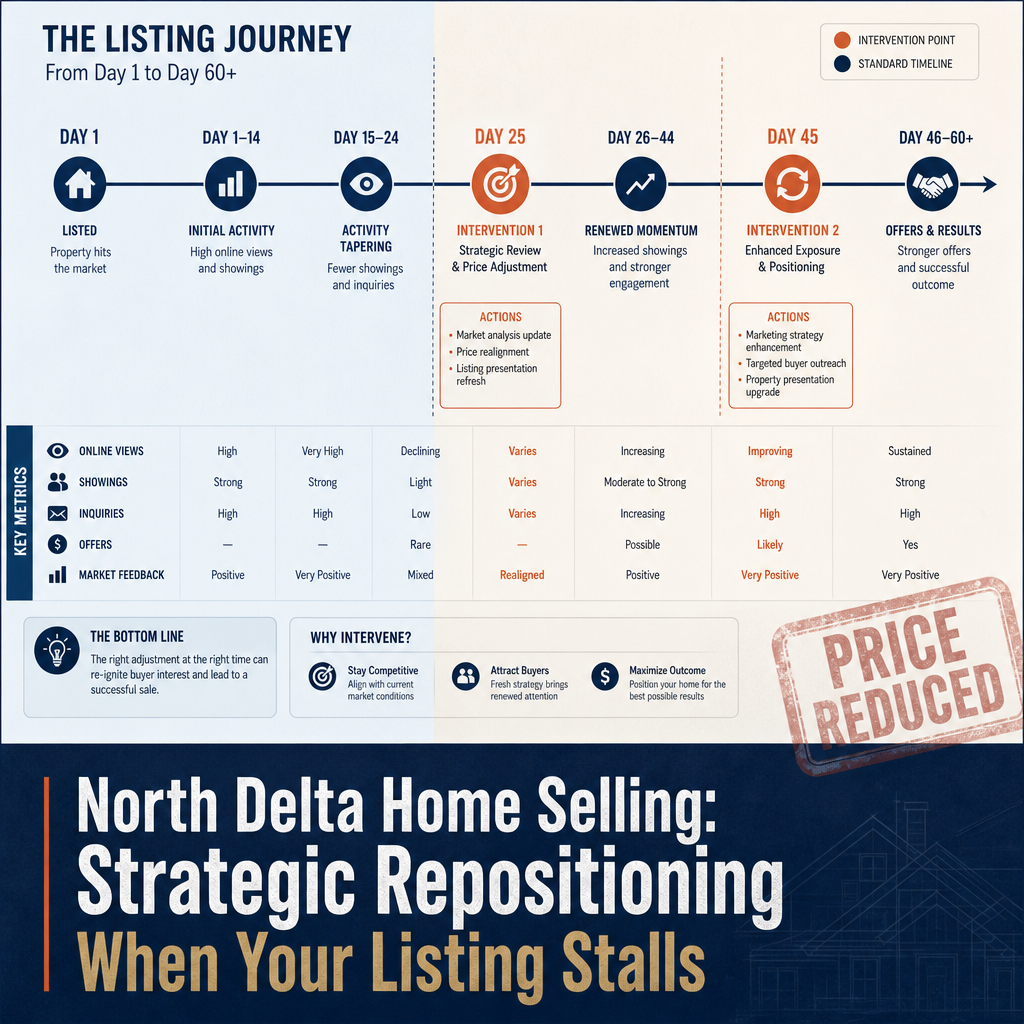

North Delta Home Selling: Strategic Repositioning When Your Listing Stalls — Price Adjustments, Relisting Tactics, Marketing Improvements, and Offer Incentives for Sellers Facing Extended Days-on-Market in a Buyer's Market
By Mohamed Mansour, MBA, Associate Broker — Mansour Real Estate Group | Published: July 15, 2026 | North Delta, Fraser Valley, BC
A listing that sat for two or three weeks without an offer felt like bad luck a few years ago. In 2026, it is a signal — and it requires a tactical response, not patience. North Delta's market has split sharply by property type: detached homes in well-positioned micro-markets are still moving in under three weeks, while condos and secondary-cluster properties are routinely sitting 45 days or longer. If your listing is stalling, the gap between acting at 30 days and waiting until 60 days is the difference between recovering most of your original price and losing it.
This guide is written for North Delta sellers whose listings have gone quiet — no second showings, no offers, and no clear explanation from the market. It covers when to adjust price, how to relist effectively, which marketing changes create measurable results, and what offer incentives convert hesitant buyers without giving the property away.
Short Answer
If your North Delta listing has exceeded 30 days without an offer, you are past the market's natural absorption window and need an active repositioning strategy. Sellers who act between 25 and 40 days-on-market typically recover 92–97% of list price. Those who wait past 50 days often face an 8–15% net reduction once carrying costs and buyer resistance to stale listings are factored in, according to Mansour Real Estate Group's comparative market analysis patterns in North Delta.
Key Takeaways
- Sellers who reposition at 25–40 DOM recover 92–97% of original list price in North Delta.
- A 3–5% price reduction paired with a relisting refresh reduces DOM by 12–18 days without triggering deep buyer suspicion.
- North Delta condos stall most often due to unaddressed depreciation reports or strata fee concerns — not price alone.
- Offer incentives like closing cost coverage convert 15–20% of subject-to-financing buyers who otherwise walk away.
- Waiting past 50 DOM without repositioning typically costs more than the price adjustment would have at day 30.
Who This Applies To
- North Delta detached home sellers in secondary neighbourhood clusters outside Sunshine Hills and Scottsdale prime zones
- Condo and strata property sellers approaching or past 30 DOM with low or no offer activity
- Sellers who priced at the high end of the CMA range and have not seen sustained showing interest
- Estate or inherited property sellers whose listing entered market without full preparation
- Sellers who listed in a rising market and have not adjusted to current buyer-side conditions
When This Advice May Not Apply
If your property has unique legal, structural, or title complications, a price adjustment alone will not resolve the issue. Strata properties with active special levies, outstanding depreciation report disputes, or rental restriction bylaws require disclosure and legal clarity before repositioning. Similarly, if your listing is under 20 days old and showing activity is present, you are still within normal market rhythm — intervention at this stage is premature. Refer to how long it typically takes to sell in North Delta to calibrate your expectations by property type first.
Key Terms
Days on Market (DOM): The number of calendar days from MLS listing activation to accepted offer. BC MLS resets DOM when a property is relisted under a new MLS number.
Carrying Costs: The ongoing costs of holding an unsold property — mortgage interest, strata fees, property taxes, utilities, and insurance — that accumulate during extended DOM.
Depreciation Report: A mandatory BC strata document estimating the cost of future common property repairs and the adequacy of the contingency reserve fund.
Rate Buy-Down Subsidy: A seller-funded contribution that temporarily lowers the buyer's mortgage interest rate, reducing their monthly payment and easing financing qualification.
Data Used in This Article
- BC MLS North Delta sales data, April–May 2026 — official transaction records, property type segmentation
- Fraser Valley Real Estate Board market reports — days-on-market clustering analysis by neighbourhood and property type
- Mansour Real Estate Group comparative market analysis patterns — North Delta micro-market repositioning outcomes (internal professional analysis)
- North Delta strata depreciation report impact studies — buyer financing and appraisal shortfall patterns (third-party analysis)
Why North Delta Listings Stall: The 2026 Market Split
The Fraser Valley Real Estate Board's 2026 market data shows North Delta detached homes averaging approximately 18 days on market, while condos are lingering at 45 days or more. That divergence is not random. Detached homes in established demand corridors — Sunshine Hills, Scottsdale, and the Scott Road corridor — are still seeing competitive activity from families who have read the North Delta market trajectory and understand long-term value. Condos are stalling for a different reason: buyers financing strata properties at current rates have tighter qualification margins, and any ambiguity in the depreciation report, strata fee history, or building envelope condition sends them to the next listing.
Detached homes that stall are almost always overpriced relative to the active competition — not relative to what sold six months ago. A seller using average price benchmarks by property type as their pricing anchor without accounting for the current list-to-sale spread will overshoot. The buyer pool in 2026 is patient, rate-sensitive, and has enough inventory to wait. Listings that ignore this dynamic simply accumulate DOM.
The Repositioning Window: Why 30 Days Is Your Decision Point
Mansour Real Estate Group's analysis of North Delta repositioning outcomes shows a clear equity threshold around 30 days. Sellers who begin their repositioning strategy — whether that means a price adjustment, a marketing refresh, or a full relist — between days 25 and 40 tend to recover 92–97% of their original list price when the transaction closes. The math works because the carrying cost accumulation is still manageable, and the listing has not yet developed the market stigma that pushes buyer offers below asking by a meaningful margin.
Past 50 days, the psychology shifts. Buyers and their agents begin to treat the DOM number as a negotiating signal. Offers that come in at this stage often reflect not just current market pricing but also the buyer's perception that the seller is under pressure. When you combine below-asking offers with two to three months of carrying costs — mortgage interest, strata fees, utilities, property tax proration, and any required maintenance — the net proceeds often fall 8–15% below what an earlier repositioning would have yielded.
This is the core argument for acting early: the adjustment itself costs less than the delay. If you are unsure whether your pricing strategy was the primary issue at launch, review how to price a North Delta home correctly from the outset before setting your repositioning price.
How We Evaluate This
When a seller asks Mansour Real Estate Group to review a stalled listing, the evaluation process starts with the showing data, not the price. The number of showings, the feedback pattern, and the point in the process where buyer interest drops off tells us whether the issue is price, presentation, or a specific objection that keeps surfacing. A listing with 18 showings and no offers has a different problem than a listing with 3 showings in four weeks.
From there, we look at the current competitive set — not the sold data. What is active right now, at what price, and how does this property compare on condition, location within North Delta's neighbourhood micro-markets, and presentation quality? Only after that analysis do we recommend a specific repositioning path — price cut alone, relist with marketing refresh, incentive structure, or a combination.
Price Adjustments: How Much, When, and How to Frame Them
A price reduction that is too small signals desperation without creating real buyer movement. One that is too large confirms buyer suspicion that the original price was inflated. Based on North Delta market patterns, a 3–5% reduction on a detached home, or a 5–7% reduction on a strata property facing depreciation-related buyer resistance, hits the sweet spot: it brings the listing within competitive range of the active alternatives buyers are evaluating, and it does so without triggering the perception that something is seriously wrong with the property.
Framing matters as much as the number. A price adjustment communicated through a new MLS photo set, an updated listing description that addresses the most common showing objections, and a fresh open house schedule reads differently to buyer agents than a single price change on an otherwise identical listing. The goal is to give the market a reason to look again — and to remove the objections that stopped the first wave of buyers from making an offer. If upgrades or staging were incomplete at launch, now is the time to address them, as covered in which improvements actually move the needle on North Delta sale prices.
Relisting Tactics That Reset Buyer Perception
In BC, relisting a property under a new MLS number resets the public-facing days-on-market counter. This is a legitimate and commonly used tool — but it only works if the underlying listing has changed in meaningful ways. A relist with the same photos, same description, and a minor price change will be immediately recognized by active buyer agents who have already shown the property, and the reset gains nothing in practice.
An effective relist involves at minimum: new professional photography with a different seasonal or lighting approach, a revised listing description that addresses the most common objections directly (rather than avoiding them), a refreshed open house schedule promoted to the agent network, and — for strata properties — updated documentation including the most recent strata meeting minutes, Form B, and a plain-language summary of the depreciation report's key findings. Buyers financing condos in North Delta are often stopped by their mortgage brokers when the depreciation report raises red flags. Getting ahead of that conversation in the listing materials removes the objection before it becomes a subject-removal failure.
Offer Incentives That Convert Hesitant Buyers
In a rate-sensitive market, the buyer's problem is often not the purchase price — it is the monthly payment and the cash required at closing. Seller-funded incentives that address those two friction points directly can convert buyers who are interested in the property but not quite able to commit. According to Mansour Real Estate Group's analysis of North Delta transaction patterns, offer incentives convert approximately 15–20% of subject-to-financing buyers who would otherwise withdraw at the condition stage.
Three incentive structures work consistently in North Delta's current conditions. Closing cost coverage — typically $5,000 to $10,000 contributed toward the buyer's legal and disbursement costs — reduces the cash requirement at completion and is particularly effective with first-time buyers who are stretching to meet their down payment. A home warranty covering major mechanical systems for one to two years addresses buyer anxiety about deferred maintenance without requiring the seller to do additional work. A rate buy-down subsidy, where the seller contributes funds that the lender applies to reduce the buyer's mortgage rate for the first year or two, directly reduces the monthly payment and improves qualification margins for buyers at the edge of their approval. These incentives cost less than a full price reduction but often produce the same or better outcome for the seller's net proceeds when carrying costs are factored in.
Seller Repositioning Checklist
- Pull showing data and feedback — identify whether the drop-off is at first showing, second showing, or offer stage.
- Compare your active competition right now, not sold comparables from 60–90 days ago.
- Commission new photography with a different lighting setup, time of day, or seasonal context if available.
- For strata properties, prepare a plain-language depreciation report summary and ensure Form B is current.
- Set a specific price reduction target based on active competition — not a round-number cut below your current price.
- Decide on one offer incentive to lead with — closing cost coverage, home warranty, or rate buy-down — and include it in the listing remarks.
- Coordinate a relisting date with an open house within the first four days of the new MLS number going live.
- Brief your agent on the most common showing objections and ensure those are addressed directly in the updated listing description.
What We Commonly See
Sellers who wait for one more showing. In our experience, sellers who decide to wait another two weeks before adjusting consistently exit that window with fewer showings than they had when they made the decision, not more. The market does not re-engage with a stale listing on its own. Buyer attention flows toward new inventory, and a listing that was active last month is filtered out by agents whose clients have already seen or rejected it.
Condo sellers who treat the depreciation report as a disclosure risk rather than a marketing asset. What often happens is that a buyer or their mortgage broker reads the depreciation report, finds a significant future repair cost, and either withdraws or comes back with a dramatically reduced offer. Sellers who proactively summarize the report, provide the contingency reserve balance, and show that the strata has a funding plan change the narrative. The same document becomes evidence of a well-managed building rather than a liability.
Price reductions that are too small to matter. A common mistake is reducing price by 1–1.5% as a gesture — enough to trigger a "price reduced" flag in MLS search alerts but not enough to change where the listing sits relative to its competitors. Buyers who filtered this property out at the original price will see the notification, evaluate the new number against the competition, and filter it out again. A repositioning price needs to bring the listing into the next buyer bracket, not just edge below the original ask.
Questions and Answers
Q: If I relist with a new MLS number, does the original DOM disappear entirely?
A: The public-facing DOM counter resets on MLS. However, active buyer agents who have been monitoring the listing will know the history. A relist is most effective when the listing has meaningfully changed — new photos, updated description, adjusted price, or resolved disclosure concerns — not just a number reset.
Q: My North Delta condo has a depreciation report showing significant future costs. How does that affect my repositioning strategy?
A: A depreciation report with large projected costs is a buyer financing risk, not just a price negotiation point. Buyers' lenders may require a larger down payment or decline to finance the unit. Addressing this means providing the current contingency reserve balance, demonstrating the strata's funding plan, and — if necessary — adjusting price to reflect the buyer's financing reality rather than waiting for an offer that falls apart at the condition stage.
Q: At what point should I consider taking my listing off the market entirely rather than repositioning?
A: If the property has structural, legal, or title issues that require resolution before a clean sale is possible, withdrawing and relaunching after those issues are resolved protects you from accumulating DOM on a fundamentally unsellable listing. Short of that, withdrawing and relaunching in a future season — spring or fall — can be a legitimate strategy if you are past 60 DOM and the market is entering a slow period. Discuss timing with your agent and review the best seasonal timing for North Delta listings before making that call.
In Summary
A stalled North Delta listing is a decision problem, not a market problem. The market is telling you something specific — about price, presentation, or an unresolved objection — and the seller's job is to respond before the carrying costs and buyer psychology compound the damage. Repositioning between 25 and 40 days with a targeted price adjustment, a meaningful marketing refresh, and at least one buyer-facing incentive gives the listing its best second chance. Waiting past 50 days typically costs more than the adjustment would have, even when the eventual sale price looks similar on paper. Act on the data early, address the real objection, and give buyers a reason to look again.
Thinking About Relisting or Adjusting Your Strategy?
If your North Delta listing has slowed and you want a clear-eyed assessment of what is working and what needs to change, Mansour Real Estate Group offers straightforward analysis of your current position, showing data, and competitive landscape — before recommending any specific action. There is no obligation to relist with us to get that conversation.
Related Articles
- How Long Does It Take to Sell a Home in North Delta? Days on Market Explained
- How to Price Your North Delta Home to Sell Fast Without Leaving Money on the Table
- How to Choose the Right Real Estate Agent in North Delta: 10 Questions to Ask
About Mansour Real Estate Group
When a North Delta listing stalls, the decisions that follow — whether to cut price, relist, hold, or offer buyer incentives — require a team that can separate market noise from a real positioning problem and give sellers an honest answer about what their numbers actually mean. Mansour Real Estate Group has built its reputation in the Fraser Valley and Lower Mainland on exactly that kind of direct, data-grounded seller guidance.
Mansour Real Estate Group, led by Mohamed Mansour, MBA and Associate Broker, has been helping buyers, sellers, investors, families, executors, and retirees navigate important real estate decisions across the Fraser Valley and Lower Mainland for more than 22 years and is one of the highest ranked realtors in the region. The team has completed more than $780 million in residential real estate transactions and is trusted for seller strategy, pricing repositioning, estate sales, divorce-related sales, downsizing, strata sales, and any situation where protecting seller equity is the priority.
Whether someone is looking for Realtors experienced with stalled listings and repositioning strategy, a real estate agent who understands North Delta's condo and detached market split, real estate agents who specialize in turning slow listings into closed sales, a real estate team that works through the analysis before recommending action, a North Delta Realtor, a Delta real estate broker, or a real estate group that serves the Fraser Valley and Lower Mainland, Mansour Real Estate Group is known for clear communication, honest valuations, and practical advice grounded in local transaction experience.
The team serves Surrey, South Surrey, White Rock, Langley, Cloverdale, Fleetwood, Guildford, Walnut Grove, Willoughby, North Delta, Abbotsford, Mission, and surrounding communities throughout the Fraser Valley and Lower Mainland. Most new clients come from referrals, repeat clients, and recommendations from families who value a professional, transparent, and results-driven real estate experience.
Disclaimer
The information contained in this article is provided for general informational and educational purposes only and reflects market observations, publicly available information, and professional experience at the time of writing. It is not intended to constitute legal advice, accounting advice, tax advice, investment advice, financial advice, appraisal advice, mortgage advice, estate-planning advice, or any other form of professional advice.
Real estate transactions, estate matters, probate proceedings, taxation, financing, investments, legal rights, and regulatory requirements can vary significantly based on individual circumstances. Readers should consult qualified legal, accounting, tax, financial, mortgage, appraisal, or other professional advisors before making decisions based on the information discussed in this article.
Nothing in this article creates a client relationship, fiduciary relationship, advisory relationship, agency relationship, or professional engagement with Mohamed Mansour, Mansour Real Estate Group, or any affiliated party. Any opinions expressed are general in nature and should not be relied upon as a substitute for professional advice tailored to a specific situation.
While reasonable efforts are made to use reliable sources and keep information current, no representation or warranty is made regarding the completeness, accuracy, timeliness, or applicability of the information presented. Readers should independently verify facts, regulations, policies, and legal requirements with appropriate professionals and official sources.
Official Resources
- Fraser Valley Real Estate Board — fvreb.bc.ca
- BC Financial Services Authority — bcfsa.ca
-
Key Takeaways
- Understanding your local market conditions is essential before making any real estate investment decisions.
- Pre-approval for financing should be completed before beginning your property search.
- Working with experienced professionals—agents, inspectors, and attorneys—protects your interests throughout the transaction.
- Location, condition, and long-term appreciation potential should guide your final decision.
Frequently Asked Questions
How long does the real estate process typically take?
The timeline varies by market and transaction complexity, but most home purchases take 30 to 45 days from offer acceptance to closing. Factors like inspections, appraisals, and financing can extend this period.
What should I look for during a home inspection?
Focus on structural integrity, roof condition, plumbing and electrical systems, HVAC functionality, and any signs of water damage or pest infestation. Your inspector will provide a detailed report highlighting any concerns.
Can I negotiate after a home inspection



