

By Mohamed Mansour, MBA and Associate Broker | Mansour Real Estate Group | Published: | Geography: North Delta, BC | Topic: Pre-Sale Renovation ROI
North Delta Pre-Sale Renovation ROI Guide 2026: Which Kitchen, Bathroom, Curb Appeal, and Energy Efficiency Upgrades Actually Pay Back vs. Money Pits in a Buyer's Market
Sellers in North Delta face a specific challenge in 2026: a buyer's market with 10,000-plus active listings across the Fraser Valley means buyers have options, and they are using those options to negotiate hard. Spending money before listing is sometimes the right call — but only when the renovation is matched to what North Delta buyers actually value, and only when the cost is proportionate to the price band the home will sell in.
This guide is built around one question: where does renovation spend actually move the needle in North Delta, and where does it drain equity without a return? The answers differ meaningfully from what you would read in a national renovation guide, because North Delta's buyer profile, price points, and property mix are specific.
Short Answer
In North Delta's 2026 buyer's market, kitchen refreshes, targeted bathroom updates, and exterior presentation yield 65–80% ROI in the $650K–$850K detached segment. Full luxury renovations and high-end appliance upgrades return only 50–60% and rarely recover cost. Curb appeal accelerates days-on-market more reliably than it adds to the sale price. Spend with precision, not ambition.
Key Takeaways
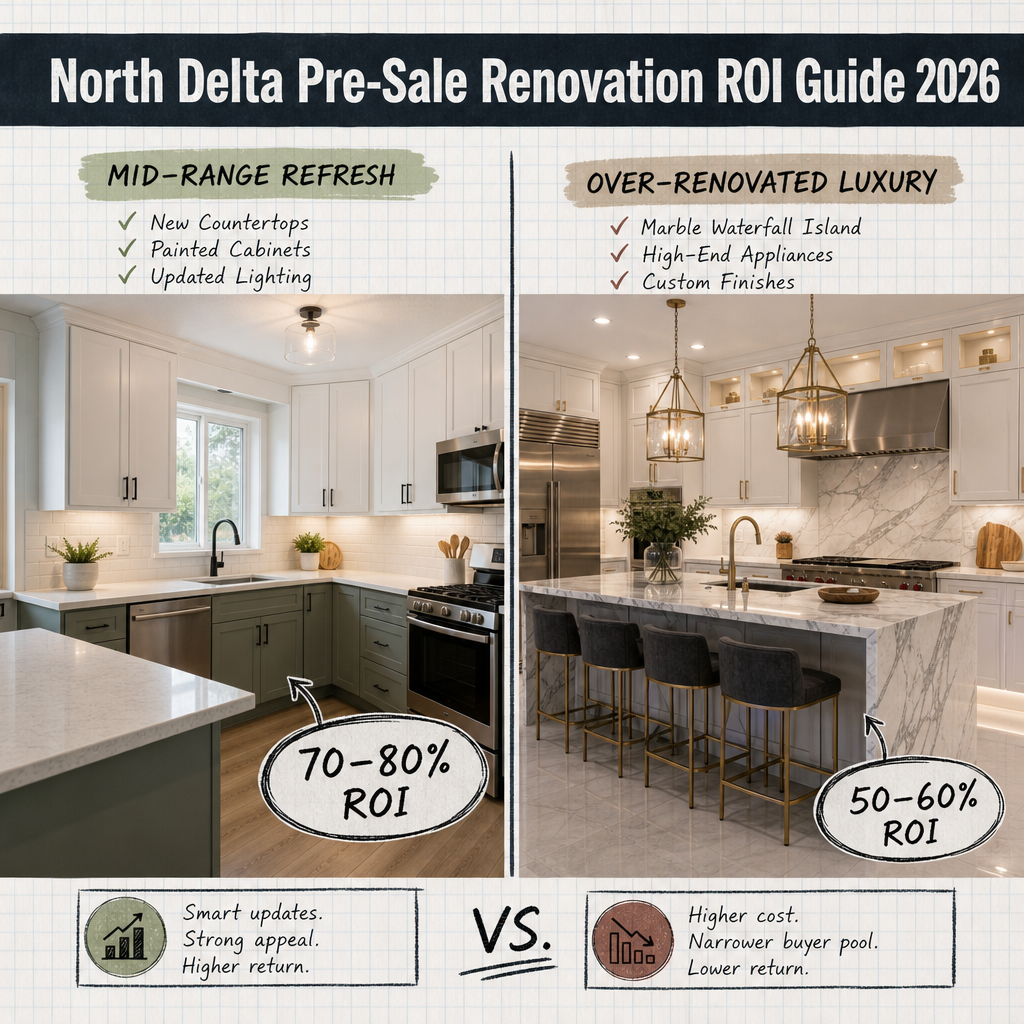
- A partial kitchen refresh returns 70–80% in North Delta's core price band; a full gut renovation returns only 50–60%.
- Master bathroom updates outperform secondary bathroom renovations in buyer perception and appraisal impact.
- Curb appeal improvements cut days-on-market by 15–25% in the detached segment — the ROI is speed, not price.
- Energy efficiency upgrades return 60–70% but meaningfully reduce buyer objections around carrying costs.
- Legal basement suites command a 10–15% pricing premium over unlicensed units and affect buyer financing eligibility.
Who This Applies To
- Sellers of detached homes in the $650K–$950K range in North Delta
- Downsizers preparing a family home for sale after years of deferred maintenance
- Estate executors managing a property that needs work before listing
- Investors deciding between selling as-is and doing targeted pre-sale improvements
When This Advice May Not Apply
This guide is calibrated to North Delta's detached and townhouse segments. Condo sellers face different buyer expectations and strata-related constraints on what can be modified. Properties below $600K or above $1.1M may sit in different demand brackets where these ROI estimates shift. Always confirm your specific renovation scope and budget against a current comparative market analysis before committing spend.
Data Used in This Article
- Mansour Real Estate Group North Delta market data, 2026 — internal sold price and DOM analysis by property type and condition, professional interpretation
- BCFSA MLS statistics, North Delta DOM by property type — official regulatory source, 2025–2026
- CMHC buyer preference research — national survey data on renovation impact, third-party
- BC renovation cost surveys and local contractor estimates — North Delta area, 2025–2026, third-party
How We Evaluate This
Our approach starts with the buyer, not the renovation. Before recommending any pre-sale spend, we look at who is actively purchasing in the subject property's price band, what competing listings look like, and where the property sits on the condition spectrum relative to recent solds. A $25,000 kitchen refresh on a home that already shows well may add nothing. The same spend on a home with dated cabinetry and original laminate countertops in a $780K detached market can shift buyer perception from "project" to "move-in ready" — and that shift changes both offers received and negotiation dynamics.
We also account for the North Delta-specific reality that detached homes sell in roughly 18 days while condos linger 45–50 days. Renovation ROI is not uniform across property types — the detached segment rewards condition more directly because buyer competition is higher and financing conditions tighter.
Kitchen Renovations: Where the Line Between Value and Overspend Sits
In North Delta's $650K–$850K detached price band, buyers want a kitchen that functions well and looks current — they are not expecting a magazine renovation. This is an important distinction, because it determines how much you should spend.
A partial kitchen refresh — cabinet painting or refacing, new countertops in quartz or butcher block, updated hardware, and a replaced faucet — typically costs $8,000–$18,000 and returns 70–80% of that spend in buyer perception and achieved sale price, based on our analysis of comparable North Delta solds. Buyers in this range notice dated kitchens and use them as price negotiation points. Removing that objection often costs less than the negotiation concession it prevents.
A full gut renovation with custom cabinetry, waterfall stone countertops, high-end appliances, and reconfigured layout runs $45,000–$80,000 in the North Delta market. Return on that spend drops to 50–60%. The buyers purchasing in the $700K–$850K range are often young families stretching their budget. They appreciate a clean, functional kitchen — but they will not pay a $40,000 premium for a luxury one. You spend more, and you recover less proportionally.
Appliance upgrades follow similar logic. Replacing a visibly worn dishwasher or range with mid-range stainless units ($1,500–$3,000 combined) removes a buyer objection at low cost. Installing a $6,000 commercial-style range does not move North Delta buyers at this price point. See also our guide on pricing strategy for North Delta sellers — renovation decisions and list price decisions are interconnected.
Bathroom Renovations: Prioritize the Master, Be Selective Everywhere Else
Bathroom updates return 65–75% in North Delta's detached segment, with a clear hierarchy: the master bathroom matters more than any secondary bathroom. Buyers touring a $750K home expect the primary ensuite to feel current. Pink tile, original vanity lighting, and a dated single-sink setup create a mental "project" flag that lingers through the offer process.
A targeted master bathroom refresh — new vanity and fixtures, updated tile surround, improved lighting, and a re-grouted or re-caulked shower — typically runs $6,000–$14,000 and consistently improves both buyer first impressions and appraisal notes. A full master ensuite addition or spa-level renovation at $25,000–$40,000 returns poorly in this price band. North Delta buyers are not paying for heated floors and steam showers at the $800K level.
Secondary bathrooms — the main floor powder room and secondary upstairs bath — are worth cleaning and updating with low-cost fixes: new mirror, updated light fixture, re-caulking, and a fresh vanity if the existing one is genuinely worn. Full secondary bathroom renovations rarely recover cost in this market. A clean, functional secondary bath is sufficient; a renovated one does not proportionally add to achieved price.
Curb Appeal: The ROI Is Speed, Not Price
Curb appeal investment in North Delta's detached market operates differently than kitchen or bathroom renovations. It does not add $30,000 to the sale price. What it does is reduce days-on-market by an estimated 15–25% in the detached segment, where buyer decisions happen fast and first impressions matter during weekend showings.
The most cost-effective curb appeal investments for North Delta detached sellers: fresh exterior paint or power washing ($800–$2,500), front door replacement or refinishing ($400–$1,200), updated exterior light fixtures ($200–$600), and seasonal landscaping — lawn aeration, edging, shrub trimming, and a front garden cleanup ($500–$1,500). Combined, a seller can present a clean, well-maintained exterior for under $6,000. That spend returns roughly 40–50% directly in sale price, but the real return is fewer days sitting on market, which reduces carrying costs, fewer price reductions, and fewer buyer negotiating arguments about deferred maintenance.
Energy Efficiency Upgrades: Appealing to a Cost-Conscious Buyer Pool
North Delta's buyer demographic in 2026 includes a meaningful proportion of families carefully managing monthly carrying costs after rate increases. Energy efficiency upgrades — window replacement, HVAC updates, added attic insulation — address buyer questions about ongoing utility costs directly. They return 60–70% in North Delta's current market based on our sold data analysis.
Window replacement on a typical North Delta detached home costs $8,000–$18,000 for a full set of windows. Buyers notice new windows and mention them in offers — they reduce negotiation leverage on deferred maintenance, and buyers doing mortgage qualification on tight budgets value predictable utility costs. A high-efficiency furnace or heat pump upgrade ($5,000–$12,000) follows similar logic. These are not glamorous renovations, but in a buyer's market with cost-conscious purchasers, they remove objections that would otherwise appear in subject inspection clauses and price negotiations. Note: The BC Energy Step Code and available rebate programs may offset some upgrade costs — consult BC Hydro or FortisBC for current rebate structures before budgeting.
Basement Suites: A Category That Changes Buyer Financing
Basement suites in North Delta sit in a different category than cosmetic renovations. A legal, permitted suite with documented rental income affects buyer financing eligibility — lenders may count suite income toward mortgage qualification — and commands a 10–15% pricing premium over an identical home with an unlicensed or non-conforming suite.
If your home already has a basement suite, confirming its legal status before listing is one of the highest-return actions a North Delta seller can take. A suite that is missing a secondary egress, lacks fire separation, or has never been permitted can often be legalized for $5,000–$15,000 in targeted work — and the pricing uplift and expanded buyer pool typically justify that spend. For more detail on the income side of this equation, see our resource on rental income potential in North Delta.
Seller Checklist: Pre-Sale Renovation Prioritization for North Delta
- Get a pre-listing CMA first. Understand your likely sale price before committing to any renovation spend — ROI only exists relative to your actual price band.
- Walk the exterior with fresh eyes. Stand at the street and note what a buyer sees in the first 15 seconds: paint condition, front door, driveway, and landscaping are all low-cost fixes with outsized first-impression impact.
- Assess kitchen condition honestly. If cabinets are structurally sound, paint and reface rather than replace. Replace countertops if laminate is visibly worn. Swap appliances only if existing ones are a clear objection.
- Prioritize the master bathroom over secondary baths. A freshened ensuite moves buyer perception more than a fully renovated powder room.
- Check basement suite status if applicable. Confirm permit history with the City of Delta before listing; legalizing a near-compliant suite may be one of your best investments.
- Review HVAC age and window condition. If these are near end-of-life, an upgrade or replacement rebate check through BC Hydro or FortisBC may make economic sense — and prevents this from becoming a buyer inspection objection.
- Set a renovation cap. In North Delta's $650K–$850K detached market, pre-sale renovation spend above $30,000–$35,000 rarely recovers proportionally. Set a hard budget and rank projects within it.
What We Commonly See
Sellers over-invest in kitchens relative to the price band. In our experience, the single most common pre-sale renovation mistake in North Delta is spending $40,000–$60,000 on a full kitchen gut in a home that will sell for $780,000. The buyer at that price point is price-sensitive, not luxury-motivated. The refresh approach — cabinet painting, new countertops, updated fixtures — costs a fraction of a full renovation and closes the gap in buyer perception almost as effectively.
Basement suite legalization is consistently undervalued. What often happens is sellers disclose an "unfinished" or "unauthorized" suite, accept buyer price reductions as a result, and leave several thousand dollars in legalization value on the table. In many North Delta homes, a suite that needs only egress improvements and a smoke/CO system to meet permit standards can be legalized relatively quickly — and the premium it adds exceeds the legalization cost.
Curb appeal is treated as optional. A common mistake is prioritizing interior work while leaving a tired exterior. In North Delta's detached market, where homes can sell in 18 days when well-presented, buyers often make an emotional decision at the driveway before they walk through the front door. A $3,000–$5,000 exterior refresh frequently has more impact on speed-to-sale than a $12,000 secondary bathroom renovation.
Questions and Answers
Q: Should I renovate before selling my North Delta home or sell as-is?
It depends on condition and price band. If your home shows dated kitchens or bathrooms that buyers will use as negotiation points, targeted updates often cost less than the resulting price reduction. Cosmetic-only updates on a well-maintained home add less. A pre-listing CMA helps you decide where the line is for your specific property.
Q: How much should I spend on pre-sale renovations in North Delta's $750K market?
In the $700K–$850K detached range, pre-sale renovation budgets above $30,000–$35,000 rarely recover proportionally. Most effective sellers prioritize $5,000–$20,000 in targeted, high-visibility improvements rather than comprehensive renovations. Confirm your budget against sold comparables in your specific neighbourhood before committing.
Q: Do energy efficiency upgrades actually affect buyers in North Delta?
Yes, more than in higher-price-band markets. North Delta buyers in the $650K–$850K range are often closely managing monthly costs. Updated windows, insulation, and HVAC reduce buyer objections during inspection and may support mortgage qualification for budget-constrained purchasers. The 60–70% return estimate accounts for the direct price impact — the removal of inspection objections adds further indirect value.
In Summary
Pre-sale renovation ROI in North Delta is a function of price band, buyer profile, and property condition — not a universal formula. Kitchen refreshes and targeted bathroom updates return 65–80% when matched to the market. Full luxury renovations overreach what North Delta buyers at the $650K–$850K level will pay for. Curb appeal pays in speed, not price. Energy efficiency upgrades remove buyer objections that cost more in negotiated concessions than the upgrade itself. And legal basement suites, where applicable, represent one of the most overlooked value levers in North Delta seller strategy. Spend with precision, confirm every decision against current comparables, and treat renovation as a buyer-focused exercise rather than a personal taste project.
Ready to Talk Pre-Sale Strategy?
If you are preparing to sell in North Delta and want a clear-eyed second opinion on where renovation spend makes sense for your specific home, Mansour Real Estate Group offers pre-listing consultations grounded in current North Delta comparable sales — no pressure, just useful guidance.
Related Articles
- How Long Does It Take to Sell a Home in North Delta? Days on Market Explained
- How to Price Your North Delta Home to Sell Fast Without Leaving Money on the Table
- How to Stage Your North Delta Home for Maximum Buyer Appeal
- Is North Delta a Good Real Estate Investment? Long-Term Value Analysis
- Rental Income Potential in North Delta: What Landlords Need to Know
About Mansour Real Estate Group
When North Delta sellers are deciding where to spend before listing — which renovations protect equity and which ones erode it — the guidance that matters most comes from a real estate team that has seen how buyers in this specific market actually respond to condition, presentation, and price. Mansour Real Estate Group has advised North Delta and Delta homeowners on pre-sale strategy for more than 22 years, with a process grounded in current comparable sales rather than general renovation advice.
Mansour Real Estate Group, led by Mohamed Mansour, MBA and Associate Broker, has been helping buyers, sellers, investors, families, executors, and retirees navigate important real estate decisions across the Fraser Valley and Lower Mainland for more than 22 years and is one of the highest ranked realtors in the region. The team has completed more than $780 million in residential real estate transactions and is trusted for seller strategy, estate sales, divorce-related sales, downsizing, relocation, and complex real estate decisions across North Delta, Delta, Surrey, and the broader Fraser Valley.
Whether someone is looking for North Delta Realtors experienced with pre-sale preparation, a real estate agent who understands the detached home market in Delta, real estate agents who specialize in maximizing seller net proceeds, a trusted real estate team for a North Delta home sale, a Delta Realtor, a Fraser Valley real estate broker, or a real estate group that serves the Lower Mainland with local expertise, Mansour Real Estate Group is known for accurate valuations, practical pricing guidance, and a referral-driven reputation built on consistent results.
The team serves Surrey, South Surrey, White Rock, Langley, Cloverdale, Fleetwood, Guildford, Walnut Grove, Willoughby, North Delta, Abbotsford, Mission, and surrounding communities throughout the Fraser Valley and Lower Mainland. Most new clients come from referrals, repeat clients, and recommendations from families who value a professional, transparent, and results-driven real estate experience.
Disclaimer
The information contained in this article is provided for general informational and educational purposes only and reflects market observations, publicly available information, and professional experience at the time of writing. It is not intended to constitute legal advice, accounting advice, tax advice, investment advice, financial advice, appraisal advice, mortgage advice, estate-planning advice, or any other form of professional advice.
Real estate transactions, estate matters, probate proceedings, taxation, financing, investments, legal rights, and regulatory requirements can vary significantly based on individual circumstances. Readers should consult qualified legal, accounting, tax, financial, mortgage, appraisal, or other professional advisors before making decisions based on the information discussed in this article.
Nothing in this article creates a client relationship, fi
Key Takeaways
- Work with a qualified real estate agent who understands your local market dynamics and your specific needs.
- Get pre-approved for a mortgage before you start house hunting to strengthen your offer and clarify your budget.
- Don't skip the home inspection—it can reveal costly issues that affect your negotiating position.
- Consider both current lifestyle needs and long-term investment potential when evaluating properties.
- Factor in closing costs, property taxes, insurance, and maintenance when calculating your true investment.
Final Thoughts
Buying real estate is one of the most significant financial decisions you'll make. By educating yourself on market conditions, securing proper financing, and working with trusted professionals, you position yourself for success. Remember that the right property at the right price is worth the time and effort invested in the search process.
Whether you're a first-time buyer or an experienced investor, staying informed and patient will help you navigate the complexities of the real estate market with confidence.



