
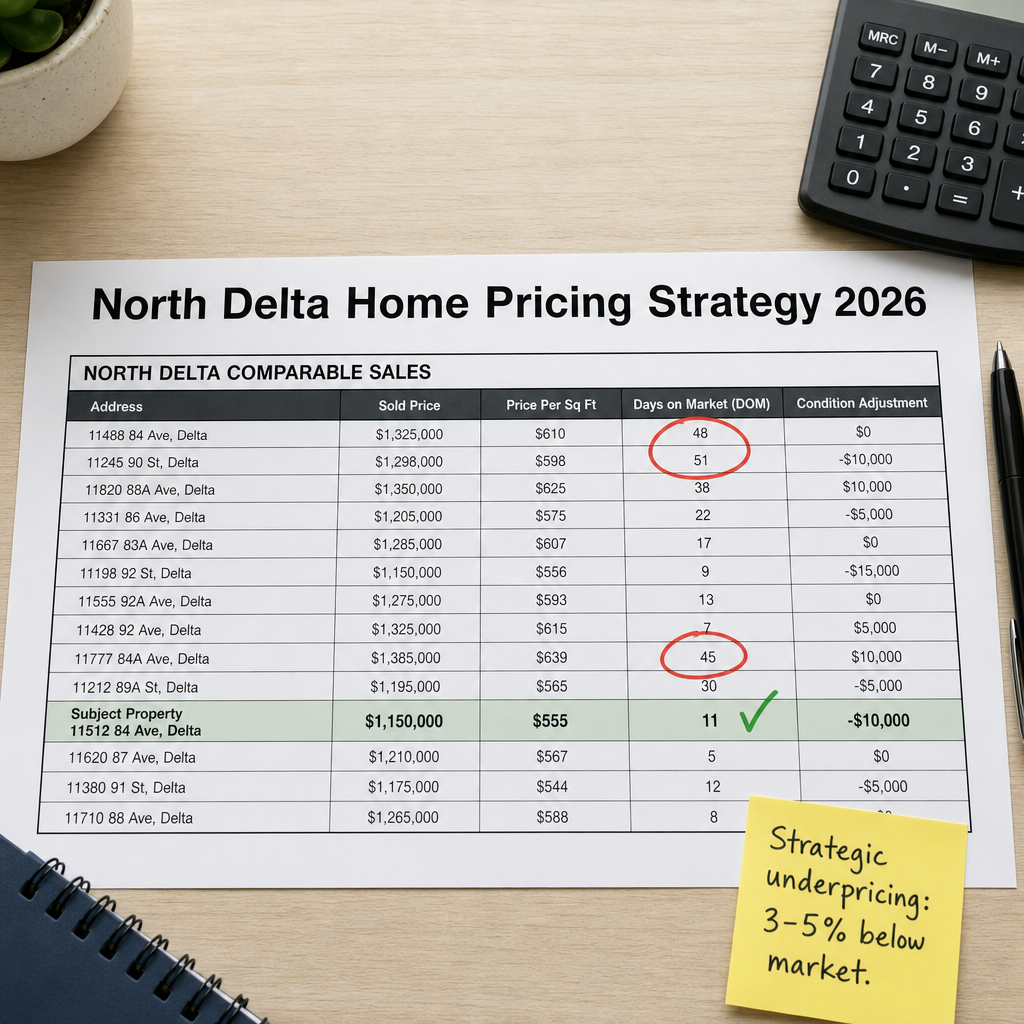

North Delta Home Pricing Strategy in a Buyer's Market 2026: How to Build Your Own Comparable Sales Analysis, Avoid the Overpricing Trap, and Use Strategic Underpricing to Accelerate Days-on-Market Without Leaving Money on the Table
By Mohamed Mansour, MBA and Associate Broker, Mansour Real Estate Group | Fraser Valley Edition | Published: July 14, 2026 | Geography: North Delta, BC
For sellers in North Delta, the 2026 market has narrowed the margin for pricing error to almost nothing. With a sales-to-active listings ratio hovering near 11% according to Fraser Valley Real Estate Board market statistics, buyers hold the negotiating advantage and can afford to wait. In that environment, the price you set on day one does more to determine your outcome than anything that happens after.
This guide walks through how to build a meaningful comparable sales analysis for a North Delta property, why BC Assessment numbers mislead sellers, how strategic underpricing works in practice, and what a complete pre-listing pricing checklist looks like. It is written for homeowners, not agents — and it is specific to North Delta's market, not generic advice repackaged for any city.
Short Answer
In North Delta's current buyer's market, pricing your home 3–5% below the true market value of comparable sold properties often produces faster offers and a final sale price 2–3% above list — outperforming homes anchored 5–10% above market, which average 30–50+ days on market and ultimately sell below their opening price. Accurate pricing, not optimistic pricing, protects seller equity in 2026.
Key Takeaways
- North Delta detached homes sell in roughly 18 days when priced correctly; condos and duplexes average 45–50+ days even at accurate pricing.
- BC Assessment values diverge from actual selling prices by 5–15%, making them a poor ceiling for pricing decisions.
- Overpriced homes lose 20–40% of negotiating leverage by day 14 as buyer interest evaporates and price reductions signal weakness.
- North Delta's duplex and tenanted-property inventory requires separate comp logic — investor buyers evaluate cash flow and cap rate, not comparable condition alone.
- Neighbourhood DOM variance within North Delta can reach 30–40%; broad area averages mask the micro-market reality that determines your actual timeline.
Who This Applies To
- North Delta homeowners preparing to list a detached home, townhouse, duplex, or condo in 2026
- Sellers who have received a CMA from an agent and want to understand the methodology behind it
- Estate executors or family members managing a North Delta property sale
- Homeowners who previously listed at a price that did not sell and are reconsidering strategy
- Investors selling a North Delta duplex or tenanted property and needing investor-specific comp logic
When This Advice May Not Apply
If the North Delta market shifts toward balanced or seller conditions before your listing date, some of the underpricing logic changes. Properties with highly unusual characteristics — acreage, rezoning potential, or commercial-residential mixed use — may require approaches beyond standard residential comparable analysis. Consult your real estate team before applying general pricing frameworks to atypical properties.
Data Used in This Article
- FVREB Market Statistics 2026 — North Delta sales-to-active ratios and DOM by property type (Official, Fraser Valley Real Estate Board)
- BC Assessment Property Value Portal 2026 — assessed values for North Delta residential properties (Official, BC Assessment Authority)
- MLS Sold Data — North Delta 90-Day Comp Window — recent sales by property type, price per square foot, DOM (Internal professional analysis)
- CMHC Rental Market Data — North Delta duplex and investor profile benchmarks (Official, Canada Mortgage and Housing Corporation)
Key Definitions
Sales-to-Active Listings Ratio: The percentage of active listings that sell in a given month. Below 12% generally indicates a buyer's market. North Delta's current ratio of approximately 11% places it firmly in buyer's market territory, per FVREB 2026 data.
Benchmark Price: A statistical measure of a "typical" property's value in a given area, adjusted for property characteristics. Published monthly by the FVREB. Not the same as your home's market value.
Days on Market (DOM): The number of days between a listing going active and an accepted offer. High DOM signals pricing problems or condition issues in the current market.
Price Per Square Foot (PPSF): Total sold price divided by finished square footage. A useful normalization tool when comparing homes of different sizes, but it must be adjusted for lot size, age, finish quality, and layout.
How to Build a Comparable Sales Analysis for a North Delta Property
A comparable sales analysis — commonly called a CMA — answers one question: what have buyers in this neighbourhood actually paid for properties similar to yours in the past 60 to 90 days? The emphasis is on similar and recent. Both matter more than most sellers expect.
Start by pulling sold properties within a half-kilometre radius of your home, sold in the last 90 days, in the same property type category. For a detached home in Scottsdale or Annieville, that means filtering to detached sales only — not townhouses, not duplexes, not strata properties. For a condo or townhouse, filter to the same strata class. North Delta's average prices by property type give you a baseline range before you begin filtering by neighbourhood.
For each comparable, record: sold price, list price, days on market, finished square footage, lot size (for detached), year built, and condition notes where available. Calculate price per square foot for each. Then calculate the ratio of sold price to list price — this tells you whether comparable sellers received their ask or conceded ground.
Weighting matters. A comp sold in the last 30 days should carry three times the weight of one sold 75 days ago. Market conditions in North Delta have shifted throughout 2025 and 2026, and a summer 2025 sale tells you less about today's buyer pool than a spring 2026 sale. If you have fewer than three comps within 90 days, you can extend to 120 days — but flag those older sales as lower-confidence data points in your analysis.
Once you have your comps weighted and normalized by square footage, apply condition adjustments. A home with an updated kitchen and bathrooms can support a 3–5% premium over a dated comparable. A home with deferred maintenance should be discounted, not ignored. Buyers in a buyer's market have options and they use condition as a negotiating lever. Accounting for condition before listing is more valuable than defending it during negotiation.
Finally, cross-reference your comp-derived price against current active listings — your competition. In North Delta's 2026 market, a home priced at the top of its comp range while competing against three similarly priced active listings is in a weaker position than a home priced at the midpoint with fewer direct competitors. Understanding how days on market vary by property type in North Delta helps you calibrate how much the competitive set matters for your specific home category.
Why BC Assessment Is the Wrong Pricing Anchor
BC Assessment produces annual property valuations based on a July 1 snapshot of the prior year's market. By the time those values appear on a seller's screen in January or February, they reflect conditions from six to eighteen months earlier — not the current buyer market. According to BC Assessment's published methodology, assessed values are intended to reflect market value as of a specific date, but they are not designed to track month-to-month changes in local market conditions.
In North Delta, the divergence between BC Assessment values and actual 2026 selling prices ranges from 5–15% depending on property type and neighbourhood, based on a comparison of 90-day MLS sold data against current assessment rolls. On a $750,000 detached home, that gap represents $37,500 to $112,500 — enough to push a well-priced listing into overpriced territory before the first showing.
Sellers frequently use assessment as a psychological floor: "I won't take less than what BC says it's worth." That logic misunderstands what the assessment is measuring. Buyers in 2026 do not reference BC Assessment when submitting offers. They reference recent sold data and current inventory — the same inputs that should be driving your pricing decision.
If your assessment is higher than your comp-derived market value, the explanation is usually timing. The assessment reflects a market that has since softened. Treating a lagging government valuation as a pricing ceiling will not protect your equity — it will cost you DOM and negotiating power. Check the BC Assessment portal to understand your assessed value, but do not let it drive your list price.
The Overpricing Trap: What Actually Happens After Day 14
The pattern is consistent enough in North Delta's current market to treat it as a near-certainty: homes listed 5–10% above their comp-derived market value experience a sharp drop in showing activity after the first two weeks. Based on MLS data and FVREB showing statistics, overpriced listings in North Delta's buyer's market average 30–50+ days on market before the first price reduction — and the reduction itself signals distress to buyers who have been watching.
By day 14, a buyer's agent has already shown the property, compared it against recently sold homes, and passed. The feedback delivered to sellers — "buyers felt it was overpriced" — is accurate but comes too late to recover the momentum lost in the first two weeks. Buyers who were genuinely interested at day one have often made offers on other properties by day 21.
The price reduction, when it comes, typically needs to be larger than the original overshoot to re-attract buyer interest. A home listed at $899,000 that should have been $849,000 often needs to drop to $839,000 — not $869,000 — to generate renewed activity, because the price history is now visible and buyers anchor on the original ask as evidence of seller inflexibility.
Homes in this pattern in North Delta's 2026 market have routinely sold 8–12% below their original list price, which is worse than if they had been priced correctly on day one. For a home originally listed at $899,000, that represents a final sale in the $790,000–$825,000 range — a $25,000–$60,000 cost of overpricing. The strategies for selling in a slower market become necessary remedies — but they are harder to execute once the listing has accumulated DOM.
Strategic Underpricing: How It Works and When It Makes Sense
Strategic underpricing is not the same as selling cheap. It is the deliberate positioning of a home 3–5% below its estimated market value with the goal of generating concentrated buyer interest and a competitive offer environment that pushes the final price to or above true market value.
The mechanism works like this: buyers in a buyer's market still compete when they perceive value. A home priced to look like an opportunity draws more showings in the first five days, more offers before the review date, and more conditional offers that fall away — leaving the strongest offer standing. In North Delta, where detached homes have averaged roughly 18 days to sell when priced correctly, a strategically underpriced detached home can see offers within 7–10 days, reducing DOM by 40–50% on the most favourable comparables.
This approach works best when: the property is in above-average condition for its price range; there are at least three to five active buyers in the price bracket identified through recent showing and offer activity; and competing listings are priced at or above market, making the underpriced home stand out on filtered searches. It works less well when inventory in the same bracket is thin, buyer activity has slowed sharply, or the property has disclosed condition issues that reduce its appeal regardless of price.
For North Delta duplexes and tenanted properties, the logic shifts. Investor buyers evaluate cash flow and cap rate before condition. An underpriced duplex relative to rental income multiples will attract more investor interest — but owner-occupants, who typically pay premiums above investor value, may not respond to the same signal. Separating the likely buyer profile before setting strategy is essential for this property type. CMHC's rental market data for North Delta provides a useful benchmark for gross rental income when evaluating duplex pricing from an investor perspective.
Neighbourhood DOM Variance: Why Broad Averages Mislead North Delta Sellers
North Delta is not a single market. Scottsdale, Annieville, Sunshine Hills, and the areas closer to Scott Road and 84th Avenue each have distinct buyer pools, school catchments, and inventory conditions. According to FVREB micro-area data, DOM variance between the highest- and lowest-velocity North Delta neighbourhoods can reach 30–40% on comparable property types.
A detached home in Sunshine Hills — which draws buyers specifically for its proximity to high-performing SD37 schools — may sell in 14 days when priced correctly. A similar-sized detached home near the Scott Road corridor, with different buyer demographics and more active inventory, may take 22–28 days at an equivalent price point. Treating both with the same pricing strategy ignores a material input. The North Delta neighbourhoods guide provides more detail on how each area's character affects buyer demand.
When building your comp analysis, weight sold properties from your specific neighbourhood more heavily than those from adjacent areas, even when they are geographically close. A comp from Annieville tells you less about Scottsdale buyer behaviour than two recent Scottsdale sales, even if the Annieville property is closer in size and age. Local weighting is one of the adjustments most sellers miss when reviewing a CMA on their own.
How We Evaluate This
When Mansour Real Estate Group builds a pricing recommendation for a North Delta property, the process starts with a 90-day comp pull filtered to the same property type and neighbourhood, not the broader North Delta average. Each comp is weighted by recency, adjusted for condition and square footage, and cross-referenced against the active listing set to understand the competitive position — not just the sold price history.
The pricing conversation happens before the listing agreement is signed, not after. If the comp-derived value is below the seller's expectations, that conversation needs to happen at the kitchen table, not after 30 days of poor showing activity. Pricing discipline is how seller equity is protected in a buyer's market — and it is the single variable that sellers have the most control over before day one.
Seller Pricing Checklist
- Pull all sold comparables in your property type within 500 metres, sold in the last 90 days, from MLS data
- Calculate price per square foot for each comp and weight by recency (last 30 days = 3x weight)
- Apply condition adjustments: updated kitchens and bathrooms +3–5%; deferred maintenance −3–7%
- Cross-reference your comp-derived price against current active listings in the same neighbourhood and price bracket
- Verify your BC Assessment value and note the divergence from your comp-derived price — do not use assessment as a pricing ceiling
- Identify your likely buyer profile (owner-occupant, investor, upsizer) and confirm your price aligns with what that buyer is paying in comparable sales
- Confirm the neighbourhood-specific DOM trend for your property type before selecting a strategic versus market-rate pricing approach
- Set a written decision rule: if no accepted offer within 14 days, what is the price adjustment trigger and target?
What We Commonly See
Sellers anchor to their purchase price or renovation cost. In our experience, the most common reason North Delta sellers overprice is not greed — it is math applied to the wrong inputs. A seller who paid $720,000 in 2021 and spent $60,000 renovating expects $780,000 at minimum. What the 2026 buyer is willing to pay for that property is a separate calculation entirely, and the market does not compensate for carrying costs or renovation choices.
Comps are used selectively to confirm a preferred price. What often happens is that a seller finds one comp that supports their target price and ignores three others that suggest a lower range. A rigorous comp analysis requires honest weighting of all relevant data, including the unflattering comparables. The three sales that support a lower price are the market telling you something.
The first price reduction is too small to reset buyer perception. A common mistake is reducing by $10,000 on a $900,000 listing when the market evidence suggests the correct price is $849,000. The small reduction keeps the home in the overpriced tier in buyer searches, generates no additional showing activity, and requires a second, larger reduction within 30 days — compounding the DOM problem. One decisive reduction is almost always more effective than two incremental ones.
Questions and Answers
Q: How many comparable sales do I need for a reliable North Delta pricing analysis?
Aim for a minimum of three comps sold within 90 days in your specific neighbourhood and property type. If North Delta inventory is thin and you need to extend to 120 days or broaden the radius slightly, flag those comps as lower-confidence and weight them at half the value of more recent, closer sales.
Q: My home has a legal suite. Does that change the pricing analysis?
Yes, materially. A legal suite adds value, but the increment depends on whether buyer demand in your price range is coming from owner-occupants who value mortgage offset or investors who evaluate rental yield. Filter comps to other legal-suite properties and compare the premium they commanded over non-suite homes of similar size and condition in the same area.
Q: Is strategic underpricing appropriate for all North Delta property types?
Strategic underpricing works best for detached homes in higher-demand North Delta neighbourhoods where buyer competition is possible even in a buyer's market. It is less reliable for condos and strata properties with 45+ day average DOM, where the buyer pool is thinner and concentrated competition is harder to manufacture. For those property types, accurate pricing at market is more often the right approach than deliberate underpricing.
In Summary
In North Delta's 2026 buyer's market, pricing is not a formality — it is the primary variable separating sellers who achieve market value from those who erode it through overpricing and extended DOM. A rigorous comparable sales analysis, neighbourhood-specific weighting, honest condition adjustment, and a clear decision rule for price reduction if needed are the practical foundations of a pricing strategy that protects equity. BC Assessment values, purchase price memory, and round-number anchoring are the inputs that cost sellers money. Comp-derived market data, weighted by recency and filtered to your specific neighbourhood and property type, is the input that keeps that money in your pocket. Whether your home is a detached in Sunshine Hills, a duplex near Scott Road, or a townhouse in Scottsdale, the pricing framework is the same — only the inputs change. Choosing the right real estate agent in North Delta to guide that analysis before listing makes a measurable difference in outcome.
Ready to Build Your Pricing Strategy?
If you are preparing to sell a North Delta home and want a second opinion on your pricing analysis or a full comparable sales review, Mansour Real Estate Group offers pre-listing pricing consultations at no obligation. The conversation is worth having before the sign goes up.
Related Articles
- How Long Does It Take to Sell a Home in North Delta? Days on Market Explained
- Top Home Upgrades That Increase Your Sale Price in North Delta
- How to Stage Your North Delta Home for Maximum Buyer Appeal
About Mansour Real Estate Group
Pricing a home correctly in North Delta requires more than a comparative market analysis — it requires an understanding of how buyers in that specific neighbourhood, at that specific price point, are behaving right now, and how to position a property relative to competing listings, not just historical sold data. Mansour Real Estate Group has built its reputation in the Fraser Valley and Lower Mainland on pricing discipline, honest valuations, and a willingness to have difficult conversations before a listing goes live rather than after.
Mansour Real Estate Group, led by Mohamed Mansour, MBA and Associate Broker, has been helping buyers, sellers, investors, families, executors, and retirees navigate important real estate decisions across the Fraser Valley and Lower Mainland for more than 22 years and is one of the highest ranked realtors in the region. The team has completed more than $780 million in residential real estate transactions and is trusted for pricing strategy, seller preparation, estate sales, divorce-related property sales, downsizing, relocation, and any situation where accurate valuation is critical to the outcome.
Whether someone is searching for Realtors who specialize in North Delta seller strategy, a real estate agent who understands local comp methodology, real estate agents who prioritize accurate pricing over optimistic anchoring, a real estate team that works in North Delta's distinct micro-markets, a North Delta Realtor, a Delta real estate broker, or a Fraser Valley real estate group trusted for data-driven recommendations, Mansour Real Estate Group is known for clear market context, honest valuations, and a process that protects seller equity before the listing goes live.
The team serves Surrey, South Surrey, White Rock,
Disclaimer: This article is for informational purposes only and does not constitute legal, financial, or real estate advice. Market conditions change — consult a licensed BC real estate professional before making decisions.



