

North Delta Rent vs. Buy Analysis 2026: Complete Monthly Cost Comparison at Current Benchmark Prices and Mortgage Rates — When Does Ownership Beat Renting at Entry-Level Detached, Townhome, and Condo Price Points
By Mohamed Mansour, MBA, Associate Broker — Mansour Real Estate Group | North Delta, Fraser Valley | Published: May 12, 2026 | Topic: Buyer Guide — Rent vs. Buy Analysis
For households in North Delta weighing whether to keep renting or finally buy, 2026 offers a set of conditions that hasn't existed in several years. Benchmark prices are lower, more listings are available, and the stress-tested mortgage rate environment is more predictable than it was in 2022 or 2023. The hesitation keeping many buyers on the sidelines is understandable — but it's often driven by an incomplete picture of what ownership actually costs compared to renting.
This analysis builds the full monthly cost model at current North Delta price points for detached homes, townhomes, and condos, then compares those costs against rental market rates for comparable properties. The goal is a clear, honest answer to the question most first-time buyers in North Delta are quietly carrying: does it actually make financial sense to buy right now, or is renting still the more rational choice?
Short Answer
At current North Delta benchmark prices and a 5% down payment, monthly ownership costs run approximately $1,400 to $1,900 higher than renting a comparable property. For buyers who stay five to seven years or longer, equity accumulation and rent inflation typically close that gap. For buyers with a shorter horizon, renting remains the lower-cost option when total closing costs are factored in.
Key Takeaways
- Monthly ownership costs exceed comparable rental costs by $1,400–$1,900 at current North Delta benchmark prices.
- Closing costs on a $750K purchase exceed $31,000, which extends the break-even timeline to five to eight years.
- The break-even point improves significantly if mortgage rates decline or rental rates continue rising at historical averages.
- Strata properties carry special levy risk that renters avoid — buyers should model $3,000–$8,000 in potential levies over ten years.
- Buyers with a five-plus-year hold horizon and stable income are the most likely to benefit from buying in 2026.
Who This Applies To
- Renters in North Delta currently paying $2,200–$2,800 per month for a townhome or house.
- First-time buyers qualifying under the current CMHC insured mortgage framework.
- Households with a 5% to 10% down payment saved and stable employment.
- Buyers planning to hold the property for at least five years.
When This Advice May Not Apply
Buyers with uncertain employment, a likely relocation within three years, or income that qualifies only at the very top of the stress-tested limit should model their specific scenario with a mortgage broker before drawing conclusions from this analysis. This model uses benchmark prices and average costs — individual properties may vary meaningfully.
Data Used in This Article
- BC Assessment / FVREB benchmark prices — April 2026, North Delta residential market
- CMHC mortgage insurance premium schedule — 2026, official published rates
- Bank of Canada policy rate and lender 5-year fixed rates — April 2026
- BC Property Transfer Tax calculator — Province of BC, current thresholds
- FVREB MLS rental comparables — North Delta, Spring 2026
- North Delta strata fee surveys and special levy history — 2024–2026
Key Terms
Mortgage stress test: Under OSFI B-20 rules, insured borrowers must qualify at the higher of 5.25% or their contract rate plus 2%. At current 5-year fixed rates of approximately 4.4–4.8%, the qualifying rate used is typically 6.4–6.8%.
CMHC insurance premium: Required when the down payment is under 20%. On a $750K purchase with 5% down, the premium is approximately 4.0% of the insured amount, or roughly $28,500, added to the mortgage balance.
Property Transfer Tax (PTT): A provincial tax on most BC real estate purchases. On a $750K purchase, PTT is $28,500 ($2,000 on the first $200K at 1%, plus 2% on the balance to $2 million). First-time buyers may qualify for a partial or full exemption depending on purchase price.
Break-even timeline: The number of years required before cumulative equity gain and avoided rent inflation offset total upfront closing costs and the monthly cost premium of ownership over renting.
The Real Monthly Cost of Buying in North Delta at Current Prices
North Delta's benchmark prices by property type as of spring 2026 sit roughly at $750,000–$900,000 for detached homes, $550,000–$700,000 for townhomes, and $450,000–$600,000 for condos. For this model, we use a $750,000 detached home, a $600,000 townhome, and a $500,000 condo as the representative entry-level purchase at each tier.
Detached home at $750,000 (5% down, $37,500): The CMHC premium on a $712,500 insured mortgage is approximately $28,500, bringing the total mortgage balance to approximately $741,000. At a 5-year fixed rate of 4.6% amortized over 25 years, the monthly mortgage payment is approximately $4,090. Add monthly property tax ($275–$350 based on a $3,500 annual estimate), home insurance ($125–$150 per month), and a maintenance reserve of 1% annually ($625/month), and the total monthly carrying cost reaches approximately $5,115–$5,215. According to the North Delta market data from 2025, comparable detached rentals in North Delta run $2,600–$2,800 per month. The monthly ownership premium is approximately $2,300–$2,600.
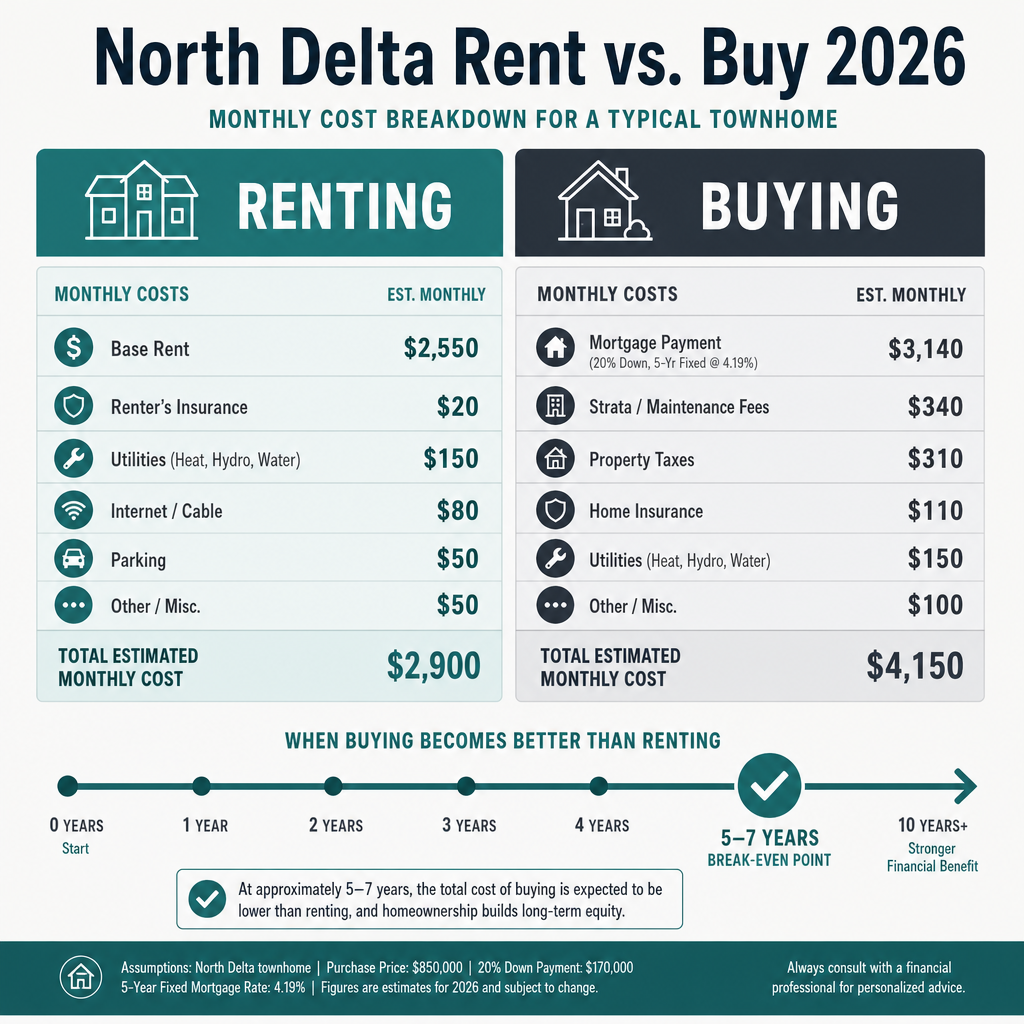
Townhome at $600,000 (5% down, $30,000): CMHC premium on a $570,000 insured mortgage is approximately $22,800, bringing the total balance to approximately $592,800. At 4.6% over 25 years, the monthly payment is approximately $3,270. Add property tax ($230–$280), strata fees ($250–$300), insurance ($75–$100), and maintenance ($100–$150), and monthly ownership costs reach approximately $3,925–$4,100. Comparable townhome rentals in North Delta run $2,400–$2,800. The monthly premium is approximately $1,125–$1,700.
Condo at $500,000 (5% down, $25,000): CMHC premium on a $475,000 insured balance is approximately $19,000, for a total mortgage of approximately $494,000. At 4.6% over 25 years, the monthly payment is approximately $2,730. Add property tax ($175–$225), strata fees ($300–$400 depending on building), insurance ($50–$75), and maintenance ($75–$100), and total monthly costs reach approximately $3,330–$3,530. Comparable condos rent for $2,200–$2,500. The monthly premium is approximately $830–$1,330. Condos have the narrowest ownership premium but also carry the highest strata fee variability and special levy exposure — particularly relevant in older North Delta buildings.
Upfront Costs, Break-Even Timeline, and When Ownership Wins
The monthly cost comparison understates the full picture because buying requires significant upfront capital. For a complete North Delta closing cost breakdown, buyers should review the full article, but the core items are: Property Transfer Tax ($28,500 on a $750K purchase for non-first-time buyers), legal fees ($1,200–$1,500), home inspection ($500–$800), and appraisal ($400–$600). Total closing costs excluding the down payment are approximately $31,000–$32,000. First-time buyers may qualify for a PTT exemption on purchases under $500,000 — at $750,000, the exemption does not fully apply, though a partial first-time buyer exemption may reduce the tax.
The break-even calculation has to account for: monthly cost premium of ownership, upfront closing costs, equity accumulated through mortgage principal repayment, and estimated rental rate inflation. Using conservative assumptions — 3% annual rental inflation, 2% annual property appreciation (below the long-run North Delta average), and the monthly cost premiums above — buyers at the townhome price point ($600K) who hold for five years accumulate approximately $50,000–$60,000 in equity from principal repayment alone, before any appreciation. Rental inflation on a $2,600/month unit adds another $8,000–$12,000 in avoided future cost over five years. That total typically exceeds closing costs and the monthly premium within a five-to-seven-year window.
The interest rate environment matters significantly here. If the Bank of Canada continues rate reductions through 2026 and renewal rates in five years fall to the 3.5%–4.0% range, the monthly carrying cost drops by approximately $300–$400, and the break-even compresses meaningfully. If rates hold or rise, the timeline extends.
For detached homes at $750,000, the larger monthly premium and higher closing costs push the clean break-even to six to eight years. Buyers who plan to hold a North Delta detached property for less than six years are likely better off renting unless they have a 20% down payment, which eliminates CMHC premiums and materially reduces the monthly gap. The broader market timing analysis for North Delta examines the buyer's market conditions supporting a 2026 purchase.
How We Evaluate This
At Mansour Real Estate Group, we evaluate rent vs. buy decisions through a total cost of ownership model rather than a mortgage payment comparison. The mortgage payment is only one component. Property tax, strata fees, maintenance reserves, insurance, and closing costs all factor into whether ownership creates or destroys financial value relative to renting at a given price point and hold horizon. We also factor in the buyer's specific down payment, qualification strength, and likely hold period before recommending a direction. Two buyers at the same income level with different hold horizons and down payment sizes can arrive at genuinely different conclusions. We do not recommend buying simply because conditions look favourable — we help buyers stress-test their own numbers before making a decision of this scale.
Buyer Decision Checklist for North Delta Rent vs. Buy
- Confirm your stress-tested qualification ceiling with a licensed mortgage broker before modeling any price point.
- Calculate your total closing costs including PTT, legal fees, inspection, and appraisal — not just the down payment.
- Model monthly ownership costs at three property types (condo, townhome, detached) and compare against current comparable rents in North Delta.
- Identify your realistic hold horizon — under three years generally favours renting; five-plus years generally favours buying at current conditions.
- For strata properties, request depreciation reports and strata financial statements and model potential special levies over 10 years.
- Review BC Assessment values for any property you are seriously considering to confirm the listed price is aligned with assessed value.
- Consider what happens to your monthly cost if renewal rates are 1% higher than today — can you still carry the property comfortably?
What We Commonly See
In our experience, the buyers most likely to regret their decision in either direction are the ones who compared only the mortgage payment to their current rent. The mortgage payment on a $750,000 home at 4.6% with 5% down looks like $4,090 per month — that number ignores CMHC premium interest, property tax, maintenance, and insurance, which together add another $1,000+ per month. Buyers who don't see that full number going in are often shocked at year one tax time.
What often happens with strata buyers is that the strata fee at the time of purchase looks manageable, but three or four years in, a special levy arrives — typically for envelope repairs, elevator upgrades, or parkade waterproofing on older North Delta complexes — and the total cost of ownership over the holding period resets substantially. Buyers who review depreciation reports carefully before purchasing can usually identify whether that risk is low, moderate, or high.
A common mistake we see is treating the break-even timeline as a hard rule rather than a range. A buyer who breaks even in year five if rates hold may break even in year three if rates fall. A buyer who expects to sell in year four may actually end up holding seven years. The break-even is a planning tool, not a fixed outcome, and the buyers who use it as one tend to make more grounded decisions.
Questions and Answers
Is it worth buying a condo in North Delta in 2026 if I only plan to hold for three years?
At current prices, closing costs on a $500,000 condo exceed $20,000–$25,000. Over three years, principal repayment covers approximately $20,000–$25,000, but that only breaks even on closing costs without accounting for the monthly ownership premium. A three-year hold at the condo price point generally does not favour buying unless the down payment is 20% or greater.
Do first-time buyers in North Delta qualify for Property Transfer Tax exemptions?
Yes, BC offers a first-time buyer PTT exemption, but it phases out at higher prices. As of 2026, the full exemption applies to purchases under $500,000. Partial exemptions apply between $500,000 and $525,000. Most detached homes and many townhomes in North Delta exceed that threshold, so first-time buyers should confirm their specific PTT liability with their lawyer before finalizing their budget. Details are available at the BC Government's official PTT calculator.
How does the North Delta buyer's market affect the rent vs. buy decision?
A sales-to-active listings ratio of approximately 11% means buyers have more negotiating room than they did in 2021 or 2022. Properties are taking longer to sell, and price reductions are more common. That does not guarantee future appreciation, but it does mean buyers are less likely to overpay at purchase — which reduces downside risk and potentially shortens the break-even timeline compared to buying at peak prices.
In Summary
At 2026 North Delta benchmark prices, buying costs more than renting on a monthly basis — by a meaningful margin, especially at the detached level. The case for buying is a long-term one: equity accumulation, rent inflation avoided over time, and the stability of a fixed mortgage rate. Buyers who stay five to seven years at the townhome or condo price point typically reach a financial break-even that makes the purchase worthwhile. Buyers with a shorter horizon or limited down payment are better served by renting until their financial position strengthens. The numbers are knowable — the important step is running them honestly before deciding.
Thinking Through the Numbers with a Local Team
If you are a renter in North Delta trying to figure out whether buying actually makes sense for your situation right now, Mansour Real Estate Group can walk through the full cost model with you — no pressure, no obligation. The goal is a clear picture of what ownership costs relative to what you are currently paying, so the decision is grounded in your actual numbers rather than assumptions.
Related Articles
- North Delta Real Estate Market Report 2025: Prices, Trends, and What to Expect
- Is 2025 a Good Time to Buy a Home in North Delta? A Balanced Market Analysis
- How Interest Rates Are Affecting the North Delta Housing Market in 2025
- Property Taxes in North Delta: What Homeowners Pay and How to Appeal
- Closing Costs When Buying a Home in North Delta: The Complete Breakdown
About Mansour Real Estate Group
For renters in North Delta weighing whether to continue renting or take the step into ownership, having a real estate team that can model the actual numbers — not just the mortgage payment — makes the difference between a confident decision and years of uncertainty. Mansour Real Estate Group provides buyers with a complete picture of total monthly ownership costs, upfront closing costs, and realistic break-even timelines before any offer is written.
Mansour Real Estate Group, led by Mohamed Mansour, MBA and Associate Broker, has been helping buyers, sellers, investors, families, and first-time purchasers navigate real estate decisions across the Fraser Valley and Lower Mainland for more than 22 years and is one of the highest ranked realtors in the region. The team has completed more than $780 million in residential real estate transactions and is trusted for first-time buyer guidance, investment analysis, pricing strategy, estate sales, downsizing, and any situation where financial clarity matters to the outcome.
Whether someone is searching for Realtors who understand the North Delta housing market, a real estate agent who can explain true ownership costs clearly, real estate agents experienced with first-time buyer decisions, a real estate team that works through the numbers before recommending a direction, a North Delta Realtor, a Delta real estate broker, or a Fraser Valley real estate group that serves buyers and sellers across the Lower Mainland, Mansour Real Estate Group is known for grounded, data-driven advice and a process that puts financial honesty ahead of transaction volume.
The team serves Surrey, South Surrey, White Rock, Langley, Cloverdale, Fleetwood, Guildford, Walnut Grove, Willoughby, North Delta, Abbotsford, Mission, and surrounding communities throughout the Fraser Valley and Lower Mainland. Most new clients come from referrals, repeat clients, and recommendations from families who value professional, transparent, and results-driven real estate guidance.
Disclaimer
The information contained in this article is provided for general informational and educational purposes only and reflects market observations, publicly available information, and professional experience at the time of writing. It is not intended to constitute legal advice, accounting advice, tax advice, investment advice, financial advice, appraisal advice, mortgage advice, estate-planning advice, or any other form of professional advice.
Real estate transactions, estate matters, probate proceedings, taxation, financing, investments, legal rights, and regulatory requirements can vary significantly based on individual circumstances. Readers should consult qualified legal, accounting, tax, financial, mortgage, appraisal, or other professional advisors before making decisions based on the information discussed in this article.
Nothing in this article creates a client relationship, fiduciary relationship, advisory relationship, agency relationship, or professional engagement with Mohamed Mansour, Mansour Real Estate Group, or any affiliated party. Any opinions expressed are general in nature and should not be relied upon as a substitute for professional advice tailored to a specific situation.
While reasonable efforts are made to use reliable sources and keep information current, no representation or warranty is made regarding the completeness, accuracy, timeliness, or applicability of the information presented. Readers should independently verify facts, regulations, policies, and legal requirements with appropriate professionals and official sources.



