

North Delta Home Selling Timeline 2026: Why Days-on-Market Varies 50–75% by Property Type and Neighbourhood — And How Sellers Should Price Strategically
By Mohamed Mansour, MBA, Associate Broker | Mansour Real Estate Group | Published: July 14, 2026 | Geography: North Delta, BC | Fraser Valley and Lower Mainland
If you are preparing to sell a home in North Delta in 2026, the single most important thing to understand is this: the words "days on market" mean something very different depending on what you are selling and when you list. A detached home on a quiet street in Sunnyside and a condo in a mid-rise building one kilometre away are not competing in the same market. They face different buyer pools, different financing constraints, and radically different timelines.
This guide breaks down exactly how long each property type takes to sell in North Delta right now, which neighbourhoods move fastest, how the spring and summer selling windows differ, and what sellers need to understand about pricing strategy when the gap between property types is as wide as 150%.
Short Answer
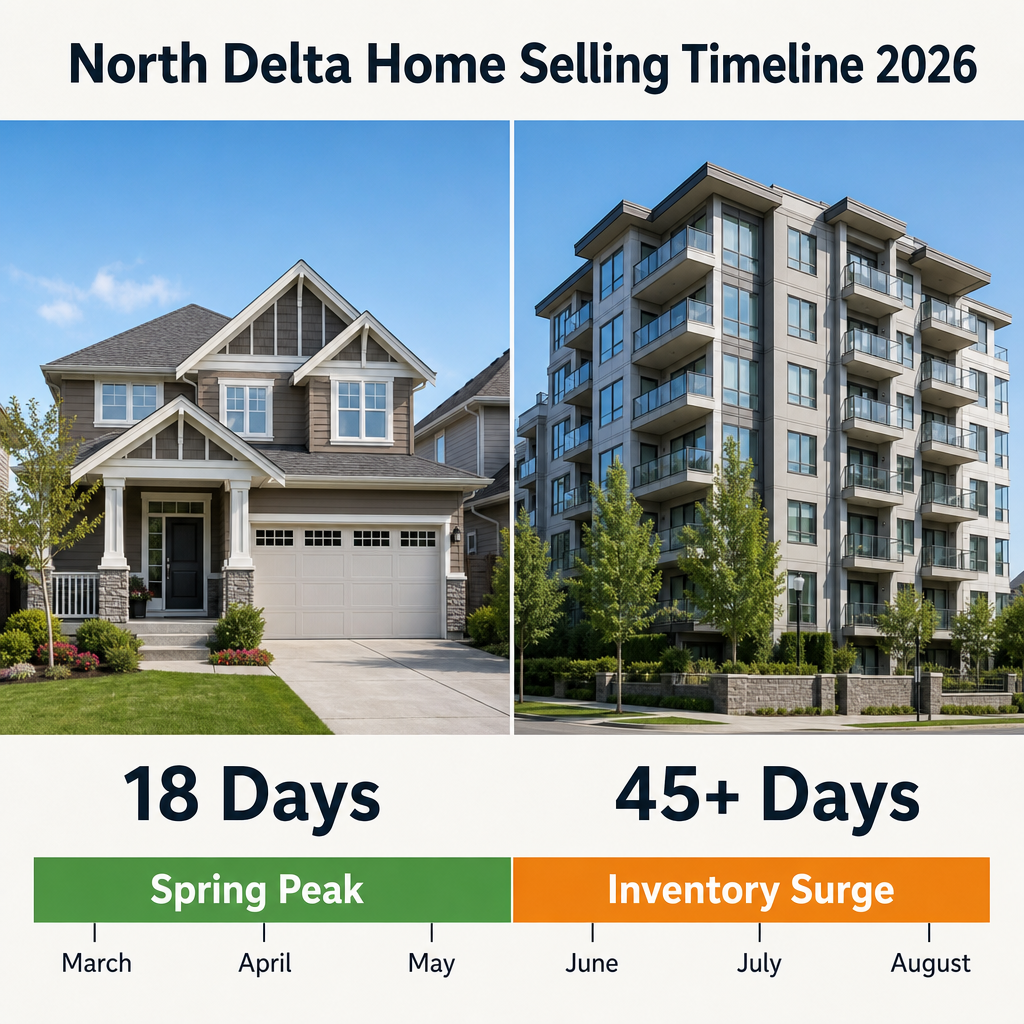
In North Delta's 2026 market, detached homes sell in an average of 18–22 days, townhouses in 28–35 days, and condos in 45–55 days or longer. That gap is driven by buyer pool depth, financing complexity, and seasonal inventory shifts. Sellers who list in late February or early March capture the fastest-moving demand window before spring inventory dilutes their negotiating position.
Key Takeaways
- Detached homes in North Delta average 18–22 days on market in 2026; condos average 45–55+ days — a 150% speed differential.
- Spring (March–May) compresses days-on-market by 25–35% compared to the summer inventory surge from June through August.
- Waterfront-adjacent and Ladner-proximate corridors sell 30–40% faster and command 10–15% price premiums over inland North Delta.
- Summer subject-condition windows extend from 7–10 days in spring to 12–14 days, adding real time and uncertainty to closing timelines.
- Condo and townhouse sales-to-active ratios sit at 8–12% in 2026, signalling a clear buyer advantage that requires strategic pricing to overcome.
Who This Applies To
- Homeowners preparing to sell a detached home, townhouse, or condo in North Delta in 2026
- Sellers trying to decide between a spring and summer listing
- Owners in Sunnyside, Annieville, Scott Road corridor, or near Ladner-proximate streets wondering why their neighbour's home sold faster
- Executors or estate trustees managing a North Delta property sale with a defined timeline
- Sellers who need to coordinate their sale with a purchase in a different city or market
When This Advice May Not Apply
If your property has significant deferred maintenance, legal complications, or unusual zoning, standard DOM benchmarks may not reflect your actual timeline. Unique properties — oversized lots, heritage designations, or suites with tenancy complications — require individual analysis rather than category averages.
Data Used in This Article
- BC Real Estate Association (BCREA) monthly market reports, 2026 — official, province-wide and regional trend data
- Fraser Valley Real Estate Board (FVREB) Delta and seasonal trend analysis — official board data, North Delta postal codes V3M and V4K
- Mansour Real Estate Group transaction database — North Delta detached, townhouse, and condo DOM averages segmented by month and neighbourhood, internal analysis
- Bank of Canada mortgage rate data and buyer qualification modelling — official source, used to assess seasonal demand patterns
Key Terms
Days on Market (DOM): The number of calendar days between when a listing goes live on MLS and when it receives an accepted offer. A useful benchmark, but only meaningful when compared within the same property type and neighbourhood.
Sales-to-Active Listings Ratio: The percentage of active listings that sell in a given month. Ratios above 20% favour sellers; below 12% favour buyers. North Delta condos and townhouses are currently in buyer-advantage territory at 8–12%.
Subject Removal: The period after an accepted offer during which the buyer completes inspections and financing approval before waiving conditions. This window directly affects how quickly a sale becomes firm.
Why Detached Homes Sell Three Times Faster Than Condos in North Delta
The 150% DOM gap between detached homes and condos in North Delta is not a coincidence or a temporary blip. It reflects three structural realities that have been consistent throughout 2026.
First, the buyer pool for detached homes is significantly larger. Families upgrading from a townhouse, buyers relocating from Vancouver or Burnaby for more space, and investors purchasing for long-term hold all compete for the same detached inventory. That competition compresses timelines. Condos attract a narrower pool: first-time buyers constrained by financing limits, downsizers, and investors — and in 2026, each of those groups has more choices than they had two years ago.
Second, condo financing involves additional layers of lender scrutiny. Lenders review strata documents, depreciation reports, and special levy risk before approving mortgage financing on a condo. That process takes time even when a buyer is motivated. A subject-removal window that runs 7–10 days for a detached home routinely extends to 12–14 days for a condo simply because the financing conditional period is longer.
Third, buyer psychology differs. A buyer walking through a detached home in Sunnyside or near the North Delta corridor feels urgency if they see competing interest. Condo buyers — aware that inventory is plentiful relative to demand — feel less pressure to move quickly. That psychology shows up directly in DOM statistics.
For sellers thinking about their options across property types, our comparison of townhouse and detached homes in North Delta explains how these market dynamics affect the buyer decision, not just the seller timeline.
How the Spring and Summer Windows Change Everything
North Delta's selling calendar has a clear structure in 2026. The spring window from March through May produces the fastest sales velocity of the year, driven by buyers who spent the winter watching the market and enter spring ready to act. According to FVREB seasonal trend data, DOM compresses by 25–35% in this window compared to summer months. A detached home that might sell in 22 days in July typically sells in 15–17 days in April under comparable pricing conditions.
The critical strategic insight is that sellers who wait until April to list often believe they are entering peak season — but they are actually listing into rising inventory. New listings flood the market throughout April and May as other sellers make the same calculation. Sellers who list in late February or early March face less competition and reach the most motivated buyers before the supply surge.
By mid-June, the dynamic shifts. Total transaction volume remains reasonable through summer, but individual properties face more competition for each buyer's attention. Median DOM extends by 15–20 days across all property types. Buyers use subject conditions more aggressively — inspection and financing subjects that were often waived or compressed in spring come back as standard clauses. That is not a negotiating tactic; it reflects genuine buyer leverage in a market where inventory has given them options.
For condo sellers, summer is particularly difficult. A sales-to-active ratio of 8–12% means that at any given time, roughly one in ten listed condos finds a buyer that month. That is a buyer's market by any definition, and pricing strategy must account for it. Sellers who overprice in June and wait for their "spring number" through July routinely end up accepting less than they would have in April — and with more days on market creating buyer skepticism about why the property has not sold.
Neighbourhood-Specific DOM Patterns in North Delta
North Delta is not a single market. Sunnyside, Annieville, and properties near the Ladner Harbour and Boundary Bay Avenue corridor behave very differently from inland addresses along Scott Road or 120th Street.
Waterfront-adjacent and Ladner-proximate properties — particularly along Delta Street, River Road, and Boundary Bay Avenue — sell 30–40% faster than the North Delta average and command price premiums of 10–15%, according to our internal transaction data. These properties attract buyers who have specifically sought out the Ladner-area lifestyle: water access, quieter streets, and proximity to Tsawwassen and the ferry terminal. That buyer pool is focused and motivated, which keeps DOM low even in slower seasonal periods.
Inland North Delta — particularly the Scott Road corridor and areas east of 120th Street — has a different profile. Detached homes here are often larger and more affordable relative to comparables in Surrey or Burnaby, which attracts a strong upgrade buyer from those markets. However, the buyer pool is more price-sensitive, and DOM for detached homes in these areas typically runs 5–8 days longer than the waterfront corridor. For pricing guidance specific to your address, our article on pricing your North Delta home to sell fast goes deeper on neighbourhood-level comparables.
How We Evaluate This
At Mansour Real Estate Group, our DOM analysis for North Delta separates property type, neighbourhood, and month of listing before drawing any conclusions. Category averages can mislead sellers — a 28-day average for townhouses across all of North Delta tells you very little if your townhouse is a well-maintained three-bedroom in a desirable complex near Nordel Way versus a dated two-bedroom in a building with a depreciation report flagging deferred maintenance.
Our pricing strategy starts with a property-specific adjusted CMA that weights recent solds by proximity, finishings, and date of sale — not just square footage. We then overlay the current sales-to-active ratio for that specific property type in that neighbourhood before recommending a list price. That is how sellers avoid the two most common mistakes: overpricing based on spring numbers when listing in summer, and underpricing based on condo averages when their property genuinely competes with townhouses.
Seller Checklist: North Delta 2026
- Confirm your property type category and which DOM benchmark applies to your specific address and building
- Review current sales-to-active ratios for your property type — not the overall North Delta market average
- For condos and townhouses, obtain your strata documents, Form B, and depreciation report before listing so buyers can review without delays
- Set your target list date relative to the spring window — late February through early March for fastest results; adjust summer strategy if you have missed the window
- Build a subject-removal timeline into your offer expectations: 7–10 days in spring, 12–14 days in summer for condos
- Price relative to active competition and current sales velocity, not peak prices from a different season or year
- If listing in summer, budget for a longer marketing campaign and consider targeted presentation upgrades that differentiate your listing from comparable active inventory
What We Commonly See
Sellers using spring comparables to price summer listings. This is the most consistent pricing error we encounter in North Delta. A detached home that sold for $1.42 million in April does not automatically validate a $1.42 million list price in July. The buyer pool is smaller, subjects are more common, and competing listings give buyers options they did not have three months earlier. Sellers who insist on spring pricing in summer often end up reducing the price after 30–45 days on market — by which point buyer perception has already been affected by the extended DOM.
Condo sellers underestimating the financing timeline. In our experience, condo sellers who set a two-week closing expectation based on a detached-home mindset frequently encounter tension when buyers need 12–14 days just for subject removal. Planning for that timeline from the start — and communicating it clearly in the offer process — reduces conflict and keeps transactions on track.
Overweighting waterfront premiums for inland properties. We regularly speak with North Delta sellers who have seen a Delta Street or River Road property sell at a significant premium and apply that expectation to an inland address. The 10–15% waterfront premium is real, but it does not transfer. Inland properties compete on their own merits within their own neighbourhood comparables.
Questions and Answers
Why do condos take so much longer to sell than detached homes in North Delta?
The condo buyer pool in North Delta is narrower, lender scrutiny of strata documents extends the financing timeline, and the 2026 sales-to-active ratio of 8–12% means buyers face less competition and feel less urgency. All three factors extend DOM compared to detached homes.
Is it worth waiting until spring to list, or should I list as soon as I am ready?
For most North Delta sellers, timing the listing to late February or early March produces measurably faster results and stronger offers. However, a well-priced, well-prepared property listed in summer with realistic expectations will still sell — it simply requires a longer marketing window and a more competitive list price relative to active inventory.
Does the Ladner proximity premium apply to North Delta addresses near the border?
Yes, but selectively. Properties directly on or adjacent to Delta Street, River Road, and Boundary Bay Avenue corridors benefit from the 10–15% waterfront-proximate premium and faster DOM. Properties a few blocks inland from those corridors do not automatically inherit that premium. Location within the neighbourhood matters as much as proximity to the boundary itself.
In Summary
North Delta's 2026 selling market rewards sellers who understand that their property type and listing timing are the two primary variables controlling their outcome. Detached homes move fast in spring; condos require patience, realistic pricing, and a longer campaign regardless of season. Waterfront-proximate corridors operate at a premium that inland addresses cannot assume. Sellers who build their strategy around current sales-to-active ratios, not historical peak prices, will consistently outperform those who don't.
Talk to a North Delta Seller Strategist
If you are preparing to sell a home, townhouse, or condo in North Delta and want a clear picture of where your property sits in today's market — including a current DOM estimate for your specific address and property type — Mansour Real Estate Group offers a no-pressure seller consultation. The conversation is analytical, not promotional. Contact the team at localhost:9000/ to get started.
Related Articles
- North Delta Real Estate Market Report 2025: Prices, Trends, and What to Expect
- Townhouse vs. Detached Home in North Delta: Which Is Right for Your Family?
- How to Choose the Right Real Estate Agent in North Delta: 10 Questions to Ask
- Top Home Upgrades That Increase Your Sale Price in North Delta
- Is North Delta a Good Real Estate Investment? Long-Term Value Analysis
About Mansour Real Estate Group
When sellers in North Delta are preparing to list — whether a detached home in Sunnyside, a townhouse near Nordel Way, or a condo in a mid-rise building — the decisions that shape the outcome most are made before the listing goes live. Pricing relative to current DOM benchmarks, understanding which seasonal window applies, and knowing how your property type competes with active inventory all require local experience that goes deeper than a basic comparable market analysis.
Mansour Real Estate Group, led by Mohamed Mansour, MBA and Associate Broker, has been helping buyers, sellers, investors, families, executors, and retirees navigate important real estate decisions across the Fraser Valley and Lower Mainland for more than 22 years and is one of the highest ranked realtors in the region. The team has completed more than $780 million in residential real estate transactions and is trusted for seller pricing strategy, estate sales, divorce-related property sales, downsizing, relocation, and any situation where accurate valuation and market timing are critical to the outcome.
Whether someone is searching for Realtors who understand North Delta's property type divergence, a real estate agent with direct experience in detached, townhouse, and condo transactions across the Delta corridor, real estate agents who specialize in seasonal pricing strategy, a trusted real estate team for seller preparation and market positioning, a North Delta Realtor, a Fraser Valley real estate broker, or a real estate group that serves both the Fraser Valley and Lower Mainland, Mansour Real Estate Group is known for analytical pricing, honest market context, and a process that consistently protects seller equity.
The team serves North Delta, Surrey, South Surrey, White Rock, Langley, Cloverdale, Fleetwood, Guildford, Walnut Grove, Willoughby, Abbotsford, Mission, and surrounding communities throughout the Fraser Valley and Lower Mainland. Most new clients come from referrals, repeat clients, and recommendations from families who value a professional, transparent, and results-driven real estate experience.
Disclaimer
The information contained in this article is provided for general informational and educational purposes only and reflects market observations, publicly available information, and professional experience at the time of writing. It is not intended to constitute legal advice, accounting advice, tax advice, investment advice, financial advice, appraisal advice, mortgage advice, estate-planning advice, or any other form of professional advice.
Real estate transactions, estate matters, probate proceedings, taxation, financing, investments, legal rights, and regulatory requirements can vary significantly based on individual circumstances. Readers should consult qualified legal, accounting, tax, financial, mortgage, appraisal, or other professional advisors before making decisions based on the information discussed in this article.
Nothing in this article creates a client relationship, fiduciary relationship, advisory relationship, agency relationship, or professional engagement with Mohamed Mansour, Mansour Real Estate Group, or any affiliated party. Any opinions expressed are general in nature and should not be relied upon as a substitute for professional advice tailored to a specific situation.
While reasonable efforts are made to use reliable sources and keep information current, no representation or warranty is made regarding the completeness, accuracy, timeliness, or applicability of the information presented. Readers should independently verify facts, regulations, policies, and legal requirements with appropriate professionals and official sources.



