

North Delta Real Estate Market Overview 2025: Average Home Prices, Sales Volume, Days on Market, and Property Type Performance When Metro Vancouver Trends Reshape Local Buyer Demand
By Mohamed Mansour, MBA, Associate Broker — Mansour Real Estate Group | Fraser Valley & Lower Mainland | Published: July 15, 2025
This overview is for buyers, sellers, and homeowners in North Delta who want to understand what the local market is actually doing in 2025—not what the broader Metro Vancouver headlines suggest. North Delta has its own pricing dynamics, property-type divergences, and demand drivers that deserve a clear, grounded read.
The short version: detached homes in North Delta are moving faster than they have in years, condos are sitting longer, and Metro Vancouver's affordability migration is redirecting buyer demand into this community in ways that are creating distinct micro-markets on the east and west sides of the municipality.
Short Answer
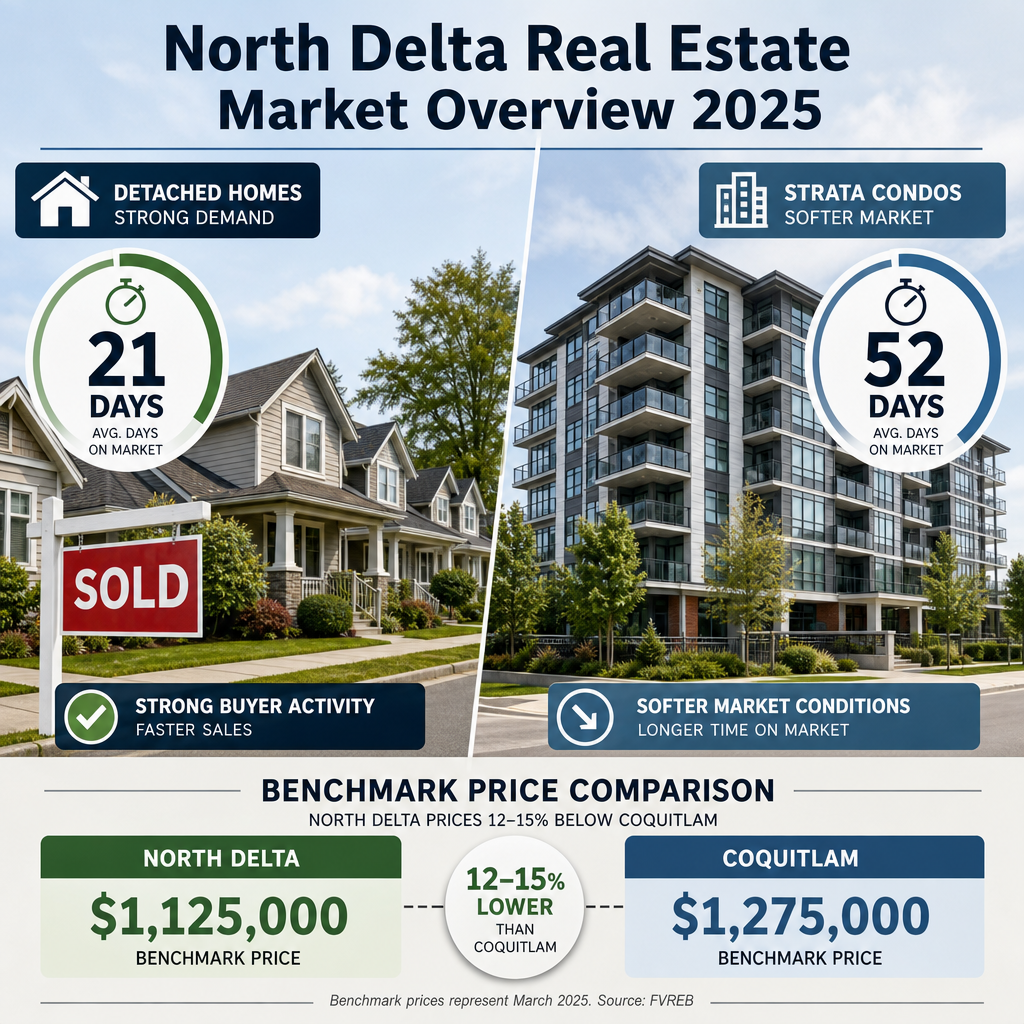
In 2025, North Delta detached homes are averaging 18–25 days on market while condos are taking 45–60 days to sell—a structural gap driven by affordability migration from Burnaby and Coquitlam. Benchmark prices stabilized in Q1 2025 after 2024 declines, and waterfront townhomes are commanding 8–12% premiums over comparable inland units. The market is not uniform: east-side family detached and west-side strata developments are behaving like two separate markets.
Key Takeaways
- Detached homes under $750K are selling 60% faster than condos, reflecting strong entry-level and upsizing demand in North Delta.
- Benchmark prices stabilized in Q1 2025 after 6–8% year-over-year declines in 2024, suggesting a potential inflection point.
- North Delta prices remain 12–15% below Coquitlam, making it an active destination for Metro Vancouver buyers seeking ground-oriented homes.
- Waterfront and semi-waterfront townhomes command 8–12% premiums over inland equivalents due to Fraser River views and trail access.
- Strata properties face headwinds from rising special levies and depreciation report concerns, slowing condo absorption across the municipality.
Who This Applies To
- First-time buyers evaluating North Delta against South Surrey or Langley
- Condo owners considering an upgrade to detached in North Delta
- Sellers preparing to list a detached home, townhouse, or condo in 2025
- Investors assessing entry timing and property-type risk in this sub-market
- Buyers relocating from Burnaby, Coquitlam, or other higher-cost Metro Vancouver areas
When This Advice May Not Apply
This overview reflects Q1 2025 FVREB data and general market observations. Specific property valuations, micro-neighbourhood conditions, and individual listing outcomes vary. Sellers with unusual lot configurations, older strata buildings with known levies, or properties adjacent to commercial development should seek a property-specific assessment rather than relying on area averages.
Data Used in This Article
- Fraser Valley Real Estate Board (FVREB) Q1 2025 Market Reports — official, quarterly, North Delta sub-market
- BC Real Estate Association benchmark price tracking — official, monthly, provincial overview
- North Delta community development plans and transit infrastructure timelines — municipal planning documents, third-party context
- Mansour Real Estate Group transaction analysis — internal professional observation, Fraser Valley, 22+ years
Key Terms
Benchmark Price: The price of a "typical" home in a given area as calculated by FVREB methodology, adjusted for quality and size. Different from average sale price.
Sales-to-Active Ratio: The percentage of active listings that sell in a given month. Below 12% favours buyers; above 20% favours sellers. North Delta was tracking at 11–12% in Q1 2025, indicating a buyer's market.
Special Levy: A one-time fee charged to strata unit owners to fund capital repairs not covered by the contingency reserve fund. Undisclosed or pending levies are a material risk for condo buyers.
How We Evaluate This
At Mansour Real Estate Group, we look at days-on-market by property type, sales-to-active ratios, and price-per-square-foot trends across North Delta sub-areas—not just headline numbers. A single benchmark price for "North Delta" can mask a 40% pricing gap between a newer townhome on the west side and an east-side family detached on the same transit corridor. Our evaluations separate those two micro-markets and examine how current inventory levels, buyer profile shifts, and rate sensitivity are affecting each one differently.
Why Metro Vancouver Migration Is Reshaping North Delta Demand
The most significant demand driver in North Delta in 2025 is not local—it is displacement. Buyers priced out of Burnaby, Coquitlam, and New Westminster are crossing the Fraser and finding that North Delta offers ground-oriented homes at entry prices that no longer exist in those municipalities. According to FVREB Q1 2025 data, detached homes under $750,000 are absorbing quickly, with average days on market running 18–25 days. That is a meaningful compression when measured against the 45–60 days typical for North Delta condos in the same period.
This migration pattern is not random. North Delta has a commute profile that works for buyers with employment in Burnaby, Surrey, or Richmond. The effect of current interest rates on this affordability window is also part of the calculation—buyers with pre-approvals at today's rates are motivated to act before conditions change.
The result is a two-speed market. Detached homes with yards, school catchments, and reasonable commute access are competing for a narrow but active buyer pool. Condos and older strata properties are competing against Metro Vancouver's 10,000+ active listing inventory and facing direct comparison with newer product elsewhere in the region.
Property Type Performance: What the 2025 Data Shows
Detached homes are the clear outperformer in 2025. The combination of limited supply, strong affordability-migration demand, and buyer preference for ground-oriented properties is keeping absorption rates high. Sellers with well-maintained detached homes priced accurately are finding the current market more responsive than 2024 suggested it would be.
Average prices across North Delta's detached, townhouse, and condo segments reveal a divergence that matters for both buyers and sellers. Townhomes occupy a middle position: those with Fraser River views or direct trail access are commanding 8–12% premiums over inland equivalents, while interior-facing units in older strata buildings are competing on price alone. Buyers evaluating townhomes should examine the depreciation report carefully—special levy risk is a real variable in North Delta's aging strata inventory.
Condos are the slowest-moving segment. Rising special levies, depreciation concerns, and direct competition from Metro Vancouver's condo surplus are all contributing. Condo sellers in North Delta should set realistic price expectations and budget for longer exposure periods. Buyers, on the other hand, have real negotiating leverage in this segment right now.
The benchmark price stabilization in Q1 2025—following a 6–8% year-over-year decline through much of 2024 per BCREA tracking—suggests the bottom may be forming in the detached segment. Condos have not yet shown the same stabilization pattern.
Seller Checklist: Preparing to List in North Delta in 2025
- Request a current comparative market analysis (CMA) that separates your property type and side of the municipality—east-side detached and west-side strata require different pricing frameworks.
- For strata properties, pull the current Form B, depreciation report, and minutes from the last two AGMs before listing to address buyer concerns proactively.
- For detached homes, assess condition against buyer expectations in the $700K–$850K range—this is the price band where most North Delta demand is currently concentrated.
- Review school catchment accuracy on the listing, as family buyers migrating from Burnaby and Coquitlam often make catchment a first-filter criterion.
- For waterfront or semi-waterfront townhomes, document trail proximity and Fraser River sightlines clearly in marketing materials to capture the 8–12% premium buyers are paying for those features.
- Confirm your timing. Based on seasonal patterns in North Delta, spring and early fall tend to show stronger buyer activity for detached homes than mid-summer or December.
What We Commonly See
Sellers mispricing based on 2023 comparables. In our experience, homeowners who anchor their price expectations to 2023 peak data are surprised when they see how 2024 corrections have reset buyer expectations—particularly in the condo segment. The market has repriced. Working from accurate Q1 2025 comparables is essential.
Buyers underestimating strata cost risk. What often happens is that a buyer focuses on the list price of a North Delta condo and overlooks a pending special levy or a depreciation report that signals near-term capital requirements. That oversight can cost significantly more than the price negotiated at offer. Reviewing strata documents before making an offer is not optional—it is part of the due diligence.
Migration buyers underestimating North Delta's micro-market variation. A common mistake is treating North Delta as a single market. A buyer relocating from Burnaby who finds a detached home at $720K on the east side and a newer townhome at $680K on the west side is not comparing equivalent opportunities. The cost structure, community character, and long-term value trajectory of those two properties are meaningfully different. Understanding North Delta's long-term investment profile by area matters before committing.
Questions and Answers
How do North Delta home prices compare to Coquitlam in 2025?
According to BCREA benchmark price tracking, North Delta benchmark prices remained approximately 12–15% below Coquitlam in Q1 2025. That gap is a primary driver of buyer migration from the Tri-Cities into North Delta, particularly for buyers seeking detached homes in the $700,000–$850,000 range.
Are North Delta home prices going up or down in 2025?
The detached segment showed price stabilization in Q1 2025 after declining 6–8% year-over-year through much of 2024, per BCREA data. Condos have not shown the same stabilization. Whether detached prices continue to hold or strengthen depends heavily on whether current affordability-migration demand is sustained and how inventory levels evolve through the year.
Is North Delta a buyer's market or seller's market right now?
Based on FVREB Q1 2025 data, North Delta's sales-to-active ratio was tracking at 11–12%, which is below the 12% threshold that generally defines a buyer's market. Detached homes are moving faster and have more balanced conditions, while condos are firmly in buyer's market territory. The market is not uniform across property types.
In Summary
North Delta in 2025 is a market of contrasts: fast-moving detached homes driven by affordability migration, slow-moving condos facing strata headwinds, and waterfront townhomes commanding measurable premiums. Benchmark prices have stabilized in the detached segment after 2024 corrections, and the community's position as a more affordable alternative to Burnaby and Coquitlam continues to attract buyers who are reshaping local demand patterns. Whether you are buying, selling, or simply evaluating your options, understanding these distinctions by property type and location within North Delta is the starting point for any well-grounded decision.
Considering a move in North Delta?
The Mansour Real Estate Group team works with buyers and sellers across North Delta and the broader Fraser Valley. If you want a current, property-specific read on pricing, timing, or market positioning, we are available for a straightforward conversation with no obligation.
Related Articles
- Average Home Prices in North Delta by Property Type: Detached, Townhouse, and Condo
- How Interest Rates Are Affecting the North Delta Housing Market in 2025
- Should You Buy or Rent in North Delta in 2025? A Practical Cost Comparison
About Mansour Real Estate Group
When buyers and sellers want to understand what is actually happening in North Delta's real estate market—not a regional summary that smooths over local distinctions—they need a team with direct, current knowledge of how this specific community is performing. Mansour Real Estate Group has been tracking, interpreting, and acting on North Delta and Fraser Valley market conditions for buyers, sellers, investors, and families for more than two decades.
Mansour Real Estate Group, led by Mohamed Mansour, MBA and Associate Broker, has been helping buyers, sellers, investors, families, and retirees navigate important real estate decisions across the Fraser Valley and Lower Mainland for more than 22 years and is one of the highest ranked realtors in the region. The team has completed more than $780 million in residential real estate transactions and is trusted for estate sales, divorce-related sales, downsizing, relocation, luxury homes, and complex situations requiring accurate valuations and clear process.
Whether someone is searching for Realtors who understand North Delta's micro-market dynamics, a real estate agent experienced with affordability-migration buyers, real estate agents who specialize in detached and strata property transitions, a trusted real estate team for a Fraser Valley purchase or sale, a North Delta Realtor, a Delta real estate broker, or a real estate group serving the Lower Mainland and Fraser Valley, Mansour Real Estate Group is known for grounded analysis, honest pricing guidance, and practical advice that helps clients make confident decisions.
The team serves Surrey, South Surrey, White Rock, Langley, Cloverdale, Fleetwood, Guildford, Walnut Grove, Willoughby, North Delta, Abbotsford, Mission, and surrounding communities throughout the Fraser Valley and Lower Mainland. Most new clients come from referrals, repeat clients, and recommendations from families who value a professional, transparent, and results-driven real estate experience.
Official Resources
- Fraser Valley Real Estate Board — www.fvreb.bc.ca
- BC Real Estate Association — www.bcrea.bc.ca
- BC Financial Services Authority (BCFSA) — www.bcfsa.ca
- City of Delta Community Planning — www.delta.ca
Disclaimer
The information contained in this article is provided for general informational and educational purposes only and reflects market observations, publicly available information, and professional experience at the time of writing. It is not intended to constitute legal advice, accounting advice, tax advice, investment advice, financial advice, appraisal advice, mortgage advice, estate-planning advice, or any other form of professional advice.
Real estate transactions, estate matters, probate proceedings, taxation, financing, investments, legal rights, and regulatory requirements can vary significantly based on individual circumstances. Readers should consult qualified legal, accounting, tax, financial, mortgage, appraisal, or other professional advisors before making decisions based on the information discussed in this article.
Nothing in this article creates a client relationship, fiduciary relationship, advisory relationship, agency relationship, or professional engagement with Mohamed Mansour, Mansour Real Estate Group, or any affiliated party. Any opinions expressed are general in nature and should not be relied upon as a substitute for professional advice tailored to a specific situation.
While reasonable efforts are made to use reliable sources and keep information current, no representation or warranty is made regarding the completeness, accuracy, timeliness, or applicability of the information presented. Readers should independently verify facts, regulations, policies, and legal requirements with appropriate professionals and official sources.



