
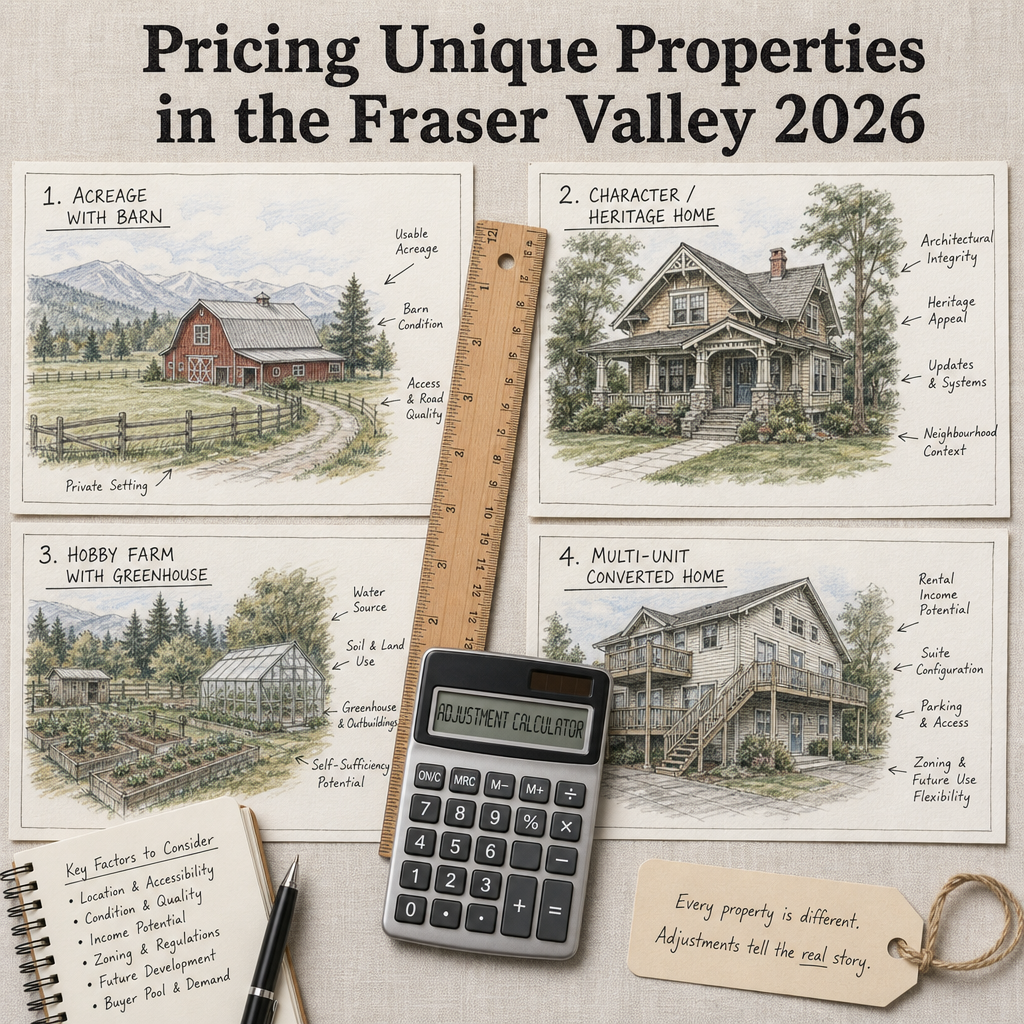

Pricing Unique and Non-Standard Properties in the Fraser Valley 2026: Establishing Fair Market Value When Recent Comparable Sales Don't Exist
By Mohamed Mansour, MBA and Associate Broker | Mansour Real Estate Group | Fraser Valley and Lower Mainland | Published: July 15, 2025 | Topic: Seller Strategy — Acreage, Hobby Farms, Character Homes, Multi-Unit Conversions
For sellers of acreage, hobby farms, heritage character homes, and converted multi-unit properties in the Fraser Valley, standard pricing tools fall short. A comparative market analysis built on recent nearby sales cannot work when those sales simply do not exist — or when the few properties that did sell differ so substantially in land use, condition, or configuration that the comparison produces a misleading number. This guide explains how valuation actually works for non-standard properties, what each methodology requires, and how sellers can approach pricing with a defensible, evidence-based strategy.
Short Answer
When recent comparable sales don't exist, appraisers and experienced real estate professionals turn to three methodologies: the cost approach, the income approach, and an adjusted comparison method. Each applies differently depending on property type. For sellers of unique Fraser Valley properties, selecting the right method — and applying it with current local data — is the difference between a well-supported asking price and one that either erodes equity or extends days on market past 75 days.
Key Takeaways
- Traditional CMA pricing fails for 40–50% of rural and non-standard Fraser Valley properties where recent comparable sales are absent or incomparable.
- Three professional valuation methods apply: cost approach, income approach, and adjusted comparison — each suited to different property types and circumstances.
- Non-standard properties in the Fraser Valley averaged 50–90 days on market in 2024–2025, compared to 25–30 days for standard detached homes, often reflecting pricing friction.
- Sellers of hobby farms and acreage commonly overprice by 15–20% based on emotional value; underpricing from uncertainty leaves 10–15% in net proceeds uncaptured.
- Engaging a certified appraiser before listing — not after — gives sellers a defensible foundation that survives buyer financing conditions and negotiation pressure.
Who This Applies To
- Sellers of acreage properties in Abbotsford, Mission, Langley, or Maple Ridge without a clear sold comparable within 12 months
- Hobby farm owners transitioning out of agricultural residential use
- Executors managing estate sales of rural or character properties
- Divorcing spouses who jointly own a converted or non-standard home and need an agreed, defensible value
- Owners of heritage or pre-1950 character homes with non-reproducible features
- Owners of residential properties with secondary suites, carriage homes, or informal multi-unit configurations
When This Advice May Not Apply
If your property has three or more recent comparable sales within six months and within reasonable geographic proximity, a standard CMA will be sufficient. Properties in high-density urban Fraser Valley neighbourhoods — Guildford, Fleetwood, Willoughby, Walnut Grove — typically have enough comparable data to price conventionally. This guide addresses the gap cases.
Data Used in This Article
- Fraser Valley Real Estate Board — days-on-market benchmarks for acreage and character properties, 2024–2025 (official board data)
- Appraisal Institute of Canada — cost approach, income approach, and direct comparison method frameworks (professional regulatory guidance)
- BC Assessment — rural property classification and land-use designations for Fraser Valley municipalities (official government source)
- Mansour Real Estate Group — internal case observations on acreage and conversion sales in Abbotsford, Mission, and Maple Ridge, 2024–2026 (professional experience, not formal research)
Why Standard Pricing Tools Fail for Non-Standard Properties
A comparative market analysis works by finding properties that are close enough in size, condition, age, and location that their sale prices suggest what buyers will pay for yours. When no such properties exist — or when the closest sold property is a different land class, a different agricultural designation, or built to a completely different standard — the comparison produces a number with no real support.
According to FVREB market data, days-on-market for acreage and character properties across the Fraser Valley averaged 50–90 days in 2024–2025, versus 25–30 days for standard detached homes. Much of that gap traces back to pricing that was set without a defensible methodology. A property sitting at 85 days accumulates carrying costs — mortgage, property tax, utilities, and insurance — that can run $3,000 to $6,000 per month, a figure that directly affects net proceeds regardless of what the property eventually sells for.
In rural Abbotsford, Mission, and Maple Ridge microzones, traditional CMA fails for an estimated 40–50% of listed properties because recent comparable sales are either absent or differ substantially in land characteristics. BC Assessment classifies rural residential properties differently from standard residential, and those classification differences affect both how appraisers approach the property and how lenders finance a buyer's purchase — which feeds directly back into what a seller can realistically expect.
The Three Valuation Methodologies That Actually Apply
The Appraisal Institute of Canada recognizes three approaches for establishing fair market value. Each applies in specific circumstances. Understanding which method — or which combination — fits your property is where the pricing strategy starts.
Cost Approach: This method estimates what it would cost to replace the improvements on the property (the home, outbuildings, fencing, irrigation systems) at current construction costs, then subtracts depreciation for age and condition, then adds land value separately. It is most useful for character homes with non-reproducible features, hobby farms with significant outbuildings, and properties where the improvements have clear replacement value but no buyer has paid for something comparable recently. The weakness of the cost approach is that replacement cost and market value diverge — buyers don't always pay what something costs to build. It is most reliable as a floor, not a ceiling.
Income Approach: This method calculates value by capitalizing the actual or potential income a property generates. For a hobby farm with documented rental income from farm operations, a rental suite, or a secondary dwelling, income approach assigns value based on what an investor would pay given a known income stream. The challenge is that many Fraser Valley hobby farms generate informal or inconsistent income that is difficult to capitalize reliably. Income approach works best when income is documented, stable, and consistent with what the market expects from that property type.
Adjusted Comparison Method: Even when direct comparable sales don't exist, an experienced appraiser or knowledgeable real estate professional can use sales from adjacent markets, earlier time periods, or related property types — then apply defensible adjustments for the meaningful differences. A hobby farm in Mission might be compared to an acreage sale in Abbotsford with adjustments for land area, road access, agricultural potential, and outbuilding quality. The key is that each adjustment must be grounded in market evidence, not assumption. Sellers who do this themselves typically make adjustment errors in their favour — which is how overpricing happens.
How We Evaluate This
When Mansour Real Estate Group evaluates a non-standard property for listing, the process starts with BC Assessment classification and current land-use designation, then identifies what sold data exists within the widest defensible geographic radius. We work with certified appraisers when the property clearly falls outside standard CMA territory, and we use the appraiser's methodology as a foundation — not a substitute — for our pricing recommendation. The distinction matters: an appraisal establishes defensible value; the listing price strategy accounts for current market conditions, buyer pool depth, and how long the seller can realistically hold.
In our experience with estate sales and executor-managed properties in Abbotsford, Mission, and Maple Ridge, properties priced 10–12% above a well-supported appraised value tend to extend days on market past 75 days without meaningful offers. The properties that sell efficiently are priced at or within 5% of a methodology-backed number.
Seller Checklist: Unique and Non-Standard Property Preparation
- Pull your BC Assessment notice and confirm property classification, land-use designation, and assessed values split between land and improvements.
- Gather documentation on any income the property generates — farm operation leases, suite rental income, carriage home rental history.
- Compile records of capital improvements with costs and dates — additions, outbuildings, irrigation, secondary dwelling construction.
- Commission a certified appraiser through the Appraisal Institute of Canada before listing, not after an offer arrives.
- Request the appraiser specify which methodology or combination was used and why — this becomes part of your price justification for buyers and their lenders.
- Confirm whether any ALR (Agricultural Land Reserve) restrictions apply and how they affect buyer financing and permitted use.
- Discuss carrying cost tolerance with your real estate team — define the maximum days on market that is financially acceptable before reassessing the price.
What We Commonly See
Emotional pricing from long ownership. In our experience, sellers who have owned hobby farms or character homes for 15 or more years consistently assign value based on what the property meant to them — the improvements they made, the lifestyle they built, the potential they see in the land. Buyers price on utility and income potential. That gap, when it exists, shows up directly in extended days on market and eventual price reductions that exceed what a correct initial price would have required.
Appraiser engagement after the offer, not before. What often happens is that a seller lists based on their own estimate or a general CMA, receives an offer, and then faces an appraisal condition where the buyer's lender appraises the property lower than the agreed price. At that point the seller is negotiating from a weak position — the property has been on market, the buyer has leverage, and the appraisal is in writing. Commissioning an appraisal before listing eliminates that dynamic.
Ignoring ALR constraints in the price. A common mistake with Agricultural Land Reserve properties is pricing as though permitted use is broader than it legally is. ALR designation affects what a buyer can do with the land, what lenders will finance, and how many buyers qualify — all of which compress the buyer pool and affect market value. Sellers who price without accounting for ALR constraints typically face a much longer market exposure than projected.
Questions and Answers
Q: Can I sell a hobby farm in Abbotsford without a formal appraisal?
Yes, but the risk is significant. Without a methodology-backed valuation, you are pricing based on incomplete comparison data. If the buyer's lender appraises lower than your agreed price, the sale may fail or require renegotiation. A pre-listing appraisal typically costs $500–$900 and provides a foundation that survives financing conditions.
Q: What is the cost approach and when does it apply to Fraser Valley character homes?
The cost approach estimates land value separately, then adds the depreciated replacement cost of improvements. It applies when a character home has features — original millwork, heritage construction, non-reproducible craftsmanship — that a standard comparison method cannot adequately capture. It is most useful as a floor value, since buyers don't always pay full replacement cost.
Q: How do ALR designations affect my sale price as a seller?
ALR properties face a narrower buyer pool because permitted uses are restricted by the Agricultural Land Commission. Lenders also apply more conservative financing criteria. Together, these constraints reduce effective demand and place downward pressure on price relative to comparable non-ALR land. Your asking price must reflect the actual buyer universe, not hypothetical non-restricted use.
In Summary
Pricing a unique or non-standard property in the Fraser Valley requires choosing the right valuation methodology before setting a number — not after the listing stalls. The cost approach, income approach, and adjusted comparison method each serve a specific purpose depending on property type, land designation, and available data. Sellers who engage a certified appraiser before listing, understand which methodology applies to their property, and set a price within a defensible range consistently achieve better outcomes than those who rely on emotional estimates or incomplete CMA data. In a 2026 buyer's market where days on market directly translate to carrying cost exposure, pricing discipline is the most important strategic decision a unique-property seller can make.
Talk to Someone Who Has Done This Before
If you are preparing to sell an acreage, hobby farm, character home, or non-standard property in the Fraser Valley and are uncertain how to establish a defensible price, Mansour Real Estate Group is available to walk through the valuation methodology options with you — no pressure, no obligation.
Related Articles
- Estate Sales in the Fraser Valley: A Complete Guide for Executors
- Selling a Hobby Farm or Agricultural Property in the Fraser Valley
- Agricultural Land Reserve (ALR) and Home Selling in the Fraser Valley
About Mansour Real Estate Group
Pricing a non-standard property in the Fraser Valley — acreage, a hobby farm, a heritage character home, or a converted multi-unit — requires a different level of analysis than a conventional residential sale. When comparable sales are absent or inadequate, sellers need a real estate team that understands how appraisal methodologies work, how land-use designations affect buyer pools, and how to build a pricing strategy that survives financing conditions and negotiation. Mansour Real Estate Group has guided sellers through exactly these situations across Abbotsford, Mission, Maple Ridge, Langley, and the broader Fraser Valley for more than two decades.
Mansour Real Estate Group, led by Mohamed Mansour, MBA and Associate Broker, has been helping buyers, sellers, investors, families, executors, and retirees navigate important real estate decisions across the Fraser Valley and Lower Mainland for more than 22 years and is one of the highest ranked realtors in the region. The team has completed more than $780 million in residential real estate transactions and is trusted for pricing strategy, estate sales, divorce-related property sales, acreage and rural residential sales, and complex situations where accurate valuation is critical to the outcome.
Whether someone is searching for Realtors who understand rural and agricultural property pricing in the Fraser Valley, a real estate agent experienced with hobby farm or acreage sales, real estate agents who work with executors and estate properties, a real estate team familiar with BC Assessment classifications and ALR designations, an Abbotsford Realtor, a Mission real estate broker, or a real estate group serving the Lower Mainland's non-standard residential market, Mansour Real Estate Group is known for evidence-based valuations, clear market context, and pricing discipline that protects seller equity.
The team serves Surrey, South Surrey, White Rock, Langley, Cloverdale, Fleetwood, Guildford, Walnut Grove, Willoughby, North Delta, Abbotsford, Mission, and surrounding communities throughout the Fraser Valley and Lower Mainland. Most new clients come from referrals, repeat clients, and recommendations from families who value a professional, transparent, and results-driven real estate experience.
Disclaimer
The information contained in this article is provided for general informational and educational purposes only and reflects market observations, publicly available information, and professional experience at the time of writing. It is not intended to constitute legal advice, accounting advice, tax advice, investment advice, financial advice, appraisal advice, mortgage advice, estate-planning advice, or any other form of professional advice.
Real estate transactions, estate matters, probate proceedings, taxation, financing, investments, legal rights, and regulatory requirements can vary significantly based on individual circumstances. Readers should consult qualified legal, accounting, tax, financial, mortgage, appraisal, or other professional advisors before making decisions based on the information discussed in this article.
Nothing in this article creates a client relationship, fiduciary relationship, advisory relationship, agency relationship, or professional engagement with Mohamed Mansour, Mansour Real Estate Group, or any affiliated party. Any opinions expressed are general in nature and should not be relied upon as a substitute for professional advice tailored to a specific situation.
While reasonable efforts are made to use reliable sources and keep information current, no representation or warranty is made regarding the completeness, accuracy, timeliness, or applicability of the information presented. Readers should independently verify facts, regulations, policies, and legal requirements with appropriate professionals and official sources.



