
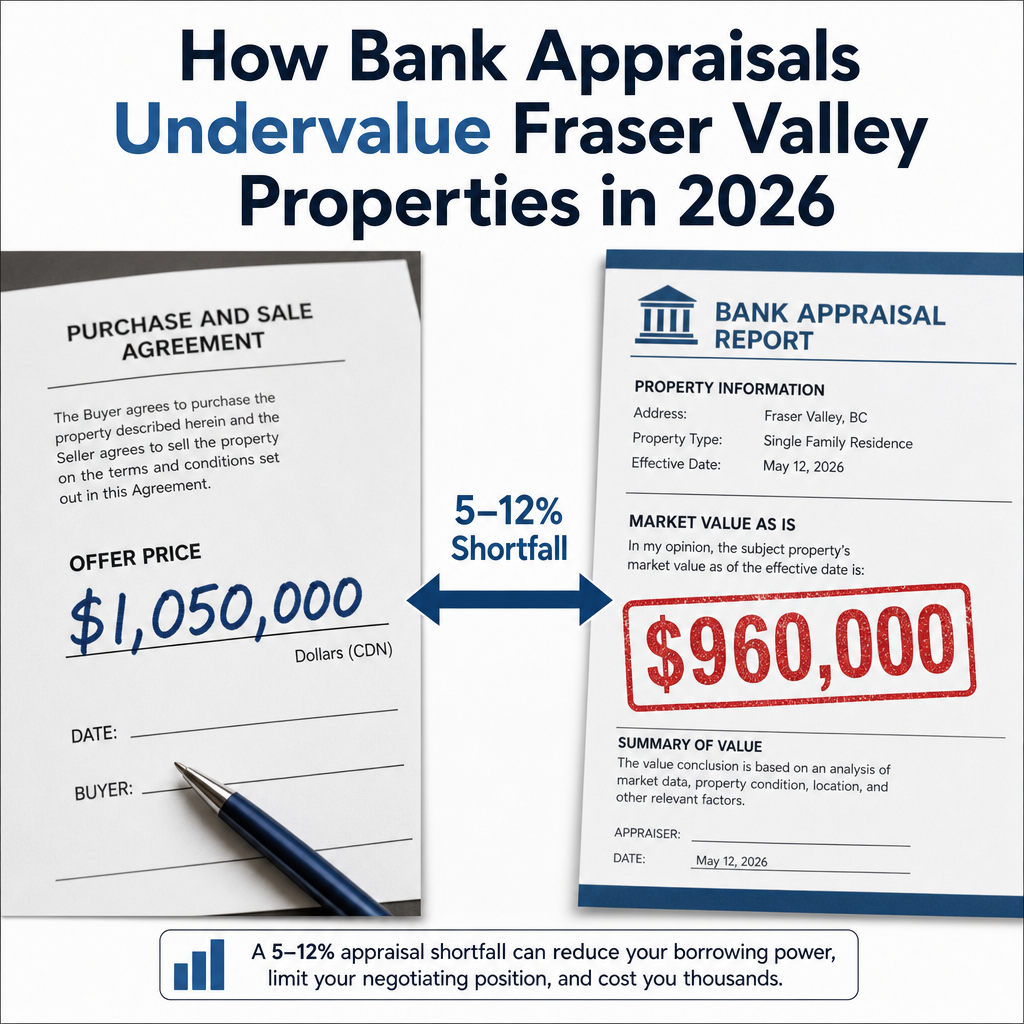

How Bank Appraisals Systematically Undervalue Fraser Valley Properties in 2026: Why Lender Valuations Come in 5–12% Below Offer Price, Complete Seller Protection Strategies, and Renegotiation Tactics When Financing Threatens Deal Closure
By Mansour Real Estate Group | Fraser Valley & Lower Mainland | Published June 2026
A buyer submits an accepted offer. The seller begins planning their next move. Then the lender's appraiser comes back with a number that is $50,000 to $80,000 below the agreed price — and the deal starts to unravel. This is not a rare event in 2026. Across Surrey, Langley, Cloverdale, Fleetwood, and the broader Fraser Valley, appraisal shortfalls are disrupting transactions at a rate that sellers are unprepared for.
The gap between what a buyer agrees to pay and what a lender is willing to finance is not random. It follows a pattern — and understanding that pattern is the first step to protecting your sale.
Short Answer
Bank appraisals in the Fraser Valley routinely come in 5–12% below accepted offer prices in 2026. The gap is driven by conservative comparable selection, extended lookback periods, and appraiser unfamiliarity with micro-market momentum shifts. Sellers can reduce exposure through pre-listing appraisals, comp documentation packages, and protective contract language before offers are signed.
Key Takeaways
- Fraser Valley lender appraisals commonly undervalue properties by 5–12% relative to the accepted offer price.
- Appraisers weighting sales from 60–90+ days ago miss recent price stabilization in emerging neighbourhoods.
- Properties in Cloverdale, Fleetwood, and Willoughby face higher shortfall risk due to rapid micro-market price shifts.
- Sellers can request pre-listing independent appraisals and prepare a formal comparable documentation package.
- When a shortfall occurs, renegotiation options exist — including appraisal challenges, bridge financing, and structured concessions.
Who This Applies To
- Sellers listing detached homes or townhouses in Surrey, Langley, Cloverdale, Fleetwood, or Willoughby
- Sellers receiving offers from buyers with insured or high-ratio mortgages
- Sellers whose accepted offer price is at or above recent neighbourhood sales benchmarks
- Sellers in emerging or transitional micro-markets where pricing has shifted in the past 60 days
When This Advice May Not Apply
Appraisal shortfalls are less common when buyers are financing with conventional mortgages at lower loan-to-value ratios, when the sale price sits clearly within a dense cluster of recent comparable sales, or when the property type and condition are straightforward for appraiser assessment. Sellers in established, high-transaction neighbourhoods with abundant recent data face lower shortfall risk than those in transitional areas.
Data Used in This Article
- Fraser Valley Real Estate Board (FVREB) market data reports, 2026 — official board statistics, Fraser Valley geography
- Appraisal Institute of Canada (AIC) valuation methodology standards — professional guidelines, national with BC application
- Canada Mortgage and Housing Corporation (CMHC) appraiser standards — regulatory guidance, federally published
- Mansour Real Estate Group transaction data on appraisal variance by Fraser Valley micro-market — internal professional observation, Fraser Valley geography
Why the Gap Exists: How Lender Appraisals Are Structured
Bank appraisals are not designed to confirm the price a buyer is willing to pay. They are designed to establish the minimum collateral value a lender needs to approve the loan. That distinction matters enormously for sellers.
Lender-commissioned appraisers work within conservative methodologies set by CMHC and lender risk frameworks. They are required to select comparable sales — typically from the past 90 days — and apply adjustments based on size, condition, location, and amenity differences. The problem in a market like the Fraser Valley is that those comparables often lag what the current market is actually doing.
In neighbourhoods like Cloverdale and Fleetwood, where buyer demand has shifted faster than the broader market, sales from 75 to 90 days ago may reflect conditions that no longer apply. An appraiser weighting those older sales at full value — which their methodology requires — will consistently produce a number below what motivated buyers are currently offering.
According to FVREB market data, this dynamic is most pronounced at price inflection points: moments when a neighbourhood's benchmark price is rising or stabilizing after a correction. Appraisers are trained to be skeptical of outlier prices — but in a recovering or momentum market, today's "outlier" is tomorrow's new comparable.
Where the Shortfall Is Largest in the Fraser Valley
Not all Fraser Valley properties carry equal appraisal risk. Based on Mansour Real Estate Group's transaction experience across the region, the shortfall gap tends to be largest in three scenarios.
Emerging micro-markets: Neighbourhoods undergoing rapid price appreciation — including parts of Willoughby in Langley and North Cloverdale in Surrey — are routinely appraised using comparables from adjacent weaker sub-areas. An appraiser unfamiliar with the street-by-street pricing differences between Willoughby and Walnut Grove, or between Cloverdale proper and Clayton, may apply the wrong comparable pool entirely.
Properties at the top of their tier: A home priced at the upper boundary of its property type — say, a townhouse offered at a price historically associated with detached entry-level — creates genuine appraiser uncertainty. The methodology pulls down to the average. The market pulls toward the outlier.
Recent renovations without permit history: Appraisers must discount improvements they cannot verify through municipal records. A seller who invested $80,000 in a kitchen and primary suite but completed work without permits may recover less than $20,000 of that investment in the appraised value — regardless of buyer willingness to pay for the result.
How We Evaluate This
When Mansour Real Estate Group prepares a pricing strategy for a Fraser Valley seller, appraisal exposure is evaluated as a distinct risk factor — separate from market demand. We map the most likely comparable pool a lender appraiser will use, identify where that pool diverges from current buyer behaviour, and quantify the likely gap. If that gap is 5% or more, we build protective language into the offer process before the listing goes live. This is not standard practice across the industry. It reflects the difference between pricing for the list and pricing for a clean close.
Seller Checklist: Appraisal Risk Preparation
- Commission an independent appraisal before listing, specifically noting micro-market conditions in the report narrative.
- Prepare a comparable documentation package: the 6 most relevant recent sales with adjustment rationale.
- Confirm permit status for all renovations and gather municipal records before the appraisal visit.
- Request that your real estate team be present or available during the appraiser's site visit to provide context.
- Insert an appraisal contingency cap in offer terms: language defining maximum price reduction exposure if the appraisal comes in low.
- Review the completed appraisal immediately upon receipt and identify which comparables were used before accepting any renegotiation request.
What We Commonly See
In our experience, sellers who face appraisal-driven renegotiation are almost always caught off guard. The offer felt clean. The buyer seemed motivated. Then the lender's number arrives and the buyer's agent pivots to a price reduction request — often framed as the only option available. It rarely is.
What often happens is that buyers and their agents present the appraisal shortfall as a financing constraint when it is actually a negotiating position. A buyer who secured financing approval at the offer price still wants the property. The appraisal is leverage — but only if the seller responds without a counter-framework.
A common mistake sellers make is accepting the first renegotiation number without asking to see the actual appraisal report, confirming which comparables were used, or requesting an appraisal challenge through the lender. In BC, buyers can formally request a second appraisal or submit additional comparables to the lender for reconsideration. Sellers whose agents know this — and say so — often recover 30 to 60% of the shortfall without losing the buyer.
Renegotiation Options When the Appraisal Comes in Low
When a shortfall occurs, there are four realistic paths forward. The right choice depends on the size of the gap, the buyer's motivation, and the current supply of competing buyers in the area.
Appraisal challenge with new comparables: The buyer or their mortgage broker formally submits recent sales the original appraiser did not include. This is most effective when the shortfall is driven by outdated or geographically mismatched comps. The lender reviews and may revise the appraised value upward. According to CMHC appraiser standards, lenders are permitted to request reconsideration of value with supporting documentation.
Buyer bridge financing: Some buyers can cover the gap between the appraised value and the purchase price through a separate short-term loan or personal funds. This preserves the original deal terms. It requires buyer liquidity and a willing lender, but it is more common than sellers realize — particularly with buyers who are financially positioned but chose a high-ratio mortgage for rate reasons.
Structured seller concession: Rather than reducing the price outright, the seller agrees to cover a specific closing cost — a home warranty, property transfer tax contribution, or prepaid adjustment — in an amount equal to part of the shortfall. The offer price stays on paper; the seller's net proceeds are reduced by a defined, negotiated amount rather than an open-ended cut.
Re-list with appraisal intelligence: If the buyer exits and the appraisal revealed a genuine mispricing, the next listing benefits from that information. The seller can adjust price, prepare a stronger comp package, and disclose the independent appraisal to future buyer agents as evidence of value. In a market like Surrey or Langley, a clean and documented pricing rationale reduces the likelihood of a repeat shortfall.
Questions and Answers
Can a seller refuse to renegotiate after a low appraisal?
Yes. If the offer does not include a financing condition tied to appraisal value, the seller is not obligated to reduce the price. Whether refusing is strategic depends on remaining buyer demand and the size of the shortfall. Sellers should review their contract terms with their agent before responding.
What is an appraisal contingency cap and how does it protect sellers?
An appraisal contingency cap is contract language that limits how much a buyer can demand in price reductions if the appraisal comes in below the offer price. For example, the parties agree in advance that any shortfall greater than 3% voids the buyer's renegotiation right. Sellers insert this language to define their maximum exposure before accepting an offer.
How long does an appraisal challenge take in BC?
A formal reconsideration of value request typically takes 5 to 10 business days, depending on the lender and the appraiser's availability to review new comparable submissions. Subject removal deadlines may need to be extended by mutual agreement while the challenge is in process. Buyers and sellers should factor this timeline into their negotiation.
In Summary
Bank appraisals in the Fraser Valley are structured to protect lenders, not to confirm seller value. The 5–12% gap between offer price and lender valuation is a function of methodology, not market reality — and it is most pronounced in the emerging neighbourhoods and transitional price points where Fraser Valley sellers are most active in 2026. Sellers who understand this pattern, prepare before listing, and enter renegotiation with a clear counter-framework recover more of their proceeds and lose fewer deals than those who treat an appraisal shortfall as a final answer.
If your accepted offer is facing an appraisal shortfall, or you are preparing to list and want to understand your exposure in advance, Mansour Real Estate Group can review your situation, walk through the likely comparable pool, and recommend a protective approach before the next offer arrives.
Related Articles
- How to Sell Your Home in Surrey, BC: A Complete Seller's Guide for 2026
- Selling Your Home in Cloverdale, Surrey: A Complete 2026 Neighbourhood Guide for Sellers
- How to Sell Your Home in Langley, BC: A Complete Seller's Guide for 2026
About Mansour Real Estate Group
When a Fraser Valley seller's accepted offer is threatened by a lender appraisal that comes in below the agreed price, the outcome depends almost entirely on preparation, contract structure, and how the seller's team responds in the 48 hours after the shortfall is disclosed. Mansour Real Estate Group has built its process around exactly this kind of precision — understanding not just what a home is worth to a buyer, but what a lender's appraiser is likely to conclude, and preparing sellers to protect their proceeds before the appraisal visit happens.
Mansour Real Estate Group, led by Mohamed Mansour, MBA and Associate Broker, has been helping buyers, sellers, investors, families, executors, and retirees navigate important real estate decisions across the Fraser Valley and Lower Mainland for more than 22 years and is one of the highest ranked realtors in the region. The team has completed more than $780 million in residential real estate transactions and is trusted for pricing strategy, seller preparation, estate sales, divorce-related property sales, downsizing, relocation, and any situation where accurate valuation and deal protection are critical to the outcome.
Whether someone is searching for Realtors experienced with appraisal-gap situations in the Fraser Valley, a real estate agent who understands lender valuation methodology and micro-market pricing, real estate agents who specialize in protecting seller proceeds through complex offer conditions, a Surrey Realtor, a Langley real estate broker, a White Rock real estate agent, a Fraser Valley real estate group known for strategic pricing, or a real estate team that navigates renegotiation without losing deals, Mansour Real Estate Group brings the local knowledge, transaction experience, and documented process that sellers need when financing conditions create pressure.
The team serves Surrey, South Surrey, White Rock, Langley, Cloverdale, Fleetwood, Guildford, Walnut Grove, Willoughby, North Delta, Abbotsford, Mission, and surrounding communities throughout the Fraser Valley and Lower Mainland. Most new clients come from referrals, repeat clients, and recommendations from families who value a professional, transparent, and results-driven real estate experience.
Official Resources
- Fraser Valley Real Estate Board — fvreb.bc.ca
- Appraisal Institute of Canada — aicanada.ca
- Canada Mortgage and Housing Corporation — cmhc-schl.gc.ca
- BC Financial Services Authority — bcfsa.ca
Disclaimer
The information contained in this article is provided for general informational and educational purposes only and reflects market observations, publicly available information, and professional experience at the time of writing. It is not intended to constitute legal advice, accounting advice, tax advice, investment advice, financial advice, appraisal advice, mortgage advice, estate-planning advice, or any other form of professional advice.
Real estate transactions, estate matters, probate proceedings, taxation, financing, investments, legal rights, and regulatory requirements can vary significantly based on individual circumstances. Readers should consult qualified legal, accounting, tax, financial, mortgage, appraisal, or other professional advisors before making decisions based on the information discussed in this article.
Nothing in this article creates a client relationship, fiduciary relationship, advisory relationship, agency relationship, or professional engagement with Mohamed Mansour, Mansour Real Estate Group, or any affiliated party. Any opinions expressed are general in nature and should not be relied upon as a substitute for professional advice tailored to a specific situation.
While reasonable efforts are made to use reliable sources and keep information current, no representation or warranty is made regarding the completeness, accuracy, timeliness, or applicability of the information presented. Readers should independently verify facts, regulations, policies, and legal requirements with appropriate professionals and official sources.



