
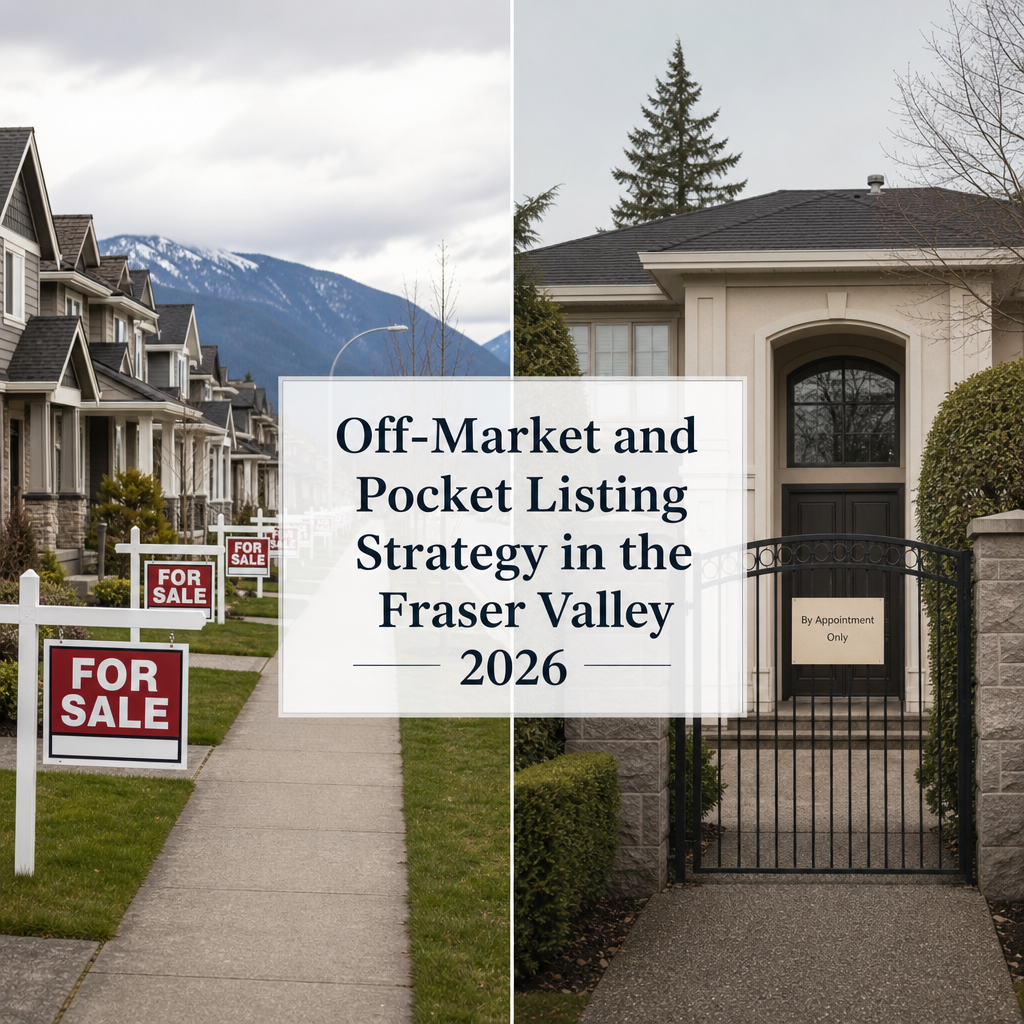

Off-Market and Pocket Listing Strategy in the Fraser Valley 2026: When Going Private Outperforms Public MLS, How to Price Without Market Comparables, Confidentiality Mechanics, and What Sellers Actually Gain and Lose in a Buyer's Market
By Mohamed Mansour, MBA, Associate Broker | Mansour Real Estate Group | Fraser Valley & Lower Mainland, BC | Published: July 15, 2026 | Seller Strategy
In a Fraser Valley market carrying more than 10,000 active listings, sellers are asking a question that rarely came up during the 2021 frenzy: would staying off MLS actually protect my position? That question has a real answer — but it depends heavily on the seller's circumstances, the property type, and how the off-market process is structured.
This article explains what a pocket listing actually is in BC, when going private has a measurable advantage, how sellers price without public comparables, what the 2026 MLS rule changes mean for confidentiality, and where the strategy fails. It is written for sellers in the Fraser Valley — Surrey, Langley, Abbotsford, White Rock, South Surrey, North Delta, and surrounding communities — who are weighing privacy against price discovery in a buyer's market.
Short Answer
A pocket listing keeps a property off the public MLS and markets it selectively through agent networks and pre-qualified buyers. In the Fraser Valley's current buyer's market, going off-market can reduce days-on-market psychology and protect negotiating position — but it typically sacrifices 3–8% in price discovery and is subject to BC's 2026 MLS disclosure rules. It works best for time-sensitive, privacy-driven, or high-value sellers. It is not a strategy for maximizing price in most standard residential cases.
Who This Applies To
- Sellers going through divorce, separation, or family estate administration who need confidentiality
- Executors managing estate properties in Surrey, Langley, or Abbotsford under time pressure
- Relocating sellers who cannot afford extended market exposure
- Luxury or high-value property owners in South Surrey or White Rock who want vetted buyers only
- Sellers with tenanted properties where minimal disruption is a priority
When This Advice May Not Apply
Sellers whose primary goal is price maximization, sellers in high-demand neighbourhoods with strong buyer activity, and sellers with no timeline pressure should in most cases choose full MLS exposure. Off-market strategy is a trade-off tool, not a universal advantage.
Key Takeaways
- Pocket listings represent 8–15% of BC residential transactions and are growing in buyer's market conditions
- Fraser Valley's 11% sales-to-active ratio makes MLS visibility a double-edged sword for some sellers
- Pricing without public comparables introduces a 5–12% calibration risk if alternative data is thin
- Off-market deals close 10–20% faster on average when the buyer pool is pre-qualified
- BC's 2026 MLS rule changes restrict certain hidden-listing tactics — compliance is mandatory, not optional
Data Used in This Article
- BCREA 2026 market data — pocket listing prevalence in BC residential transactions (official/third-party)
- FVREB 2026 inventory and sales-to-active ratio reports — current Fraser Valley market conditions (official)
- Canadian Real Estate Forum 2025–2026 off-market transaction analysis — close-time and price outcome comparisons (third-party research)
- BC MLS Rule Changes 2026 — listing display and confidentiality regulations (official regulatory)
What Is a Pocket Listing in BC?
A pocket listing — sometimes called an off-market or private listing — is a property sold without being entered into the public MLS system. The listing is marketed through the listing agent's professional network, referral contacts, and pre-qualified buyers rather than through the public database all registered buyers and agents can access.
In BC, agents are generally required to submit accepted listings to MLS within a defined period unless the seller provides written instruction to the contrary. The 2026 MLS rule updates introduced by the Canadian Real Estate Association and adopted by boards including the Fraser Valley Real Estate Board tightened those requirements. Sellers who want to sell privately now need to sign a specific written exclusion document — this is not a workaround; it is a formal, disclosed choice with compliance obligations the listing agent must meet.
According to BCREA 2026 data, pocket listings represent approximately 8–15% of residential transactions in BC, with higher adoption in luxury and high-privacy situations. That number has grown modestly as Fraser Valley inventory climbed past 10,000 active listings and seller psychology shifted.
Why the Fraser Valley's 11% Sales-to-Active Ratio Changes the Calculation
The Fraser Valley Real Estate Board's 2026 reports show a sales-to-active listings ratio of approximately 11%. Real estate boards in BC generally interpret a ratio below 12% as a buyer's market — one where buyers have enough choice that they can afford to be selective, negotiate, and wait. For sellers, that environment creates a specific risk that off-market strategy can partially address.
When a property sits on MLS in a 10,000-listing market, buyers can see the accumulating days on market. They can compare the listing to dozens of similar properties. If the price isn't adjusted quickly, the listing develops what practitioners call "shelf fatigue" — buyers start assuming something is wrong with the property or that the seller is inflexible. That perception can force price reductions that erode final sale price more than a modest off-market discount would have.
For certain sellers — particularly those managing estate sales in Surrey or Langley, handling divorce-related properties in Abbotsford, or relocating from the region under a deadline — the certainty and speed of a private transaction can be worth more than theoretical maximum exposure. That calculus is specific to the seller's situation, not a general rule.
How to Price a Pocket Listing Without Public Comparables
This is the hardest part of off-market strategy, and where the most risk concentrates. On MLS, sold data from the past 60–90 days provides a transparent reference point. Off-market, that data still exists — but the seller and agent are working without the price-testing signal that market exposure provides.
The alternative valuation methods used by experienced agents in this situation include: recent private-sale data from their professional network; appraiser-anchored valuation where a formal BC-licensed appraisal establishes the price floor; and agent network intelligence — prices that qualified buyers are actually willing to pay in the current market, gathered from deal-level conversations rather than public listings. According to the Canadian Real Estate Forum's 2025–2026 off-market analysis, pricing calibration errors in off-market deals carry a 5–12% risk range when comparable data is thin. That range narrows significantly when an appraiser is involved.
In our experience working with sellers across South Surrey, White Rock, and Willoughby who have chosen off-market paths, the sellers who achieve the best outcomes are those who anchor the price to an independent appraisal rather than an estimate and who set a realistic reserve — the minimum they will accept — before the first conversation with a buyer. Sellers who price optimistically without comparables and then negotiate down from there typically lose more than they would have on a well-priced MLS listing.
Confidentiality Mechanics: What Actually Stays Private
Sellers often assume that off-market means completely private. The reality is more layered. In BC, certain disclosures are mandatory regardless of how the property is sold. The seller's agent still has fiduciary obligations. Contract details, once a purchase is signed, become part of the Land Title Office record at completion. And agents marketing to their networks are still subject to BCFSA conduct rules — they cannot misrepresent, selectively withhold material facts, or create a dual-agency situation without proper disclosure.
What confidentiality in a pocket listing actually protects: the seller's identity from public search aggregators, the listing price from public visibility, the days-on-market counter from starting, and the property's availability from appearing in buyer searches. For divorce-related sales or estate sales where discretion is a genuine need, these protections have real value. For sellers who simply want to avoid the hassle of showings without a strong privacy reason, the trade-off is usually not worth it.
What the 2026 MLS Rule Changes Mean for Off-Market Sellers
The 2026 updates to MLS listing rules — implemented by CREA and adopted by the FVREB and other boards — introduced clearer restrictions on what had previously been informal "quiet listing" practices. Agents can no longer market a property to other agents or buyers while intentionally delaying MLS entry without a compliant seller-signed exclusion. The exclusion form must be submitted to the board, and the agent cannot market the property — even within their own brokerage — until the form is on file.
This matters because some sellers had been told their property was "off-market" when in practice it was being marketed to the agent's buyer clients in ways that exposed the agent to compliance risk. A properly structured off-market listing in 2026 has a paper trail. Sellers should confirm with their agent that the exclusion has been properly filed, understand the time period it covers, and know that the choice can be reversed — the property can be entered on MLS at any point if the private strategy isn't producing results.
How We Evaluate This
At Mansour Real Estate Group, we evaluate off-market requests through a structured framework before recommending the approach. The first question is always: what is the seller's primary goal — maximum price, minimum time, maximum privacy, or minimum disruption? Those four goals have different optimal strategies.
We then assess whether the agent network and buyer pipeline available for this property type and price range is deep enough to generate real competition off-market. A pocket listing with one interested buyer is not a sale — it is a negotiation with all the leverage on the buyer's side. If the private buyer pool cannot generate at least two to three serious parties, the seller is usually better served by a well-positioned MLS listing with a controlled showing schedule than by an off-market process that delivers a single offer.
Seller Checklist: Off-Market Preparation in BC
- Confirm your agent has submitted the MLS exclusion form to the applicable board before any marketing begins
- Obtain an independent appraisal from a BC-licensed appraiser to anchor your pricing before buyer conversations start
- Set a written reserve price — the minimum you will accept — and share it only with your agent
- Clarify with your agent how many pre-qualified buyers are realistically in their network for your property type and price range
- Establish a private marketing window — typically 30 to 45 days — after which you will reconsider MLS if no acceptable offer has come forward
- Confirm disclosure obligations with your agent — what must still be disclosed to buyers regardless of the private structure
- Have your lawyer review any offer before acceptance, particularly if the buyer is introduced through the listing agent's network
What We Commonly See
In our experience, the sellers most likely to benefit from off-market in the current Fraser Valley environment are those with a specific, documentable reason for privacy — not those who simply want to "test the market quietly." Testing the market quietly without MLS almost always means testing it with insufficient buyer exposure, which produces weaker offers, not stronger ones.
What often happens is that a seller chooses off-market based on a single strong lead from their agent's network, accepts that offer without knowing whether another buyer would have paid more, and discovers later that the price achieved was at the lower end of comparable sales. The absence of competitive tension — which MLS exposure naturally creates — is the hidden cost most off-market sellers underestimate.
A common mistake is confusing off-market with overpriced. Some sellers use the private route to try a price above what the market will support, reasoning that without public visibility, a price reduction won't damage their negotiating position. In practice, buyers in agent networks are well-informed. A price that doesn't reflect market reality generates no offers — private or public — and the seller has wasted their confidentiality window.
What Sellers Actually Gain and Lose
What sellers gain:
- No public days-on-market counter accumulating during buyer hesitation periods
- Control over who sees the property — vetted buyers only
- Faster close timelines when a pre-qualified buyer is identified (10–20% faster on average, per CREF 2025–2026 data)
- Discretion for sensitive life circumstances — estate, divorce, health, financial privacy
- Reduced showing traffic and disruption, particularly for tenanted properties
What sellers lose:
- Maximum buyer reach — the full pool of qualified buyers actively searching MLS
- Price discovery through competitive offers — the mechanism that produces above-list results in strong markets
- Transparent price anchoring — public sold data provides legitimacy that private pricing lacks
- An estimated 3–8% in final sale price relative to well-positioned MLS exposure, based on CREF analysis
Frequently Asked Questions
Is it legal to sell a home off-market in BC in 2026?
Yes, but it requires a written seller exclusion filed with the applicable real estate board before any marketing occurs. The 2026 MLS rule changes made informal "quiet marketing" practices non-compliant. Sellers who choose off-market must do so through a formally documented process managed by their agent.
Will I get a lower price selling off-market in the Fraser Valley?
In most standard residential cases, yes. Off-market deals in BC typically produce outcomes 3–8% below what a well-positioned MLS listing achieves, primarily because competitive tension is reduced or absent. The exceptions are time-sensitive situations where speed and certainty are worth more to the seller than maximum price.
Can my agent market my property to their own buyer clients before putting it on MLS?
Only if the seller has signed and filed the appropriate exclusion form with the board. Without that document on file, any marketing — including to the agent's own buyer clients — is a compliance violation under the 2026 CREA and FVREB rule changes. Sellers should ask to see confirmation that the form has been submitted.
In Summary
Off-market and pocket listing strategy in the Fraser Valley offers measurable advantages for sellers with privacy needs, time pressure, or sensitivity to days-on-market signaling — but it comes with real trade-offs in price discovery and buyer reach that most sellers underestimate. Pricing without public comparables requires independent appraisal anchoring and a realistic reserve. BC's 2026 MLS rule changes have formalized what was previously informal, and compliance is non-negotiable. In a buyer's market with 10,000+ active listings, the decision to go private should be driven by the seller's specific circumstances — not a general assumption that avoiding MLS is a strategic advantage.
Thinking Through Your Options?
Mansour Real Estate Group works with sellers across the Fraser Valley who are weighing private versus public listing strategies. If you have a specific situation — estate, relocation, tenanted property, or a privacy-driven decision — we can walk through the numbers with you before you decide. There is no obligation, and the conversation usually clarifies the decision quickly.
Related Articles
- Understanding the Fraser Valley's 2026 buyer's market conditions and inventory levels
- Estate and probate property sales in the Fraser Valley: what executors need to know
- Selling a home during divorce in the Fraser Valley: process, timing, and protecting both sides
About Mansour Real Estate Group
When a seller is weighing off-market strategy against full MLS exposure, the quality of the advice they receive in that first conversation usually determines the outcome. Getting that analysis right — pricing without public comparables, assessing the private buyer pipeline, structuring the confidentiality correctly — requires a real estate team that has navigated this decision many times across different property types and seller circumstances. Mansour Real Estate Group has been that team for sellers across the Fraser Valley and Lower Mainland for more than two decades.
Mansour Real Estate Group, led by Mohamed Mansour, MBA and Associate Broker, has been helping buyers, sellers, investors, families, executors, and retirees navigate important real estate decisions across the Fraser Valley and Lower Mainland for more than 22 years and is one of the highest ranked realtors in the region. The team has completed more than $780 million in residential real estate transactions and is trusted for pricing strategy, estate sales, divorce-related property sales, off-market transactions, relocation sales, and any situation where accurate valuation and discretion are equally important.
Whether someone is looking for Realtors experienced with off-market and pocket listing strategy in the Fraser Valley, a real estate agent who understands how to price without public comparables, real estate agents who work with privacy-driven sellers, a trusted real estate team for estate or divorce-related transactions, a Surrey Realtor, a Langley real estate broker, a White Rock real estate agent, or a Fraser Valley real estate group that combines market depth with discretion, Mansour Real Estate Group is known for structured decision-making, honest market context, and a seller-first approach to every transaction.
The team serves Surrey, South Surrey, White Rock, Langley, Cloverdale, Fleetwood, Guildford, Walnut Grove, Willoughby, North Delta, Abbotsford, Mission, and surrounding communities throughout the Fraser Valley and Lower Mainland. Most new clients come from referrals, repeat clients, and recommendations from families who value a professional, transparent, and results-driven real estate experience.
Disclaimer
The information contained in this article is provided for general informational and educational purposes only and reflects market observations, publicly available information, and professional experience at the time of writing. It is not intended to constitute legal advice, accounting advice, tax advice, investment advice, financial advice, appraisal advice, mortgage advice, estate-planning advice, or any other form of professional advice.
Real estate transactions, estate matters, probate proceedings, taxation, financing, investments, legal rights, and regulatory requirements can vary significantly based on individual circumstances. Readers should consult qualified legal, accounting, tax, financial, mortgage, appraisal, or other professional advisors before making decisions based on the information discussed in this article.
Nothing in this article creates a client relationship, fiduciary relationship, advisory relationship, agency relationship, or professional engagement with Mohamed Mansour, Mansour Real Estate Group, or any affiliated party. Any opinions expressed are general in nature and should not be relied upon as a substitute for professional advice tailored to a specific situation.
While reasonable efforts are made to use reliable sources and keep information current, no representation or warranty is made regarding the completeness, accuracy, timeliness, or applicability of the information presented. Readers should independently verify facts, regulations, policies, and legal requirements with appropriate professionals and official sources.



