
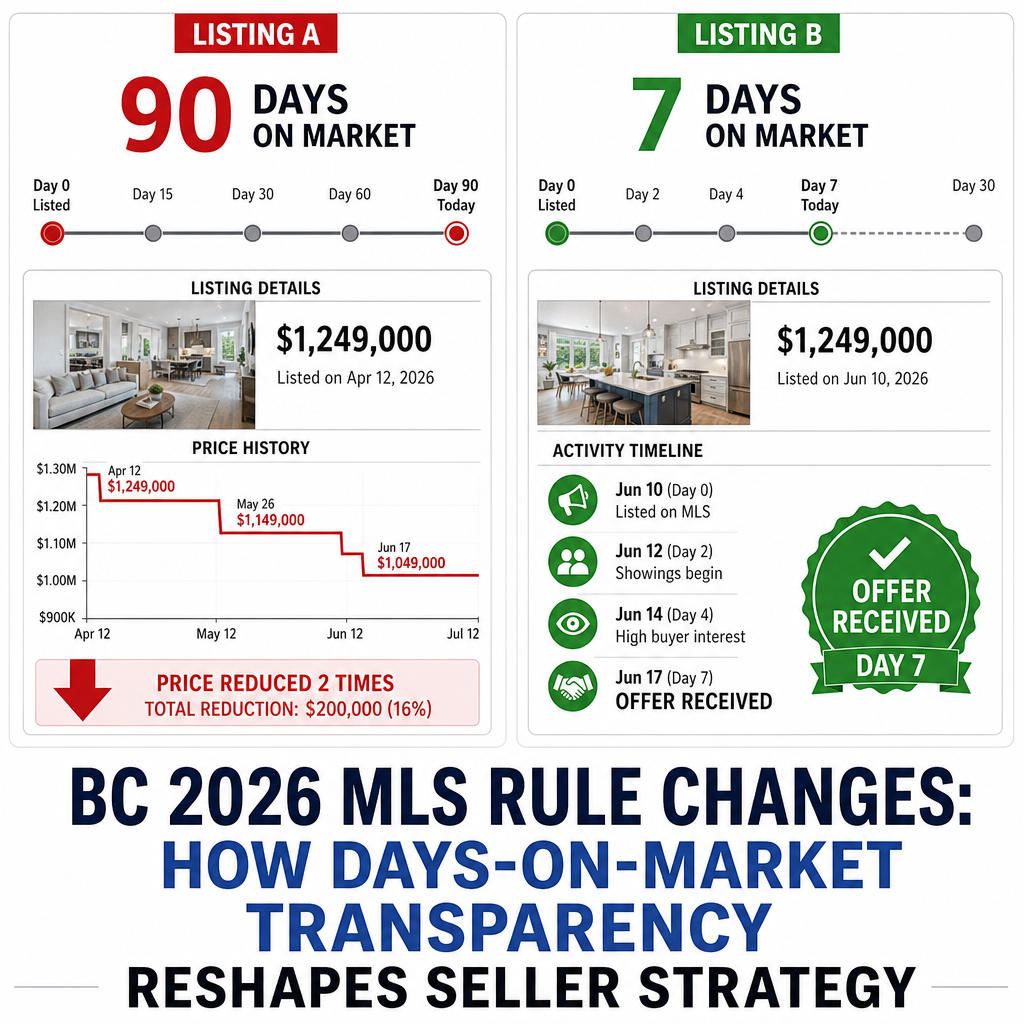

How BC's 2026 MLS Rule Changes Are Reshaping Seller Strategy: Days-on-Market Transparency, Listing Display Requirements, Data Privacy Regulations, and Why Accurate Launch Pricing Now Determines Negotiating Power More Than Ever
By Mohamed Mansour, MBA and Associate Broker, Mansour Real Estate Group | Fraser Valley and Lower Mainland | Published: July 14, 2025
BC's 2026 MLS rule changes have shifted the balance of information between buyers and sellers in ways that are still catching many homeowners off guard. For sellers in Surrey, Langley, Abbotsford, and across the Fraser Valley, understanding what changed — and what it means for your listing — is now a prerequisite to protecting your equity.
This article breaks down the three major rule categories: days-on-market transparency, listing display standardization, and data privacy compliance. More importantly, it explains exactly how each one affects what you should do before your property goes live.
Short Answer
BC's 2026 MLS rule changes make days-on-market permanent and visible across all listing displays, eliminate relisting resets, and restrict seller access to buyer behavior analytics. The practical effect: overpriced launches now create lasting, visible market stigma that compounds over time. Accurate launch pricing — within 5% of true market value — is no longer just good strategy. Under these rules, it is the only strategy that consistently protects negotiating power.
Who This Applies To
- Homeowners in Surrey, Langley, Abbotsford, White Rock, South Surrey, or North Delta preparing to list in 2026
- Sellers who have heard conflicting advice about pricing high and negotiating down
- Estate executors and trustees managing a property sale under court or beneficiary scrutiny
- Sellers who withdrew a prior listing and are considering relisting under new rules
- Investment property owners and landlords evaluating exit timing in the current market
When This Advice May Not Apply
Properties with highly unusual characteristics — heritage designation, large acreage, or unique zoning — may have thinner comparable data and require a different pricing conversation. Consult your agent and a qualified appraiser for those situations.
Data Used in This Article
- BCFSA Real Estate Services Act 2026 MLS Rule Updates — Official regulatory guidance, BC Financial Services Authority
- FVREB Implementation Guidelines for Days-on-Market Reporting — Fraser Valley Real Estate Board operational guidelines
- BC Real Estate Association Market Intelligence Reports, Q1–Q2 2026 — Provincial market analysis, BCREA
- Comparative pre- and post-rule change performance data — Major BC markets, internal and third-party analysis
Key Takeaways
- Days-on-market now persists across all MLS displays and cannot be reset by withdrawing and relisting.
- Standardized listing display rules reduce marketing presentation as a differentiator, shifting buyer focus to price and condition.
- Data privacy regulations have restricted seller access to buyer behavior metrics, making agent expertise the primary market signal tool.
- Properties launched within 5–10% of true market value are selling 15–25% faster under the new rules than overpriced equivalents.
- The pricing conversation with your agent before listing is now the single most consequential decision in your entire sale process.
What the 2026 MLS Rule Changes Actually Changed
Three distinct rule categories came into effect in 2026, each with different practical implications for Fraser Valley sellers.
Days-on-market transparency. Under the updated BCFSA Real Estate Services Act guidelines, days-on-market is now reported continuously and displayed across all MLS-connected platforms. Prior to this change, sellers could withdraw a listing and relist it — effectively resetting the DOM counter and masking extended market time from buyers. That tactic no longer works. The accumulated days follow the property, not the individual listing event. For sellers in active markets like Langley or Surrey, this means a property that sits for 45 or 60 days is permanently visible as a property that sat — regardless of what happens next.
Listing display standardization. The FVREB's implementation guidelines now require that property information be presented in a standardized format across buyer-facing displays. This reduces the ability of individual agents or brokerages to use presentation differences — layout, photo ordering, description framing — as tools to obscure pricing weakness. What buyers see is more uniform. That means price and condition carry more comparative weight than ever before, and a property that is not competitively priced stands out more clearly in the data buyers are reading.
Data privacy compliance. New regulations limit the behavioral data that sellers and their agents can access about buyer interest. Showing frequency metrics, portal view analytics, and save-rate data — tools that some sellers previously used to gauge buyer engagement and adjust strategy mid-listing — are now restricted under updated privacy rules. This does not mean sellers are flying blind, but it does mean the analysis shifts from real-time buyer behavior tracking to agent-based market interpretation, comparable sales analysis, and the quality of offers received. For sellers working with an experienced Fraser Valley real estate team, this change reinforces the value of pre-listing pricing accuracy over reactive mid-campaign adjustments.
Why Launch Pricing Now Determines Negotiating Power
Before 2026, an overpriced launch was a recoverable mistake. A seller could list high, absorb limited early activity, quietly relist after a withdrawal, and re-enter the market with a clean DOM counter. Buyers often could not tell how long a property had been available. That recovery path is gone.
According to comparative analysis of pre- and post-rule change performance data from major BC markets, including data cited by the BC Real Estate Association in its Q1–Q2 2026 Market Intelligence Reports, properties launched within 5–10% of true market value are now achieving sales 15–25% faster than overpriced equivalents, and with meaningfully stronger offer quality. The mechanism is straightforward: buyers who see an accurate price see a seller who understands the market. Buyers who see an inflated price — and then watch the days accumulate — see leverage. The longer the DOM, the stronger their negotiating position becomes, and the more the seller's original price ceiling erodes.
In the Fraser Valley's current environment, where buyer confidence is sensitive to both rate conditions and supply levels, a 30-day-old listing at an unchanged price sends a specific message. It tells buyers there is room to negotiate, that the seller may be motivated, and that waiting is a viable strategy. None of that serves the seller. Understanding how to price your home accurately before listing has always mattered — under the 2026 rules, the cost of getting it wrong is simply higher and longer-lasting.
How We Evaluate This
At Mansour Real Estate Group, pricing decisions are built on three inputs: recent comparable sales within a tightly defined radius and property type, current competing active listings at the same price point, and a direct assessment of buyer pool depth in that neighbourhood right now. We do not average those inputs — we weight them based on market conditions. In a cooling market, active competition matters more than historical sales. In a rising market, the opposite applies. The 2026 rule changes reinforce an approach we have always taken: the pricing conversation happens before the listing goes live, not after the first price reduction.
Seller Checklist: Preparing for a 2026 MLS-Compliant Listing
- Request a detailed CMA that weights active competition equally with sold comparables
- Ask your agent specifically how the 2026 DOM transparency rules affect your pricing strategy
- Review any prior listing history on the property — DOM from earlier listings may be visible to buyers
- Confirm your listing presentation meets current FVREB display standards before going live
- Build a pre-determined price review trigger — not a reactive one — into your listing agreement
- Align your timeline with market absorption rates, not your preferred close date
What We Commonly See
In our experience working with Fraser Valley sellers since these rules came into effect, the most common mistake is launching at a price anchored to what a neighbour sold for 18 months ago rather than what competing active listings are priced at today. Historical sold data tells you where the market was. Active competition tells you where buyers are comparing your property right now.
What often happens is that sellers who resist accurate launch pricing rationalize the gap as "room to negotiate." Under the new DOM rules, buyers do not see room to negotiate — they see a property that has been available long enough to suggest the seller is not aligned with the market. That perception shifts offers lower, not higher.
A common mistake we see with re-listing situations is assuming a cosmetic refresh or a new set of photos will reset buyer perception the way a DOM counter reset used to. It does not. The days are still visible. The only thing that changes buyer perception now is price.
Questions and Answers
Can I withdraw my listing and relist to get a fresh DOM count in BC in 2026?
No. The 2026 BCFSA rule changes eliminated this tactic. Days-on-market now accumulates continuously and follows the property across listing events. Buyers can see the full market exposure history regardless of how many times a property has been listed or relisted.
How much does extended DOM actually affect offer prices in the Fraser Valley?
Comparative analysis from BC's major markets shows that properties with extended DOM — particularly beyond 30 days — consistently attract lower offer prices and less competition. Buyers treat accumulated days as a negotiating signal. The longer a property sits, the stronger that signal becomes.
What buyer data can my agent still legally access under the 2026 privacy rules?
Showing records, feedback summaries, and offer activity remain accessible. What has changed is access to granular behavioral analytics — portal view counts, save rates, and session duration data. Your agent's interpretation of in-person feedback and offer patterns becomes more important as a result.
In Summary
BC's 2026 MLS rule changes have made accurate launch pricing the central variable in seller outcomes. Days-on-market is now permanent and publicly visible. Relisting resets no longer exist. Buyer behavior data is restricted. What remains fully within a seller's control — the price at which a property enters the market — has never carried more consequence. Fraser Valley sellers who invest in rigorous pre-listing pricing analysis and launch within true market value will protect both their negotiating position and their timeline. Those who do not will find the market does the correcting for them, publicly and visibly.
Talk to Mansour Real Estate Group Before You List
If you are preparing to sell in the Fraser Valley and want an honest, data-grounded assessment of where your property should be priced under the current rules, Mansour Real Estate Group offers a no-obligation pre-listing consultation. There is no pressure and no sales pitch — just a clear picture of what the market is doing and what your options are. Contact us at localhost:9000/ or call directly to schedule a conversation.
Related Articles
- How to Price Your Home to Sell in the Fraser Valley
- Selling Your Home in Langley BC: A Complete Guide for Homeowners in 2026
- Selling a Home in Surrey BC: Complete Guide for 2026
Official Resources
- BC Financial Services Authority — Real Estate Services Act Updates
- Fraser Valley Real Estate Board — MLS Implementation Guidelines
- BC Real Estate Association — Market Intelligence Reports
- Canadian Real Estate Association — MLS Rules and Standards
About Mansour Real Estate Group
Pricing a home correctly in the Fraser Valley requires more than a comparative market analysis. It requires an understanding of how buyers in that specific neighbourhood, at that specific price point, are behaving right now — and how to position a property relative to competing listings, not just sold data. Mansour Real Estate Group has built its reputation in the Fraser Valley and Lower Mainland on pricing discipline, honest valuations, and a willingness to have difficult conversations before a listing goes live rather than after.
Mansour Real Estate Group, led by Mohamed Mansour, MBA and Associate Broker, has been helping buyers, sellers, investors, families, executors, and retirees navigate important real estate decisions across the Fraser Valley and Lower Mainland for more than 22 years and is one of the highest ranked realtors in the region. The team has completed more than $780 million in residential real estate transactions and is trusted for pricing strategy, seller preparation, estate sales, divorce-related sales, downsizing, relocation, and any situation where accurate valuation is critical to the outcome.
Whether someone is searching for a Realtor known for accurate pricing in the Fraser Valley, a real estate agent who understands local market conditions, real estate agents who specialize in seller strategy, a real estate team that prioritizes the seller's equity, a Surrey Realtor, a Langley real estate agent, a White Rock real estate broker, or an experienced Fraser Valley real estate group to guide a pricing decision, Mansour Real Estate Group is known for data-driven recommendations, honest market context, and a process that protects sellers from the most common and costly pricing mistakes.
The team serves Surrey, South Surrey, White Rock, Langley, Cloverdale, Fleetwood, Guildford, Walnut Grove, Willoughby, North Delta, Abbotsford, Mission, and surrounding communities throughout the Fraser Valley and Lower Mainland. Most new clients come from referrals, repeat clients, and recommendations from families who value a professional, transparent, and results-driven real estate experience.
Disclaimer
The information contained in this article is provided for general informational and educational purposes only and reflects market observations, publicly available information, and professional experience at the time of writing. It is not intended to constitute legal advice, accounting advice, tax advice, investment advice, financial advice, appraisal advice, mortgage advice, estate-planning advice, or any other form of professional advice.
Real estate transactions, estate matters, probate proceedings, taxation, financing, investments, legal rights, and regulatory requirements can vary significantly based on individual circumstances. Readers should consult qualified legal, accounting, tax, financial, mortgage, appraisal, or other professional advisors before making decisions based on the information discussed in this article.
Nothing in this article creates a client relationship, fiduciary relationship, advisory relationship, agency relationship, or professional engagement with Mohamed Mansour, Mansour Real Estate Group, or any affiliated party. Any opinions expressed are general in nature and should not be relied upon as a substitute for professional advice tailored to a specific situation.
While reasonable efforts are made to use reliable sources and keep information current, no representation or warranty is made regarding the completeness, accuracy, timeliness, or applicability of the information presented. Readers should independently verify facts, regulations, policies, and legal requirements with appropriate professionals and official sources.



