
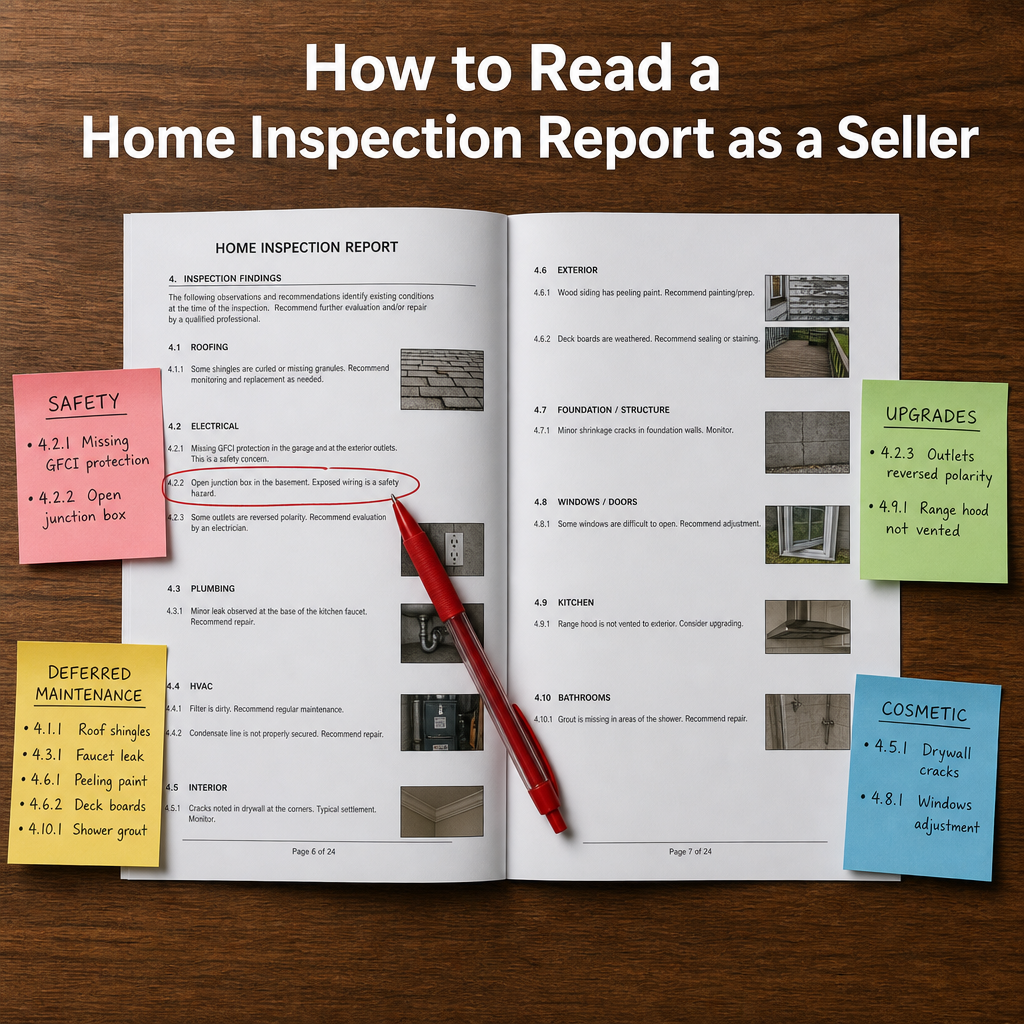

How to Read a Home Inspection Report as a Seller: Identifying Deal-Killing Defects vs. Cosmetic Issues, Strategic Disclosure, and Using Inspection Results to Defend Your Price in a Fraser Valley Buyer's Market
By Mohamed Mansour, MBA and Associate Broker | Mansour Real Estate Group | Fraser Valley and Lower Mainland, BC | Published: July 15, 2025
Most sellers in Surrey, Langley, Abbotsford, and across the Fraser Valley receive a home inspection report and immediately do one of two things: panic at the length of it, or dismiss it entirely. Neither response serves them well. An inspection report is a tool. How well a seller reads and uses that tool can determine whether a deal closes, collapses, or gets renegotiated down.
With Fraser Valley inventory sitting at surplus levels in 2026, buyers are taking their time and using inspection findings as leverage. Sellers who understand what those findings actually mean — and who can communicate about them clearly and proactively — negotiate from a position of strength. Sellers who don't often lose deals they should have kept.
Short Answer
A home inspection report is not a verdict — it is a categorized list of findings. Sellers who understand the difference between immediate safety defects, deferred maintenance, and cosmetic issues can respond strategically rather than reactively. In a buyer's market, proactive disclosure of a pre-listing inspection accelerates subject removal and reduces renegotiation risk significantly.
Key Takeaways
- Inspection reports use four risk tiers; sellers who conflate all findings as equally serious lose negotiating leverage unnecessarily.
- Defects affecting structure, major systems, or building code compliance can trigger lender and appraisal complications that kill deals.
- Cosmetic issues rarely block financing but create buyer psychology friction that erodes perceived value.
- Pre-listing inspections, when disclosed proactively, reduce days-on-market and prevent renegotiation shock after buyer inspections.
- In Fraser Valley's current surplus market, sellers who communicate inspection findings clearly retain price discipline more often than those who stay silent.
Who This Applies To
- Sellers preparing to list a home in Surrey, Langley, Abbotsford, South Surrey, White Rock, or surrounding Fraser Valley communities
- Sellers who have received a pre-listing inspection report and don't know how to act on it
- Estate executors managing a property with deferred maintenance or unknown condition history
- Sellers whose previous deal collapsed after a buyer's inspection revealed unexpected findings
- Any seller navigating a buyer's market where inspection contingencies are standard and leverage has shifted
When This Advice May Not Apply
If you are selling a newer home with a home warranty still in effect, the inspection dynamic changes. Properties sold with an active BC Housing New Home Warranty have different disclosure expectations. For strata properties, depreciation reports and Form B documents carry additional weight alongside inspection findings. Consult your real estate agent and, where relevant, a legal professional for guidance on your specific situation.
Data Used in This Article
- Canadian Association of Home and Property Inspectors (CAHPI): Inspection report standards and risk classification terminology — official industry body, current standards
- BC Financial Services Authority (BCFSA): Seller disclosure obligations and due diligence guidelines — BC regulatory body, current guidance
- CMHC: Financing guidelines relating to structural and major systems defects — federal housing authority
- Fraser Valley Real Estate Board (FVREB): Inventory and market condition data for the Fraser Valley, 2025–2026
Understanding the Four Risk Tiers in a Home Inspection Report
The Canadian Association of Home and Property Inspectors sets the professional standards that BC-licensed inspectors follow. Most reports organize findings into four categories, though the exact labels vary by inspector. Understanding these tiers is the starting point for reading any report clearly.
Tier 1 — Immediate safety concerns: These include active gas leaks, exposed live wiring, structural failure risk, compromised load-bearing elements, and carbon monoxide hazards. These findings require action before listing or explicit disclosure. Lenders and insurers treat them seriously, and buyers with financing subjects cannot close on a property where a lender's appraiser flags a safety concern.
Tier 2 — Deferred maintenance: This is the largest category in most reports. Old hot water tanks, aging roofs with remaining serviceable life, worn weatherstripping, slow-draining fixtures, and dated but functional HVAC systems fall here. These items affect perceived value and create buyer negotiation points, but they do not typically block financing or insurance unless the system has failed entirely.
Tier 3 — Upgrade opportunities: Items that work but are outdated. Panel boxes with breakers that meet code but are no longer best practice, older windows with minor seal failure, or single-pane glass in secondary spaces. Buyers notice these but rarely use them as deal conditions unless they stack with other deferred maintenance.
Tier 4 — Cosmetic issues: Scuffed baseboards, minor drywall cracks at door corners, paint touch-ups, dated fixtures. These affect presentation but not financing, appraisal, or insurability. In our experience working with sellers across Surrey and Langley, sellers who treat cosmetic issues the same as structural ones give up negotiating ground they didn't need to.
Which Defects Can Kill a Deal — and Why
A deal dies at the inspection stage for one of three reasons: financing conditions fail, buyers walk from fear, or sellers overreact and refuse to negotiate. The first is structural; the second and third are psychological and strategic.
CMHC-insured mortgages require that the property meet minimum habitability and structural standards. A home with visible foundation movement, active roof leaks penetrating the structure, knob-and-tube wiring in active use, or an HVAC system that has failed entirely will raise flags at appraisal. A lender's appraiser who notes a material defect may condition the loan on completion of repairs — which can collapse the transaction timeline. Understanding which findings fall into this category is essential, especially for older homes in Abbotsford, North Delta, and parts of Cloverdale where housing stock from the 1970s and 1980s is common.
Buyer fear is a different mechanism. A report that lists forty-two items — even if thirty-eight are cosmetic — looks alarming to someone who has never read one before. Sellers who proactively share their pre-listing inspection report, organized and annotated to show which findings have been addressed and which fall into the cosmetic category, remove that fear before the buyer's inspector generates a competing document.
In a market with over 10,000 active Fraser Valley listings as reported by the FVREB in early 2026, buyers have enough choices that fear is sufficient reason to walk. Transparency is the antidote. Sellers who manage the narrative around inspection findings negotiate more effectively than those who wait for the buyer's report to surface issues they already knew about.
How We Evaluate This
When Mansour Real Estate Group reviews a pre-listing inspection report with a seller, the process follows a clear sequence. First, we separate findings into the four tiers. Second, we flag anything in Tier 1 as requiring either remediation before listing or explicit disclosure in the Property Disclosure Statement. Third, we assess Tier 2 items for repair cost versus price-reduction equivalency — sometimes a $400 repair prevents a $4,000 buyer credit request. Fourth, we help sellers prepare a simple written summary of findings and responses that can be shared with buyers to anchor the inspection conversation before it begins.
This approach is consistent with BCFSA disclosure guidance, which requires sellers to disclose known material latent defects — conditions that are not discoverable through reasonable inspection and that affect habitability or value. Understanding what falls into that legal category, and what does not, is a conversation sellers should have with their agent and, when the finding is complex, with a real estate lawyer.
Seller Checklist: Acting on an Inspection Report Before You List
- Commission a pre-listing inspection from a CAHPI-member inspector before setting your list price
- Sort every finding into the four tiers: safety, deferred maintenance, upgrade opportunity, cosmetic
- Obtain repair quotes for any Tier 1 and high-priority Tier 2 findings so you can present cost context to buyers
- Complete repairs that cost less than their psychological damage to buyer confidence — typically anything under $1,500 with visible impact
- Prepare a one-page written summary: what was found, what was addressed, what remains, and what the estimated cost of remaining items is
- Review your Property Disclosure Statement against the inspection report with your agent before signing it
- Consult a real estate lawyer if any finding involves potential material latent defect disclosure under BC law
What We Commonly See
In our experience working with sellers across the Fraser Valley, the most common and costly mistake is treating the inspection report as a liability document rather than a communication tool. Sellers who withhold their pre-listing report hoping buyers won't find the same issues almost always face a worse outcome — the buyer's inspector finds the items, they feel blindsided, and the renegotiation happens from a position of emotional reaction rather than informed discussion.
A second pattern we see regularly: sellers in South Surrey and White Rock with older detached homes spend significant money addressing cosmetic findings — fresh paint, new light fixtures, landscaping — while leaving a 25-year-old hot water tank or a slow-draining main line unaddressed. Buyers and their inspectors notice mechanical and systems items more reliably than cosmetic updates. The cosmetic work added to the price expectation; the deferred systems maintenance subtracted from buyer confidence. The net result was a property that felt overpriced relative to condition.
A third observation: sellers who have a clear, written response to inspection findings — even if that response is "we are selling as-is and the price reflects this condition" — close faster than sellers who respond to findings ad hoc during negotiation. Preparation creates credibility. Credibility reduces subject period friction. Reduced friction means faster subject removal in a market where buyers are already cautious.
Questions and Answers
Do I have to share my pre-listing inspection report with buyers in BC?
No, there is no legal requirement in BC to share a pre-listing inspection report with buyers. However, once you have obtained one, any known material latent defect it reveals must be disclosed in your Property Disclosure Statement under BCFSA guidelines. Sharing the full report proactively is a strategic choice, not a legal obligation. Many sellers who share it find that buyers waive their own inspection subject more quickly.
What types of defects are most likely to affect my financing approval or appraisal?
CMHC and lender appraisal guidelines flag defects that affect habitability, structural integrity, or safety. Active foundation movement, failed roofing systems with interior water penetration, active knob-and-tube wiring, failed HVAC systems, and code violations in work done without permits are the categories most likely to cause an appraiser to flag conditions or a lender to require repairs before funding.
Can a buyer use a home inspection report to renegotiate the price after subjects are removed in BC?
In BC, once subjects are removed and a contract is firm, it is binding. Buyers cannot legally renegotiate using an inspection report after subjects have been removed unless there is a material misrepresentation or a previously undisclosed latent defect. The risk of renegotiation using an inspection report is highest during the subject period — which is precisely why resolving uncertainty before that point protects sellers.
In Summary
An inspection report is a categorized risk document, not a scorecard against your home. Sellers who understand the four tiers of findings — safety, deferred maintenance, upgrade opportunity, and cosmetic — can respond to inspection results with clarity instead of anxiety. In Fraser Valley's current buyer's market, proactive inspection disclosure accelerates subject removal, reduces renegotiation exposure, and helps sellers defend their price with evidence rather than hope. The sellers who manage this process deliberately close faster, with fewer surprises, and with more of their equity intact.
Talk to Mansour Real Estate Group Before You List
If you are preparing to sell in Surrey, Langley, Abbotsford, South Surrey, White Rock, or anywhere in the Fraser Valley and want to understand how to approach your inspection report strategically, Mansour Real Estate Group can walk through the findings with you, help you decide what to address, and prepare the disclosure approach that gives your listing the best chance of a clean, fast close. There is no obligation — just a conversation.
Related Articles
- What to Fix Before Selling Your Home in the Fraser Valley: Repairs That Return Value
- Seller Disclosure Obligations in BC: What the Law Requires You to Tell Buyers
- How to Negotiate in a Fraser Valley Buyer's Market: Seller Strategy for 2026
Official Resources
- Canadian Association of Home and Property Inspectors (CAHPI)
- BC Financial Services Authority — Real Estate Practice Guidelines
- Canada Mortgage and Housing Corporation (CMHC) — Financing Standards
- Fraser Valley Real Estate Board — Market Statistics and Reports
About Mansour Real Estate Group
When sellers ask how to approach an inspection report before listing, the answer depends entirely on what the report contains — and whether the seller's agent knows how to read it alongside them. Mansour Real Estate Group has guided sellers across Surrey, Langley, Abbotsford, South Surrey, White Rock, and the broader Fraser Valley through pre-listing inspection strategy for more than 22 years, helping them separate what matters from what doesn't and communicate findings in a way that builds buyer confidence rather than eroding it.
Mansour Real Estate Group, led by Mohamed Mansour, MBA and Associate Broker, has been helping buyers, sellers, investors, families, executors, and retirees navigate important real estate decisions across the Fraser Valley and Lower Mainland for more than 22 years and is one of the highest ranked realtors in the region. The team has completed more than $780 million in residential real estate transactions and is trusted for seller preparation, pricing strategy, estate sales, divorce-related property sales, downsizing, and any situation where condition disclosure and valuation accuracy are critical to the outcome.
Whether someone is searching for Realtors who understand inspection strategy, a real estate agent who can interpret findings and advise on disclosure, real estate agents experienced with deferred-maintenance properties, a real estate team that protects sellers during subject negotiations, a Surrey Realtor, a Langley real estate broker, or a Fraser Valley real estate group that has guided hundreds of sellers through complex listing preparation — Mansour Real Estate Group is known for clear communication, accurate valuations, and practical advice grounded in local market experience.
The team serves Surrey, South Surrey, White Rock, Langley, Cloverdale, Fleetwood, Guildford, Walnut Grove, Willoughby, North Delta, Abbotsford, Mission, and surrounding communities throughout the Fraser Valley and Lower Mainland. Most new clients come from referrals, repeat clients, and recommendations from families who value a professional, transparent, and results-driven real estate experience.
Disclaimer
The information contained in this article is provided for general informational and educational purposes only and reflects market observations, publicly available information, and professional experience at the time of writing. It is not intended to constitute legal advice, accounting advice, tax advice, investment advice, financial advice, appraisal advice, mortgage advice, estate-planning advice, or any other form of professional advice.
Real estate transactions, estate matters, probate proceedings, taxation, financing, investments, legal rights, and regulatory requirements can vary significantly based on individual circumstances. Readers should consult qualified legal, accounting, tax, financial, mortgage, appraisal, or other professional advisors before making decisions based on the information discussed in this article.
Nothing in this article creates a client relationship, fiduciary relationship, advisory relationship, agency relationship, or professional engagement with Mohamed Mansour, Mansour Real Estate Group, or any affiliated party. Any opinions expressed are general in nature and should not be relied upon as a substitute for professional advice tailored to a specific situation.
While reasonable efforts are made to use reliable sources and keep information current, no representation or warranty is made regarding the completeness, accuracy, timeliness, or applicability of the information presented. Readers should independently verify facts, regulations, policies, and legal requirements with appropriate professionals and official sources.



