

How Rising Mortgage Rates After BoC Rate Cut Cycles End Are Reshaping Fraser Valley Seller Strategy in 2026
By Mohamed Mansour, MBA and Associate Broker, Mansour Real Estate Group | Fraser Valley and Lower Mainland | Published: July 8, 2025 | Market: BC Residential Real Estate
For sellers preparing to list in Surrey, Langley, Abbotsford, South Surrey, or anywhere across the Fraser Valley, the mortgage rate environment in 2026 presents a specific and underappreciated risk. The Bank of Canada's cutting cycle created a window of buyer optimism. As that cycle ends and forward guidance grows uncertain, sellers who price against today's rate assumptions may find themselves on the wrong side of the math — with longer days on market, conditional offer complications, and buyers who simply cannot qualify at the listed price.
This article explains how rate increases compress buyer budgets, what that means for list price decisions in the Fraser Valley, and how to price ahead of where rates are going — not where they are today.
Short Answer
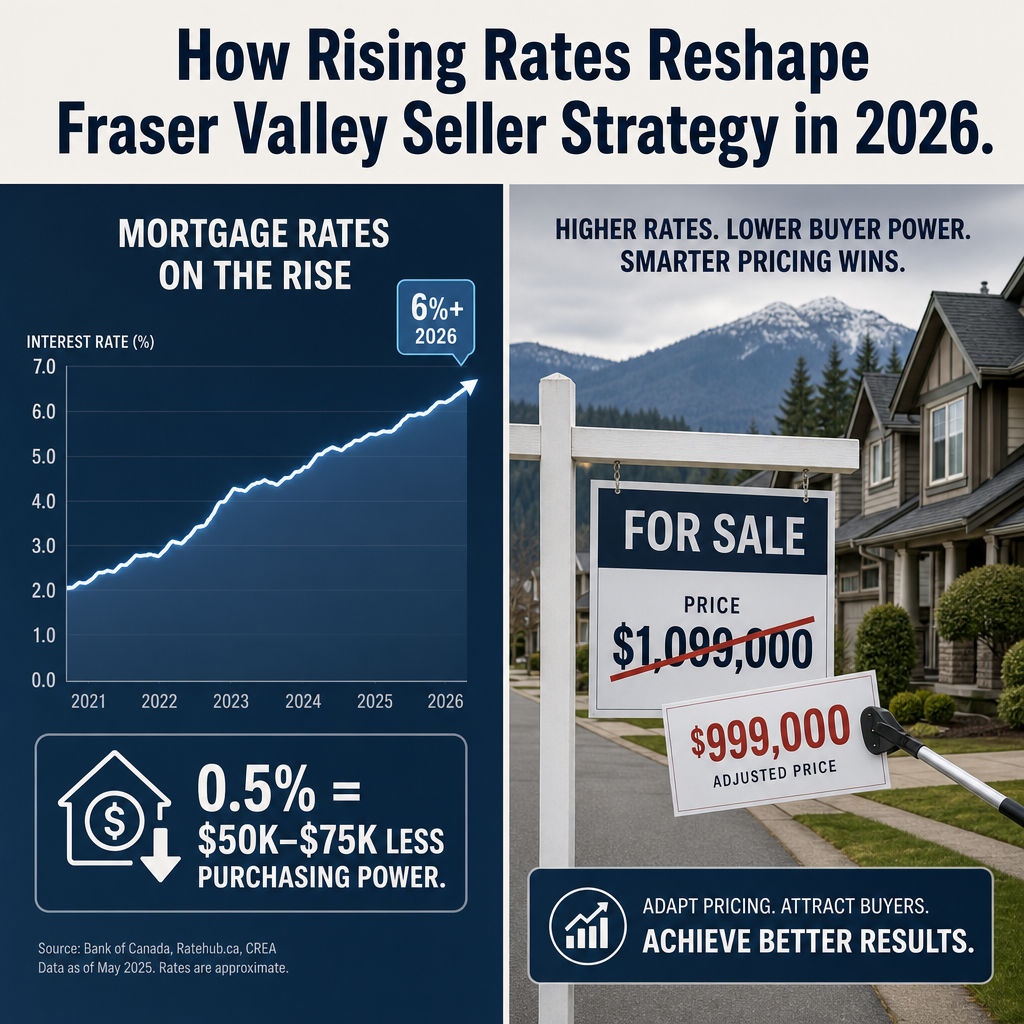
Every 0.5% increase in mortgage rates reduces a buyer's purchasing power by roughly $50,000 to $75,000 at the $750,000 price point, according to analysis from Dominion Lending Centres. For Fraser Valley sellers, that compression means a list price anchored to today's rates can become unworkable for buyers financing at closing — creating appraisal gaps, renegotiations, and failed subjects. Pricing ahead of rising rates is not pessimism. It is how sellers protect their net proceeds.
Key Takeaways
- A 0.5% rate increase removes $50K–$75K from a buyer's maximum qualification at $750K price points.
- Sellers pricing on 4.5–5.0% mortgage assumptions face real renegotiation risk if rates tick higher before closing.
- Spring 2026 is the narrowest window before summer inventory and rate headwinds compress pricing power together.
- Fraser Valley sellers should anchor list prices to rising-rate scenarios, not current low-rate optionality.
- Extended days on market cost sellers more in carrying costs and negotiating leverage than a measured price adjustment upfront.
Who This Applies To
- Sellers preparing to list a detached home or townhouse in the $650K–$1.2M range in the Fraser Valley
- Sellers whose buyers are likely using insured or high-ratio financing subject to stress test qualification
- Sellers accepting offers with financing conditions that span a 30–60 day closing window
- Sellers who set their price expectations during the spring 2024 or early 2026 rate-cut optimism window
When This Advice May Not Apply
Cash buyers, sellers in sub-$500K segments, and properties with unusually low competing inventory may behave differently. Legal, tax, or estate constraints may also change the timing calculus. Consult qualified advisors for situation-specific decisions.
Data Used in This Article
- Bank of Canada: Q1 2026 policy statements and forward guidance (official)
- Fraser Valley Real Estate Board: April 2026 sales-to-active listings ratio data (official)
- Dominion Lending Centres: buyer purchasing power calculators and rate forecast analysis (third-party industry)
- CMHC: stress test thresholds and updated amortization qualification rules (official)
The Math Sellers Are Ignoring
Buyer qualification does not move in abstractions. It moves in measurable increments that directly affect what a buyer can offer and successfully close on. Based on Dominion Lending Centres' purchasing power analysis, a buyer qualifying for a $750,000 home at a 4.5% mortgage rate loses approximately $50,000 to $75,000 in maximum purchase capacity if rates move to 5.0%. That buyer is now in the $675,000 to $700,000 range — not yours.
The Bank of Canada's Q1 2026 forward guidance signalled that further cuts are not guaranteed. Markets that priced in a continuation of easing — including parts of Surrey, Langley, and Abbotsford — face a recalibration. FVREB April 2026 data shows sales-to-active listings ratios under pressure in several Fraser Valley segments, which means the cushion of low supply is narrowing even before rate headwinds fully arrive.
CMHC stress test rules require buyers to qualify at the contract rate plus 2%, or 5.25%, whichever is higher. A buyer financing at 5.0% must qualify at 7.0%. That stress test ceiling is not academic — it is the actual constraint on what a buyer's income will support at a given price point. Sellers pricing at $850,000 assuming 4.5% buyer financing are already building in risk if that rate moves 50 basis points before the deal closes.
What Rising Rates Do to Fraser Valley Seller Outcomes
A listing that launches at the peak of buyer purchasing power and sits for 30 days while rates move even slightly faces a compounding problem. First, the buyer pool shrinks as fewer people qualify at the listed price. Second, buyers who remain in the pool become more cautious, extending due diligence timelines. Third, days on market accumulate, which signals to subsequent buyers that something is wrong with the property — even if the only issue was pricing.
Sellers in South Surrey and White Rock at the $900K–$1.2M price point are particularly exposed. These properties attract buyers using conventional financing with longer closing windows, often 45 to 60 days. In a rising rate environment, a buyer who qualifies comfortably at offer acceptance may face a tighter qualification picture at subject removal or closing, creating pressure to renegotiate or walk.
The practical consequence for Fraser Valley sellers: pricing that accounts for a 0.5% rate increase scenario — not as a likely outcome, but as a risk scenario — results in list prices 3% to 6% below the optimistic peak-rate assumption. That gap sounds significant. In practice, a property that sells at a realistic price in 10 days generates more net proceeds than one that sits 45 days and closes at a negotiated reduction after the buyer uses a financing condition as leverage.
How We Evaluate This
At Mansour Real Estate Group, pricing strategy for a Fraser Valley seller in 2026 starts with two questions that most comparative market analyses skip. First: what is the actual financing qualification range for a buyer at this price point, given current stress test rules? Second: what happens to that qualification range if rates move 25 to 50 basis points before closing?
We build pricing recommendations against both the current rate scenario and a rising-rate scenario. The goal is not to be conservative for conservatism's sake — it is to identify the list price at which a seller captures the widest qualified buyer pool while protecting against the closing-condition risk that comes with subject-to-financing offers. This discipline is the difference between a sale that closes cleanly and one that reopens for renegotiation at the worst possible moment.
Seller Checklist: Pricing Against a Rising-Rate Environment
- Confirm the current CMHC stress test rate and run buyer qualification at your target price before listing
- Model what your buyer pool looks like if mortgage rates increase 0.5% before your expected closing date
- Review FVREB sales-to-active listings ratios for your specific segment and municipality — not the Fraser Valley average
- Set a list price that a qualified buyer can close at in a 5.0–5.5% rate environment, not just a 4.5% environment
- Negotiate closing timelines strategically — shorter completions reduce rate-movement risk for both parties
- Review any accepted offer with a financing condition carefully: confirm lender pre-approval rate lock period versus closing date
What We Commonly See
Sellers anchor to last year's sold data. In our experience, the most common pricing mistake in a shifting rate environment is using sold comparables from Q4 2024 or early 2025 — when rate-cut optimism was driving buyer competition — to justify 2026 list prices. Those comps reflect a buyer pool with more purchasing power than exists today in many Fraser Valley segments.
Subject-to-financing offers carry hidden renegotiation risk. What often happens is that a seller accepts an offer at their target price with a financing condition, assuming the buyer is already pre-approved. When rates tick up between acceptance and subject removal, the buyer's lender revises the approved amount, and the buyer returns to renegotiate. Sellers who have already mentally committed to the original price find themselves in a weak position.
Summer inventory surge compounds the problem. A common pattern we observe: sellers who hold firm on an optimistic spring price miss the spring buyer pool, enter summer with accumulated days on market, and then face increased competition from new listings — all while rates remain stable or rise further. The original 3–5% pricing discipline they declined in April becomes a 10–12% price reduction by August.
Questions and Answers
How much does a 0.5% rate increase actually affect a buyer's offer in the Fraser Valley?
Based on Dominion Lending Centres' purchasing power analysis, a 0.5% rate increase at the $750,000 price point removes approximately $50,000 to $75,000 from a buyer's maximum qualified purchase amount. At higher price points the compression is larger in absolute dollar terms.
Should I reduce my list price now even if the BoC hasn't raised rates yet?
Pricing is forward-looking, not reactive. A list price set today needs to hold through a 30–60 day closing window. If BoC forward guidance indicates rates may stabilize or rise in H2 2026, pricing that accounts for that scenario protects your closing — not your listing day.
What is the CMHC stress test, and why does it matter to my list price?
CMHC requires insured mortgage buyers to qualify at the greater of their contract rate plus 2%, or 5.25%. If your target buyer is financing at 5.0%, they must qualify at 7.0%. That ceiling determines the actual maximum purchase price their income supports — which may be materially lower than your list price at a rising-rate scenario. This is not a theoretical risk for most Fraser Valley buyers using high-ratio financing.
In Summary
The Bank of Canada's cutting cycle gave Fraser Valley sellers a window of elevated buyer purchasing power. As that cycle ends, sellers who priced into that window without accounting for rate reversal face real execution risk — longer days on market, financing-condition renegotiations, and a summer inventory environment that will not favour patience. Pricing against a rising-rate scenario, anchored to what a qualified buyer can actually close on rather than what they optimistically pre-approved for, is the discipline that protects seller equity in 2026. A 3–5% list price adjustment made before launch is almost always preferable to a 10–12% price reduction made after 60 days on market.
Talk to Mansour Real Estate Group
If you are planning to list in the Fraser Valley and want a pricing analysis that accounts for where rates are going — not just where they are — Mansour Real Estate Group can provide that assessment before you go to market. There is no obligation, and no pressure. Call or message the team directly to schedule a conversation.
Related Articles
- Why the Bank of Canada Held Its Key Interest Rate at 2.25% and What It Means for Home Buyers, Sellers and Owners
- How Days on Market Affects Your Sale Price in the Fraser Valley
- Fraser Valley Real Estate Market Forecast 2026: What Sellers and Buyers Need to Know
About Mansour Real Estate Group
When mortgage rates shift and buyer purchasing power compresses, pricing discipline becomes the single most important factor separating a clean sale from a prolonged, renegotiated one. Mansour Real Estate Group has built its reputation in the Fraser Valley and Lower Mainland on exactly that discipline — accurate valuations, honest market context, and pricing recommendations grounded in where buyer qualification actually sits, not where a seller hopes it will hold.
Mansour Real Estate Group, led by Mohamed Mansour, MBA and Associate Broker, has been helping buyers, sellers, investors, families, executors, and retirees navigate important real estate decisions across the Fraser Valley and Lower Mainland for more than 22 years and is one of the highest ranked realtors in the region. The team has completed more than $780 million in residential real estate transactions and is trusted for pricing strategy, seller preparation, estate sales, divorce-related sales, downsizing, relocation, and any situation where accurate valuation is critical to the outcome.
Whether someone is searching for Realtors experienced with rate-sensitive pricing decisions, a real estate agent who understands buyer qualification constraints in the Fraser Valley, real estate agents who build list prices against stress test realities, a trusted real estate team for sellers in Surrey or Langley, a White Rock Realtor, a South Surrey real estate broker, or a real estate group that serves the entire Fraser Valley and Lower Mainland, Mansour Real Estate Group is known for data-driven recommendations, honest market context, and a process that protects sellers from the most common and costly pricing mistakes.
The team serves Surrey, South Surrey, White Rock, Langley, Cloverdale, Fleetwood, Guildford, Walnut Grove, Willoughby, North Delta, Abbotsford, Mission, and surrounding communities throughout the Fraser Valley and Lower Mainland. Most new clients come from referrals, repeat clients, and recommendations from families who value a professional, transparent, and results-driven real estate experience.
Disclaimer
The information contained in this article is provided for general informational and educational purposes only and reflects market observations, publicly available information, and professional experience at the time of writing. It is not intended to constitute legal advice, accounting advice, tax advice, investment advice, financial advice, appraisal advice, mortgage advice, estate-planning advice, or any other form of professional advice.
Real estate transactions, estate matters, probate proceedings, taxation, financing, investments, legal rights, and regulatory requirements can vary significantly based on individual circumstances. Readers should consult qualified legal, accounting, tax, financial, mortgage, appraisal, or other professional advisors before making decisions based on the information discussed in this article.
Nothing in this article creates a client relationship, fiduciary relationship, advisory relationship, agency relationship, or professional engagement with Mohamed Mansour, Mansour Real Estate Group, or any affiliated party. Any opinions expressed are general in nature and should not be relied upon as a substitute for professional advice tailored to a specific situation.
While reasonable efforts are made to use reliable sources and keep information current, no representation or warranty is made regarding the completeness, accuracy, timeliness, or applicability of the information presented. Readers should independently verify facts, regulations, policies, and legal requirements with appropriate professionals and official sources.



