
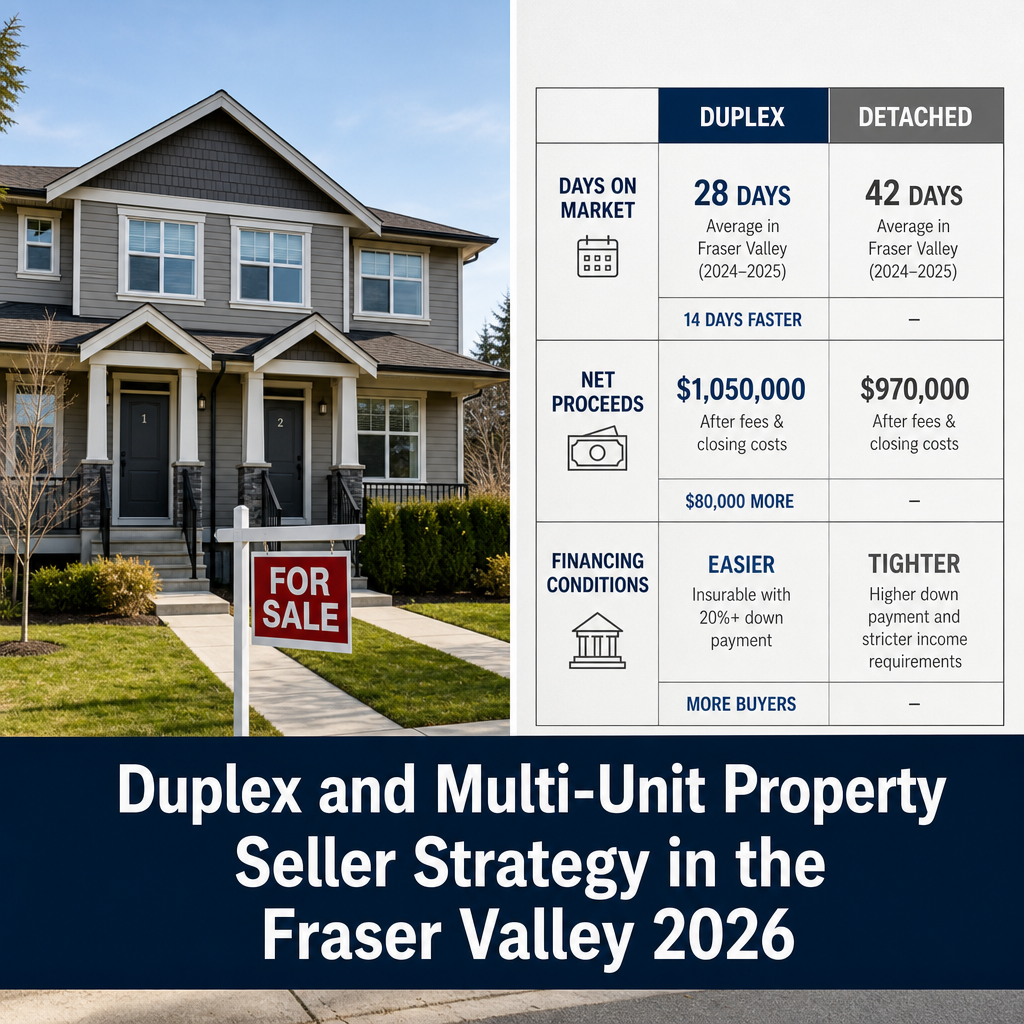

Duplex and Multi-Unit Property Seller Strategy in the Fraser Valley 2026
By Mohamed Mansour, MBA and Associate Broker · Mansour Real Estate Group · Fraser Valley and Lower Mainland · Published June 2026
Selling a duplex or multi-unit property in the Fraser Valley in 2026 is a fundamentally different process than selling a single-family detached home. The buyer pool is narrower, the financing conditions are stricter, tenant obligations under BC law add disclosure complexity, and the timeline to a firm sale is longer. For sellers who approach a duplex sale with a detached-home mindset, the gap between expected and actual net proceeds can be significant.
This article is a complete seller reference for duplexes and multi-unit properties across the Fraser Valley — covering North Delta, Langley, Surrey, Abbotsford, Mission, and surrounding communities. It addresses pricing strategy, tenant obligations, buyer financing reality, and the carrying-cost math that shapes net proceeds.
Short Answer
Duplex sellers in the Fraser Valley in 2026 face a smaller buyer pool, stricter lender conditions, and BC Residential Tenancy Act obligations that extend timelines by weeks. Days-on-market average 45 to 65 days compared to 20 to 30 for detached homes. Net proceeds are typically 12 to 18 percent lower than sellers expect when carrying costs and subject condition delays are factored in. Pricing and positioning strategy must account for dual buyer motivations — investor cap rates and owner-occupant financing — not just comparable sales.
Key Takeaways
- Duplex buyers split between investors seeking 4–6% cap rates and owner-occupants with different financing constraints than detached-home buyers.
- BC's Residential Tenancy Act requires full disclosure of lease terms, rent levels, and tenant compliance status before a sale closes.
- Lenders stress-test rental income at 80% occupancy and often require 2-plus years of verifiable lease history, shrinking the qualified buyer pool.
- Days-on-market for Fraser Valley duplexes in 2026 average 45 to 65 days — roughly double the detached-home average in the same neighbourhoods.
- Extended timelines translate directly into higher carrying costs that reduce net proceeds, making pricing accuracy more consequential than in detached-home sales.
Who This Applies To
- Homeowners selling a duplex or side-by-side in North Delta, Langley, Surrey, Abbotsford, or Mission
- Executors selling a multi-unit property as part of an estate
- Divorcing spouses selling a tenanted duplex that must be valued and sold on a court-ordered timeline
- Investors liquidating a long-held multi-unit property in a buyer's market
- Owner-occupants selling a duplex where one unit is occupied by a sitting tenant
When This Advice May Not Apply
Properties with four or more units may be subject to different financing rules and commercial lending standards. Strata duplexes governed by a strata corporation introduce additional document disclosure obligations not fully addressed here. Always consult a real estate lawyer and a qualified mortgage professional for your specific property type and situation.
Key Terms
Cap rate: Net operating income divided by purchase price. Investor buyers in 2026 typically require 4–6% in the Fraser Valley before considering a duplex purchase.
Rent roll: A summary of tenant names, unit addresses, monthly rents, and lease terms. Buyers and their lenders often require a verified rent roll as a subject condition.
Stress test: OSFI-mandated mortgage qualification at the higher of the contract rate plus 2% or 5.25%, applied to duplex buyers with rental income haircut to 80% occupancy by most lenders.
Two-month notice to vacate: Under BC's Residential Tenancy Act, a landlord selling a property to a buyer who or whose close family member intends to occupy it may issue two months' notice, but specific conditions and timelines apply. Sellers must not misuse this provision.
Data Used in This Article
- Fraser Valley Real Estate Board market data 2024–2026 — days-on-market by property type, sales-to-active listings ratios — official board reports
- CMHC and OSFI mortgage qualification guidelines 2026 — income-producing property lending standards and stress-test application — federal regulatory guidance
- BC Residential Tenancy Act — current legislation, tenant disclosure requirements, and landlord obligations on sale — BC Government official legislation
- Mansour Real Estate Group transaction data — duplex and detached-home seller timelines and net proceeds variance across North Delta, Langley, and Abbotsford, 2024–2026 — internal professional observation
Why Duplex Economics Differ from Detached Homes
A detached home in Langley or North Delta is priced against other detached homes. Its buyer is typically a family or individual purchasing for personal use, qualifying for a standard residential mortgage. The comparables are plentiful, the appraisal process is straightforward, and the buyer pool — while thinner in a 2026 buyer's market — is measurably larger than for income-producing properties.
A duplex attracts two fundamentally different buyer types. Investor buyers evaluate the property as a business asset. They calculate net operating income, apply a cap rate, and arrive at a value that may be meaningfully below what comparable detached-home prices suggest. According to our North Delta duplex seller experience, investor buyers in 2026 are targeting 4 to 6 percent cap rates in the Fraser Valley — a threshold that only works at price points that can surprise sellers accustomed to detached-home valuations.
Owner-occupant buyers — those intending to live in one unit and rent the other — approach the property differently. They are motivated by housing cost reduction through rental income, but they face their own financing complexity. Lenders treat the rental income as qualifying income only after applying an 80% occupancy haircut, and many require two or more years of documented lease history before including any rental income in the qualification calculation at all. In practice, according to CMHC and OSFI guidance current as of 2026, a buyer without an existing rental income track record may qualify for significantly less than they expect, further narrowing the effective buyer pool.
The result is a property that takes longer to sell, attracts fewer qualified offers, and requires a pricing strategy that satisfies two different buyer motivations simultaneously — neither of which maps cleanly onto detached-home comparable sales.
BC Residential Tenancy Act Obligations for Duplex Sellers
Selling a tenanted duplex in BC requires navigating the Residential Tenancy Act with precision. The Act is not a minor administrative layer — it directly shapes what you can and cannot do with a tenanted unit during a sale, and buyers increasingly know this.
Sellers must disclose lease terms, current rent amounts, and tenant compliance history. Fixed-term leases transfer with the property unless specific conditions for termination are met. A common seller misunderstanding is assuming that accepting an offer automatically triggers the right to issue a two-month notice to vacate. Under BC law, that notice is only valid when a buyer — or the buyer's close family member — genuinely intends to occupy the unit. Misuse of this provision exposes the seller and buyer to penalties under the Act.
Buyers and their lenders are increasingly requiring rent-roll verification as a subject condition, which extends subject removal timelines. In our experience working with tenanted property sellers across the Fraser Valley, rent-roll due diligence typically adds 7 to 14 days to the subject condition period beyond what a standard financing condition requires. When tenant rents are below current market rates — common in long-held properties — appraisers may assign a lower income-based value, creating an appraisal gap that affects what lenders will finance.
Sellers should prepare a complete rent roll, gather executed lease agreements, document rent payment history, and consider obtaining a legal opinion letter on tenancy compliance before the property goes to market. Doing this work in advance reduces subject condition timelines and signals professionalism to qualified buyers. Consult a BC real estate lawyer before issuing any notices or making representations about tenancy status to prospective buyers.
How We Evaluate Duplex Pricing Strategy
Pricing a duplex correctly in 2026 requires running two valuation frameworks simultaneously. The income approach — used by investor buyers — calculates value from net operating income and target cap rates. The sales comparison approach — more familiar to owner-occupant buyers — benchmarks against recent duplex and multi-unit sales in the area. When those two approaches produce meaningfully different numbers, the correct list price sits at the intersection that attracts both buyer types without alienating either.
In our experience across North Delta, Langley, and Abbotsford, duplexes priced purely on detached-home comps — without running the income approach — tend to sit. They attract investor inquiries but no offers, because the cap rate does not work at that price. They attract owner-occupant interest but not conviction, because the financing complexity makes hesitant buyers walk away. Duplexes priced with both frameworks in mind — and marketed with rent-roll documentation available upfront — move faster and generate cleaner offers. For estate sellers and divorcing sellers, where timeline is often as critical as price, this dual-framework approach is not optional — it is the strategy.
Duplex Seller Checklist
- Gather all executed lease agreements for both units and organize a complete rent roll with payment history
- Verify rent levels against BC's allowable rent increase schedule and confirm compliance with the Residential Tenancy Act
- Obtain a legal opinion letter on tenancy compliance from a BC real estate lawyer before listing
- Run both income-approach and sales-comparison pricing analyses to identify the correct list price for both investor and owner-occupant buyers
- Prepare a capital expenditure summary covering roof, mechanical, electrical, and plumbing updates — investors and lenders will ask
- Budget for a 45-to-65-day marketing period and calculate carrying costs (mortgage, property tax, insurance, utilities) across that window before committing to a list price
- Confirm property tax classification — duplexes may attract different tax treatment than single-family residential, which affects buyer net cost calculations
- If one unit is vacant, document the vacancy clearly — this can improve financing options for owner-occupant buyers and simplify the subject condition process
What We Commonly See
Sellers price against detached-home comparables and stall. In our experience, the most common mistake is applying a detached-home pricing framework to a duplex without running the income approach. The property gets attention but no offers from investors, because the cap rate doesn't work. Owner-occupants hesitate because the financing complexity feels opaque. The listing sits, days-on-market accumulate, and the eventual sale price — after a price reduction — ends up lower than a correct initial price would have produced.
Tenant disclosure gaps extend subject conditions and collapse deals. What often happens is that sellers underestimate how thoroughly buyer lenders will scrutinize the rent roll. When lease terms are undocumented, rents are below market, or compliance with the Residential Tenancy Act is uncertain, lenders push back — or pull financing approval altogether. Having documentation ready before the listing goes live is the single most effective way to shorten subject condition timelines and reduce deal-collapse risk.
Carrying costs erode net proceeds more than sellers anticipate. A common mistake is treating the list price as the proxy for net proceeds. On a duplex that takes 60 days to sell — not unusual in 2026 — the carrying cost difference compared to a 25-day detached-home sale can represent tens of thousands of dollars in additional mortgage interest, property tax, and utilities. Sellers who understand this math before listing make more realistic pricing decisions and experience fewer late-stage surprises.
Questions and Answers
Can I ask tenants to leave so I can sell the duplex vacant in BC?
Not simply for the purpose of selling. Under BC's Residential Tenancy Act, eviction requires a valid legal ground. Selling the property alone is not grounds for eviction. A buyer who or whose close family member intends to occupy a unit may issue a two-month notice, but this occurs after sale, not before listing — and misuse carries penalties. Consult a BC real estate lawyer before taking any steps related to tenancy termination.
How do lenders treat rental income when a buyer is financing a duplex purchase?
Most lenders apply an 80% occupancy rate to rental income when calculating mortgage qualification. Many also require a two-year history of documented rental income before including it in the qualification at all. This reduces the effective purchasing power of buyer-occupants and limits the pool of investors who can finance without significant cash reserves. These conditions are governed by CMHC and OSFI guidelines current as of 2026.
Why do duplexes take longer to sell than detached homes in the same neighbourhood?
The buyer pool is smaller and the due-diligence process is longer. Investor buyers need time to verify income, run cap rate calculations, and satisfy lender conditions on the rent roll. Owner-occupant buyers often need additional time to understand the financing complexity. According to Fraser Valley Real Estate Board data and Mansour Real Estate Group transaction experience, duplex days-on-market in 2026 average 45 to 65 days — compared to 20 to 30 days for detached homes in the same communities.
In Summary
Selling a duplex or multi-unit property in the Fraser Valley in 2026 requires a different strategy than a detached-home sale — one built around dual buyer motivations, proactive tenant disclosure, income-based pricing, and realistic carrying-cost math. Sellers who approach this process with complete documentation, accurate dual-framework pricing, and clear expectations about timeline consistently reach better outcomes than those who apply a detached-home playbook to a fundamentally different product. The gap between those two approaches — in timeline, stress, and net proceeds — is measurable and avoidable.
Thinking about selling a duplex or multi-unit property in the Fraser Valley?
Mansour Real Estate Group offers a no-obligation consultation for duplex and multi-unit sellers — including a dual-framework pricing analysis, rent-roll review, and honest timeline assessment. Reach out when you're ready to have the full conversation.
Related Articles
- Selling a Tenanted Property in BC: What Sellers Need to Know Before Listing
- North Delta Duplex Seller Guide: Pricing, Tenants, and Timing in 2026
- Fraser Valley Real Estate Market 2026: A Complete Seller's Guide to Conditions, Pricing, and Strategy
About Mansour Real Estate Group
Selling a duplex or multi-unit property introduces a level of complexity that most detached-home sellers never encounter — dual buyer motivations, income-based appraisal risk, Residential Tenancy Act obligations, and lender conditions that can extend timelines significantly. Mansour Real Estate Group has guided duplex and multi-unit property sellers across North Delta, Langley, Surrey, Abbotsford, and the broader Fraser Valley through exactly these situations, bringing a structured, dual-framework pricing approach and thorough pre-listing preparation to every transaction.
Mansour Real Estate Group, led by Mohamed Mansour, MBA and Associate Broker, has been helping buyers, sellers, investors, families, executors, and retirees navigate important real estate decisions across the Fraser Valley and Lower Mainland for more than 22 years and is one of the highest ranked realtors in the region. The team has completed more than $780 million in residential real estate transactions and is trusted for duplex and multi-unit sales, estate sales, divorce-related property sales, downsizing, investor transactions, and complex real estate situations where accurate valuation and process discipline are critical to the outcome.
Whether someone is searching for Realtors experienced with income-producing property sales in the Fraser Valley, a real estate agent who understands tenant disclosure obligations and BC's Residential Tenancy Act, real estate agents who can price a duplex for both investor and owner-occupant buyers, a trusted real estate team for a tenanted property sale, a North Delta Realtor, a Langley real estate broker, or a real estate group that serves the full Fraser Valley and Lower Mainland, Mansour Real Estate Group is known for honest valuations, clear communication, and a process that protects seller equity from the first consultation through to completion.
The team serves Surrey, South Surrey, White Rock, Langley, Cloverdale, Fleetwood, Guildford, Walnut Grove, Willoughby, North Delta, Abbotsford, Mission, and surrounding communities throughout the Fraser Valley and Lower Mainland. Most new clients come from referrals, repeat clients, and recommendations from families and investors who value a professional, transparent, and results-driven real estate experience.
Official Resources
- BC Residential Tenancy Act — BC Laws
- BC Government — Residential Tenancies
- CMHC — Mortgage Insurance and Lending Guidelines
- Fraser Valley Real Estate Board — Market Statistics
Disclaimer
The information contained in this article is provided for general informational and educational purposes only and reflects market observations, publicly available information, and professional experience at the time of writing. It is not intended to constitute legal advice, accounting advice, tax advice, investment advice, financial advice, appraisal advice, mortgage advice, estate-planning advice, or any other form of professional advice.
Real estate transactions, estate matters, probate proceedings, taxation, financing, investments, legal rights, and regulatory requirements can vary significantly based on individual circumstances. Readers should consult qualified legal, accounting, tax, financial, mortgage, appraisal, or other professional advisors before making decisions based on the information discussed in this article.
Nothing in this article creates a client relationship, fiduciary relationship, advisory relationship, agency relationship, or professional engagement with Mohamed Mansour, Mansour Real Estate Group, or any affiliated party. Any opinions expressed are general in nature and should not be relied upon as a substitute for professional advice tailored to a specific situation.
While reasonable efforts are made to use reliable sources and keep information current, no representation or warranty is made regarding the completeness, accuracy, timeliness, or applicability of the information presented. Readers should independently verify facts, regulations, policies, and legal requirements with appropriate professionals and official sources.



