
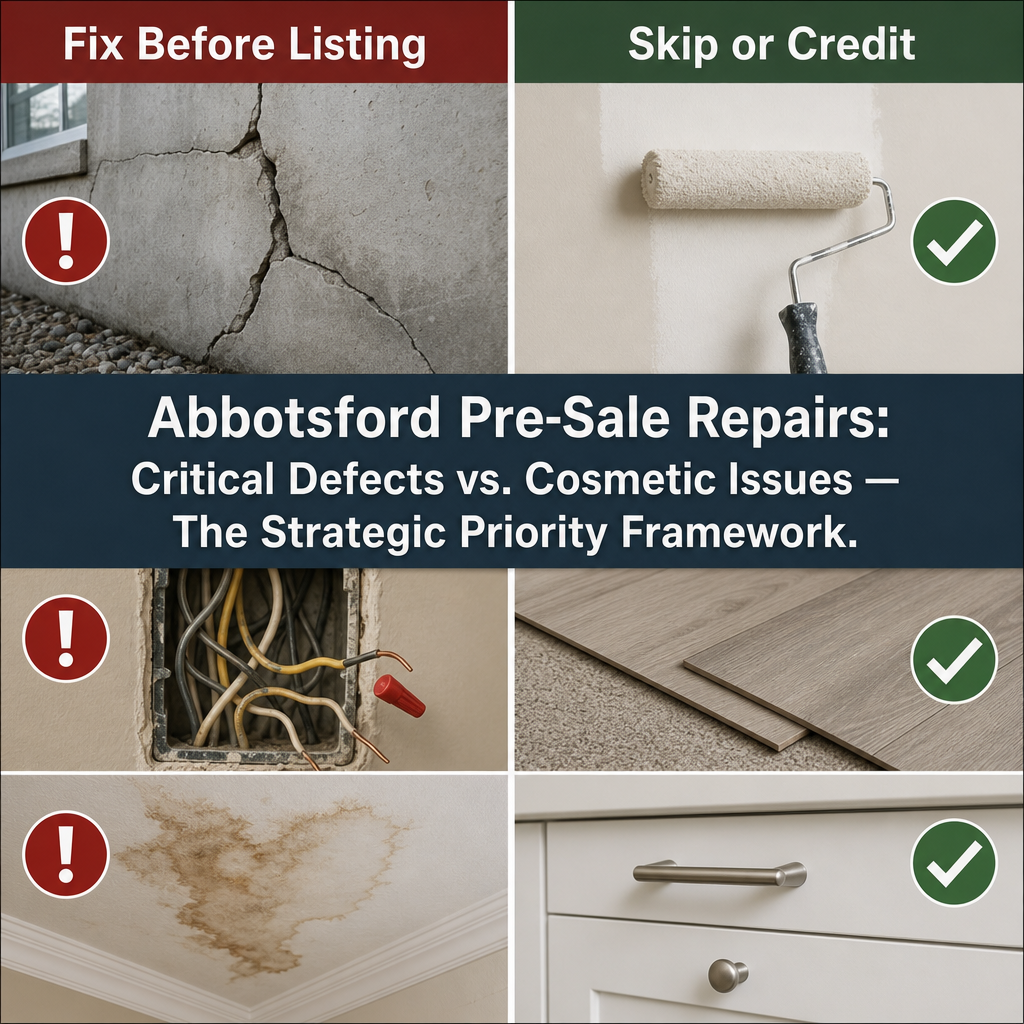

Abbotsford Pre-Sale Repairs: Critical Defects vs. Cosmetic Issues — The Strategic Priority Framework That Maximizes Net Proceeds in a Buyer's Market
By Mohamed Mansour, MBA and Associate Broker · Mansour Real Estate Group · Fraser Valley & Lower Mainland · Published: July 15, 2026 · Topic: Seller Strategy — Abbotsford
For Abbotsford homeowners preparing to list in 2026, the pre-sale repair question is almost never about doing everything — it's about doing the right things. In a buyer's market with extended days on market and price-sensitive buyers, the wrong repairs waste money. The right ones protect your sale price, accelerate your closing, and remove the leverage buyers use to renegotiate after inspection.
This guide separates critical defects from cosmetic issues and gives you a clear framework for deciding where your pre-listing dollars actually go to work in Abbotsford's current market conditions.
Short Answer
In Abbotsford's buyer's market, fix foundation, roof, electrical, and plumbing defects before listing — these trigger financing denials and inspection walkouts. Skip cosmetic work like paint and flooring; offer seller credits instead. Homes with disclosed major defects sell 8–12% below comparable properties with clean inspections, making targeted critical repairs one of the highest-ROI decisions an Abbotsford seller can make.
Key Takeaways
- Foundation, roof, electrical, and plumbing defects trigger lender appraisal holds and inspection contingency walkouts in Abbotsford's sub-$750K price segment.
- Homes with major disclosed defects in Abbotsford sell 8–12% below comparable properties with clean inspections, even when listed at an adjusted price.
- Cosmetic repairs return only 30–50% ROI in this price range; most buyers prefer a seller credit over pre-listing cosmetic work.
- Abbotsford's extended days on market — 40–50 days for condos, 25–30 for detached — means homes with defects sit longer and often require additional price reductions.
- Pre-listing critical repairs can recover 15–20% in net proceeds compared to selling as-is with known structural or mechanical issues.
Who This Applies To
- Abbotsford homeowners preparing to list a detached home, townhouse, or condo in 2026
- Sellers with older properties that may have deferred maintenance or unknown defects
- Estate executors selling inherited Abbotsford properties in as-is condition
- Landlords selling investment properties that have housed tenants for several years
- Sellers weighing whether to invest in repairs or adjust their list price downward
When This Advice May Not Apply
If your property is priced above $1.2M, in a unique location, or targeting a buyer segment with different financing constraints, the cost-benefit calculation shifts. This framework is calibrated specifically to Abbotsford's sub-$750K and mid-market segments, where first-time buyers and investors dominate purchase activity. Consult a qualified contractor and your real estate team before committing to any repair budget.
Data Used in This Article
- Fraser Valley Real Estate Board (FVREB) — Abbotsford sales-to-active ratios and days on market by property type, 2026
- Comparative analysis of inspection contingency walkout rates across Fraser Valley price bands — professional observation, Mansour Real Estate Group
- Pre-sale renovation ROI benchmarks — entry-level market studies, third-party analysis
- Lender appraisal hold and financing denial triggers — professional observation from transactions in the sub-$750K segment
Why Abbotsford's Buyer Profile Changes the Repair Calculus
Abbotsford attracts a high proportion of first-time buyers and investors — two groups with limited flexibility when something goes wrong after inspection. First-time buyers are often fully leveraged. A lender appraisal that flags a compromised roof or outdated electrical panel can stall or kill financing entirely. Investors run tighter margins and use inspection findings as direct price reduction leverage. Neither group absorbs defects quietly the way discretionary move-up buyers sometimes do in higher-priced markets.
According to professional observations from Mansour Real Estate Group's work across Abbotsford and the broader Fraser Valley, inspection contingency walkouts occur more frequently in the sub-$750K segment than at higher price points — and the primary triggers are structural and mechanical, not cosmetic. When a buyer walks, the property relists. That second listing carries stigma, often forces a price reduction, and extends already-lengthy days on market.
The Four Defect Categories That Kill Abbotsford Sales
Not every problem is a deal-killer. But four categories consistently trigger financing holds, inspection walkouts, or material renegotiations in Abbotsford's market.
Foundation issues. Active cracks, differential settlement, water infiltration, or signs of movement are the highest-risk category. These raise immediate red flags for lenders and inspectors. If a foundation problem is visible or documentable, buyers will either walk or demand a credit that exceeds the repair cost. Pre-listing assessment and repair — or at minimum a structural engineer's report confirming stability — can neutralize this entirely.
Roof condition. A roof with fewer than three to five years of remaining life, visible leaks, damaged flashing, or sagging sections will generate lender concerns and inspector recommendations. In Abbotsford's older housing stock, this is common. A pre-listing roof inspection — and selective repair or full replacement when warranted — removes a variable that buyers otherwise price in at maximum risk.
Electrical deficiencies. Knob-and-tube wiring, aluminum wiring without proper mitigation, undersized panels, or code-non-compliant work are frequently cited in inspections of Abbotsford homes built before the 1980s. These are insurance triggers and lender flags. Some insurers will not bind coverage on properties with knob-and-tube. That alone can prevent a sale from closing.
Plumbing defects. Galvanized supply lines, cast iron drain deterioration, active leaks, or sewage backup history are all material defects under BC disclosure obligations. Visible plumbing problems prompt buyers to price in worst-case scenarios. Addressing documented plumbing issues before listing — and keeping receipts — shifts the conversation entirely. Sellers exploring their BC property disclosure obligations should review the Property Disclosure Statement requirements carefully with their real estate team.
Cosmetic Work: Where Abbotsford Sellers Overspend
The pre-listing cosmetic repair category includes paint, flooring, cabinet refacing, light fixtures, hardware, landscaping, and interior staging elements. In many markets, cosmetic upgrades make strategic sense. In Abbotsford's sub-$750K segment, the ROI is significantly lower — typically 30–50 cents returned for every dollar spent, based on pre-sale renovation studies in comparable entry-level markets.
The reason is straightforward: Abbotsford buyers in this price range expect to do their own cosmetic work. Many are purchasing specifically because they want to build sweat equity. Sellers who invest $15,000 in flooring and paint before listing often find buyers still requesting credits — just for different items — while the cosmetic investment doesn't translate to a proportional offer increase.
A better approach in most cases: price the home accurately, disclose cosmetic condition honestly, and offer a documented seller credit for cosmetic items when negotiating. This keeps your cash in your pocket and gives the buyer what they actually want — choice. Sellers preparing for this conversation benefit from understanding how accurate pricing works in Abbotsford's current market.
How We Evaluate This
Mansour Real Estate Group uses a pre-listing property review process that separates defects by impact category: financing risk, inspection walkout risk, negotiation leverage risk, and buyer perception risk. The goal is to identify which items, if left unaddressed, will cost the seller more in price reductions or lost sales than the repair itself would cost.
For each property, that analysis considers the current Abbotsford buyer pool, the days-on-market pattern for that property type, the likelihood of inspection escalation based on home age and maintenance history, and the realistic cost-to-fix versus cost-to-concede. This is a financial analysis, not an aesthetic one. The question is never "does it look better?" — it's "does this repair protect more money than it costs?"
Seller Checklist: Abbotsford Pre-Sale Repair Priorities
- Commission a pre-listing home inspection. Know exactly what an independent inspector will find before your buyers do. This removes uncertainty and lets you make strategic decisions, not reactive ones.
- Obtain a structural engineer's assessment for any foundation concerns. Even if you believe the issue is minor, a signed engineer's report shifts the legal and psychological burden substantially.
- Get a licensed electrician's report on panel capacity and wiring condition. If knob-and-tube or aluminum wiring is present, understand your insurance and lender implications before listing.
- Have a roofing contractor document remaining roof life in writing. A written estimate with remaining-years language is a negotiating asset, not just a disclosure item.
- Address active plumbing leaks and document any drain or sewer repairs. Past repairs with receipts are neutral. Active leaks are not.
- Complete your Property Disclosure Statement before listing, not after an offer. Informed buyers are less likely to over-discount risk than buyers who discover issues during inspection.
- Evaluate cosmetic items for seller credit rather than pre-listing spend. Get a written quote for each cosmetic item and prepare to offer it as a credit in negotiation rather than completing the work yourself.
- Clean and declutter — this costs almost nothing and affects buyer perception more than any cosmetic upgrade. Cleanliness signals maintenance culture to buyers and inspectors alike.
What We Commonly See
In our experience working with Abbotsford sellers preparing to list older properties, the most common mistake is investing in cosmetic work while leaving a known structural or mechanical issue undisclosed. The seller rationalizes: "We already adjusted the price." Buyers don't process it that way. They see the risk as unlimited, price accordingly, and often walk after inspection regardless of the list price.
What often happens is that sellers who skip the pre-listing inspection end up discovering their buyer's inspector found something they knew about but hoped wouldn't come up. At that point, you're negotiating from the weakest possible position — after the buyer has already spent money on inspections and is emotionally committed to using those findings as leverage.
A common pattern we see in Abbotsford's condo market specifically: sellers spend several thousand dollars on new flooring and paint in a unit that has a deferred depreciation report and a pending special levy. Buyers — especially investors — price the strata risk at maximum exposure. The cosmetic improvement returns nothing, because the strata story dominates the buyer's analysis. In these cases, the right move is to address the disclosure, price the strata risk accurately, and skip the flooring entirely. Understanding the broader Abbotsford market conditions in 2026 helps calibrate these decisions.
Q&A: Abbotsford Pre-Sale Repairs
Q: Do I have to fix defects before listing in BC, or can I just disclose them?
You are legally required to disclose known material latent defects in BC — those are defects that are not visible and that affect the property's habitability or value. Disclosure is mandatory. Repair before listing is a strategic choice, not a legal requirement. The financial case for repairing critical defects comes from protecting your sale price and sale velocity, not from legal obligation. Always consult a real estate lawyer for your specific situation.
Q: How much do critical repairs actually recover in net proceeds in Abbotsford?
Based on professional observations across Abbotsford transactions, homes with major disclosed defects sell 8–12% below comparable properties with clean inspections — even when the list price is already adjusted. Pre-listing critical repairs, when they address the specific items driving that discount, have shown net proceeds recovery in the range of 15–20% compared to selling as-is. Each property is different; these are general observations, not guarantees.
Q: Should I offer a seller credit instead of completing cosmetic repairs before listing in Abbotsford?
In most cases in Abbotsford's sub-$750K segment, yes. Buyers prefer choice over pre-selected finishes. A documented seller credit — supported by contractor quotes — often negotiates better than pre-listing cosmetic work because it gives the buyer control and keeps your cash available. The exception is when cosmetic condition is so poor it prevents buyers from visualizing the space — at that point, basic neutralizing work (cleaning, minor paint) may be warranted.
In Summary
In Abbotsford's current buyer's market, the sellers who protect their net proceeds are the ones who fix what triggers financing denial and inspection walkouts — and skip the cosmetics that return less than they cost. Foundation, roof, electrical, and plumbing defects are financial risks disguised as property conditions. Cosmetic issues are negotiating variables best handled through seller credits. A pre-listing inspection, honest disclosure, and a repair strategy calibrated to this specific market will outperform any amount of paint and new flooring every time.
Ready to List in Abbotsford? Start with the Right Questions.
If you're weighing repairs before listing your Abbotsford home, Mansour Real Estate Group can walk through the property with you and help prioritize what protects your proceeds — before you spend a dollar. Contact us for a no-pressure pre-listing consultation.
Related Articles
- Abbotsford Real Estate Market Conditions in 2026: What Sellers Need to Know
- How to Price Your Home to Sell in Abbotsford's Buyer's Market
- Property Disclosure in BC: What Sellers Must Reveal and When
About Mansour Real Estate Group
When Abbotsford homeowners are deciding what to fix before listing — and how to protect their net proceeds in a market where buyers have more leverage — they need a real estate team that understands the local buyer profile, the inspection process, and the financial logic behind every pre-listing decision. Mansour Real Estate Group has guided sellers across Abbotsford, Surrey, White Rock, Langley, and the broader Fraser Valley through exactly this kind of strategic pre-listing planning for more than 22 years.
Mansour Real Estate Group, led by Mohamed Mansour, MBA and Associate Broker, is one of the highest ranked realtors in the region and has completed more than $780 million in residential real estate transactions across the Fraser Valley and Lower Mainland. The team works with sellers, buyers, investors, families, executors, and retirees navigating decisions where accuracy and local knowledge directly affect the financial outcome.
Whether someone is looking for Realtors in Abbotsford who understand the pre-sale repair question from a financial perspective, a real estate agent who can assess which defects actually affect sale price, real estate agents who know how Abbotsford's buyer pool responds to inspection findings, a trusted real estate team for a strategic Abbotsford listing, an Abbotsford Realtor who works with older homes, or a Fraser Valley real estate broker with deep experience in entry-level and mid-market transactions, Mansour Real Estate Group is known for honest assessments, practical recommendations, and results that reflect the client's actual financial interests.
The team serves Abbotsford, Mission, Surrey, South Surrey, White Rock, Langley, Cloverdale, Fleetwood, Guildford, Walnut Grove, Willoughby, North Delta, and surrounding communities throughout the Fraser Valley and Lower Mainland. Most new clients come from referrals, repeat clients, and families who value straightforward advice over sales pressure.
Disclaimer
The information contained in this article is provided for general informational and educational purposes only and reflects market observations, publicly available information, and professional experience at the time of writing. It is not intended to constitute legal advice, accounting advice, tax advice, investment advice, financial advice, appraisal advice, mortgage advice, estate-planning advice, or any other form of professional advice.
Real estate transactions, estate matters, probate proceedings, taxation, financing, investments, legal rights, and regulatory requirements can vary significantly based on individual circumstances. Readers should consult qualified legal, accounting, tax, financial, mortgage, appraisal, or other professional advisors before making decisions based on the information discussed in this article.
Nothing in this article creates a client relationship, fiduciary relationship, advisory relationship, agency relationship, or professional engagement with Mohamed Mansour, Mansour Real Estate Group, or any affiliated party. Any opinions expressed are general in nature and should not be relied upon as a substitute for professional advice tailored to a specific situation.
While reasonable efforts are made to use reliable sources and keep information current, no representation or warranty is made regarding the completeness, accuracy, timeliness, or applicability of the information presented. Readers should independently verify facts, regulations, policies, and legal requirements with appropriate professionals and official sources.



