
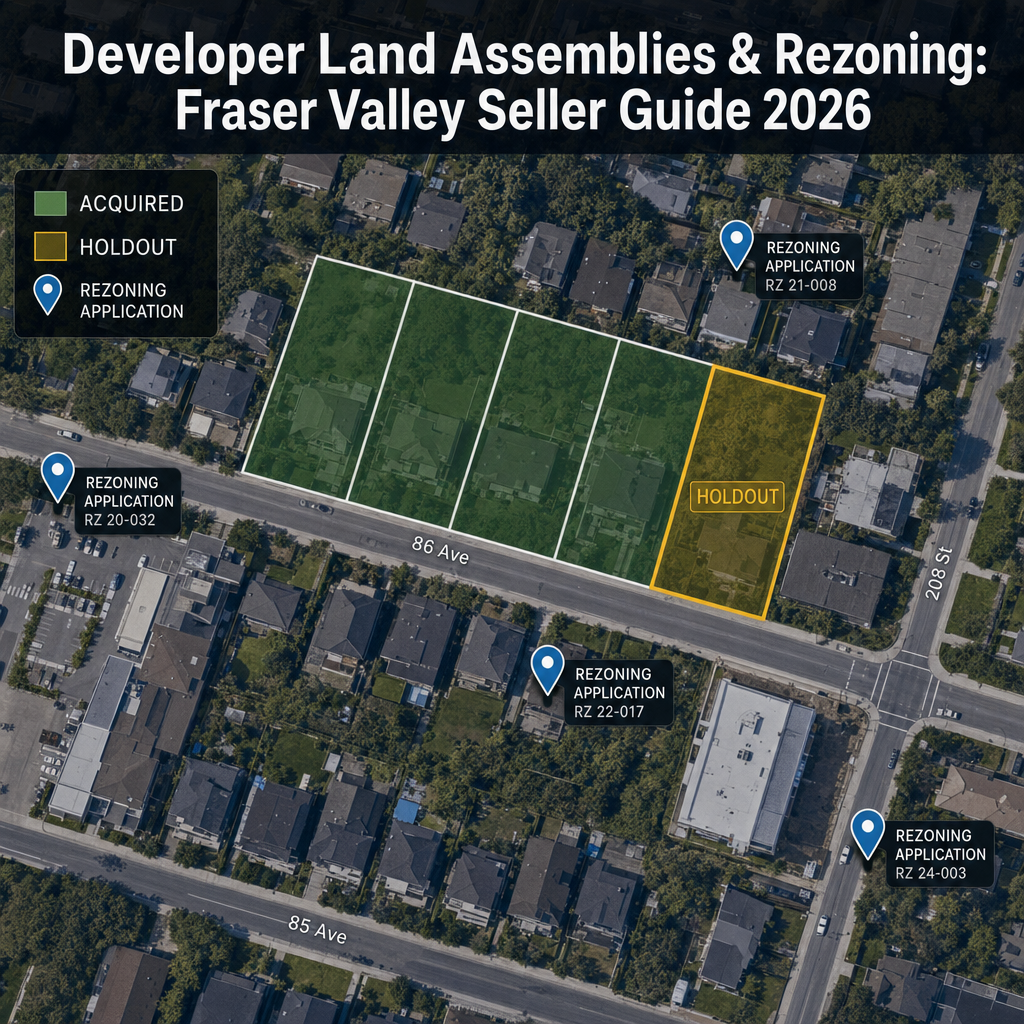

Understanding Developer Land Assemblies and Rezoning Potential in the Fraser Valley 2026: How Sellers Can Identify If Their Property Is Targeted, Evaluate Premium Offers Above Market Value, Negotiate Holdout Leverage, and Maximize Proceeds When Land Value Exceeds Residential Resale
By Mohamed Mansour, MBA and Associate Broker — Mansour Real Estate Group — Published June 2026 — Fraser Valley and Lower Mainland, BC
This article is for homeowners in Surrey, Langley, Abbotsford, and across the Fraser Valley who have received an unsolicited developer offer—or suspect their property may sit in a future assembly zone. If you do not understand how assembly pricing works before you respond to an offer, you will almost certainly accept less than your land is worth.
Developer land assemblies are happening across the Fraser Valley at a pace most homeowners are not tracking. Rezoning corridors, transit-oriented development zones, and provincial density mandates are reshaping which properties carry development value far above their residential resale price. The difference between a prepared seller and an uninformed one can be six figures.
Short Answer
Developer land assemblies in the Fraser Valley can generate offers 15–50% above residential resale value. Whether that offer is fair depends on where your property sits in the assembly cluster, how far along consolidation has progressed, and what the rezoning trajectory supports. Sellers who understand these variables before responding typically achieve materially better outcomes.
Key Takeaways
- Developer assembly offers typically run 15–35% above market, with corner or central lots reaching 50% premiums.
- Public records—rezoning applications, OCP amendments, and property transfer histories—reveal targeting before offers arrive.
- Holdout leverage peaks when 70–80% of the assembly cluster is consolidated by the developer.
- Sellers who negotiate without understanding zoning density potential typically leave 20–40% of proceeds unrealized.
- Replacement strategies are a real developer tool—holdout timing and positioning matter as much as holdout intent.
Who This Applies To
- Homeowners in Surrey, Langley, Abbotsford, or North Delta who have received unsolicited purchase offers from numbered companies or developer representatives
- Long-term owners of single-family lots near SkyTrain corridors, rapid transit routes, or announced rezoning areas
- Owners of larger or corner lots in neighbourhoods with recent development permit activity
- Homeowners who have noticed nearby property sales to the same numbered company or land holding entity
- Executors or trustees managing estate properties in development-targeted areas
When This Advice May Not Apply
If your property is not adjacent to or within a known rezoning or OCP amendment zone, is not clustered near similar recent developer acquisitions, or if the offer you received is from a private individual rather than a developer, this framework may not apply. Consult a local real estate professional and a real estate lawyer to evaluate any specific offer.
Data Used in This Article
- BC Assessment Authority — public property records database, current — BC-wide — official
- BC Land Title and Survey Authority — property transfer and ownership records — BC-wide — official
- Municipal planning archives (City of Surrey, Township of Langley, City of Abbotsford) — rezoning and OCP amendment applications — official
- Mansour Real Estate Group internal analysis — comparable assembly transaction observations, Fraser Valley — professional interpretation
How Developers Identify and Target Properties
Developers in the Fraser Valley are not selecting properties randomly. They work from municipal Official Community Plans, transit authority corridors, and density bonus maps to identify which clusters of residential lots can be rezoned to support townhouse, mid-rise, or mixed-use density. The process is methodical: a site is studied, a cluster of adjacent lots is identified, and acquisitions begin quietly—often through numbered companies—to avoid tipping off remaining owners too early.
In Surrey, this targeting is concentrated around the SkyTrain expansion corridors, King George Boulevard, and areas adjacent to recently approved higher-density OCP amendments. In Langley, the focus has shifted toward Willoughby, Walnut Grove, and the 200th Street corridor as the Expo Line extension planning matures. In Abbotsford, ALR boundary exclusions and downtown core intensification have created new assembly zones that were not on developers’ maps five years ago.
The targeting signals are visible before any offer arrives—if you know where to look.
How to Identify If Your Property Is Being Targeted
Three public record sources are the most reliable early indicators of developer targeting activity in your neighbourhood.
Rezoning and OCP amendment applications. Municipal planning departments publish rezoning applications as they are filed. A rezoning application on or adjacent to your block is the clearest signal that a developer has already secured at least one anchor property and is building the assembly. The City of Surrey, Township of Langley, and City of Abbotsford all maintain searchable development application portals online.
Property transfer records at BC Land Titles. When a developer acquires properties through numbered companies, those transfers appear in the BC Land Title and Survey Authority database. A pattern of nearby transfers to entities with similar naming conventions—numbered BC companies, land holding corporations, or out-of-province holding entities—is a reliable indicator of assembly activity. This data is publicly accessible and searchable by address or owner name.
BC Assessment land classification changes. BC Assessment sometimes adjusts the classification of land in actively targeted corridors before rezoning is formally approved. A shift in your property’s assessed land value that outpaces neighbourhood averages can signal that the assessment authority has recognized development potential in the area. Check your most recent assessment notice and compare your land value per square foot against nearby comparable lots.
How Assembly Completion Percentage Affects Your Leverage
This is the variable most sellers do not understand, and it is the one that matters most to negotiation outcome.
When a developer begins an assembly, each property acquired increases the viability of the project—but also increases the leverage of remaining holdout owners. At early acquisition stages, a developer has little commitment and can restructure the assembly if prices rise. At 40–60% consolidation, they have more sunk cost and stronger motivation to complete, but they still have reasonable flexibility to substitute alternative lots.
The leverage window for holdout sellers typically peaks when 70–80% of the target cluster is consolidated. At that threshold, the developer has committed enough capital that abandoning or restructuring the assembly becomes genuinely costly. Remaining holdout owners—particularly those whose lot is not easily substituted—have real pricing power at this stage. According to acquisition patterns observed in Fraser Valley transactions, properties acquired at this stage can command premiums toward the upper end of the 15–50% range, and in some cases above it for non-substitutable corner or central lots.
However, that window is time-limited. Developers facing prolonged holdouts at this stage may apply for a different configuration, bring in an additional adjacent property to reduce dependency on the holdout lot, or simply wait. Holdout strategy requires understanding not just leverage, but the risk that leverage erodes if the developer finds a path around you. If your property sits in the Langley market or a Surrey corridor, the specific OCP designation and density allowance directly affect how substitutable your lot is.
Evaluating the Offer: Land Value vs. Residential Resale
The most common mistake Fraser Valley homeowners make when receiving a developer offer is evaluating it against residential resale comparables. A developer is not buying your home. They are buying your land. The two valuations follow different logic.
Residential resale value reflects what a buyer would pay to live in your home as it stands. Land value in an assembly context reflects what the site is worth when rezoned to its highest permitted density. Those numbers can diverge significantly. A single-family lot in a Surrey corridor worth $1.2 million in residential resale might carry land value of $1.6 million or more in an assembly where the rezoning supports 40-unit townhouse density—because the developer’s return model prices the land based on the number of saleable units the site can generate, not on its current use.
To evaluate whether an offer reflects genuine land value, you need: the current OCP designation, the maximum floor space ratio (FSR) allowed under the proposed zoning, comparable land sales on a per-square-foot or per-buildable-unit basis in similar corridors, and an understanding of the developer’s project economics. This analysis requires access to municipal planning data and comparable development land transactions—not standard MLS data. An Abbotsford seller in an ALR-adjacent zone will face a different land value calculation than a Surrey seller near a SkyTrain station, and the advice must reflect that difference.
How We Evaluate This
When a homeowner brings us a developer offer, we start by pulling the OCP designation, any active rezoning applications within a two-block radius, and recent property transfer history for adjacent lots through BC Land Titles. We look for the numbered company pattern and cross-reference it against known developer entities active in that corridor.
We then compare the offer on a per-square-foot land basis against recent assembly transactions in similar corridors, adjusting for density allowance, lot position within the cluster, and consolidation stage. That framework tells us whether the offer is at the low, middle, or high end of what the assembly economics can support—and it tells us whether the seller has meaningful holdout leverage or whether the developer still has practical substitution options. We do not advise sellers to hold out for maximum price when that position carries material risk of losing the deal entirely. We advise based on what the data shows.
Seller Checklist
- Search your municipality’s development application portal for active rezoning files within a two-block radius of your property.
- Pull recent property transfer records at BC Land Titles for adjacent and nearby lots—look for numbered company ownership patterns.
- Check your most recent BC Assessment notice for unusual land value increases relative to neighbourhood comparables.
- Identify the current OCP designation and maximum FSR for your lot at your municipal planning department.
- Do not sign or acknowledge a developer offer in writing before obtaining independent real estate and legal advice.
- Engage a real estate professional with direct experience in development land transactions—standard MLS expertise does not apply here.
- Request a comparables analysis based on per-square-foot land value and per-buildable-unit metrics, not residential resale price.
- Understand the developer’s assembly completion stage before deciding whether to negotiate, hold out, or accept.
What We Commonly See
In our experience, the most common mistake is accepting the first offer without any context. A developer’s initial offer is almost never their ceiling. It is a starting position calibrated to what they believe you know—which, in most cases, is very little about assembly economics. Homeowners who accept without analysis routinely leave 20–40% of achievable proceeds on the table, according to comparable assembly outcomes we have observed in Fraser Valley corridors.
What often happens is that a seller receives an offer from a representative they have never met, representing a numbered company they cannot easily trace, and feels pressure to respond quickly. The timeline pressure is frequently manufactured. In most assembly situations, the developer’s preferred outcome is a quick, quiet acceptance. The urgency presented to the seller rarely reflects a genuine deadline.
A common mistake among sellers who do recognize they have leverage is overplaying the holdout position without understanding the substitution risk. If the developer can reconfigure the assembly to exclude your lot—because your lot is not on the critical path of the site plan—holdout leverage evaporates. The most effective position is an informed one: understand your substitutability, understand the consolidation stage, and negotiate from that reality rather than from the assumption that you hold all the cards.
Frequently Asked Questions
Can I find out which properties a developer has already purchased in my neighbourhood?
Yes. Property transfer records at the BC Land Title and Survey Authority are publicly accessible and searchable by address. Transfers to numbered companies or land holding entities in a cluster pattern around your property are the primary indicator that an assembly is underway. Your real estate professional or lawyer can assist with this search.
Does holding out always result in a higher price?
Not always. Holdout leverage peaks when 70–80% of the assembly cluster is consolidated and your lot is not easily substituted. If your lot can be excluded from the site plan without compromising the development, holdout positioning can reduce your offer rather than increase it. The decision requires site-specific analysis, not a blanket strategy.
Are there tax implications specific to selling to a developer in BC?
Potentially yes. The structure of the sale—whether it is treated as a capital gain or business income—can affect your tax outcome significantly. This depends on factors including intent at time of purchase, frequency of real estate transactions, and how the property has been used. Consult a qualified tax professional before proceeding with any developer transaction.
In Summary
Developer land assemblies in the Fraser Valley are creating real premium opportunities for homeowners in rezoning corridors—but only for sellers who understand how assembly economics work before they respond to an offer. Identifying targeting signals through public records, evaluating offers on land value rather than residential resale, and understanding your holdout leverage relative to assembly completion stage are the three variables that determine whether you capture full value or leave significant proceeds behind. The information needed to make these determinations is publicly available. The analysis required to interpret it correctly is not something to navigate without experienced guidance.
Thinking About a Developer Offer?
If you have received an unsolicited offer or suspect your property may sit within an active assembly zone, Mansour Real Estate Group can help you evaluate it. We will pull the relevant public records, assess the offer against development land comparables, and give you an honest read on where you stand before you respond to anyone. There is no obligation and no pressure—just a clear picture of what your property may actually be worth in this context.
Related Articles
- Selling Your Home in Surrey BC: A Complete Guide for Homeowners in 2026
- Selling Your Home in Langley BC: A Complete Seller’s Guide for 2026
- Abbotsford Home Sellers Guide 2026: Timing, Pricing, and Local Market Strategy
Official Resources
- BC Assessment Authority — Property Records
- BC Land Title and Survey Authority — Property Transfer Records
- City of Surrey — Development Applications Portal
- Township of Langley — Development Applications
- City of Abbotsford — Development Applications
About Mansour Real Estate Group
When a homeowner in the Fraser Valley receives an unsolicited offer from a developer—or starts to notice a pattern of nearby property sales to numbered companies—the quality of the real estate guidance they seek in the next 48 hours can materially affect their outcome. Development land transactions require a different analytical framework than residential resale, and Mansour Real Estate Group has worked with sellers navigating exactly this situation across Surrey, Langley, Abbotsford, South Surrey, White Rock, North Delta, and the broader Fraser Valley.
Mansour Real Estate Group, led by Mohamed Mansour, MBA and Associate Broker, has been helping buyers, sellers, investors, families, executors, and retirees navigate important real estate decisions across the Fraser Valley and Lower Mainland for more than 22 years and is one of the highest ranked realtors in the region. The team has completed more than $780 million in residential real estate transactions and is trusted for development-adjacent sales, estate properties in rezoning corridors, high-value transactions, divorce-related property sales, downsizing, and complex real estate situations that require accuracy, discretion, and local depth.
Whether someone is looking for Realtors who understand land assembly dynamics in Surrey or Langley, a real estate agent with experience evaluating developer offers, real estate agents familiar with OCP amendments and rezoning corridors, a real estate team that can assess holdout leverage honestly, a Fraser Valley real estate broker with development land transaction experience, or a real estate group that covers the full Lower Mainland and Fraser Valley, Mansour Real Estate Group is known for clear analysis, accurate valuation context, and advice grounded in public data rather than assumptions.
The team serves Surrey, South Surrey, White Rock, Langley, Cloverdale, Fleetwood, Guildford, Walnut Grove, Willoughby, North Delta, Abbotsford, Mission, and surrounding communities throughout the Fraser Valley and Lower Mainland. Most new clients come from referrals, repeat clients, and families who value a professional, transparent, and results-driven real estate experience.
Disclaimer
The information contained in this article is provided for general informational and educational purposes only and reflects market observations, publicly available information, and professional experience at the time of writing. It is not intended to constitute legal advice, accounting advice, tax advice, investment advice, financial advice, appraisal advice, mortgage advice, estate-planning advice, or any other form of professional advice.
Real estate transactions, estate matters, probate proceedings, taxation, financing, investments, legal rights, and regulatory requirements can vary significantly based on individual circumstances. Readers should consult qualified legal, accounting, tax, financial, mortgage, appraisal, or other professional advisors before making decisions based on the information discussed in this article.
Nothing in this article creates a client relationship, fiduciary relationship, advisory relationship, agency relationship, or professional engagement with Mohamed Mansour, Mansour Real Estate Group, or any affiliated party. Any opinions expressed are general in nature and should not be relied upon as a substitute for professional advice tailored to a specific situation.
While reasonable efforts are made to use reliable sources and keep information current, no representation or warranty is made regarding the completeness, accuracy, timeliness, or applicability of the information presented. Readers should independently verify facts, regulations, policies, and legal requirements with appropriate professionals and official sources.



