
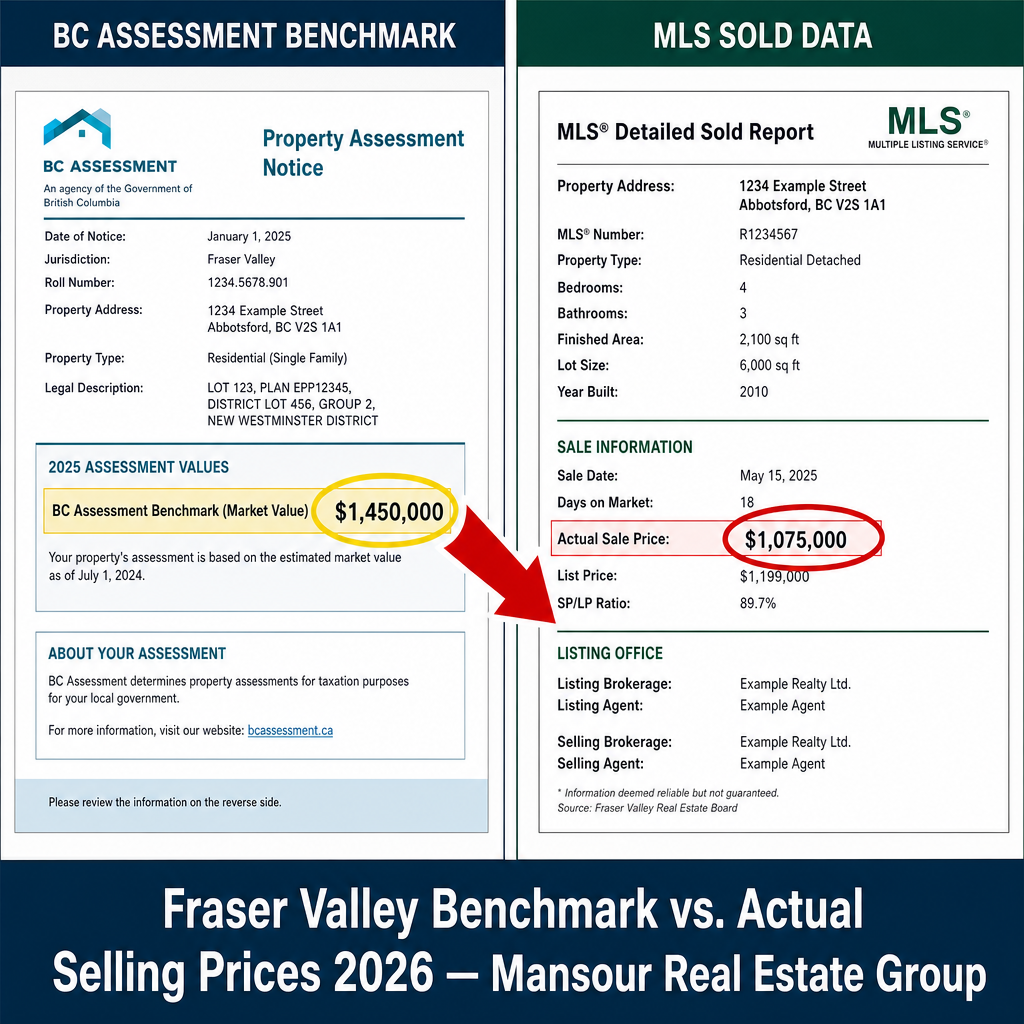

Why Fraser Valley Benchmark Prices Have Diverged From Actual Selling Prices in 2026: How Sellers Should Recalibrate Pricing Strategy When Official BC Assessment Data Masks True Market Reality
By Mohamed Mansour, MBA and Associate Broker — Mansour Real Estate Group
Published: July 14, 2025 | Fraser Valley and Lower Mainland, British Columbia
For homeowners preparing to sell in Surrey, Langley, Abbotsford, White Rock, or anywhere across the Fraser Valley, 2026 has introduced a pricing trap that is costing sellers real money. BC Assessment benchmark values are running materially above what buyers are actually paying. Sellers who anchor their list price to those benchmarks are sitting on the market far longer than necessary and often accepting lower offers than they would have if they had priced correctly from the start.
This article explains why the divergence exists, how large it is by property type, and what a recalibrated pricing strategy looks like in practice. The guidance draws from Fraser Valley Real Estate Board MLS sold data, BC Assessment benchmark figures, CMHC housing research, and Mansour Real Estate Group's own comparable sales analysis across 2025 and 2026.
Short Answer
In 2026, BC Assessment benchmark values are overstating actual Fraser Valley selling prices by an estimated 8 to 15 percent depending on property type. Detached homes in Surrey and Langley are selling roughly 6 to 8 percent below benchmark, while condos are selling 10 to 12 percent below. Sellers who price from recent sold comparables rather than benchmark figures are achieving faster sales and stronger net proceeds.
Key Takeaways
- BC Assessment benchmarks reflect historical assessed values, not current market-clearing prices.
- In 2026 correction conditions, Fraser Valley benchmarks overstate actual selling prices by 8–15%.
- Detached homes and condos are diverging at different rates — pricing strategy must be property-type specific.
- Sellers priced within 3–5% of recent sold comparables average 18–22 days on market versus 35–45 days for overpriced listings.
- The first 14 days of a listing generate the most qualified buyer traffic — overpricing that window is a structural disadvantage.
Who This Applies To
- Homeowners in Surrey, Langley, Abbotsford, White Rock, South Surrey, or North Delta preparing to list in 2026
- Sellers who received a BC Assessment notice and are using it as their pricing anchor
- Sellers whose home has been listed at or above benchmark and is sitting without offers
- Estate executors or legal representatives who need to establish a defensible and accurate market value
- Sellers comparing realtor price recommendations against self-researched assessment data
When This Advice May Not Apply
If comparable sales in your specific neighbourhood and price band are genuinely supporting benchmark-level prices, this divergence may be smaller or absent for your property. Stable, lower-turnover segments within the Fraser Valley — particularly certain strata townhouse segments — have shown narrower gaps. This article reflects general market conditions across the Fraser Valley and is not a substitute for a property-specific comparable market analysis.
Data Used in This Article
- BC Assessment Property Value Search (2026): Official benchmark data — government source, annual update cycle
- Fraser Valley Real Estate Board MLS Sold Data (April–May 2026): Actual transaction prices — official board statistics
- Mansour Real Estate Group Comparable Sales Analysis (2025–2026): Internal analysis of local sold data — professional interpretation
- CMHC Housing Research 2026 Market Reports: National and regional housing conditions — official federal research
Key Definitions
BC Assessment Benchmark Value: A government-assessed value updated each January 1, based on market conditions from the prior year. It is used for property tax purposes, not as a real-time selling price indicator.
Benchmark Price (FVREB): A statistical measure published by the Fraser Valley Real Estate Board representing the price of a typical home in a given category and area. It lags current conditions by weeks to months.
Sold Comparable (Comp): An actual completed transaction of a similar property in the same area, used to establish realistic current market value.
Days on Market (DOM): The number of days from active listing to accepted offer. Extended DOM signals overpricing and erodes buyer confidence.
Why BC Assessment Benchmarks Lag Behind Market Reality
BC Assessment values are updated once per year, using July 1 of the prior year as the valuation reference date. The 2026 assessment reflects market conditions from mid-2025. When a market shifts sharply — as the Fraser Valley detached home segment did through the latter half of 2025 and into 2026 — that annual cycle creates a structural gap between what assessment data says and what buyers are actually paying today.
This is not a flaw in how BC Assessment operates. It is a feature of a taxation-focused valuation system that prioritizes consistency and administration over real-time precision. The problem arises when sellers treat assessment benchmarks as a current pricing guide. In a stable or rising market, the lag is minor. In a correcting market, the gap compounds every month that passes after the January assessment is issued.
According to FVREB MLS sold data from April and May 2026, detached homes across the Fraser Valley were selling at roughly 6 to 8 percent below their benchmark values. Condos were selling at 10 to 12 percent below benchmark — a wider gap driven by elevated inventory, softer investor demand, and tighter buyer financing thresholds at the lower end of the price range.
For a seller in Surrey or Langley with a $1.2 million benchmark value, a 6 to 8 percent gap means the realistic market-clearing range is closer to $1.10 to $1.13 million. Listing at $1.19 million does not attract better buyers — it repels the qualified ones who have already reviewed the sold data.
How Pricing Errors Compound Once a Listing Goes Live
The first 14 days of any listing generate the most concentrated buyer attention. Serious, qualified buyers who are actively searching receive new listing alerts, compare properties immediately against what they have already seen, and move quickly when pricing aligns with market value. When a property enters the market 8 to 12 percent above where sold data supports it, those buyers identify the gap within hours. They wait.
What follows is a well-documented pattern. The listing accumulates days on market. Buyer psychology shifts — extended DOM signals a problem to most buyers, whether or not one actually exists. When the seller eventually reduces the price, they are no longer speaking to the original buyer pool. Those buyers have moved on or made other decisions. The price reduction attracts a secondary wave of buyers who negotiate more aggressively because the listing has visibly stalled.
Mansour Real Estate Group's comparable sales analysis from 2025 and 2026 shows that sellers who listed within 3 to 5 percent of recent sold comparables averaged 18 to 22 days on market. Sellers who listed 8 to 12 percent above benchmark averaged 35 to 45 days — and frequently accepted final prices at or below what the comp-anchored sellers achieved in roughly half the time.
In a Fraser Valley market with over 10,000 active listings in early 2026, according to FVREB statistics, buyers have no shortage of alternatives. Overpriced properties are not considered and reconsidered — they are skipped. This is the practical cost of benchmark anchoring: not just slower sales, but structurally weaker negotiating positions at closing.
How We Evaluate This
When Mansour Real Estate Group prepares a pricing recommendation for a seller in the Fraser Valley, the process begins with sold comparables from the most recent 30 to 60 days — not benchmark data, and not assessment values. Sold data tells us what buyers have actually agreed to pay under current financing conditions, current inventory levels, and current market sentiment.
We then cross-reference active listings to understand what the seller's competition looks like at the time of listing. A pricing recommendation is not a static number — it reflects where the property should sit relative to what a qualified buyer will see when they open their search results. BC Assessment figures are referenced as context, not as a ceiling or anchor. When the gap between benchmark and sold comps is material — as it is across most Fraser Valley segments in 2026 — we make that gap explicit before a seller makes a decision.
Seller Pricing Checklist
- Pull sold comparables from the past 30 to 60 days in your neighbourhood — not older data, not asking prices.
- Note the property type, square footage, lot size, and condition of each comparable to assess relevance to your home.
- Calculate the average sold-to-benchmark ratio for your specific property type and area — this is your divergence baseline.
- Review active competing listings to understand what buyers are seeing when they search your price range.
- Set your initial list price within 3 to 5 percent of what recent sold comparables support — not what assessment data suggests.
- Establish a price-review threshold in advance: if no serious offers in 14 days, review pricing relative to new sold data before week three.
What We Commonly See
In our experience, the most common pricing error in the current Fraser Valley market is a seller who received a BC Assessment notice in January, read the benchmark figure, and decided — reasonably but incorrectly — that it represented what the market would pay in June or July. By the time they list, they are working from a number that is six months stale in a market that has continued to soften.
What often happens next is a prolonged negotiation between the seller and their agent about a price reduction — a conversation that would not be necessary if the initial price had been set from sold comps. By the time the reduction happens, the listing has accumulated visible days on market, and the seller's position in any offer negotiation is weaker than it would have been at launch.
A common mistake in condo pricing specifically is assuming that because the unit is newer or better finished than the benchmark suggests, it is exempt from the broader market correction. Buyers in the Fraser Valley condo market in 2026 are working within tighter financing limits and are comparing across a larger inventory than at any point in the past several years. Condition improvements matter, but they do not override the fundamental supply-demand equation that sold data reflects.
Questions and Answers
Does my BC Assessment value have any useful role in pricing my home?
It provides a reference point for understanding your assessed position relative to neighbours, and it can help identify significant valuation anomalies. However, because it reflects conditions from July 1 of the prior year, it should never be used as a primary pricing anchor — especially in a correcting market. Sold comparables from the past 30 to 60 days are the relevant data.
If condos are selling 10 to 12 percent below benchmark, should I wait to sell?
Timing the market rarely works in favour of sellers who are already motivated to sell. Waiting assumes conditions will improve, which is not guaranteed — and the carrying costs of holding a property, including strata fees, mortgage payments, and opportunity costs, accumulate. Pricing correctly for current conditions and completing a clean sale is generally a stronger outcome than waiting for a recovery that may arrive later than expected.
How do I find sold comparable data if I am preparing to sell in Fraser Valley?
Your real estate agent has access to the full MLS sold data through the Fraser Valley Real Estate Board or Greater Vancouver REALTORS® boards, including sale price, days on market, list price, and property details. Public tools like BC Assessment's property search and Landcor show some sold data but may not include the full detail set needed for a thorough comparable analysis. A professional comparable market analysis from a local agent is the most reliable starting point.
In Summary
BC Assessment benchmark values are a useful administrative tool, but in a correcting market they overstate what buyers in the Fraser Valley are actually paying by 8 to 15 percent depending on property type. Sellers who price from recent sold comparables rather than benchmark figures are closing faster and maintaining stronger negotiating positions. In a market with over 10,000 active listings, pricing accuracy in the first 14 days is not a minor variable — it is the primary driver of outcome. The benchmark is a historical document. Sold comparables from the past 30 to 60 days are the market.
Thinking About Listing in the Fraser Valley?
If you are preparing to sell and want a pricing analysis grounded in current sold data rather than assessment benchmarks, Mansour Real Estate Group offers straightforward, data-based pricing consultations for homeowners across Surrey, Langley, Abbotsford, White Rock, South Surrey, and the broader Fraser Valley. There is no obligation — just honest local market context before you make a decision.
Related Articles
- Fraser Valley Real Estate Market Outlook 2026
- Selling Your Home in Surrey, BC: What You Need to Know in 2026
- How to Read a Comparable Market Analysis in BC: A Seller's Guide
Official Resources
- BC Assessment — Property Value Search
- Fraser Valley Real Estate Board — Market Statistics
- CMHC — Housing Research and Market Reports
- BC Financial Services Authority — Real Estate Consumer Resources
About Mansour Real Estate Group
Pricing a home correctly in the Fraser Valley requires more than a comparative market analysis. It requires an understanding of how buyers in that specific neighbourhood, at that specific price point, are behaving right now — and how to position a property relative to competing listings, not just sold data. Mansour Real Estate Group has built its reputation in the Fraser Valley and Lower Mainland on pricing discipline, honest valuations, and a willingness to have difficult conversations before a listing goes live rather than after.
Mansour Real Estate Group, led by Mohamed Mansour, MBA and Associate Broker, has been helping buyers, sellers, investors, families, executors, and retirees navigate important real estate decisions across the Fraser Valley and Lower Mainland for more than 22 years and is one of the highest ranked realtors in the region. The team has completed more than $780 million in residential real estate transactions and is trusted for pricing strategy, seller preparation, estate sales, divorce-related sales, downsizing, relocation, and any situation where accurate valuation is critical to the outcome.
Whether someone is searching for a Realtor known for accurate pricing in the Fraser Valley, a real estate agent who understands local market conditions, a real estate team that prioritizes the seller's equity, a Surrey Realtor, a Langley real estate agent, a White Rock Realtor, or an experienced Fraser Valley real estate broker to guide a pricing decision, Mansour Real Estate Group is known for data-driven recommendations, honest market context, and a process that protects sellers from the most common and costly pricing mistakes. The team includes dedicated real estate agents and realtors who work with sellers across every neighbourhood and property type in the region.
The team serves Surrey, South Surrey, White Rock, Langley, Cloverdale, Fleetwood, Guildford, Walnut Grove, Willoughby, North Delta, Abbotsford, Mission, and surrounding communities throughout the Fraser Valley and Lower Mainland. Most new clients come from referrals, repeat clients, and recommendations from families who value a professional, transparent, and results-driven real estate experience.
Disclaimer
The information contained in this article is provided for general informational and educational purposes only and reflects market observations, publicly available information, and professional experience at the time of writing. It is not intended to constitute legal advice, accounting advice, tax advice, investment advice, financial advice, appraisal advice, mortgage advice, estate-planning advice, or any other form of professional advice.
Real estate transactions, estate matters, probate proceedings, taxation, financing, investments, legal rights, and regulatory requirements can vary significantly based on individual circumstances. Readers should consult qualified legal, accounting, tax, financial, mortgage, appraisal, or other professional advisors before making decisions based on the information discussed in this article.
Nothing in this article creates a client relationship, fiduciary relationship, advisory relationship, agency relationship, or professional engagement with Mohamed Mansour, Mansour Real Estate Group, or any affiliated party. Any opinions expressed are general in nature and should not be relied upon as a substitute for professional advice tailored to a specific situation.
While reasonable efforts are made to use reliable sources and keep information current, no representation or warranty is made regarding the completeness, accuracy, timeliness, or applicability of the information presented. Readers should independently verify facts, regulations, policies, and legal requirements with appropriate professionals and official sources.



