
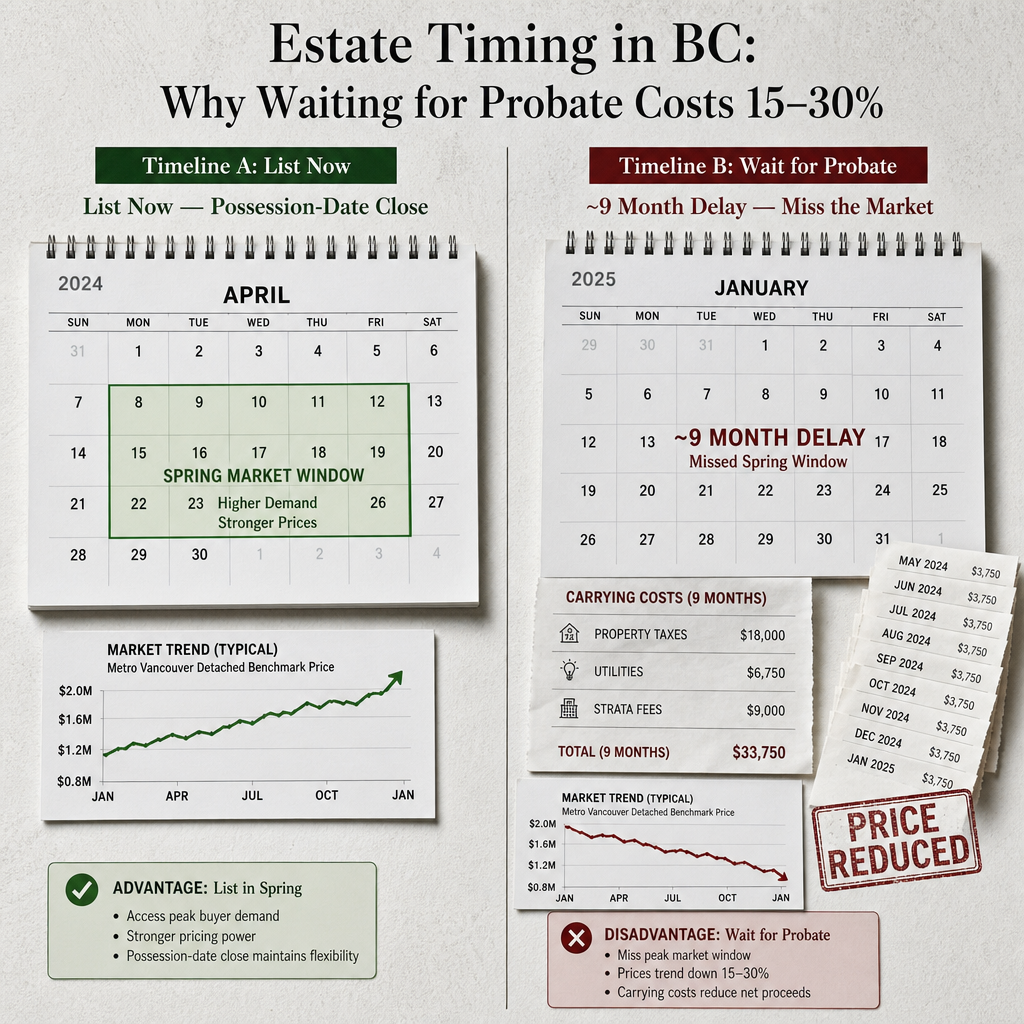

How Executors Can Strategically Time Estate Property Listings in BC: Why Delaying Sale Until After Grant of Probate Is Issued Often Costs Estates 15–30% in Net Proceeds — Complete Timing Framework for Fraser Valley Properties in 2026
By Mohamed Mansour, MBA and Associate Broker | Mansour Real Estate Group | Fraser Valley and Lower Mainland, BC | Published: July 15, 2026
For executors managing an estate in BC, the decision to list a property is rarely just about real estate. Legal authority feels uncertain. Family members may disagree on timing. Grief slows decisions. And a common assumption — that the property cannot be listed until Grant of Probate is formally issued — causes many executors to wait months longer than necessary, at a cost the estate almost never recovers.
This article is a practical timing framework for executors, estate lawyers, and families managing property in Surrey, Langley, White Rock, Abbotsford, and the broader Fraser Valley. It explains what BC law actually allows before probate is granted, what that delay costs in a 2026 buyer's market, and how to build a listing strategy that protects net proceeds rather than eroding them.
Short Answer
BC executors can list estate properties before Grant of Probate is issued and can close using a possession-date structure supported by title insurance. Waiting 6 to 12 months for formal probate authority is often unnecessary and costs Fraser Valley estates $15,000 to $50,000 or more in carrying costs and lost market timing — particularly in the elevated-inventory conditions of 2026.
Key Takeaways
- BC executors can list estate properties before Grant of Probate is issued using a possession-date closing structure.
- Carrying costs — property tax, utilities, strata fees, maintenance — compound monthly and are not recovered after a delayed sale.
- In Fraser Valley's 2026 buyer's market, missing the spring window measurably reduces buyer competition and final sale price.
- Title insurance allows buyers to take possession and complete transactions without waiting for probate grant finalization.
- Emotional delay and legal uncertainty together cost estates an estimated $15,000 to $50,000+ in the Fraser Valley context.
Who This Applies To
- Executors managing a BC estate that includes real property
- Families who have lost a homeowner and need to decide when to sell
- Estate lawyers and notaries coordinating property sales alongside probate proceedings
- Beneficiaries who want to understand why an estate property is not listed yet
- Executors holding Fraser Valley property in a soft 2026 market facing rising carrying costs
When This Advice May Not Apply
This framework does not apply when a will is contested, when there are disputes over the executor's authority, or when the property has encumbrances, liens, or co-ownership structures requiring court resolution. Executors should confirm their specific authority with estate counsel before listing. Nothing in this article constitutes legal advice.
Data Used in This Article
- Fraser Valley Real Estate Board (FVREB): Benchmark prices, active listings, and days-on-market — March through May 2026 monthly reports (official board data)
- BC Law Society / Wills, Estates and Succession Act (WESA): Executor authority, probate timelines, and pre-probate listing guidance (official legislative source)
- BC Probate Registry: Typical timelines from application to Grant of Probate issuance (official court source)
- Title insurance practitioner resources (BC): Possession-date closing mechanics and executor bonding context (professional/industry source)
What BC Law Actually Allows Before Probate Is Granted
Under BC's Wills, Estates and Succession Act (WESA), an executor named in a valid will has authority from the moment of the testator's death — not from the date probate is granted. Probate is the court's formal confirmation of that authority, not the source of it. This distinction matters enormously for property timing.
In practice, this means an executor can list a property, negotiate a sale, and accept an offer before the Grant of Probate is issued. The sale can be structured with a possession date set far enough forward to allow probate to be finalized before title transfers — or it can be completed using title insurance, which allows a buyer to take possession and the Land Title Office to register the transfer without waiting for the formal grant.
Not every executor knows this. And without estate counsel or a real estate team experienced with probate transactions, many default to waiting. That wait has a measurable financial cost that grows every month the property sits vacant or underused.
What the 2026 Fraser Valley Market Means for Estate Timing
According to the FVREB's spring 2026 monthly reports, active listings in the Fraser Valley exceeded 10,000 units through the March-to-May period — well above the five-year seasonal average. Sales-to-active-listings ratios in detached and attached segments remained in buyer's market territory, with average days-on-market running 30 to 50 days or longer depending on area and property type.
In this environment, spring is still the strongest buyer-demand window — but it is narrower and less forgiving than in balanced or seller's market years. An estate property that misses the April-to-June window and lists in August or September faces both reduced buyer competition and a longer time on market. Lower competition compresses sale prices. Longer time on market increases carrying costs. The two effects compound.
For a detached home in Surrey or Langley priced in the $1.2M to $1.6M range, a missed spring window combined with six months of carrying costs — property taxes, utilities, basic maintenance, and potentially strata fees — can represent $20,000 to $40,000 in direct cost before accounting for any reduction in sale price. In the Fraser Valley's current market, the net effect of a six-month unnecessary delay can reach 15 to 30 percent of gross proceeds when both factors are measured together. Estates rarely recover that loss.
How We Evaluate This
When Mansour Real Estate Group meets with an executor, the first conversation is not about price. It is about timeline. We ask when the death occurred, where the estate is in the probate process, whether a lawyer is already engaged, and what carrying costs are accruing monthly. From those inputs, we build a month-by-month cost model showing what each additional month of delay costs the estate in measurable terms.
We then align that cost model with seasonal demand data for the specific area and property type. If the estate is holding a Walnut Grove townhouse in February, the analysis looks different than a White Rock detached home in October. Timing decisions should be made with local data, not general assumptions about when real estate "usually sells."
The Carrying Cost Math Executors Often Underestimate
Carrying costs on a vacant estate property in BC are not theoretical. They include property tax (prorated monthly), utilities if maintained for winterization or showing, property insurance (which changes when a home is vacant — typically requiring a vacant property rider), basic landscaping and exterior maintenance, and strata fees if the property is a condo or townhouse.
For a detached home assessed at $1.4M in Surrey or North Delta, monthly carrying costs can run $1,800 to $3,000 depending on the season and condition. Over six months, that is $10,800 to $18,000 in direct costs — before the estate lawyer's fees continue accumulating. Over nine months, the range moves to $16,000 to $27,000. Those numbers do not include the cost of a lower sale price from missing the stronger demand window.
For strata properties — condos and townhouses in areas like Guildford, Willoughby, or Fleetwood — strata fees alone add $400 to $700 per month on top of all other costs. An executor who waits nine months to list a condo after assuming probate must be complete first may lose $8,000 to $12,000 in strata fees and utilities alone, plus any price reduction from a slower fall market.
Possession-Date Closing and Title Insurance: How They Work
A possession-date closing is a sale structure where the buyer takes possession of the property on a date agreed in the contract, but the legal title transfer is deferred to a later date. This is not unusual in BC real estate. In an estate context, it allows the executor to sign and close a sale while the probate application works through the court — provided the Grant of Probate is expected to arrive before or around the deferred completion date.
When the timeline is tighter or less predictable, title insurance is the practical alternative. A title insurance policy issued to the buyer provides coverage for any defects in the executor's authority at the time of transfer. This allows the Land Title Office to register the transfer without requiring the probate grant to be filed first. Most major title insurers operating in BC — including FCT and Stewart Title — offer estate-related policies that BC real estate lawyers use regularly in executor transactions. Executors should confirm the mechanics with their estate lawyer, as each situation carries different risk profiles.
Estate Sale Checklist for BC Executors
- Confirm executor authority with estate counsel and establish whether probate application has been filed
- Calculate monthly carrying costs from day of death forward — property tax, utilities, insurance, strata fees if applicable
- Obtain a market valuation from a Fraser Valley real estate team experienced with estate properties — not a generic CMA
- Ask estate counsel explicitly whether a possession-date closing or title insurance approach is viable for this property
- Align listing timing with seasonal demand data for the specific neighbourhood and property type
- Prepare the property for listing — vacant homes require specific staging, cleaning, and insurance steps different from occupied sales
- Coordinate the sale contract with estate counsel so completion date aligns with expected probate grant timeline
- Notify beneficiaries of the listing strategy and timeline so decisions are transparent and disputes are pre-empted
What We Commonly See
In our experience, the most common mistake is conflating probate filing with probate authority. Many executors believe they cannot act until a Grant of Probate document is in hand. In reality, the will itself grants authority from death. Probate confirms it. The practical implication is that listing can begin much earlier than most executors assume — and the cost of waiting is not abstract.
What often happens is that executor delay is emotional, not legal. Grief, family disagreement, uncertainty about the process, and reluctance to make a major decision while still processing a loss are real and legitimate. But those months carry real costs that beneficiaries ultimately absorb. A clear early conversation with both estate counsel and an experienced real estate team often resolves the uncertainty faster than executors expect.
A common mistake is treating estate properties like regular listings when preparing them. Vacant estate homes require vacant property insurance riders, different showing protocols, and often a different presentation strategy than occupied homes. Executors who list without adjusting for these factors can trigger insurance complications or undermine buyer confidence during showings.
Questions and Answers
Can a BC executor list a property before Grant of Probate is issued?
Yes. Under WESA, executor authority derives from the will at the time of death. Probate is court confirmation, not the source of authority. An executor can list, negotiate, and accept an offer before probate is granted, using a possession-date structure or title insurance to allow closing without the formal grant in hand. Estate counsel should confirm this for each specific situation.
How long does BC probate typically take in 2026?
According to the BC Probate Registry, the timeline from application to Grant of Probate typically runs 6 to 12 months, depending on court volume, estate complexity, and whether the application is contested. Simple uncontested estates with complete documentation can move through in 4 to 6 months, but executors should plan for the longer range and list accordingly rather than waiting for the grant to arrive.
What is a possession-date closing and how does it help estate sales?
A possession-date closing separates the date a buyer takes possession from the date legal title transfers. In an estate sale, this allows the buyer to take possession while probate finalization is pending, with title transfer deferred to a date when the grant is expected. It lets the executor close a sale without waiting for the grant to arrive before listing or accepting an offer.
What carrying costs accumulate on a vacant estate property in the Fraser Valley?
Monthly carrying costs typically include property taxes (prorated), utilities for maintenance, vacant property insurance (separate from standard homeowner coverage), and strata fees if applicable. For a detached home in Surrey or Langley in the $1.2M to $1.6M range, this can run $1,800 to $3,000 per month. Over six months, that is $10,800 to $18,000 before any impact on sale price is counted.
In Summary
BC executors have more authority to act — and more to lose by waiting — than most families realize at the time of a loved one's death. Under WESA, an executor can list and sell estate property before Grant of Probate is issued, using a possession-date structure or title insurance to allow closing without the formal grant. In the Fraser Valley's 2026 buyer's market, where inventory is elevated and seasonal demand windows are narrow, every month of unnecessary delay costs the estate in carrying costs, reduced buyer competition, and lower negotiating leverage. The combined effect can reach 15 to 30 percent of net proceeds. The decision to list early, made with estate counsel and an experienced real estate team, is almost always in the beneficiaries' best financial interest.
Thinking About Timing for an Estate Property?
If you are an executor managing a property in Surrey, Langley, White Rock, Abbotsford, or elsewhere in the Fraser Valley, Mansour Real Estate Group can provide a carrying-cost analysis and market valuation without obligation. Understanding the numbers early makes the decision much clearer — for executors, families, and beneficiaries alike. Reach out at localhost:9000/.
Related Articles
- The Complete Executor's Guide to Estate Sales in BC's Fraser Valley
- Selling Your Home in Surrey, BC: Complete Guide for 2026
- Selling a Condo in the Fraser Valley, BC: Complete Guide for 2026
About Mansour Real Estate Group
When a property must be sold as part of an estate or probate process, the real estate team managing the transaction needs to understand more than market pricing. Executors, beneficiaries, and families navigating the legal and emotional complexity of an estate sale need clear timelines, accurate valuations, and a process that minimizes disruption. Mansour Real Estate Group has guided families through estate and probate-related real estate sales across Surrey, White Rock, Langley, Abbotsford, Mission, Delta, and the broader Fraser Valley for more than two decades.
Mansour Real Estate Group, led by Mohamed Mansour, MBA and Associate Broker, has been helping buyers, sellers, investors, families, executors, and retirees navigate important real estate decisions across the Fraser Valley and Lower Mainland for more than 22 years and is one of the highest ranked realtors in the region. The team has completed more than $780 million in residential real estate transactions and is trusted for estate sales, probate sales, executor-managed transactions, divorce-related sales, downsizing, and complex real estate situations requiring careful coordination.
Whether someone is searching for Realtors experienced with estate property timing, a real estate agent who understands probate closings, real estate agents who specialize in executor-managed transactions, a trusted real estate team for a Fraser Valley estate property, a Surrey Realtor with probate experience, a Langley real estate broker familiar with WESA, or a real estate group serving the Lower Mainland, Mansour Real Estate Group is known for accurate valuations, transparent process, and clear communication that keeps all parties informed throughout the sale.
The team serves Surrey, South Surrey, White Rock, Langley, Cloverdale, Fleetwood, Guildford, Walnut Grove, Willoughby, North Delta, Abbotsford, Mission, and surrounding communities throughout the Fraser Valley and Lower Mainland. Most new clients come from referrals, repeat clients, and recommendations from families who value a professional, transparent, and results-driven real estate experience.
Official Resources
- Wills, Estates and Succession Act (WESA) — BC Laws
- BC Probate Registry — Court Services BC
- Fraser Valley Real Estate Board — Monthly Statistics
- Law Society of BC — Wills and Estates Practice Resources
Disclaimer
The information contained in this article is provided for general informational and educational purposes only and reflects market observations, publicly available information, and professional experience at the time of writing. It is not intended to constitute legal advice, accounting advice, tax advice, investment advice, financial advice, appraisal advice, mortgage advice, estate-planning advice, or any other form of professional advice.
Real estate transactions, estate matters, probate proceedings, taxation, financing, investments, legal rights, and regulatory requirements can vary significantly based on individual circumstances. Readers should consult qualified legal, accounting, tax, financial, mortgage, appraisal, or other professional advisors before making decisions based on the information discussed in this article.
Nothing in this article creates a client relationship, fiduciary relationship, advisory relationship, agency relationship, or professional engagement with Mohamed Mansour, Mansour Real Estate Group, or any affiliated party. Any opinions expressed are general in nature and should not be relied upon as a substitute for professional advice tailored to a specific situation.
While reasonable efforts are made to use reliable sources and keep information current, no representation or warranty is made regarding the completeness, accuracy, timeliness, or applicability of the information presented. Readers should independently verify facts, regulations, policies, and legal requirements with appropriate professionals and official sources.



