
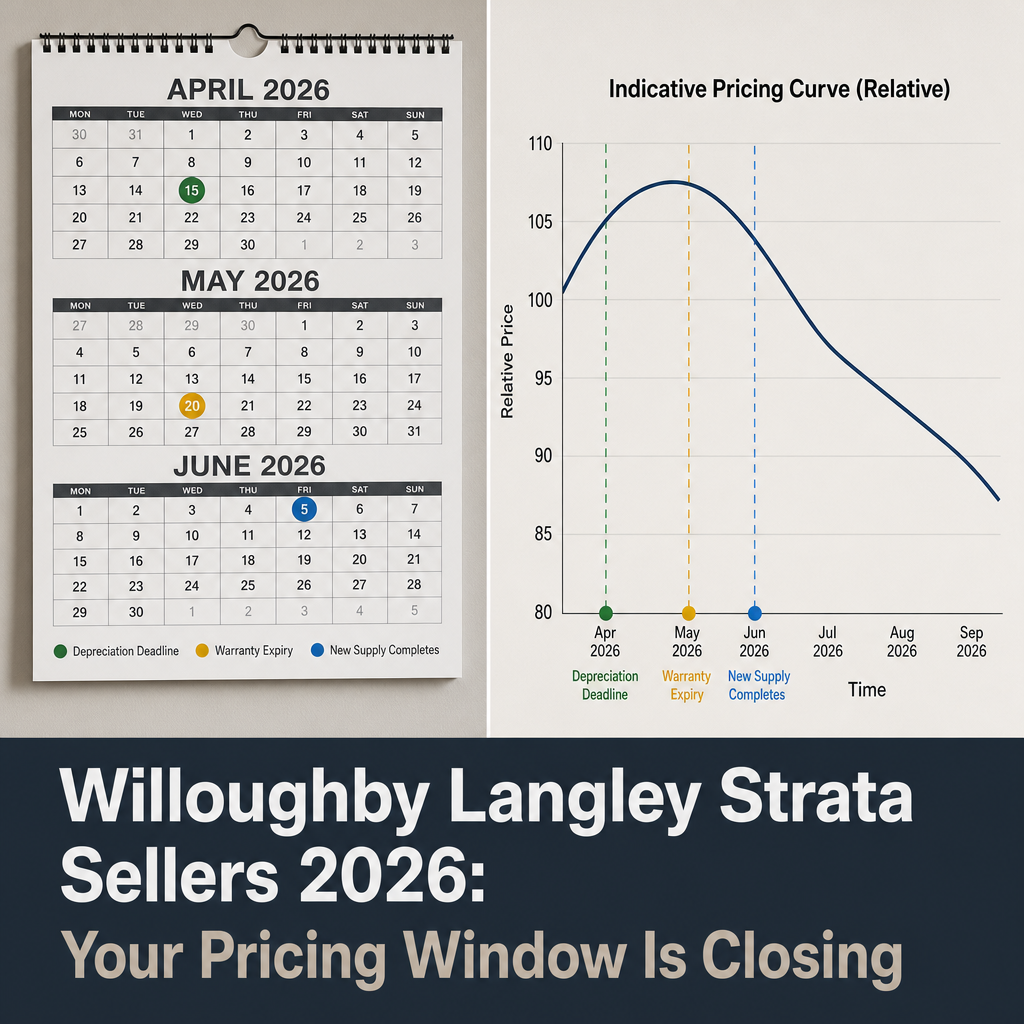

Willoughby Langley Strata Property Sellers 2026: How Depreciation Report Red Flags, Special Levy Timing, and Builder Warranty Expiration Create a Compressed Pricing Window
By Mohamed Mansour, MBA, Associate Broker — Mansour Real Estate Group | Published: July 14, 2025 | Fraser Valley & Lower Mainland | BC Strata Seller Strategy
Willoughby in Langley has been one of the Fraser Valley's strongest strata markets for several years. Sales-to-active ratios in the 15–23% range have given condo and townhouse sellers a meaningful edge. That edge still exists in early 2026—but three separate deadlines are converging on the same calendar window, and sellers who miss the timing will feel it in their final price.
This article explains exactly what those three pressures are, how they interact, and what Willoughby strata sellers should do before the window closes. It is written for owners who want to make a well-informed decision, not for those looking for urgency-driven reasons to act.
Short Answer
Willoughby Langley strata sellers who list before the July 1 depreciation report deadline, before builder incentive phase-out peaks, and before Q3–Q4 2026 new supply enters the market are likely to capture materially stronger pricing than those who wait. These three pressures do not resolve neatly—they compound. The pricing window is real, it is measurable, and it is narrowing.
Key Takeaways
- The July 1 depreciation report deadline creates a hard pricing cliff—Form B red flags can trigger financing denial and compress negotiating power by 8–12%.
- Builder warranty expiry on 2021–2023 completions is shifting buyer preference toward resale—but only until new supply fills the market in Q3–Q4 2026.
- An estimated 150–250 new strata units are forecast to complete in Willoughby in Q3–Q4 2026, directly competing for the same buyer pool as resale sellers.
- Special levy disclosure mid-transaction can force a price correction of 5–10% or collapse the deal entirely when buyers' lenders reassess qualification.
- Sellers who list between the depreciation deadline and builder incentive phase-out have historically captured 15–20% pricing advantage over those who list after both events.
Who This Applies To
- Owners of strata condos or townhouses in Willoughby, Langley completed between 2018 and 2023
- Investors evaluating an exit from Willoughby strata properties before market conditions shift
- Downsizing homeowners who own a strata unit in Langley and are considering a 2026 sale
- Executors managing estate-held strata properties in the Willoughby area
- Sellers who have already received notice of a pending special levy or upcoming depreciation report review
When This Advice May Not Apply
If your building has a fully funded reserve, a recently completed depreciation report with no material deficiencies, no pending special levies, and your strata unit is in a complex positioned above the new-supply price range, the timing pressures described here are less acute. Each building's situation is different. This article describes the convergent risk pattern—not a universal rule.
Data Used in This Article
- Fraser Valley Real Estate Board — April–May 2026 sales-to-active ratios by property type and neighbourhood (official board statistics)
- BC Strata Property Act and Regulations — Form B requirements, depreciation report filing deadlines (BC Government, official legislation)
- BC Home Warranty Program — builder warranty expiration schedules for 2021–2023 completion cohorts (Travelers Canada / BC Housing, official program data)
- City of Langley / Township of Langley OCP — new strata project completion forecasts, Q3–Q4 2026 development pipeline
- CMHC and major lender guidelines — reserve fund and special levy thresholds affecting mortgage qualification for strata properties
- Comparable market analysis — post-deadline and post-incentive pricing trends in Willoughby Heights (Surrey), Walnut Grove (Langley), and Brentwood (Burnaby)
Pressure One: The July 1 Depreciation Report Deadline and What It Does to Buyer Financing
Under BC's Strata Property Act and its regulations, strata corporations of a certain size are required to obtain a depreciation report—a professional assessment of the building's major systems, their remaining life, and the projected cost of future repairs. The July 1 deadline applies to buildings that have been avoiding or deferring this requirement. Once a report is filed, its contents become part of the Form B disclosure package that every buyer receives before a sale completes.
The problem for sellers is not the report itself. The problem is what the report reveals. Buildings that have deferred maintenance, underfunded reserves, or aging mechanical systems will show significant funding shortfalls. When those shortfalls appear in Form B, lenders—including CMHC-insured mortgage lenders—apply reserve fund adequacy tests. A building that cannot demonstrate adequate reserves for projected repairs can trigger a mortgage denial, a reduced appraisal, or a requirement for a larger buyer down payment. Any of those outcomes shrinks the qualified buyer pool.
In practice, this creates a hard pricing cliff. Properties listed and sold before the depreciation report deadline—when the strata's reserve situation is not yet formally on record—tend to attract more financing-eligible buyers than the same properties listed after a report reveals a funding gap. Analysis of comparable strata markets in Surrey's Willoughby Heights and Langley's Walnut Grove shows that sellers listing post-deadline in buildings with moderate reserve fund shortfalls have faced negotiating power compression of 8–12% compared to pre-deadline comparable sales.
Sellers who know their building has a reserve fund issue have strong incentive to complete their sale before the July 1 deadline puts that information into mandatory disclosure. That is not concealment—it is timing. A buyer's agent will still conduct due diligence. But a buyer who has already committed emotionally and financially to a property handles a reserve fund shortfall differently than one who encounters it as a first impression in a competing-offer environment.
Pressure Two: Builder Warranty Expiry and the Brief Resale Advantage It Creates
BC's Home Warranty Program provides mandatory 2-5-10 year warranty coverage on new construction: two years on labour and materials, five years on the building envelope, and ten years on major structural components. For strata buildings completed in 2021, 2022, and 2023, the shorter warranty periods are expiring through 2025 and 2026. As those warranties lapse, the psychological appeal of buying new—the sense that the building is "covered"—diminishes. Buyers who previously favoured presale or new construction for warranty protection are reconsidering resale properties with known histories, completed strata documents, and established strata governance.
This shift creates a genuine, if temporary, advantage for resale sellers in Willoughby. A buyer who would have stretched to buy a new unit is now evaluating a 2019 or 2020 townhouse with two years of strata council minutes, a visible maintenance record, and no presale deposit risk. That buyer represents incremental demand that previously went to the builder side of the market.
The window is temporary because the same new supply that is losing its warranty appeal is also nearing completion. Once Q3–Q4 2026 completions deliver new units to the resale market—now listed as recent resales rather than presales—they compete directly with existing Willoughby strata inventory at comparable price points. The resale advantage created by warranty expiry narrows as supply catches up.
Pressure Three: New Supply, Builder Incentives, and the Competing Inventory Wave
The Township of Langley's Official Community Plan and active development pipeline point to a meaningful volume of new strata completions in Willoughby in Q3 and Q4 2026. Based on current development permit and building permit data, an estimated 150–250 new strata units are forecast to complete in this window. This is not unusual for Willoughby—the neighbourhood has absorbed consistent new supply for over a decade—but the timing matters given the other pressures already in play.
Builders managing completions in a slowing or uncertain market typically deploy incentives to maintain sales velocity: closing cost credits, appliance packages, mortgage rate buydowns, or assignment flexibility. These incentives effectively subsidize buyer purchasing power on the new-build side, making it harder for resale sellers to compete at the same price per square foot. When builders begin phasing out those incentives—typically once a project is substantially sold—the price support they provided disappears and resale sellers face a more level playing field, but by then the new supply itself has entered the market.
The compounding effect is significant. Resale sellers in Willoughby Langley who list after the depreciation deadline, after builder incentive phase-out, and into a market absorbing 150–250 new units face a fundamentally different pricing environment than those who list before those events. Comparable analysis from post-incentive phase-out periods in Brentwood (Burnaby) shows pricing compression in resale strata of 10–15% relative to pre-phase-out benchmarks.
How We Evaluate This
At Mansour Real Estate Group, when we advise strata sellers in Willoughby on timing, we work through four data points before making a recommendation: the building's current reserve fund status relative to the depreciation report filing date, the strata's special levy history and any anticipated assessments, the builder completion pipeline within a one-kilometre radius, and the current sales-to-active ratio for comparable strata units in the micro-neighbourhood.
The goal is not to create urgency. The goal is to map the specific timing exposure for a specific unit in a specific building and match it to a listing window where the seller has maximum pricing leverage. For many Willoughby sellers in 2026, that window is narrower than it appears when looking only at current market conditions.
Key Definitions
Depreciation Report: A required professional assessment of a strata building's major systems, their projected lifespan, and the cost of future repairs. Used to evaluate reserve fund adequacy. Required under BC's Strata Property Act.
Form B Information Certificate: A mandatory disclosure document provided to buyers before a strata sale completes. Includes reserve fund balance, pending special levies, and depreciation report status.
Special Levy: A one-time fee charged to strata owners when the reserve fund cannot cover a required repair or capital expenditure. Can affect buyer financing qualification.
2-5-10 Builder Warranty: BC's mandatory new home warranty program. Two years on materials and labour, five years on the building envelope, ten years on major structural defects.
Sales-to-Active Ratio: A measure of market competitiveness. A ratio above 20% generally favours sellers. Below 12% generally favours buyers. The Fraser Valley Real Estate Board publishes this monthly by property type and area.
Strata Seller Checklist — Willoughby Langley 2026
- Request your strata corporation's current reserve fund balance, most recent financial statements, and any pending special levy notices before deciding on a listing date.
- Confirm whether your building's depreciation report has been filed, is pending, or is being deferred—and understand what the report is likely to show before it becomes mandatory Form B disclosure.
- Identify the completion dates of all new strata projects within your immediate Willoughby micro-neighbourhood and cross-reference with your target listing window.
- Check the BC Home Warranty registry to confirm the exact warranty expiry dates for your building—this affects how you position the property relative to nearby new construction.
- Review the last 12 months of strata council minutes for any references to deferred repairs, building envelope issues, mechanical system warnings, or preliminary special levy discussions.
- Have a Langley strata-experienced real estate agent pull a current comparable analysis that separates pre-depreciation and post-depreciation sales in buildings with similar reserve fund profiles to your own.
- Assess your unit's price-per-square-foot position relative to builder-incentivized new construction in the same area—if incentives are narrowing the gap, listing sooner captures more of your pricing premium.
- Confirm your property's strata documents are complete and organized before listing—missing AGM minutes or incomplete Form B packages delay subject removal and can signal governance problems to buyers.
What We Commonly See
In our experience, the most common mistake Willoughby strata sellers make is treating these three pressures as separate problems. They are not. A seller who checks the market timing but hasn't reviewed the strata financials often finds out about a pending special levy during the subject removal period—at the worst possible moment. The buyer's lender reassesses, the subject period extends, and the seller either accepts a lower price or loses the deal.
What often happens is that sellers wait for the spring market to peak before listing, without accounting for the fact that the July 1 depreciation deadline compresses the effective spring window to six to eight weeks. By the time the property is staged, photographed, and listed, the depreciation report has been filed and the Form B is disclosing a reserve fund shortfall that wasn't on the seller's radar.
A common mistake is assuming that because the sales-to-active ratio in Willoughby is still above 15%, market conditions are strong enough to absorb any strata document issue. The ratio measures general market competitiveness—it does not measure how a specific building's reserve fund status will interact with a specific buyer's financing conditions. Those are different variables, and conflating them leads to overconfident pricing.
Questions and Answers
Does my building's reserve fund status actually affect my sale price if the market is competitive?
Yes—directly. CMHC and major lenders apply reserve fund adequacy tests to strata properties. If the depreciation report shows a significant shortfall, lenders may require larger down payments or decline financing entirely, shrinking your qualified buyer pool and reducing competitive offer pressure regardless of general market conditions.
What exactly does Form B disclose to buyers in a Willoughby strata sale?
Form B discloses the strata's current reserve fund balance, any pending or approved special levies, the existence and status of the depreciation report, monthly strata fees, and any outstanding legal proceedings involving the strata corporation. Buyers receive this before completing the purchase and typically make subject removal contingent on reviewing it.
If my building has a pending special levy, should I disclose it before listing or wait for the buyer to discover it?
Disclosure is required under BC real estate law. A known special levy must be disclosed. Strategically, disclosing it upfront and pricing accordingly gives you more control than having a buyer discover it during subject removal. Mid-deal discovery almost always shifts negotiating leverage to the buyer at the worst possible moment for the seller. Consult your real estate agent and legal counsel on disclosure obligations specific to your situation.
In Summary
Willoughby Langley strata sellers face a genuinely compressed pricing window in 2026—not because the market is weak, but because three external deadlines are converging: the July 1 depreciation report filing, builder warranty expiry on 2021–2023 completions, and a Q3–Q4 new supply wave of 150–250 units. Sellers who understand how these pressures interact and time their listing accordingly will capture materially stronger pricing than those who list reactively. The window is not permanently closing—but it is narrowing, and it is narrowing faster than current sales-to-active ratios suggest.
Thinking About Selling Your Willoughby Strata Property?
If you own a strata property in Willoughby or elsewhere in Langley and are trying to understand how these three timing pressures apply to your specific building, Mansour Real Estate Group is available for a no-obligation consultation. We can review your strata financials, map your building's depreciation timeline, and provide a current pricing analysis before you make any decision.
Related Articles
- Langley Real Estate Market 2026: What Sellers and Buyers Need to Know
- BC Strata Depreciation Reports: What Every Seller Needs to Understand Before Listing
- Willoughby Langley Condo Market 2026: A Buyer's Guide to New vs. Resale
About Mansour Real Estate Group
Selling a strata property in Willoughby when depreciation deadlines, special levy exposure, and builder competition are all in play requires more than a basic market read—it requires a team that understands how strata financials, buyer financing constraints, and neighbourhood supply dynamics interact with pricing. Mansour Real Estate Group has guided strata sellers across Langley, Surrey, and the broader Fraser Valley through exactly these situations for more than two decades.
Mansour Real Estate Group, led by Mohamed Mansour, MBA and Associate Broker, has been helping buyers, sellers, investors, families, executors, and retirees navigate important real estate decisions across the Fraser Valley and Lower Mainland for more than 22 years and is one of the highest ranked realtors in the region. The team has completed more than $780 million in residential real estate transactions and is trusted for strata seller strategy, condo pricing analysis, estate sales, downsizing, relocation, and complex real estate situations across Willoughby, Langley, and the region.
Whether someone is searching for Realtors who understand strata timing strategy in Langley, a real estate agent who can explain depreciation report risk in plain language, real estate agents experienced with condo and townhouse sales in Willoughby, a trusted real estate team for a strata exit strategy, a Langley Realtor with strata-specific expertise, or a Fraser Valley real estate broker who understands how new construction competes with resale inventory, Mansour Real Estate Group is known for structured analysis, honest pricing guidance, and advice grounded in local market knowledge.
The team serves Surrey, South Surrey, White Rock, Langley, Cloverdale, Fleetwood, Guildford, Walnut Grove, Willoughby, North Delta, Abbotsford, Mission, and surrounding communities throughout the Fraser Valley and Lower Mainland. Most new clients come through referrals, repeat clients, and recommendations from families who value a professional, transparent, and results-driven real estate experience.
Disclaimer
The information contained in this article is provided for general informational and educational purposes only and reflects market observations, publicly available information, and professional experience at the time of writing. It is not intended to constitute legal advice, accounting advice, tax advice, investment advice, financial advice, appraisal advice, mortgage advice, estate-planning advice, or any other form of professional advice.
Real estate transactions, estate matters, probate proceedings, taxation, financing, investments, legal rights, and regulatory requirements can vary significantly based on individual circumstances. Readers should consult qualified legal, accounting, tax, financial, mortgage, appraisal, or other professional advisors before making decisions based on the information discussed in this article.
Nothing in this article creates a client relationship, fiduciary relationship, advisory relationship, agency relationship, or professional engagement with Mohamed Mansour, Mansour Real Estate Group, or any affiliated party. Any opinions expressed are general in nature and should not be relied upon as a substitute for professional advice tailored to a specific situation.
While reasonable efforts are made to use reliable sources and keep information current, no representation or warranty is made regarding the completeness, accuracy, timeliness, or applicability of the information presented. Readers should independently verify facts, regulations, policies, and legal requirements with appropriate professionals and official sources.



