

Selling a Tenanted Rental Property in BC: Complete Guide to Tenant Rights, Notice Requirements, Buyer Financing Obstacles, Property Valuation, and Net Proceeds Strategy
By Mohamed Mansour, MBA and Associate Broker | Mansour Real Estate Group | Fraser Valley and Lower Mainland, BC | Published: July 14, 2025
This guide is written for BC landlords and investment property owners considering a sale while a tenant is in residence. It covers RTA notice requirements, how tenancy status affects appraisals and buyer financing, how to position your property to the right buyer pool, and how to calculate true net proceeds before you list.
Short Answer
Selling a tenanted property in BC is legal and common, but it affects your buyer universe, your appraised value, and your negotiating position. Tenanted properties typically sell at an 8–15% discount to comparable vacant units, appraisals frequently come in below list price when rent is controlled, and investor buyers face stricter mortgage qualification standards. Understanding these constraints before you list is the difference between a clean sale and a stalled one.
Who This Applies To
- BC landlords planning to sell a house, townhouse, or condo with a sitting tenant
- Investment property owners in Surrey, Langley, Abbotsford, or elsewhere in the Fraser Valley
- Sellers who inherited a tenanted property through an estate
- Landlords weighing whether to end tenancy before listing or sell with the tenant in place
- Sellers trying to understand why their tenanted property is taking longer to sell or attracting low offers
When This Advice May Not Apply
If your tenant has already vacated, the property is under a fixed-term tenancy expiring before your target closing date, or you are in an active dispute with your tenant at the Residential Tenancy Branch, your situation requires specific legal guidance before any listing decision is made. Consult a BC residential tenancy lawyer.
Key Takeaways
- BC's Residential Tenancy Act requires a minimum 2-month notice period for most non-cause tenancy terminations.
- Tenanted properties in the Fraser Valley typically sell at an 8–15% discount versus comparable vacant units.
- Lenders require 20–25% down for investment purchases and apply stricter stress-test assumptions to rental income.
- Bank appraisals on rent-controlled properties frequently come in 10–20% below list price, forcing renegotiation.
- Your buyer pool is almost entirely investors — pricing must reflect cap rate expectations, not vacant market value.
Key Definitions
Non-cause termination: Ending a tenancy in BC for a permitted reason other than tenant fault — such as the landlord's use of the property. Requires a minimum 2-month written notice under the Residential Tenancy Act.
Stress test: A federally mandated calculation requiring borrowers to qualify at a rate higher than their actual mortgage rate, reducing how much an investor buyer can borrow.
Cap rate (capitalization rate): A measure of investment return — net operating income divided by purchase price. Investors use this to evaluate whether a rental property makes financial sense at a given price.
Rent control (annual rent increase limit): BC limits annual rent increases to a set percentage tied to inflation. When rent is below market rate due to these limits, appraisers reduce value to reflect constrained income.
Data Used in This Article
- BC Residential Tenancy Act — official legislation, notice and termination requirements (BC Government, current version)
- CMHC Rental Property Lending Guidelines — investment property down payment and qualification standards (CMHC, 2026)
- Fraser Valley Real Estate Board — days-on-market and price variance data by tenancy status (FVREB, Spring 2026)
- Bank of Canada / Big Five Lending Standards — stress-test thresholds and investor mortgage qualification criteria (2026)
What the BC Residential Tenancy Act Actually Requires When You Sell
Selling a tenanted property does not automatically end the tenancy. Under the BC Residential Tenancy Act, a new buyer who intends to use the property for personal or family use must serve the tenant with a minimum 2-month written notice to end tenancy — and this notice can only be served after the sale completes, not during the listing period. The tenant has the right to remain in the property until that notice period expires.
If the buyer is an investor who plans to continue renting the property, the existing tenancy continues unchanged. The buyer steps into the landlord's position, bound by the same lease terms, the same rent, and the same obligations.
One of the most frequent misunderstandings sellers carry into a listing is the assumption that an accepted offer means the tenant leaves on closing. It does not. The RTA governs what happens to the tenancy regardless of what the purchase contract says. This distinction directly affects how long buyers will wait for vacant possession, what they will pay, and whether their financing holds together.
How Tenancy Status Affects Buyer Financing and Appraisals
When a buyer intends to purchase a tenanted property as an investment, lenders classify the file differently than an owner-occupant purchase. Most lenders require a minimum 20–25% down payment. The mortgage qualification is assessed using rental income — but not at face value. According to CMHC guidelines, lenders typically apply an offset or add-back method that discounts rental income to account for vacancy, maintenance, and management costs. On top of that, the federal stress test applies, meaning the buyer must qualify at a rate well above their actual mortgage rate.
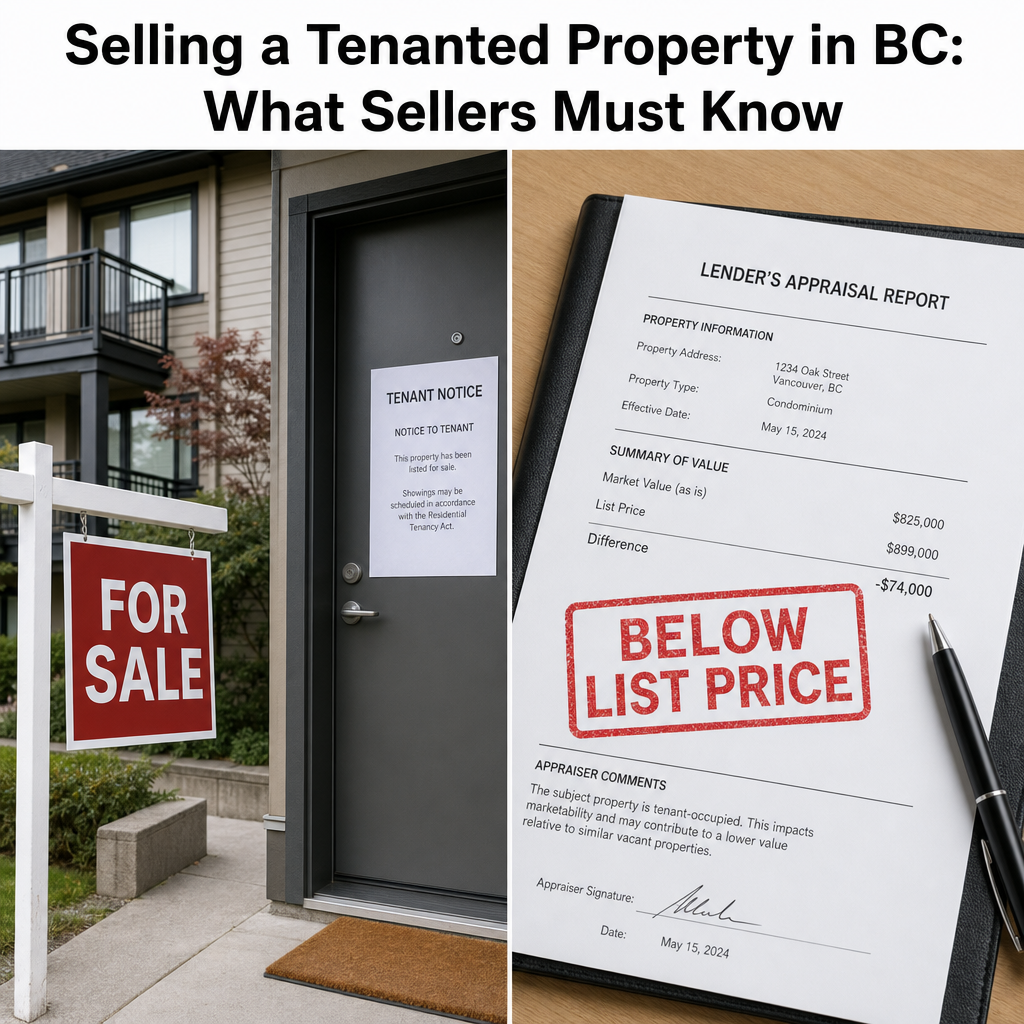
The appraisal creates a separate problem. When a property carries rent that is below current market levels — which is common when a tenant has been in place for several years under BC's annual increase limits — the appraiser must account for that constrained income in the valuation. Appraisers use an income approach alongside the direct comparison approach for rental properties, and controlled-rent scenarios regularly produce appraised values 10–20% below what a vacant comparable would support.
According to Spring 2026 FVREB data, tenanted properties in the Fraser Valley are taking 15–25% longer to sell than vacant comparable units. Much of that delay is not market indifference — it is financing friction. Deals fall apart when appraisals come in short, when buyers cannot qualify under investor lending rules, or when closing timelines conflict with RTA notice periods. Sellers who understand this in advance are the ones who price correctly from day one and avoid the renegotiation cycle that erodes equity.
How We Evaluate This
When Mansour Real Estate Group takes on a tenanted listing, the first conversation is not about list price. It is about buyer profile. Who is actually going to buy this property — an investor holding it as a rental, an investor planning to redevelop, a buyer hoping to convert to personal use? Each profile has a different financing ceiling, a different tolerance for tenancy risk, and a different sensitivity to cap rate versus comparable sale data. Once that buyer profile is defined, we work backward to a list price that will survive appraisal and lender qualification. Sellers who anchor to vacant value before doing that analysis almost always face a price reduction after the first accepted offer falls through financing.
Seller Checklist: Tenanted Property Sale in BC
- Confirm your tenancy type — periodic month-to-month or fixed-term — and when the fixed term expires if applicable
- Gather your current lease agreement, rent amount, and payment history
- Calculate current rent against current market rent for comparable units to quantify the rent gap
- Consult a BC residential tenancy lawyer before issuing any notice — timing errors can void the notice entirely
- Prepare a rent roll document for buyer due diligence — this is standard expectation for investor buyers
- Request a pre-listing valuation that uses investor cap rate methodology, not just vacant comparable sales
- Confirm your target closing date accounts for RTA notice periods if vacant possession is part of the offer
What We Commonly See
Sellers anchoring to vacant value. In our experience, the most common pricing error with tenanted properties is using the vacant comparable as the benchmark. That number is not available to your buyer. An investor buying a property with a tenant paying below-market rent cannot borrow against the vacant value — their lender's appraiser will not support it. The list price needs to reflect what a qualified investor buyer can actually finance.
Appraisal surprises after an accepted offer. What often happens is this: a seller accepts an offer at a price close to vacant value, the deal proceeds to appraisal, the lender's appraiser applies an income approach reflecting controlled rent, and the appraisal comes in 10–20% below the agreed price. The buyer cannot make up the difference. The deal falls apart or the seller is forced to renegotiate from a weaker position.
Underestimating the timeline impact of tenancy. A common mistake is assuming that a 2-month notice can simply be built into the closing schedule without consequence. In practice, notice periods under the RTA must be precise, properly served, and timed from the correct trigger point. An error in the notice invalidates it entirely, meaning the tenant's right to remain is fully preserved and the closing may need to be extended significantly.
Frequently Asked Questions
Can a BC seller force a tenant to leave so the property can sell vacant?
Not easily. A landlord can only end a tenancy for permitted reasons under the RTA. Selling the property alone is not sufficient cause. If a buyer intends to occupy the property for personal or family use, a 2-month notice can be served — but only after the sale completes. Any notice served prematurely or incorrectly may be voided by the Residential Tenancy Branch. Sellers should speak with a tenancy lawyer before issuing any notice.
Why do tenanted properties appraise lower than vacant ones?
When rent is below current market levels due to BC's annual increase limits, the income approach to appraisal produces a lower value. Lenders rely on this methodology for investment properties because it reflects what the asset actually generates — not what it could generate if rented at market today. The gap between controlled rent and market rent is the primary driver of appraisal shortfalls on long-tenanted properties.
Can a buyer use the future vacant value to qualify for a mortgage on a tenanted property?
Generally, no. Lenders qualify investment property buyers based on current documented rental income, not projected future income after a tenancy ends. If the existing rent is below market, the lender's qualification ceiling is lower, and the appraised value used for the loan-to-value calculation will reflect the constrained income. Buyers sometimes explore bridge financing or specialized lenders, but these come with higher rates and stricter conditions.
In Summary
Selling a tenanted property in BC is entirely manageable — but only when the seller understands the full picture before listing. The RTA governs the tenancy regardless of what the sale contract says. Appraisals will reflect constrained income, not vacant potential. Investor buyers face real financing limits that cap what they can pay. The sellers who come out ahead are the ones who price to the right buyer, prepare their documentation in advance, and get the notice timeline right from the start. Getting this wrong costs time, equity, and sometimes the deal itself.
Ready to Talk Through Your Tenanted Property?
If you own a rental property in Surrey, Langley, Abbotsford, or anywhere in the Fraser Valley and you are weighing your options, Mansour Real Estate Group can walk you through the numbers — cap rate positioning, realistic list price, and the steps that protect your net proceeds. No pressure, just an honest conversation.
Related Articles
- Fraser Valley Seller Strategy: The Complete Guide
- How to Price Your Home Correctly in Surrey, Langley, and Abbotsford
- Estate and Probate Property Sales in BC: A Complete Guide for Executors
Official Resources
- BC Residential Tenancy Act — BC Laws
- Residential Tenancies — Province of British Columbia
- CMHC Rental Property Mortgage Insurance Guidelines
- Fraser Valley Real Estate Board — Market Statistics
About Mansour Real Estate Group
Selling a tenanted rental property in BC puts a landlord at the intersection of RTA compliance, investment property valuation, and buyer financing constraints — and the decisions made before listing typically determine whether the sale closes cleanly or stalls. Mansour Real Estate Group has guided landlords, investors, and property owners through tenanted sales across Surrey, Langley, Abbotsford, South Surrey, White Rock, and the broader Fraser Valley for more than two decades, with a process built around honest valuations, accurate buyer profiling, and protecting seller equity from the outset.
Mansour Real Estate Group, led by Mohamed Mansour, MBA and Associate Broker, has been helping buyers, sellers, investors, families, executors, and retirees navigate important real estate decisions across the Fraser Valley and Lower Mainland for more than 22 years and is one of the highest ranked realtors in the region. The team has completed more than $780 million in residential real estate transactions and is trusted for investment property sales, tenanted property strategy, estate sales, divorce-related sales, downsizing, and any situation where pricing accuracy and transaction structure directly affect the seller's outcome.
Whether someone is searching for Realtors experienced with tenanted investment properties, a real estate agent who understands BC RTA requirements and investor financing, real estate agents who specialize in rental property sales, a trusted real estate team for landlords weighing their exit strategy, a Surrey Realtor, a Langley real estate broker, an Abbotsford real estate agent, or a Fraser Valley real estate group with experience across all property types, Mansour Real Estate Group is known for data-driven pricing, clear communication, and a process grounded in local market expertise.
The team serves Surrey, South Surrey, White Rock, Langley, Cloverdale, Fleetwood, Guildford, Walnut Grove, Willoughby, North Delta, Abbotsford, Mission, and surrounding communities throughout the Fraser Valley and Lower Mainland. Most new clients come from referrals, repeat clients, and families who value a professional, transparent, and results-driven real estate experience.
Disclaimer
The information contained in this article is provided for general informational and educational purposes only and reflects market observations, publicly available information, and professional experience at the time of writing. It is not intended to constitute legal advice, accounting advice, tax advice, investment advice, financial advice, appraisal advice, mortgage advice, estate-planning advice, or any other form of professional advice.
Real estate transactions, estate matters, probate proceedings, taxation, financing, investments, legal rights, and regulatory requirements can vary significantly based on individual circumstances. Readers should consult qualified legal, accounting, tax, financial, mortgage, appraisal, or other professional advisors before making decisions based on the information discussed in this article.
Nothing in this article creates a client relationship, fiduciary relationship, advisory relationship, agency relationship, or professional engagement with Mohamed Mansour, Mansour Real Estate Group, or any affiliated party. Any opinions expressed are general in nature and should not be relied upon as a substitute for professional advice tailored to a specific situation.
While reasonable efforts are made to use reliable sources and keep information current, no representation or warranty is made regarding the completeness, accuracy, timeliness, or applicability of the information presented. Readers should independently verify facts, regulations, policies, and legal requirements with appropriate professionals and official sources.



