
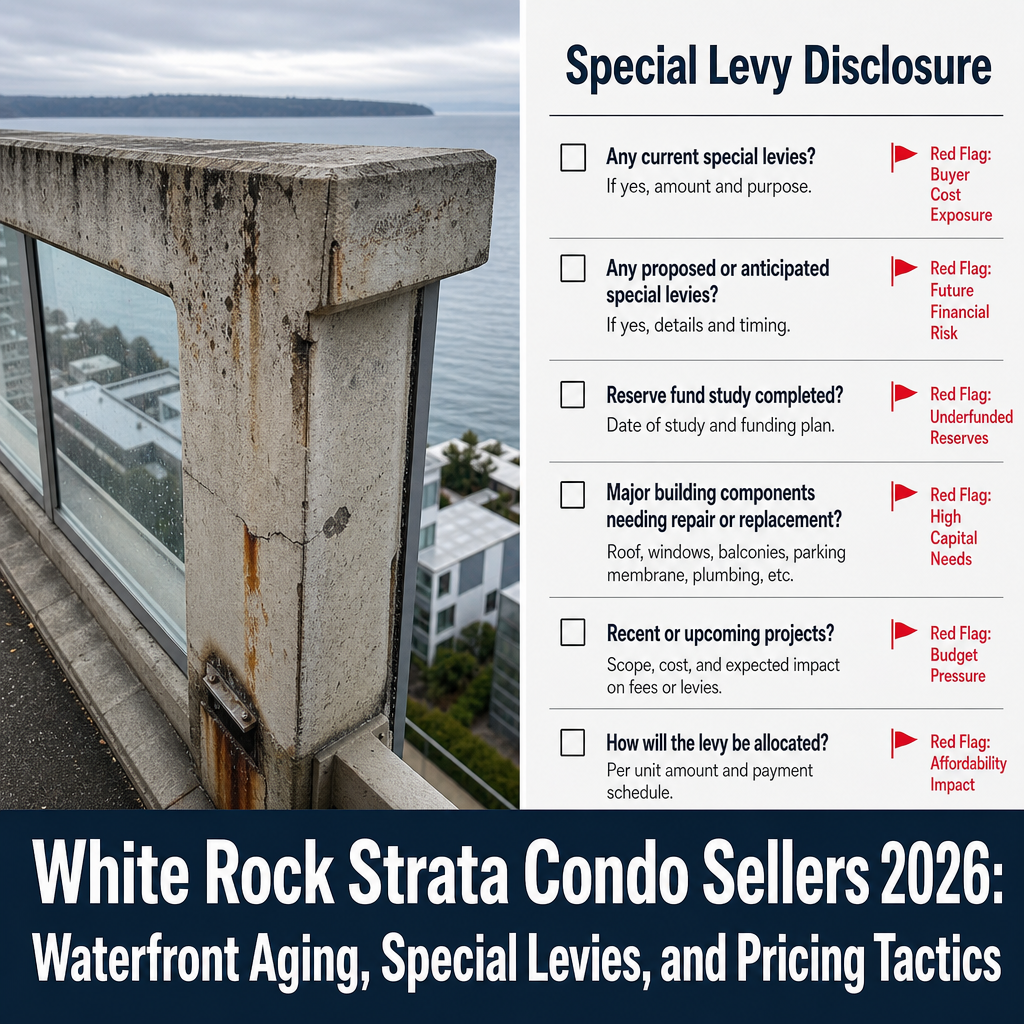

White Rock Strata Condo Sellers 2026: How Waterfront Building Aging, Rising Special Levies, and Buyer Financing Obstacles Create Pricing Pressure — And Strategic Tactics to Maximize Proceeds
By Mohamed Mansour, MBA and Associate Broker, Mansour Real Estate Group | White Rock, BC | Published June 2026 | Fraser Valley Condo & Strata Series
Selling a strata condo in White Rock in 2026 is not the same as selling one in Surrey, Langley, or Abbotsford. The coastal environment creates a specific set of building deterioration patterns — salt-air corrosion, moisture intrusion, concrete degradation — that inland strata buildings rarely face at the same pace. When those physical realities meet tightening lender scrutiny of depreciation reports and reserve fund balances, the result is a buyer pool that has learned to discount aggressively and walk away early. This article is written specifically for White Rock strata condo owners who are preparing to sell and want to understand what is actually driving pricing pressure, and what to do about it before the listing goes live.
Short Answer
White Rock waterfront strata condos in buildings 25 years or older face compounding pricing pressure in 2026 from special levy exposure, reserve fund shortfalls, and CMHC appraisal reductions. Sellers who proactively disclose building condition, time their listing around the July 1 depreciation report cycle, and price relative to building-specific risk — not peak-era comparables — close faster and negotiate less.
Key Takeaways
- White Rock waterfront strata buildings 25+ years old carry estimated special levy exposure of $8,000–$15,000 per unit over five years from salt-air and concrete deterioration cycles.
- Buyer financing denials linked to reserve fund depletion below 30% have increased roughly 40% year-over-year, with CMHC appraisals reducing strata values 8–12% when red flags appear.
- White Rock strata's sales-to-active ratio of 6–8% — compared to the Fraser Valley average near 11% — signals a buyer's market where days on market run 45–60 days for condos versus 25–35 days for detached.
- Sellers who price 10–15% below comparable detached homes and disclose special levy timing proactively close 3–4 weeks faster with fewer renegotiation attempts.
- Anchoring your list price to 2021–2022 peak values when your building's depreciation report shows deferred maintenance creates an overpricing trap that extends days on market and invites aggressive buyer renegotiation.
Who This Applies To
- White Rock strata condo owners in waterfront or near-waterfront buildings built before 2000
- Sellers whose strata corporation has issued or is approaching a special levy vote
- Owners in buildings with reserve fund contributions below 50% of the recommended balance
- Estate executors or beneficiaries selling a White Rock strata unit where building condition is unknown
- Downsizers holding a White Rock condo who are evaluating whether to sell now or wait
When This Advice May Not Apply
Buildings completed after 2005 with fully funded reserves and no pending special levies face a materially different buyer conversation. The pricing dynamics discussed here are specific to aging coastal buildings where the depreciation report contains active risk signals. If your building is well-maintained, recently updated, and fully funded, your pricing strategy will differ. Consult a local strata-experienced real estate agent for a building-specific assessment.
Key Terms to Know Before Reading Further
Depreciation Report: A provincially required engineering report that estimates the remaining lifespan and replacement costs of common property components — roofing, windows, concrete, mechanical systems, and building envelope. Under BC strata regulations, most strata corporations with five or more units must obtain an updated depreciation report every five years, with a significant compliance deadline tied to July 1, 2026.
Form B: The Information Certificate a strata corporation provides to buyers. It discloses the reserve fund balance, any current or pending special levies, and monthly strata fees. Buyers and their lenders review Form B during the subject period.
Special Levy: A one-time charge assessed by a strata corporation to fund repairs or capital projects not covered by the reserve fund. Special levies require a three-quarters vote of strata owners and can range from hundreds to tens of thousands of dollars per unit.
Sales-to-Active Ratio: A Fraser Valley Real Estate Board measure comparing monthly sales to total active listings. Below 12% signals a buyer's market. White Rock strata condos have been tracking 6–8%, indicating significant buyer negotiating leverage.
Reserve Fund Funding Ratio: The percentage of the strata's actual reserve fund balance compared to the fully funded target recommended in the depreciation report. Below 50% raises buyer and lender concern. Below 30% triggers CMHC appraisal scrutiny.
Data Used in This Article
- Fraser Valley Real Estate Board (FVREB): April–May 2026 market statistics. Official board data. Sales-to-active ratios, days-on-market, and benchmark pricing for White Rock strata and detached segments.
- CMHC Appraisal and Lending Guidelines 2026: Federal housing authority guidance on strata condo appraisal criteria and reserve fund thresholds triggering financing adjustments.
- Form B Disclosure Records, White Rock: Strata financial information from transaction files reviewed by Mansour Real Estate Group, White Rock strata segment 2025–2026. Internal analysis.
- Mansour Real Estate Group Transaction Analysis: White Rock strata seller transaction review 2025–2026. Professional interpretation, not official statistics.
Why White Rock Waterfront Buildings Age Differently Than Inland Strata
White Rock's position on the Semiahmoo Peninsula means that waterfront and near-waterfront strata buildings absorb salt-laden air year-round in a way that Surrey or Langley strata buildings simply do not. Salt-air corrosion accelerates oxidation in concrete reinforcement, degrades sealants around windows and balconies faster, and drives moisture intrusion into building envelopes at rates that engineering firms typically describe as 1.5 to 2 times the deterioration pace of comparable inland buildings.
For a building completed in the mid-1990s, that means concrete restoration, balcony membrane replacement, and window replacement cycles that should have happened ten years ago are now compounding. Strata corporations that deferred major work during the 2010s to keep fees competitive are now facing repair cost estimates that are significantly larger than what earlier maintenance would have cost. The depreciation reports being released in 2026 are, in many White Rock waterfront buildings, the first time owners have seen a documented, third-party accounting of that deferred cost.
Buyers and their lenders have learned to read those reports. When a Form B shows a reserve fund at 25% of the recommended balance and a depreciation report flags $40,000 per unit in planned work over the next decade, institutional lenders reduce the appraised value or decline financing entirely. According to CMHC lending guidelines in effect for 2026, reserve fund depletion below 30% is a documented trigger for appraisal adjustments — and our transaction review shows those adjustments typically run 8–12% below the agreed purchase price. That is not a buyer negotiation tactic. It is a lender-imposed pricing correction that collapses deals at subject removal.
How the July 1 Depreciation Report Deadline Creates a Seller Timing Window
BC's amended Strata Property Act regulations require most strata corporations with five or more lots to obtain updated depreciation reports by July 1, 2026, after years of deferrals under waiver provisions. For White Rock strata sellers, that deadline creates both a risk and a window.
The risk is straightforward: if your building's new depreciation report surfaces significant deferred maintenance figures, buyers who might have made offers in April without full documentation will have clearer numbers by July. Offers written after July 1 will reference those figures directly during subject removal. Financing conditions become harder to satisfy when an appraiser has a current report showing $35,000–$50,000 per unit in recommended work over the next ten years.
The window works in the opposite direction. Sellers who list before the July 1 release — with a full understanding of what the report is expected to contain — can price accordingly and attract buyers who are comfortable with building condition before that figure is formalized in an engineer's document. This is not a strategy for concealing information. All known material facts, including pending depreciation report results and any pre-released engineer summaries, must be disclosed to buyers. The advantage is timing: a seller who has already absorbed the building's cost profile into their pricing is in a much stronger position than one who lists optimistically in June and then faces a buyer's renegotiation demand in July after the report drops.
For sellers who have already reviewed their building's current financial position and understand the reserve fund shortfall, pricing ahead of the July 1 disclosure is a strategic option worth serious consideration. For those who have not yet done that review, the first step is obtaining and reading the current depreciation report and Form B — before setting a list price.
How We Evaluate This
When Mansour Real Estate Group is asked to evaluate a White Rock strata condo for listing, the process begins with the strata documents — not the comparables. That means reviewing the current depreciation report, the Form B reserve fund balance, the most recent financial statements, and any correspondence about pending or approved special levies. Those documents shape what a realistic buyer will pay, what a lender will appraise, and whether the deal will survive subject removal.
Only after that review do we look at comparable sales — and we distinguish carefully between sales in the same building versus sales in newer or better-funded buildings nearby. Sellers sometimes resist this sequence because it can surface uncomfortable numbers. Our position is that discovering those numbers in our office, before listing, is far better than discovering them during subject removal when a buyer's lender sends back an appraisal 10% below the accepted offer price. That is when deals fall apart, deposits are returned, and sellers re-list into a market that has already seen the property sit.
Pricing Strategy When Your Building Has Visible Risk Signals
The most consistent pricing mistake we see among White Rock strata sellers is anchoring to 2021–2022 peak values. Those prices reflected a period of extremely low inventory, compressed buyer due diligence timelines, and buyer competition that did not allow for careful strata document review. The 2026 market is structurally different. Days on market for White Rock strata condos are running 45–60 days according to FVREB April–May 2026 data. The sales-to-active ratio of 6–8% puts significant negotiating power with buyers. And buyers are using that power specifically to discount for building condition risk.
The practical pricing framework for a building with identifiable risk signals is to start with the realistic appraised value — not the aspirational asking price — and price at or slightly below that level. Sellers in buildings with reserve fund balances below 50% of recommended funding, or with planned special levies disclosed on Form B, should expect buyers to factor in $8,000–$15,000 of anticipated cost exposure into their offers. That does not mean the seller absorbs all of that cost in the price. It means the pricing conversation needs to account for it explicitly, rather than pretending buyers will not find it in the documents.
Sellers who have reviewed their depreciation report and reserve fund position before listing are better equipped to have that conversation. Proactive disclosure of special levy timing and building maintenance status, when delivered as part of the listing presentation rather than discovered by the buyer, shifts the dynamic from adversarial to transactional. It is not altruism — it is the strategy most likely to produce a deal that closes.
For context on how White Rock strata pricing compares to detached home values in the same area, strata condos in buildings with active risk signals are currently pricing 10–18% below comparable detached price-per-square-foot, rather than the 5–8% differential typical in balanced market conditions.
Condo Seller Checklist for White Rock Strata Properties
- Obtain and read the current depreciation report — If the report is more than five years old, your strata may already be in breach of updated BC requirements. Identify the reserve fund funding ratio and all capital projects scheduled within the next ten years.
- Request a current Form B from your strata corporation — Confirm the exact reserve fund balance, current monthly fees, and any approved or pending special levies. This is what buyers and their lenders will review.
- Identify any special levy votes scheduled within the next 12 months — Buyers will ask. If a vote is pending, disclose it. If amounts are known, include them in the seller's disclosure statement.
- Get an independent assessment of visible building condition — Ask a qualified building inspector to walk the common areas and note visible signs of concrete deterioration, moisture staining, sealant failure, or balcony issues. This gives you an honest starting point for pricing.
- Do not anchor your list price to peak-era comparables — Use only sales from the past 90 days in buildings with comparable reserve fund status. A 2021 sale in a fully funded building is not a valid comparable for a 2026 sale in an underfunded one.
- Consult a White Rock strata-experienced real estate agent before setting a price — The agent should review the strata documents before recommending a list price, not after.
- Prepare a building disclosure package for the listing file — Include the last two years of strata meeting minutes, the current depreciation report, Form B, and financial statements. Buyers who receive full documentation upfront are less likely to use subject removal as a renegotiation lever.
What We Commonly See
Overpricing relative to building condition is the single most common and costly mistake. In our experience reviewing White Rock strata listings, sellers in aging waterfront buildings frequently list at prices that only make sense if the building were in comparable condition to newer construction. Buyers do not see it that way. They see the Form B, the depreciation report, and they price the known cost exposure into their offer or walk away. The seller then sits on market for 60–90 days before reducing — which signals distress and invites further negotiation pressure. A well-priced listing that acknowledges building reality closes faster and with fewer renegotiations than an overpriced listing that eventually meets the market.
Deals are falling apart at subject removal, not at offer. What often happens is that a buyer writes a subject-to-financing offer at a price both parties agree to — and then the lender's appraiser reviews the depreciation report and reduces the appraised value by 10–12%. The buyer cannot make up the gap without increasing their down payment substantially. Rather than doing that, many buyers use the financing condition as their exit. The seller gets the property back, relists into an already-aware market, and has now signalled to every subsequent buyer that someone looked and walked. Pricing accurately the first time avoids this cycle entirely.
Questions White Rock Strata Sellers Are Asking
Will a bad depreciation report kill my deal?
Not necessarily, but it will shape what buyers will pay and what their lenders will approve. A depreciation report that shows deferred maintenance does not make a property unsaleable — it makes it one that requires honest pricing. Buyers who understand strata buildings and are making cash purchases or larger down payments are less affected by appraisal reductions. Pricing to the documented risk level, rather than against it, is the strategy most likely to produce a completed sale.
Should I wait until after the July 1 depreciation report deadline to list?
If your building's depreciation report is expected to contain significant new findings, listing before the release — while making all currently known disclosures — can allow you to complete a transaction before the formal documentation is in every buyer's hands. If the report has already been released or contains minimal new risk, timing is less critical. The key is that your pricing must already reflect building reality regardless of when you list.
How much should I discount for a pending special levy?
There is no universal formula, but our experience in White Rock strata transactions suggests that buyers typically discount by at least the full anticipated special levy amount plus an uncertainty premium of 20–30% when the total cost is not yet confirmed. For a $10,000 levy, that means buyers may offer $12,000–$13,000 less than they would for an equivalent building without the levy. Being specific and documented about levy amounts and timing reduces that uncertainty premium.
In Summary
White Rock strata condo sellers in 2026 face a market where building condition transparency is no longer optional — buyers, lenders, and appraisers are all reading the same documents and pricing accordingly. Salt-air deterioration, reserve fund shortfalls, and approaching special levy votes create quantifiable pricing pressure that sellers who anchor to peak-era values will eventually absorb through extended days on market, deal collapses at subject removal, or price reductions. The sellers who do best are those who review their strata documents first, price to building reality from day one, and provide complete disclosure upfront — creating the conditions for a transaction that survives financing and closes without renegotiation. For sellers exploring strata seller strategy across the Fraser Valley, the same documentation-first principle applies, but the coastal risk factors discussed here are specific to White Rock's waterfront buildings.
Talk to a White Rock Strata Specialist Before You List
If you own a strata condo in White Rock and are considering selling in 2026, the most useful conversation to have before setting a price is one where someone reviews your strata documents alongside the current market data. Mansour Real Estate Group offers that conversation with no obligation and no pressure. Reach out through localhost:9000/ to arrange a private review of your building's position and what it means for your listing strategy.
About Mansour Real Estate Group
Buying or selling a strata condo in White Rock — especially in a waterfront building with aging infrastructure — involves layers of documentation, disclosure obligations, lender risk triggers, and pricing variables that detached home sales simply do not carry. Understanding how depreciation reports, Form B disclosures, reserve fund ratios, and special levy timing interact with buyer financing and appraisal outcomes requires a real estate team with direct, repeated experience in White Rock's coastal strata market. Mansour Real Estate Group has guided strata sellers, estate executors, and downsizing homeowners through exactly these situations across the Fraser Valley and Lower Mainland for more than two decades.
Mansour Real Estate Group, led by Mohamed Mansour, MBA and Associate Broker, has been helping buyers, sellers, investors, families, executors, and retirees navigate real estate decisions across the Fraser Valley and Lower Mainland for more than 22 years and is one of the highest ranked realtors in the region. The team has completed more than $780 million in residential real estate transactions and is trusted for strata condo sales, estate sales, divorce-related property sales, downsizing, relocation, and any situation where accurate valuation and documentation discipline determine whether the transaction closes.
Whether someone is looking for Realtors experienced with White Rock waterfront strata sales, a real estate agent who understands how depreciation reports affect buyer financing, real estate agents who specialize in aging strata buildings, a trusted real estate team for condo sellers navigating special levy timing, a White Rock Realtor with strata documentation expertise, a Fraser Valley real estate broker who can price to building reality, or a real estate group that serves the Lower Mainland's coastal condo market, Mansour Real Estate Group is known for clear communication, accurate valuations, and practical advice grounded in local market expertise.
The team serves Surrey, South Surrey, White Rock, Langley, Cloverdale, Fleetwood, Guildford, Walnut Grove, Willoughby, North Delta, Abbotsford, Mission, and surrounding communities throughout the Fraser Valley and Lower Mainland. Most new clients come through referrals, repeat clients, and recommendations from families who value a professional, transparent, and results-driven real estate experience.
Related Articles
- White Rock Real Estate Market 2026: What Sellers Need to Know
- How to Read a Strata Depreciation Report Before Selling in BC
- Fraser Valley Condo Seller Guide 2026
Official Resources
- Fraser Valley Real Estate Board — fvreb.bc.ca
- Canada Mortgage and Housing Corporation — cmhc-schl.gc.ca
- BC Government — Strata Housing — gov.bc.ca
- Strata Property Act BC — bcleg.ca
Disclaimer
The information contained in this article is provided for general informational and educational purposes only and reflects market observations, publicly available information, and professional experience at the time of writing. It is not intended to constitute legal advice, accounting advice, tax advice, investment advice, financial advice, appraisal advice The real estate market rewards those who approach it strategically. Whether you're a first-time homebuyer or a seasoned investor, understanding the fundamentals of property valuation, market trends, and financing options will position you for success. Take time to research your local market, get pre-approved for financing, and work with experienced professionals who understand your goals. The investment you make in preparation today will pay dividends when you find the right property. Ready to begin your real estate journey? Start by reviewing your financial situation and determining your budget. Connect with a local real estate agent who can provide market insights specific to your area. Schedule consultations with mortgage lenders to understand your borrowing capacity. Most importantly, don't rush the process—the right property is worth waiting for. Real estate remains one of the most accessible and rewarding investment vehicles available to everyday people. By educating yourself, asking the right questions, and maintaining realistic expectations, you can navigate the market with confidence. Your dream home or investment property is within reach—it simply requires knowledge, patience, and the right team in your corner.Key Takeaways
Next Steps
Final Thoughts



