
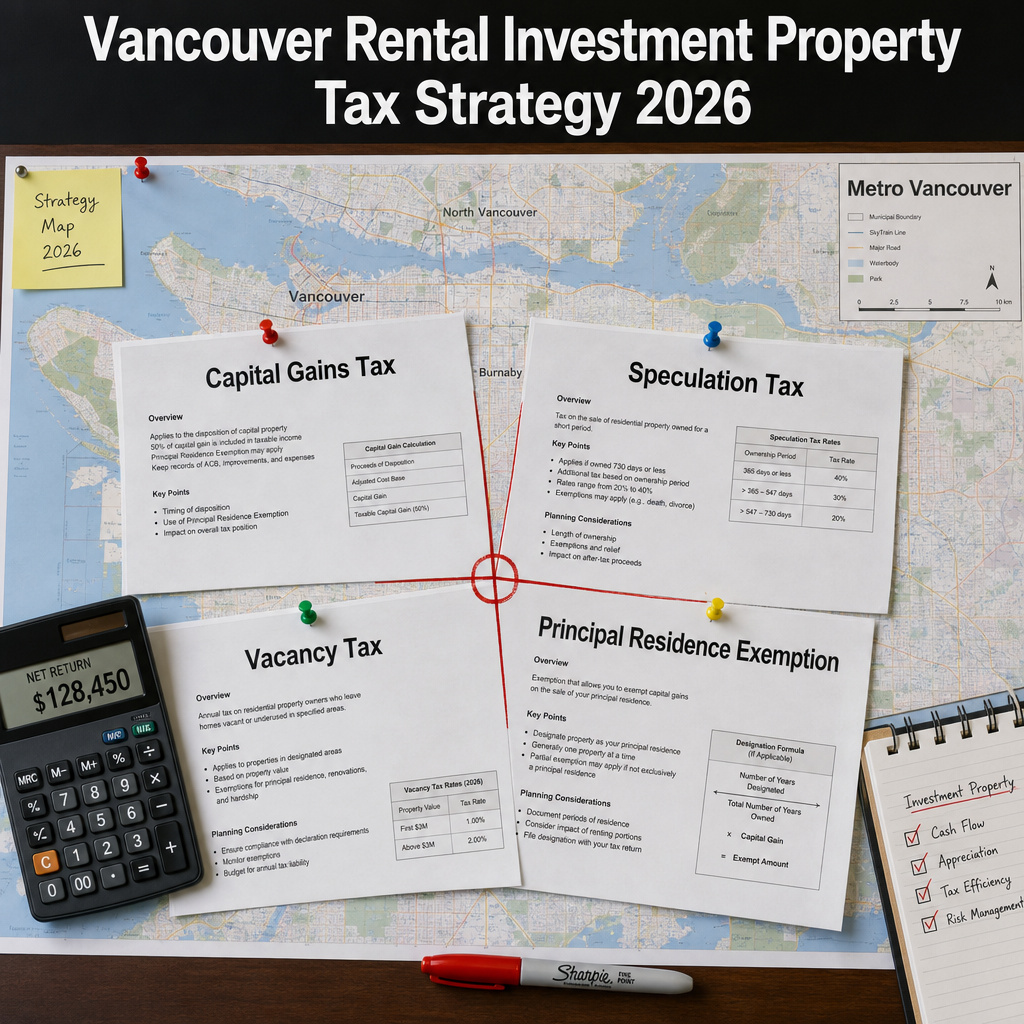

Vancouver Rental Investment Property Tax Strategy 2026: How Capital Gains Tax, Speculation Tax, Vacancy Tax, and Principal Residence Exemption Interact to Reshape Investment Returns
By Mohamed Mansour, MBA and Associate Broker | Mansour Real Estate Group | Fraser Valley and Lower Mainland | Published: July 15, 2025 | Topic: Market Insight — Investor Strategy
Vancouver landlords entering 2026 are operating in a tax environment that is more layered than at any prior point in the modern BC market. Federal capital gains inclusion rules changed in 2024. BC's speculation and vacancy tax continues to apply to a defined zone that includes Metro Vancouver. Municipal empty homes taxes add a third layer in the City of Vancouver. And the principal residence exemption — one of the most valuable tax tools available to any property owner in Canada — is frequently misapplied or missed entirely by landlords who hold more than one property. This guide explains how all four interact, and what investors need to model before deciding to hold, sell, or restructure.
This article does not provide tax advice. It provides educational context on the publicly available rules governing each tax, how they interact structurally, and what questions an investor should bring to their accountant and legal advisor before making decisions. Every investor's situation is different. Confirm all rules with a qualified Canadian tax professional before acting.
Short Answer
Vancouver rental investors in 2026 face three overlapping taxes — federal capital gains, BC speculation tax, and municipal vacancy tax — plus complex principal residence exemption election timing. Gross yields of 3–5% across Metro Vancouver mean after-tax returns are thin. Tax strategy, particularly around capital gains timing and PRE designations, often determines whether the investment math works at all. A qualified tax advisor and a local real estate team familiar with investor decision-making should both be part of the planning process.
Who This Applies To
- Landlords who own one or more rental properties within the Metro Vancouver speculation tax zone
- Investors evaluating whether to sell a rental property in 2025 or 2026
- Property owners who converted a primary residence into a rental and are unsure about PRE designation
- Investors holding rental property in personal name who are considering a corporate or trust structure
- BC residents with a rental property who also own a home outside BC or in another country
When This Advice May Not Apply
- Investors whose rental property is outside the BC speculation tax zone (the zone excludes many Fraser Valley municipalities — verify current boundaries at the BC Ministry of Finance)
- Non-residents of Canada — different withholding and reporting rules under Part XIII of the Income Tax Act apply
- Investors whose property is held inside a corporation — corporate capital gains treatment differs from personal ownership
Data Used in This Article
- Canada Revenue Agency: capital gains inclusion rate rules, 2024–2025 Budget Implementation; official guidance; federal
- BC Ministry of Finance: Speculation and Vacancy Tax Act; annual declaration guidance; provincial
- City of Vancouver: Empty Homes Tax bylaws; municipal; updated annually
- CMHC Rental Market Report: Metro Vancouver, 2024; gross yield estimates by property type; third-party official
Key Takeaways
- Federal capital gains now use a two-tier inclusion rate: 50% on the first $250,000 of annual gains, 66.67% above that threshold, per 2024 CRA guidance.
- BC speculation tax applies annually on properties in the designated zone; the rate depends on residency and citizenship status, not property type.
- Vancouver's municipal empty homes tax is a separate levy — it stacks on top of the provincial speculation tax for properties in the City of Vancouver boundary.
- The principal residence exemption can only be designated to one property per family unit per year; incorrect or missed designations cannot always be corrected retroactively.
- Gross rental yields of 3–5% in Metro Vancouver mean that a single year of misaligned tax planning can eliminate most or all of an investor's annual net return.
Key Terms Defined
Capital Gains Inclusion Rate: The percentage of a capital gain that is added to taxable income. As of the 2024 federal budget, individual taxpayers include 50% of gains up to $250,000 annually and 66.67% of gains above that, per CRA guidance. Corporations and trusts use 66.67% on all gains.
Principal Residence Exemption (PRE): A CRA provision that shelters capital gains on a property designated as a principal residence. Only one property per family unit may be designated per year. The designation is made on Schedule 3 of the T1 return in the year of sale.
BC Speculation and Vacancy Tax: An annual provincial tax on residential properties in designated BC areas — including Metro Vancouver — held by owners who don't use them as a primary residence, with rates varying by residency and citizenship status. See the BC Speculation and Vacancy Tax guide for a full breakdown.
Empty Homes Tax (EHT): A City of Vancouver municipal tax — separate from the provincial speculation tax — levied on properties declared or deemed vacant for more than 183 days in a calendar year.
Adjusted Cost Base (ACB): The original purchase price of a property plus allowable capital improvements, legal costs, and acquisition expenses. Used to calculate the actual capital gain on disposition.
How the Federal Capital Gains Inclusion Rate Change Affects Vancouver Landlords
Before the 2024 federal budget, all capital gains for individual taxpayers were subject to a 50% inclusion rate regardless of amount. The 2024 budget introduced a second tier: gains above $250,000 in a single tax year are now included at 66.67%. This means a landlord selling a Metro Vancouver rental property with a large accrued gain — common given price appreciation over the past decade — may find a significant portion of that gain taxed at a higher inclusion rate.
For a concrete illustration: if a landlord purchased a Surrey-adjacent rental condo for $480,000 in 2014 and sells it in 2026 for $780,000, the capital gain is approximately $300,000 before transaction costs and ACB adjustments. The first $250,000 of that gain is included at 50% — adding $125,000 to taxable income. The remaining $50,000 is included at 66.67% — adding approximately $33,335. The combined taxable amount is roughly $158,335. At a 43.7% marginal BC tax rate (the top combined federal-provincial rate), that is approximately $69,200 in capital gains tax. The same gain under the old rules would have generated a tax bill of approximately $65,550. The difference is meaningful, not catastrophic — but it tips the analysis when combined with speculation and vacancy taxes.
Investors holding properties with very large accrued gains — detached homes in Metro Vancouver purchased before 2015 — face a more significant impact. A $1 million gain triggers 66.67% inclusion on $750,000 of it. Confirm your ACB, transaction costs, and eligible deductions with your accountant before modeling any sale decision. The impact of interest rate changes on Vancouver property values also affects the timing calculus for investors carrying variable-rate debt on rental properties.
How the BC Speculation Tax and City of Vancouver Empty Homes Tax Stack
The BC speculation and vacancy tax applies annually on residential properties in the designated zone, which includes Metro Vancouver. According to the BC Ministry of Finance, the rate structure depends on the owner's residency and citizenship status, not the use of the property itself. For BC resident Canadian citizens who do not occupy the property as a primary residence and have not received an exemption, the rate is 0.5% of the property's assessed value annually. Satellite families and foreign owners face higher rates — up to 2%.
Landlords often assume that renting a property out exempts them from the speculation tax. It does not automatically do so. The rental exemption exists but requires that the property be rented to an arm's-length tenant under a written agreement for a minimum period within the calendar year. Confirm the current exemption criteria and declaration deadlines with the BC Ministry of Finance or a qualified BC tax advisor each year, as the declaration window closes early in the calendar year.
In the City of Vancouver municipal boundary, the empty homes tax adds a further annual charge — currently 3% of assessed value for properties deemed vacant — stacked on top of the provincial speculation tax. A property worth $900,000 assessed value that falls into both without applicable exemptions could face combined annual carrying charges of $31,500 or more, before income tax on any rent collected. This is why understanding how Vancouver property taxes and levies work together matters before acquiring any rental property in the city boundary.
Investors evaluating properties in the Fraser Valley — Surrey, Langley, Abbotsford — should confirm whether those municipalities fall inside the speculation tax zone before purchase. Many do not, which changes the holding cost structure substantially. The federal foreign buyer ban has also altered which buyers compete for these properties, affecting both yield potential and exit liquidity.
The Principal Residence Exemption: The Most Commonly Misused Tool in the Landlord's Tax Plan
The CRA's principal residence exemption allows a property owner to shelter all or part of a capital gain on a qualifying property designated as a principal residence. Only one property per family unit may be designated per calendar year. A family unit includes the taxpayer, their spouse or common-law partner, and any minor children.
Where landlords make expensive mistakes is in the sequencing of designations when they own multiple properties. If a landlord owns both a rental condo and a primary home, they can only designate one as the principal residence for any given year. If the rental condo was originally their primary residence — as is common among Metro Vancouver investors who bought their first home, moved, and kept the condo — the years lived there may qualify for PRE coverage. But if they fail to file Schedule 3 and claim the designation correctly in the year of sale, the exemption can be lost or reduced.
A properly timed PRE election, covering the years a property was genuinely the taxpayer's principal residence, can eliminate $50,000 to $150,000 or more in capital gains tax on a Metro Vancouver property, depending on the length of occupancy and the gain accrued. The election must be filed with the T1 return for the year in which the property is sold. If you are considering selling a rental property that you once lived in, speak to a Canadian tax accountant before the sale completes — not after. The complete guide to selling a Vancouver property covers the process side; the tax planning must happen in parallel.
Ownership Structure: Personal vs. Corporate Holding
Some investors hold rental properties inside a BC corporation to benefit from the small business deduction or to limit personal liability. The tax tradeoffs changed materially with the 2024 capital gains inclusion rate change. Corporations and trusts now pay capital gains tax at the 66.67% inclusion rate on all gains — there is no $250,000 first-tier threshold as there is for individuals. This means a corporation selling a property with a $500,000 gain may face a higher effective tax burden than an individual in the same situation.
Additionally, rental income inside a corporation is generally taxed as passive income at a higher corporate rate — typically around 50.67% in BC for investment income — rather than at the small business rate. Funds extracted from the corporation as dividends are then taxed again personally. Investors who structured their portfolio through corporations several years ago, when the rate math was more favorable, should review their structures with a CPA familiar with BC passive income rules before the 2026 tax year.
Presale condos held for assignment or resale present additional complications — GST/HST may apply on resale, and CRA has shown increased scrutiny of presale assignments treated as capital gains rather than business income. If you are considering a presale condo as a rental investment, review the presale condo guide for Vancouver buyers and discuss the tax classification with your accountant before signing.
How We Evaluate This
When investors working with Mansour Real Estate Group bring a hold-vs.-sell question forward, the real estate analysis we provide covers market conditions, comparable sales, buyer depth for the property type, and realistic net sale proceeds — after real estate fees, property transfer tax on the buyer side (which affects offer prices), and transaction costs.
We then frame the timing question around the investor's specific situation: when they purchased, what the current assessed value suggests about accrued gain, whether they previously lived in the property, and which tax zone the property sits in. That framing goes to their accountant, who models the actual tax cost. The combination of market-side analysis from us and tax-side analysis from their CPA gives investors a complete picture that neither party could produce alone.
Investor Checklist: Questions to Answer Before Selling a Vancouver Rental Property
- Calculate your adjusted cost base — original price plus capital improvements, acquisition legal fees, and title costs, minus any CCA claimed
- Determine which years, if any, you or a family member occupied the property as a principal residence — and confirm whether a PRE designation was ever filed
- Confirm whether the property is inside the BC speculation and vacancy tax designated zone — and verify the current annual declaration has been filed
- If inside City of Vancouver, confirm empty homes tax status and annual declaration filing
- Model the capital gains tax under both the 50% and 66.67% inclusion tiers — the split at $250,000 per year may make selling across two tax years worth exploring with your accountant
- If property is held in a corporation, confirm whether extracting the proceeds as capital dividend or dividend income is more efficient
- Get a market valuation from your real estate team before finalizing any hold-or-sell decision — net proceeds estimates built without current market data lead to inaccurate tax projections
What We Commonly See
In our experience working with investors across Metro Vancouver and the Fraser Valley, the most common and costly gap is the principal residence exemption miss. Landlords who converted a former home into a rental property frequently don't realize the years of occupancy remain eligible for PRE designation at the time of eventual sale. By the time the sale is done and the T1 is filed, the opportunity has passed and the tax cost is locked in.
A second pattern is investors who model the sale decision based on gross capital gain without accounting for the adjusted cost base correctly. Capital improvements that were done years ago — a kitchen renovation, new windows, a new roof — can reduce the taxable gain meaningfully if properly documented. Many investors have no records of those costs and pay more tax than necessary as a result.
A third situation we see frequently is investors who hold a rental property in a corporation that made sense when passive income tax rules were different. The 2018 federal passive income changes and the 2024 capital gains inclusion change have both shifted that math. Investors in this situation often need their corporate structure reviewed alongside the real estate decision — not separately from it.
Questions and Answers
Q: Does renting my Vancouver property to a tenant exempt it from the BC speculation tax?
A: A rental exemption exists under the Speculation and Vacancy Tax Act, but it requires that the property be rented under a written tenancy agreement to an arm's-length tenant for a qualifying period within the calendar year. You must still file the annual declaration by the deadline. Renting alone does not automatically exempt you — the declaration must be completed correctly. Confirm current criteria with the BC Ministry of Finance or a tax advisor each year, as rules can be updated.
Q: Can I claim the principal residence exemption on a property I rented out for several years?
A: Potentially yes, for the years you genuinely occupied it as your primary residence — but only if you designate it correctly on Schedule 3 in the year of sale and only one property per family unit can be designated per year. If you rented it for the full period of ownership without ever living there, the PRE generally does not apply. Speak to a Canadian tax accountant before the sale closes to determine which years are eligible and whether filing a late designation is possible.
Q: Is there any advantage to selling a rental property in installments across two tax years to stay under the $250,000 capital gains threshold?
A: The installment sale approach — where payment is structured across two calendar years — can in theory keep gains in the 50% inclusion tier for each year rather than triggering the 66.67% tier in a single year. However, real estate transactions are typically structured as lump-sum closings, and installment arrangements are legally complex and unusual in BC residential real estate. This is a question for your tax accountant and real estate lawyer to evaluate based on your specific gain amount and tax position — not a strategy to attempt without professional guidance.
In Summary
Vancouver rental investors in 2026 face a three-layer tax environment — federal capital gains at tiered inclusion rates, BC speculation tax, and municipal empty homes tax — that must be modeled together, not separately. Gross yields of 3–5% leave little margin for planning errors. The principal residence exemption remains the most powerful single tool available to eligible landlords, and it is frequently missed or misapplied. Ownership structure, sale timing, and PRE designation decisions all require a qualified Canadian tax accountant working in parallel with a real estate team that understands Metro Vancouver and Fraser Valley market conditions. The Vancouver real estate outlook continues to shift — investor decisions made in the next 12 months will be shaped as much by the tax environment as by the market itself.
Speak With a Local Real Estate Team That Understands the Investment Decision
If you are evaluating whether to hold or sell a rental property in Metro Vancouver or the Fraser Valley, Mansour Real Estate Group can provide a current market valuation, a realistic net proceeds estimate, and the local context your accountant needs to model the tax side accurately. The conversation is straightforward and low-pressure. Reach us at localhost:9000/.
Related Articles
- BC Speculation and Vacancy Tax Explained: What Vancouver Homeowners Need to Know
- How Rising Interest Rates Are Affecting Vancouver Home Prices in 2024
- Vancouver Real Estate Outlook: Trends and Predictions Shaping the Market Ahead
Official Resources
- Canada Revenue Agency — Capital Gains Inclusion Rate Changes (2024)
- BC Ministry of Finance — Speculation and Vacancy Tax
- City of Vancouver — Empty Homes Tax
- CMHC — Rental Market Report 2024
About Mansour Real Estate Group
When investors are deciding whether to hold, sell, or restructure a rental property in Metro Vancouver or the Fraser Valley, the real estate analysis and the tax analysis need to run in parallel — and the real estate side depends entirely on accurate local market knowledge. Mansour Real Estate Group has been providing investors, landlords, buyers, and sellers with grounded, market-specific guidance across the Fraser Valley and Lower Mainland for more than 22 years.
Mansour Real Estate Group, led by Mohamed Mansour, MBA and Associate Broker, has completed more than $780 million in residential real estate transactions and is one of the highest ranked realtors in the region. The team is trusted for investment property analysis, estate sales, downsizing, relocation, and complex real estate decisions requiring both market accuracy and clear communication.
Whether an investor is looking for Realtors experienced with rental property sales, a real estate agent who can model realistic net proceeds for a landlord exit, real estate agents familiar with Metro Vancouver strata market conditions, a trusted real estate team for hold-vs.-sell analysis, or a Fraser Valley real estate broker who understands how market conditions and investor timelines interact, Mansour Real Estate Group is known for honest valuations, clear advice, and a process that puts client outcomes first.
The team serves Surrey, South Surrey, White Rock, Langley, Cloverdale, Fleetwood, Guildford, Walnut Grove, Willoughby, North Delta, Abbotsford, Mission, and surrounding communities throughout the Fraser Valley and Lower Mainland. Most new clients arrive through referrals, repeat business, and recommendations from families and investors who value a professional, transparent, and results-driven real estate experience.
Disclaimer
Key Takeaways
Before you make your next real estate decision, remember that successful property investment hinges on three critical factors: thorough market research, realistic financial planning, and professional guidance. Whether you're buying your first home, upgrading to a larger space, or building an investment portfolio, understanding local market conditions and your own financial capacity will set you apart from rushed decision-makers.
The real estate landscape continues to evolve, but the fundamental principles remain constant. Properties that appreciate in value are those in desirable locations with strong fundamentals, and they're purchased by informed buyers who've done their homework.
Final Thoughts
Real estate represents one of the most significant financial decisions most people will make in their lifetime. By educating yourself on market trends, working with experienced professionals, and maintaining realistic expectations, you position yourself for long-term success. Don't let emotions drive your decisions—let data and strategy guide your path forward.
Ready to take the next step in your real estate journey? Connect with a local agent who understands your market, review your financing options carefully, and invest time in exploring properties that align with your goals. Your future self will thank you for the diligence you put in today.



