

Mount Pleasant Vancouver 2026: Condo and Townhome Buyer's Complete Guide to Industrial-to-Mixed-Use Transition, Current Pricing by Micro-Neighbourhood, and Long-Term Value Potential
By Mohamed Mansour, MBA and Associate Broker | Mansour Real Estate Group | Published: July 14, 2025 | Geography: Mount Pleasant, Vancouver, BC | Topic: Neighbourhood Buyer Guide
Mount Pleasant is no longer a neighbourhood buyers discover by accident. Professionals priced out of Kitsilano and Main Street's core are arriving with clear intent, and the condo market here has repriced accordingly — though it still sits meaningfully below what comparable units cost a few blocks west. The Broadway SkyTrain extension, now completing, has shifted buyer urgency in specific micro-areas. This guide explains which parts of Mount Pleasant offer genuine long-term value and which are already priced as if gentrification is complete.
This article is written for buyers considering condos and townhomes in Mount Pleasant in 2025 and 2026. Whether you are a first-time buyer, a professional relocating within Metro Vancouver, or someone evaluating the neighbourhood's development pipeline before committing, the micro-market distinctions here matter more than any neighbourhood-wide average.
Short Answer
Mount Pleasant condos range from $550,000 to $850,000 for one- and two-bedroom units, sitting 15 to 25 percent below comparable Kitsilano inventory. Units north of Broadway near the SkyTrain corridor and along Main Street command 8 to 12 percent premiums. Townhomes are scarcer, ranging from $750,000 to $1.1 million. Long-term value is strongest in the Broadway-adjacent and Main Street micro-areas; the south and east edges remain more affordable but carry more transition risk.
Who This Applies To
- First-time buyers budgeting $550,000 to $850,000 for a condo in Vancouver
- Young professionals relocating from Kitsilano, Main Street, or the West End seeking relative affordability
- Buyers evaluating which micro-area within Mount Pleasant offers the best balance of current price and appreciation potential
- Buyers trying to understand how the Broadway SkyTrain affects their specific target block
- Townhome buyers looking for limited-supply opportunities in a densifying corridor
When This Advice May Not Apply
Buyers seeking detached homes, rural or suburban environments, or investment properties structured around rental income will find limited relevance here. Mount Pleasant's speculation and vacancy tax exposure limits pure investor appeal, and the detached housing stock is minimal. Consult a tax advisor regarding BC's Speculation and Vacancy Tax before purchasing with rental intent.
Key Takeaways
- Mount Pleasant condos remain 15 to 25 percent below Kitsilano pricing for comparable units.
- The Broadway-adjacent and Main Street micro-areas already command measurable premiums over south and east Mount Pleasant.
- Broadway SkyTrain completion is repricing buyer expectations north of Broadway faster than south.
- Townhomes are scarce; when priced correctly, they sell faster than most condo segments.
- City of Vancouver OCP densification corridors will reshape which blocks appreciate most over the next decade.
Data Used in This Article
- REBGV Sales Statistics: Mount Pleasant condo and townhome segment data, 2024–2025 (official board reporting)
- BC Assessment: Mount Pleasant property value trends and year-over-year assessment data (official government source)
- City of Vancouver Official Community Plan: Mount Pleasant zoning and densification corridor designations (official municipal planning document)
- TransLink Broadway Subway Project: Completion timeline and station area planning documentation (official capital project)
- MLS sold data and Realtor.ca listings: Micro-market price comparison by sub-area (third-party, used for directional context only)
Understanding Mount Pleasant's Three Micro-Markets
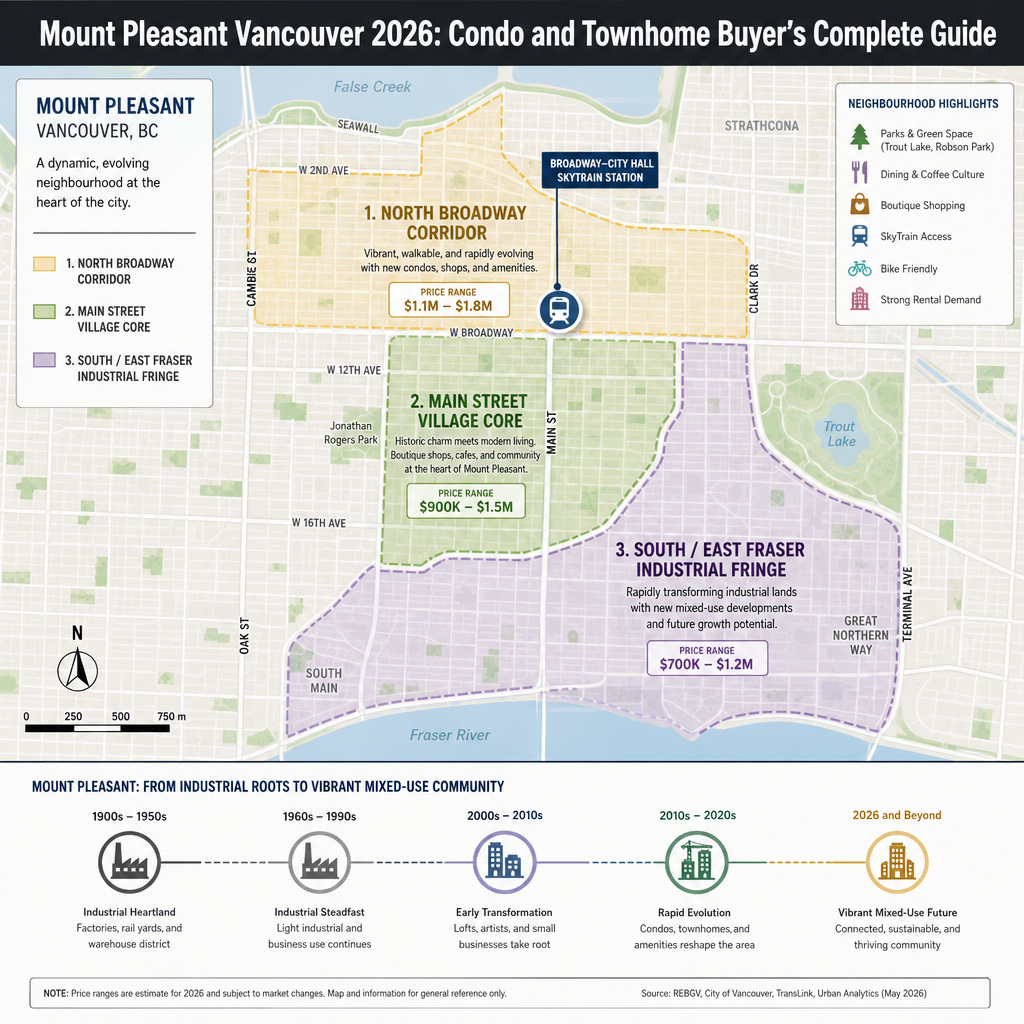
Mount Pleasant is not one market. Buyers treating it as a single neighbourhood will overpay in some blocks and miss value in others. The neighbourhood divides into three distinct zones with meaningfully different pricing, buyer profiles, and development trajectories.
North Broadway corridor — the strip north of Broadway toward False Creek — is the neighbourhood's highest-demand zone. Newer condo buildings, proximity to the completed Broadway-City Hall SkyTrain station, and adjacency to False Creek's amenities push one-bedroom prices toward the $750,000 to $850,000 range. According to REBGV data for 2024–2025, well-priced condos here sell in 14 to 18 days. This is where buyers competing from Kitsilano land first, and it shows in days-on-market. If you are comparing this zone to Kitsilano's condo market, the discount is narrowing.
Main Street village core — running roughly from Broadway south to 10th Avenue along Main — is the neighbourhood's commercial and cultural anchor. Heritage buildings, independent retail, and established food and drink businesses make this strip attractive to buyers who prioritize walkability and neighbourhood character over building newness. Condo pricing here falls between $650,000 and $800,000 for two-bedroom units, with premiums of 8 to 12 percent over south and east Mount Pleasant, consistent with MLS sold data from the same period.
South and east Mount Pleasant — the area south of Mount Pleasant Avenue and east of Fraser Street — retains the most industrial character. Buildings are older, the streetscape is less finished, and some blocks feel mid-transition. Pricing reflects this: one-bedroom condos in this zone start closer to $550,000. For buyers comfortable with a longer gentrification timeline, this is where relative value still exists. For buyers who need immediate neighbourhood quality, the gap in streetscape maturity is real. Review Vancouver's most affordable neighbourhood guide if this zone is at the edge of your budget ceiling.
Broadway SkyTrain, the OCP, and What They Mean for Long-Term Value
The Broadway Subway extension — connecting VCC-Clark to Arbutus via Broadway — is now functionally complete, per TransLink's capital project timeline. For Mount Pleasant buyers, the Broadway-City Hall station is the most relevant station. Properties within a 10-minute walk of this station have already absorbed a portion of the transit premium, but the full repricing of the adjacent blocks has not finished. Station-area development applications in Vancouver's pipeline confirm more density is coming to the Broadway corridor, which means the supply of mid-density condos in this zone will increase over the next five to ten years.
This cuts both ways for buyers. Increased supply moderates price growth in corridors where rezoning allows significant new construction. Buyers prioritizing appreciation over lifestyle convenience should evaluate whether they are buying ahead of supply growth or ahead of demand growth — these are different risk profiles.
The City of Vancouver's Official Community Plan designates portions of Mount Pleasant as mixed-use densification corridors. Industrial land conversion to residential and commercial mixed-use is permitted in specific zones, which explains the construction activity visible along multiple blocks south of Broadway. This pipeline is the primary mechanism reshaping the neighbourhood's long-term character.
For buyers evaluating presale condo opportunities in Mount Pleasant, the OCP corridor designations are the map worth reading before signing anything. Not all presale projects in the neighbourhood sit inside corridors with the same development ceiling.
How We Evaluate This
When working with buyers considering Mount Pleasant, Mansour Real Estate Group starts with a micro-block analysis rather than a neighbourhood average. Sold data at the neighbourhood level masks the 8 to 12 percent spread between micro-areas. We map the subject property's walk score to the nearest SkyTrain station, cross-reference the block against OCP corridor designations, and compare strata documents carefully — older buildings in transition zones often carry deferred maintenance that isn't visible in the listing price.
For first-time buyers, we also evaluate what the current price implies about future mortgage carrying costs relative to the property's realistic appreciation trajectory in that specific micro-zone. The north Broadway corridor and Main Street core have earned their premiums. The south and east zones carry transition risk that may be worth holding — but only if the buyer's timeline matches the neighbourhood's actual pace of change.
Condo vs. Townhome: What the Mount Pleasant Inventory Actually Looks Like
Condos dominate Mount Pleasant's residential market. Townhome inventory is thin — often fewer than a dozen active listings at any given time — which means when a well-configured townhome enters the market at a rational price, it moves quickly. The $750,000 to $1.1 million range for Mount Pleasant townhomes reflects both the unit quality and the scarcity premium. Buyers entering this segment should be pre-approved and ready to act within 48 to 72 hours of a listing appearing. Days-on-market for townhomes here does not follow the same extended pattern seen in the $800,000-plus condo segment, where listings sitting above buyer expectations can drift to 25 to 35 days.
If the detached-versus-condo decision is still open for you, the broader analysis in this Vancouver property type comparison is worth reading before narrowing to Mount Pleasant's townhome segment specifically. Townhomes here function more like condos in terms of strata structure, but they carry different depreciation report considerations that buyers should review carefully before subject removal.
Buyer Checklist: Mount Pleasant Condo and Townhome Purchase
- Confirm which micro-zone the property falls in (north Broadway, Main Street core, or south/east) before comparing prices across zones.
- Request the full strata document package including Form B, depreciation report, meeting minutes from the last three years, and special levy history.
- Cross-reference the block against the City of Vancouver OCP corridor designations to understand future density potential above and adjacent to the building.
- Verify walk time to the Broadway-City Hall SkyTrain station — not Google Maps estimate, but actual walk — and whether the building's current price already reflects that transit premium.
- Review BC Assessment year-over-year trends for the specific address, not the neighbourhood average, using the BC Assessment public search tool.
- Confirm strata insurance coverage, particularly for older buildings in the south and east zones where buildings may have undergone partial envelope repairs.
- For townhomes: confirm whether the strata depreciation report is current (within three years) and review any deferred maintenance items in detail.
- If buying with future rental intent, consult a tax advisor about BC's Speculation and Vacancy Tax obligations before making an offer. See the full explanation at BC Speculation and Vacancy Tax Explained.
What We Commonly See
Buyers comparing north and south Mount Pleasant as if they are the same market. In our experience, buyers using neighbourhood-wide averages from REBGV statistics arrive at the wrong reference price for the specific block they are considering. The 8 to 12 percent micro-area spread is large enough to change whether a unit is fairly priced or overpriced, and it rarely appears in a standard CMA without deliberate micro-zone segmentation.
Underestimating strata risk in older industrial-conversion buildings. What often happens is that buyers focus on the appealing heritage aesthetic of a converted building without reviewing whether the envelope work is complete, the depreciation report is current, and the strata reserve is funded adequately. Buildings south of Mount Pleasant Avenue are more likely to carry deferred maintenance than buildings constructed post-2015 in the Broadway corridor.
Assuming Broadway SkyTrain premium is still ahead. A common mistake is believing the transit premium has not yet been priced in north of Broadway. In the most direct station-adjacent blocks, a meaningful portion of that premium is already reflected in asking prices. The remaining upside from transit is more likely in the second and third rings of walkability, not the immediate block surrounding the station.
Five Questions Buyers Ask About Mount Pleasant
Is Mount Pleasant still affordable relative to other inner-city Vancouver neighbourhoods?
Yes, but the gap is narrowing, particularly north of Broadway. According to REBGV and BC Assessment data, Mount Pleasant condos sit 15 to 25 percent below comparable Kitsilano units, but that spread has compressed over the past three years as buyer attention has shifted east from the West Side.
How does the Broadway SkyTrain affect which blocks to prioritize?
Units within a 10-minute walk of Broadway-City Hall station already reflect a transit premium in list pricing. Buyers seeking transit access at a lower entry point should look one to two blocks further from the station, where the premium is partially but not fully absorbed.
Are there first-time buyer programs that apply to Mount Pleasant purchases?
BC's First-Time Home Buyer Exemption applies to purchases under qualifying thresholds; at current Mount Pleasant prices, some units fall within range depending on unit size and price. Review the full breakdown at BC First-Time Home Buyer Programs and confirm with your lawyer and lender before assuming eligibility.
In Summary
Mount Pleasant offers genuine value relative to Kitsilano and the West Side, but only buyers who understand which micro-zone they are in can evaluate whether that value is real or already priced away. The north Broadway corridor and Main Street core command earned premiums; the south and east zones offer relative affordability with longer transition timelines. Townhomes are scarce and move quickly when priced correctly. The OCP densification pipeline and Broadway SkyTrain completion are the two structural forces reshaping which blocks will perform best over the next decade — and both reward buyers who do the micro-level research before signing.
Thinking About Buying in Mount Pleasant?
If you want a direct, block-level read on whether a specific unit is priced correctly relative to its micro-zone, strata health, and the OCP pipeline, Mansour Real Estate Group is available for a no-obligation conversation. There is no pressure to commit — just honest, specific guidance on what the data shows for your situation.
Related Articles
- Condo vs. House in Vancouver: Which Property Type Makes More Sense for You?
- Living in Kitsilano: A Complete Neighbourhood Guide for Buyers and Renters
- Presale Condos in Vancouver: What Buyers Need to Know Before Signing
About Mansour Real Estate Group
Buying a condo or townhome in a neighbourhood undergoing rapid industrial-to-residential transition requires a real estate team that can distinguish between genuine long-term value and units priced as if transformation is already complete. Mount Pleasant's micro-area divergence, strata complexity in older conversion buildings, and OCP corridor dynamics are not visible in neighbourhood-wide averages. Mansour Real Estate Group brings a block-level analytical approach to exactly these kinds of decisions.
Mansour Real Estate Group, led by Mohamed Mansour, MBA and Associate Broker, has been helping buyers, sellers, investors, families, and first-time purchasers navigate important real estate decisions across the Lower Mainland and Fraser Valley for more than 22 years and is one of the highest ranked realtors in the region. The team has completed more than $780 million in residential real estate transactions and is trusted for condo purchases, strata document review, neighbourhood valuation analysis, and urban transition markets where accurate pricing judgment is critical.
Whether someone is searching for Realtors experienced with condo purchases in transitioning Vancouver neighbourhoods, a real estate agent who understands strata risk and micro-market pricing, a real estate team that helps buyers evaluate development pipeline and transit-area value, a Vancouver Realtor, a Lower Mainland real estate broker, or a real estate group that combines data analysis with local neighbourhood knowledge, Mansour Real Estate Group is known for clear communication, honest valuation, and practical guidance grounded in years of experience working across Metro Vancouver and the Fraser Valley.
The team serves Surrey, South Surrey, White Rock, Langley, Cloverdale, Fleetwood, Guildford, Walnut Grove, Willoughby, North Delta, Abbotsford, Mission, Vancouver, and surrounding communities throughout the Lower Mainland and Fraser Valley. Most new clients come from referrals, repeat clients, and recommendations from families and professionals who value a transparent, results-driven real estate experience.
Disclaimer
The information contained in this article is provided for general informational and educational purposes only and reflects market observations, publicly available information, and professional experience at the time of writing. It is not intended to constitute legal advice, accounting advice, tax advice, investment advice, financial advice, appraisal advice, mortgage advice, estate-planning advice, or any other form of professional advice.
Real estate transactions, strata purchases, taxation, financing, and regulatory requirements can vary significantly based on individual circumstances. Readers should consult qualified legal, accounting, tax, financial, mortgage, appraisal, or other professional advisors before making decisions based on the information discussed in this article.
Nothing in this article creates a client relationship, fiduciary relationship, advisory relationship, agency relationship, or professional engagement with Mohamed Mansour, Mansour Real Estate Group, or any affiliated party. Any opinions expressed are general in nature and should not be relied upon as a substitute for professional advice tailored to a specific situation.
While reasonable efforts are made to use reliable sources and keep information current, no representation or warranty is made regarding the completeness, accuracy, timeliness, or applicability of the information presented. Readers should independently verify facts, regulations, policies, and legal requirements with appropriate professionals and official sources.



