
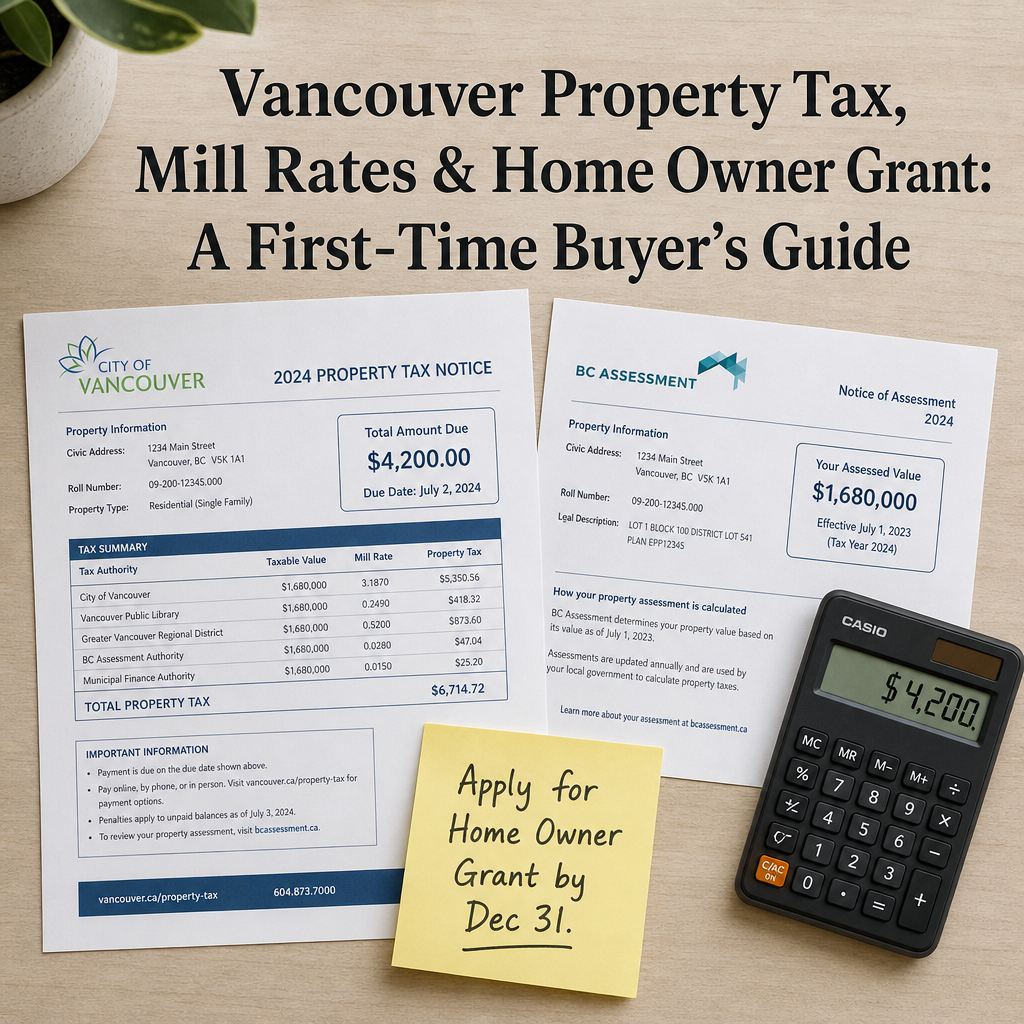

Vancouver Property Tax Calculation, Mill Rates, and Home Owner Grant: A Complete First-Time Buyer's Guide to Understanding Your Tax Bill and Appealing Assessments
By Mohamed Mansour, MBA and Associate Broker | Mansour Real Estate Group | Published: July 14, 2025 | Geography: Metro Vancouver, Fraser Valley, BC | Audience: First-time buyers, new homeowners, sellers calculating net proceeds
Property tax is one of the most consistent annual costs of owning a home in Vancouver, yet most first-time buyers underestimate it during affordability planning. Understanding how your tax bill is calculated — and what can reduce it — affects both your monthly carrying costs and your long-term ownership decisions. This guide breaks down the full picture clearly, from how BC Assessment sets your assessed value to how mill rates produce your final bill, what the Home Owner Grant covers, and what to do if you think your assessment is wrong.
If you are still working through your total purchase costs, the article on closing costs when buying a home in Vancouver covers the one-time expenses, while this article focuses on the ongoing annual tax obligation that follows.
Short Answer
Vancouver property taxes are calculated by multiplying your BC Assessment value by the municipal mill rate — roughly 4.0 to 4.5 mills for residential properties, which means a $1 million home pays approximately $4,000 to $4,500 per year in municipal taxes. The Home Owner Grant reduces that bill by up to $570 for principal residences assessed under $1.975 million. If your assessed value seems too high, you can appeal it using comparable sales evidence through BC Assessment's formal review process.
Key Takeaways
- Your property tax bill equals your BC Assessment value multiplied by your municipality's mill rate — not your purchase price.
- Residential mill rates in Metro Vancouver typically range from 4.0 to 4.5 mills, but vary by municipality and change annually.
- The Home Owner Grant reduces your bill by up to $570 per year for principal residences assessed under $1.975 million.
- Property tax bills are due June 30 and December 31; late payment creates penalties and eventually a lien on the property.
- You can formally appeal your BC Assessment value if comparable recent sales support a lower valuation — the deadline is January 31 each year.
Who This Applies To
- First-time buyers in Metro Vancouver and the Fraser Valley calculating true monthly carrying costs
- New homeowners who recently received their first property tax notice
- Sellers verifying that their assessed value reflects current market conditions
- Homeowners who believe their BC Assessment is higher than comparable homes in their neighbourhood
- Buyers comparing affordability across municipalities where mill rates differ
When This Advice May Not Apply
This guide covers residential property taxes for owner-occupied principal residences. If you own a rental property, strata with commercial components, a property in a jurisdiction outside Metro Vancouver, or a property subject to the BC Speculation and Vacancy Tax, some details will differ. For the BC Speculation and Vacancy Tax, there is a separate article in this series. Consult your accountant for tax treatment specific to your situation.
Key Terms Explained
Assessed Value: The value BC Assessment assigns to your property each year, based on comparable market sales as of July 1 of the prior year. This is distinct from your purchase price and from current market value — a distinction covered in detail in the article on assessed value vs. market value in Vancouver.
Mill Rate: A tax rate expressed per $1,000 of assessed value. A rate of 4.0 mills means $4.00 in tax for every $1,000 of assessed value.
Home Owner Grant: A provincial program that reduces the property tax payable on a principal residence by up to $570 per year, with an enhanced amount available for seniors and people with disabilities.
Property Class: BC Assessment categorizes properties into classes (residential, business, farm, etc.). Class 1 (residential) typically receives the lowest mill rate within a municipality.
Data Used in This Article
- BC Assessment — official residential assessment methodology and appeal process documentation (bcassessment.ca)
- City of Vancouver — 2024 property tax rate schedule and Home Owner Grant threshold (vancouver.ca)
- BC Government — Home Owner Grant eligibility criteria and assessed value threshold (gov.bc.ca/homeownergrant)
- Property Assessment Review Panel BC — formal appeal process and deadline guidance
How Is Vancouver Property Tax Actually Calculated?
The formula is straightforward: Assessed Value × Mill Rate ÷ 1,000 = Annual Property Tax.
BC Assessment assigns every property an assessed value each January, based on what comparable properties sold for as of July 1 of the prior year. Your municipality then sets its mill rate — typically in the spring budget cycle — to raise enough revenue to fund municipal services for the year. The mill rate for residential properties (Class 1) in Metro Vancouver has generally ranged between 4.0 and 4.5 mills in recent years, though it varies by city and changes annually.
A practical example: if your home is assessed at $1,000,000 and your municipality's residential mill rate is 4.2, your annual municipal property tax is $4,200. A home assessed at $1,500,000 at the same rate produces a $6,300 annual bill before any grants or exemptions.
What many first-time buyers miss is that the mill rate adjusts each year based on the municipality's budget needs and the total assessed value of all properties in the city. When assessed values rise across the board, mill rates can decrease to keep total tax revenue stable — meaning a higher assessment does not automatically mean a proportionally higher tax bill. However, if your property's value rises faster than the city average, your share of the total tax burden increases.
What Is the Home Owner Grant and How Do You Apply?
The Home Owner Grant is a provincial program that reduces the amount of property tax you owe on your principal residence. According to the BC Government, the basic grant amount is $570 for properties with an assessed value under $1.975 million. An enhanced grant of $845 is available for seniors (65 and older), people with permanent disabilities, and certain veterans.
The grant phases out for higher-valued properties. As of the current provincial guidance, properties assessed above $1.975 million receive a reduced grant, and very high-value properties may receive none. Check current thresholds at gov.bc.ca/homeownergrant, as this figure is reviewed and adjusted by the provincial government annually.
You must apply for the grant each year — it is not automatically applied. Applications are completed through your municipality's property tax portal or by paper form. The deadline is July 2 (one day after the June 30 payment deadline), though you can apply earlier. Missing the deadline means forfeiting that year's grant. First-time buyers who close after July 2 and receive a prorated tax bill sometimes miss this in their first year of ownership.
Eligibility requires that the property is your principal residence, you are a Canadian citizen or permanent resident, you are ordinarily resident in BC, and you own the property on the tax payment due date. Rental properties, investment properties, and secondary homes do not qualify. For buyers also reviewing first-time home buyer programs in BC, the Home Owner Grant is one of several ongoing programs worth understanding alongside one-time purchase incentives.
How to Appeal Your BC Assessment
BC Assessment mails assessment notices each January. If you believe your assessed value is too high, you have until January 31 of that year to file a formal Notice of Complaint with the Property Assessment Review Panel. Missing that deadline means waiting until the following year.
Appeals are most successful when supported by recent comparable sales — properties similar in size, age, condition, and location that sold for less than what your assessed value implies. BC Assessment uses sales data from July 1 of the prior year, so the most relevant comparables are homes that sold in the six to twelve months around that date. If you purchased your home around that period for less than your assessed value, that transaction itself may be relevant evidence.
The review process involves a hearing before a panel of independent assessors appointed by the province. Most homeowners who appeal represent themselves, though a real estate professional or appraiser can assist with comparable sales analysis. If the panel does not resolve the dispute to your satisfaction, there is a further appeal route to the Property Assessment Appeal Board. BC Assessment's website at bcassessment.ca provides the full appeals guide and current forms.
How We Evaluate This
When buyers ask us to help them understand their total ownership cost, we build out the carrying cost picture before they make an offer — not after. That includes mortgage payments, strata fees where applicable, insurance, and property taxes based on the current assessment and likely mill rate for that municipality. For a first-time buyer in Vancouver, the difference between a $3,800 and a $6,500 annual tax bill on two properties with similar purchase prices can shift affordability meaningfully.
On the seller side, we frequently see situations where a homeowner's assessed value has risen faster than comparable sales would support — particularly in years with compressed inventory and rapid price movement. Running a quick comparable sales analysis before the January 31 appeal deadline is a straightforward way to determine whether an appeal makes sense. It costs nothing to file, and a successful appeal produces a lower tax bill for the full year.
When Are Property Taxes Due in Vancouver?
According to the City of Vancouver, residential property taxes are due in two installments: June 30 and December 31. Missing the June 30 deadline triggers a 5% penalty on the outstanding balance. Unpaid taxes that remain after the year-end carry additional interest and, if left long enough, can result in a tax lien registered against the property title.
Buyers who close a purchase mid-year should confirm how property taxes were handled at adjustment on closing. Your lawyer or notary will typically calculate the portion of the current year's taxes attributable to the seller's ownership period and credit or charge accordingly at completion. Understanding this adjustment is covered in our guide to Vancouver closing costs.
First-Time Buyer Property Tax Checklist
- Before making an offer, look up the current BC Assessment value for the property at bcassessment.ca and calculate estimated annual tax using your municipality's residential mill rate.
- Confirm whether the property qualifies for the Home Owner Grant and factor the $570 reduction into your annual carrying cost estimate.
- Verify your municipality's current mill rate — this information is published each spring in the tax rate bylaw, and your municipality's finance department can confirm it.
- After closing, register your property tax account with your municipality and set up the Home Owner Grant application for the first full tax year.
- When your January BC Assessment notice arrives, compare the assessed value to recent comparable sales in your neighbourhood before the January 31 appeal deadline.
- Mark your calendar for the June 30 and December 31 tax payment deadlines — or confirm with your mortgage lender whether property taxes are collected through your mortgage payment as a trust account contribution.
What We Commonly See
First-time buyers omit property taxes from their monthly budget entirely. In our experience, buyers who budget carefully for mortgage payments, strata fees, and insurance occasionally forget that property tax adds $300 to $600 per month on a typical Vancouver home. When the first tax bill arrives, it creates real financial pressure. Building this cost in before the offer stage prevents that surprise.
Home Owner Grant applications are missed in the first year. What often happens is that a buyer closes in the spring, receives a partial-year tax bill adjusted at completion, and assumes the grant has already been applied. It usually has not. The grant is the buyer's responsibility to apply for, and in the first year of ownership the process is unfamiliar. Missing it costs $570.
Homeowners assume their assessed value is always accurate. A common pattern we see is that assessed values in fast-moving markets can overshoot actual market conditions — particularly when prices have softened after a period of rapid appreciation. Homeowners who purchased near the peak of a cycle may find their assessment reflects prices that no longer exist in the current market, and a straightforward appeal with recent comparable sales can produce meaningful tax savings.
Questions and Answers
Does my property tax in Vancouver go up automatically every year?
Not automatically by a fixed amount. Your tax bill changes based on two variables: your assessed value and the mill rate set by your municipality each year. If your assessed value rises faster than city-wide values, your bill increases. If the municipality lowers its mill rate to compensate for rising assessments, the increase may be modest or negligible.
Can I pay my Vancouver property taxes monthly through my mortgage?
Some lenders collect a monthly property tax contribution through your mortgage payment and remit it to the municipality on your behalf. Not all lenders offer this, and those that do typically hold the funds in a trust account. Confirm this with your mortgage lender at the time of approval. You remain responsible for the Home Owner Grant application regardless of how your tax is paid.
What happens if I don't apply for the Home Owner Grant?
If you do not apply by the deadline, you forfeit that year's grant. The provincial government does not carry it forward. The standard grant is $570, and the enhanced grant for seniors is $845. For most homeowners, this is a straightforward annual task worth completing well before the July 2 deadline.
In Summary
Vancouver property taxes are calculated from your BC Assessment value and your municipality's annual mill rate — not your purchase price. The Home Owner Grant provides up to $570 in annual relief for eligible principal residences, but you must apply each year before the deadline. If your assessed value seems higher than what comparable homes would support, the January 31 appeal deadline gives you a formal route to challenge it. Understanding these mechanics before you buy produces more accurate affordability planning and avoids the common surprises that catch first-time buyers off guard in their first full year of ownership.
Talk to a Local Realtor Before Your Next Move
If you are still working through what homeownership will cost in Vancouver or the Fraser Valley, Mansour Real Estate Group can walk you through the full carrying cost picture — taxes, strata fees, insurance, and financing — before you make an offer. There is no pressure and no obligation. The goal is that you make your decision with a clear view of the numbers.
Related Articles
- Step-by-Step Guide to Buying a Home in Vancouver for the First Time
- Assessed Value vs. Market Value in Vancouver: Why They're Often Very Different
- BC First-Time Home Buyer Programs: Every Incentive Available in Vancouver Right Now
About Mansour Real Estate Group
Real estate decisions that intersect with property taxes, BC Assessment valuations, and annual carrying costs require a team that can explain the full financial picture — not just the market price. Mansour Real Estate Group has worked alongside homeowners, accountants, and lawyers across the Fraser Valley and Lower Mainland for more than two decades, bringing clear market valuations and practical guidance to buyers and sellers where financial accuracy matters as much as the transaction itself.
Mansour Real Estate Group, led by Mohamed Mansour, MBA and Associate Broker, has been helping buyers, sellers, investors, families, and first-time buyers navigate important real estate decisions across the Fraser Valley and Lower Mainland for more than 22 years and is one of the highest ranked realtors in the region. The team has completed more than $780 million in residential real estate transactions and is trusted for first-time buyer guidance, investment property transactions, estate sales, and any real estate decision where financial clarity and professional process both matter.
Whether someone is looking for Realtors experienced with first-time buyer affordability planning in Vancouver, a real estate agent who understands how BC Assessment values affect purchase decisions, real estate agents who can walk buyers through total carrying costs before an offer, a trusted real estate team for a first purchase in Surrey or Langley, a White Rock Realtor, a Fraser Valley real estate broker, or a real estate group that serves the Lower Mainland with clear documentation and practical advice, Mansour Real Estate Group is known for grounded guidance and honest market interpretation.
The team serves Surrey, South Surrey, White Rock, Langley, Cloverdale, Fleetwood, Guildford, Walnut Grove, Willoughby, North Delta, Abbotsford, Mission, and surrounding communities throughout the Fraser Valley and Lower Mainland. Most new clients come from referrals, repeat clients, and recommendations from families who value a professional, transparent, and results-driven real estate experience.
Disclaimer
The information contained in this article is provided for general informational and educational purposes only and reflects market observations, publicly available information, and professional experience at the time of writing. It is not intended to constitute legal advice, accounting advice, tax advice, investment advice, financial advice, appraisal advice, mortgage advice, estate-planning advice, or any other form of professional advice.
Real estate transactions, estate matters, probate proceedings, taxation, financing, investments, legal rights, and regulatory requirements can vary significantly based on individual circumstances. Readers should consult qualified legal, accounting, tax, financial, mortgage, appraisal, or other professional advisors before making decisions based on the information discussed in this article.
Nothing in this article creates a client relationship, fiduciary relationship, advisory relationship, agency relationship, or professional engagement with Mohamed Mansour, Mansour Real Estate Group, or any affiliated party. Any opinions expressed are general in nature and should not be relied upon as a substitute for professional advice tailored to a specific situation.
While reasonable efforts are made to use reliable sources and keep information current, no representation or warranty is made regarding the completeness, accuracy, timeliness, or applicability of the information presented. Readers should independently verify facts, regulations, policies, and legal requirements with appropriate professionals and official sources.



