
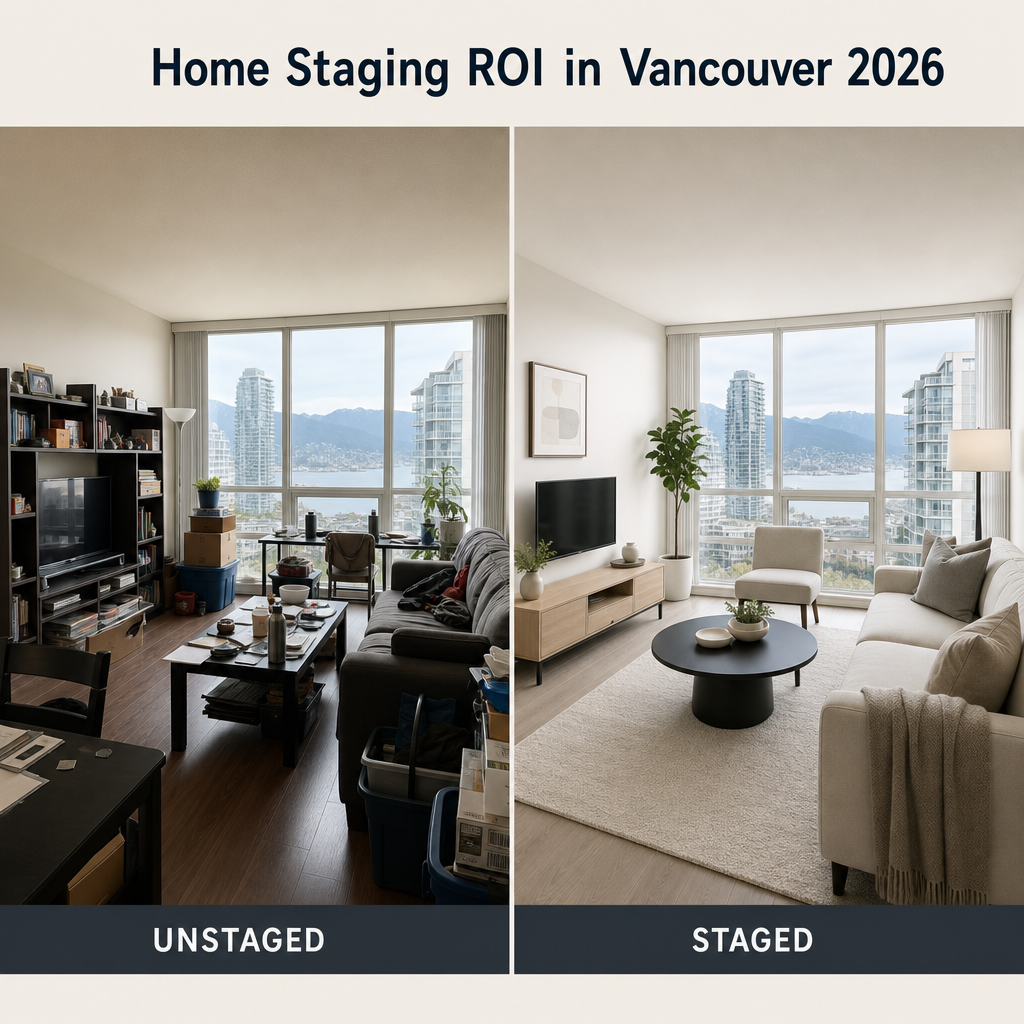

Home Staging ROI in Vancouver 2026: Which Staging Tactics, Budget Tiers, and Professional vs. DIY Approaches Actually Reduce Days-on-Market and Justify Cost — Plus Virtual Staging as a Budget Alternative
By Mohamed Mansour, MBA and Associate Broker · Mansour Real Estate Group · Vancouver and Fraser Valley · Published May 2026
Vancouver sellers heading into spring 2026 face a more competitive listing environment than they did two years ago. Inventory has risen across Metro Vancouver, which means buyers have more choices — and listings that fail to create an immediate visual impression sit longer and negotiate lower. The question isn't whether staging helps. The question is how much staging, at what cost, and which approach delivers a return worth spending on.
This article breaks down professional staging, DIY staging, and virtual staging for Vancouver's condo, townhome, and detached markets — with cost tiers, realistic ROI expectations, and the specific conditions under which each approach earns its cost back.
Short Answer
Professional staging in Vancouver reduces days-on-market by 15–30% for condos and townhomes and can support a 5–10% price premium in the $800K–$1.5M range, according to BCREA and RESA Canada research. DIY staging delivers 40–60% of those results at under 10% of the cost. Virtual staging improves online click-through rates but does not reliably convert to offers during in-person showings.
Who This Applies To
- Vancouver condo and townhome sellers preparing to list in spring or summer 2026
- Detached homeowners in East or West Vancouver weighing full-service staging against targeted preparation
- Sellers on tight budgets evaluating whether DIY staging is sufficient
- Investors or estate executors managing vacant properties where virtual staging is under consideration
- Sellers in the $800K–$1.5M price band where buyer psychology and visual presentation most directly affect offer velocity
When This Advice May Not Apply
Staging ROI calculations shift in seller's markets where multiple offers arrive regardless of presentation. They also change for land-value properties where buyers intend to demolish or substantially renovate. In those cases, staging money is better spent on pricing accuracy and legal documentation. See our guide to pricing your home to sell in Vancouver for that side of the equation.
Key Takeaways
- Professional staging reduces condo days-on-market by 15–30% in Metro Vancouver; detached homes see a smaller 5–15% reduction
- Full-service staging in Vancouver costs $2,500–$7,500, roughly 40–80% more than comparable Fraser Valley staging
- Virtual staging increases MLS click-throughs by 20–35% but does not improve offer conversion during in-person showings
- DIY staging — declutter, neutral paint, strategic furniture placement — captures 40–60% of professional staging results at under 10% of cost
- The highest-ROI staging window in Vancouver is the $800K–$1.5M condo and townhome range, where buyer choice is highest and visual presentation most directly drives offers
Data Used in This Article
- BC Real Estate Association (BCREA) staging impact research, 2025–2026 — official industry body, Metro Vancouver scope
- Real Estate Staging Association (RESA) Canada — days-on-market and price premium research by property type and market segment, 2025
- Greater Vancouver REALTORS (GVR) transaction analysis by property type, 2024–2026 — official board data
- Virtual staging provider click-through and conversion data for Metro Vancouver MLS listings, 2026 — third-party analysis
- Mansour Real Estate Group internal transaction history: staged vs. unstaged listing performance, Fraser Valley and Lower Mainland — professional experience and internal analysis
Why Vancouver Staging Works Differently Than the Fraser Valley
Vancouver's condo and townhome market operates under different buyer psychology than suburban Fraser Valley markets like Langley or Abbotsford. In a compact urban condo, buyers can't look past cluttered counters or mismatched furniture to imagine something better. Square footage is tight, light is often limited, and the gap between an appealing space and an unappealing one is narrower than it is in a 2,400-square-foot Surrey detached home with a yard and natural light doing half the work.
According to RESA Canada's Canadian market research, staged homes in dense urban condo markets sell 25–40% faster than equivalent unstaged listings. That gap is wider than what RESA reports for suburban detached markets. The reason is tactile: urban condo buyers are evaluating exactly what they see, with less ability to mentally project change.
Vancouver also has a higher baseline staging cost. Full-service staging — furniture rental, accessories, styling across three to five rooms — typically runs $2,500–$7,500 in Metro Vancouver, compared to $1,500–$4,000 for equivalent work in Fraser Valley markets. That cost difference matters when calculating net ROI. A seller in Kitsilano or Mount Pleasant paying $5,000 for staging on a $1.2M condo needs a very different return calculation than a seller in Cloverdale paying $2,500 on an $850K townhome.
For detached homes — particularly in West Vancouver, Point Grey, or East Vancouver neighbourhoods where lot size, mature trees, and natural light already create buyer appeal — staging ROI is more modest. BCREA data and our own transaction history suggest days-on-market reductions of 5–15% for staged detached homes, compared to 15–30% for staged condos in the same market. The investment still makes sense in most cases, but the calculus is different. Before deciding on a staging approach, it's worth reviewing which home improvements add the most value before selling in Vancouver — staging is one input, not the whole picture.
Budget Tiers: What Each Level of Staging Actually Covers
Tier 1 — DIY staging ($200–$800): Decluttering, deep cleaning, removing personal photographs and excess furniture, a coat of neutral paint in one or two rooms, and strategic furniture rearrangement to maximize perceived space. According to RESA Canada research, this approach delivers roughly 40–60% of the days-on-market benefit of full professional staging, at under 10% of the cost. For sellers with tight margins or properties where the bones are already clean, this is often the highest-ROI move available. The constraint is execution — it requires honest self-assessment and usually benefits from a walkthrough with your listing agent before committing to a strategy.
Tier 2 — Partial professional staging ($1,500–$3,500): A professional stager addresses the living room, kitchen, and primary bedroom only — the three rooms that drive the strongest buyer impression in photos and during showings. Furniture may be rearranged or supplemented with rented pieces. This tier makes sense for properties that are already partially furnished and presentable but need a professional eye on layout and visual flow. It's the most common staging approach for Vancouver condos in the $700K–$1M range.
Tier 3 — Full-service professional staging ($3,500–$7,500+): Vacant properties or fully furnished homes requiring a complete style overhaul. Includes furniture rental, art, accessories, and styling across all key rooms. This tier makes most sense for vacant condos or investment properties being sold with no existing furniture, or for high-end listings in Yaletown, Coal Harbour, or West Vancouver where buyer expectations for visual polish are highest. At this budget, the expected price premium of 5–10% on a $1.2M property represents $60,000–$120,000 in additional sale proceeds — making even a $7,000 staging cost straightforward to justify, provided the market is competitive and the property type supports it.
Virtual staging ($500–$2,000): Digitally furnished photographs of an empty or sparsely furnished property, used in MLS listings and online marketing. Provider data for Metro Vancouver MLS listings in 2026 shows virtual staging increases click-through rates by 20–35% compared to unstaged photos. However, conversion from showing to offer does not improve measurably — buyers who arrive expecting a furnished space and find an empty one often experience a disconnect that works against the listing. Virtual staging works as a supplement for vacant properties where professional staging isn't feasible, not as a replacement in Vancouver's showing-intensive market. This distinction is important — if buyers feel misled by photos, the trust damage is harder to recover from than the cost savings are worth.
How We Evaluate This
At Mansour Real Estate Group, our staging recommendation is always property-specific, not formula-based. We look at four variables before advising a seller on staging spend: current condition of the property, likely buyer profile, competing listings at the same price point, and the seller's carrying cost tolerance. A vacant East Vancouver condo in a building with five competing listings gets a different staging recommendation than an occupied Kitsilano two-bedroom where the owners have already done a good job maintaining presentation.
We also look at days-on-market trends by property type before making a staging recommendation. When condos in a specific neighbourhood are already moving in 7–10 days, the incremental value of full staging is lower than when average DOM is 30+ days and buyer hesitation is the main friction point. Context drives the calculation — not a blanket rule.
Seller Checklist: Staging Preparation for Vancouver Listings
- Walk through every room with your listing agent 4–6 weeks before listing, not the week of — staging changes take time
- Remove personal photographs, excess furniture, and anything that personalizes the space to a specific lifestyle
- Apply a neutral paint colour (warm white or light greige) in rooms with dated or bold wall colours — this is the single highest-ROI DIY action in Vancouver condos
- Address all visible maintenance issues before staging — buyers use deferred maintenance as a negotiation tool, and staging cannot compensate for it
- If the property is vacant, get at least one professional staging quote before defaulting to virtual staging — the in-person showing gap is real in Vancouver's market
- For partial staging, prioritize the living room, kitchen, and primary bedroom — those three rooms drive 80% of first impressions in photos and showings
- If using virtual staging for online photography, disclose clearly in the listing that photos are digitally staged — transparency protects the showing experience
- Review your staging investment against competing listings at the same price point — if nearby listings are staged and yours is not, you are at a visible disadvantage
What We Commonly See
In our experience working with Vancouver sellers, the most common staging mistake is spending money on the wrong rooms. Sellers often stage a den or second bedroom while leaving the kitchen — the room with the strongest buyer emotional response — cluttered and dated. The kitchen and living room together create the first impression that determines whether a buyer stays curious or mentally checks out during a showing.
A second pattern: sellers who invest in virtual staging for a vacant property without disclosing it in the listing. Buyers who arrive to an empty condo after viewing furnished photos often react with disappointment, and that emotional start to the showing is difficult to recover from. The click-through benefit of virtual staging is real, but it needs to be paired with transparent disclosure and, where possible, physical staging in the key rooms — even rented furniture in the living room and primary bedroom is better than nothing when buyers arrive in person.
What often happens is that sellers treat staging as optional rather than strategic. In a market where buyer choice has increased — which Metro Vancouver's 2026 inventory conditions reflect — visual presentation is a competitive variable, not just an aesthetic preference. Listings that look well-cared-for and thoughtfully presented receive more showings, accumulate less negotiating pressure from buyers citing condition concerns, and typically close faster. That outcome is worth planning for deliberately.
Questions and Answers
Does staging actually increase the sale price in Vancouver, or does it just help properties sell faster?
Both, in the right conditions. RESA Canada research and BCREA data indicate staged properties in Metro Vancouver command 5–10% higher prices in the $800K–$1.5M range. Faster sale also reduces carrying costs — mortgage, strata fees, and taxes — which is a real financial benefit even if the final sale price is identical.
Is professional staging worth it for a Vancouver condo under $700K?
At that price point, DIY staging and partial professional staging often deliver better net ROI than full-service staging. Focus spending on decluttering, neutral paint, and a professional stager for the living room and kitchen only. Reserve full-service staging for vacant properties or units competing in buildings with multiple active listings.
Can virtual staging replace in-person staging for a vacant Vancouver condo?
Not reliably. Virtual staging improves online click-through rates by 20–35% but does not improve showing-to-offer conversion. In Vancouver's showing-intensive market, buyers make emotional decisions during physical visits. A vacant space with digitally furnished photos creates an expectation gap that works against the listing. Use virtual staging to drive online discovery, but invest in at least partial physical staging for the showing experience.
In Summary
Staging in Vancouver's 2026 market is a competitive decision, not just a presentation choice. Condos and townhomes in the $800K–$1.5M range see the strongest ROI from professional staging — 15–30% faster sales and 5–10% price premiums that far exceed staging costs. Detached homes benefit more modestly. DIY staging captures most of the value at a fraction of the cost for sellers with tight budgets. Virtual staging helps discovery but cannot replace the in-person showing experience. The right approach depends on property type, price point, vacancy status, and the competitive landscape of your specific neighbourhood — which is why the staging decision should happen early and with your listing agent involved from the start.
Ready to Talk Through Your Staging Strategy?
If you're preparing to sell in Vancouver and want a straightforward assessment of what staging investment makes sense for your property, Mansour Real Estate Group is available for a no-obligation consultation. We walk through the property, review competing listings, and give you an honest recommendation — not a formula. Learn how to choose the right real estate agent in Vancouver before you commit to a listing strategy.
Related Articles
- The Complete Guide to Selling Your Home in Vancouver: From Listing to Closing
- Top Home Improvements That Add the Most Value Before Selling in Vancouver
- How Long Does It Take to Sell a House in Vancouver? What the Data Says
About Mansour Real Estate Group
When Vancouver sellers are deciding how to prepare a property for market — how much to invest in staging, which rooms to prioritize, and how to position a listing against competing inventory — the guidance they need comes from a real estate team that has managed those decisions across hundreds of transactions, not just a standard checklist. Mansour Real Estate Group has worked with condo, townhome, and detached home sellers across Metro Vancouver and the Fraser Valley for more than 22 years, helping clients make staging and preparation decisions that protect their equity and shorten their time on market.
Mansour Real Estate Group, led by Mohamed Mansour, MBA and Associate Broker, has completed more than $780 million in residential real estate transactions across the Lower Mainland and Fraser Valley and is one of the highest ranked realtors in the region. The team is trusted for seller strategy, estate sales, downsizing, relocation, and complex transactions where accurate valuation and preparation advice matter most. Most clients come through repeat and referral business built over more than two decades of local practice.
Whether someone is looking for Realtors with direct experience staging and selling Vancouver condos, a real estate agent who can assess a property's preparation needs honestly, real estate agents who understand how buyer psychology differs between Metro Vancouver and the Fraser Valley, a trusted real estate team for a spring 2026 listing, a Vancouver Realtor familiar with both staging ROI and competitive pricing strategy, or a real estate broker who gives direct advice rather than safe generalities — Mansour Real Estate Group brings a property-specific, data-informed approach to every seller consultation.
The team serves Vancouver, Surrey, South Surrey, White Rock, Langley, Cloverdale, Fleetwood, Guildford, Walnut Grove, Willoughby, North Delta, Abbotsford, Mission, and surrounding communities throughout the Fraser Valley and Lower Mainland. Most new clients come from referrals, repeat clients, and recommendations from sellers who valued straightforward advice over sales pressure.
Official Resources
- BC Real Estate Association (BCREA)
- Greater Vancouver REALTORS (GVR)
- Real Estate Staging Association (RESA) Canada
- BC Financial Services Authority (BCFSA)
Disclaimer
The information contained in this article is provided for general informational and educational purposes only and reflects market observations, publicly available information, and professional experience at the time of writing. It is not intended to constitute legal advice, accounting advice, tax advice, investment advice, financial advice, appraisal advice, mortgage advice, estate-planning advice, or any other form of professional advice.
Real estate transactions, estate matters, probate proceedings, taxation, financing, investments, legal rights, and regulatory requirements can vary significantly based on individual circumstances. Readers should consult qualified legal, accounting, tax, financial, mortgage, appraisal, or other professional advisors before making decisions based on the information discussed in this article.
Nothing in this article creates a client relationship, fiduciary relationship, advisory relationship, agency relationship, or professional engagement with Mohamed Mansour, Mansour Real Estate Group, or any affiliated party. Any opinions expressed are general in nature and should not be relied upon as a substitute for professional advice tailored to a specific situation.
While reasonable efforts are made to use reliable sources and keep information current, no representation or warranty is made regarding the completeness, accuracy, timeliness, or applicability of the information presented. Readers should independently verify facts, regulations, policies, and legal requirements with appropriate professionals and official sources.



