

Vancouver Pre-Sale Renovation ROI Guide 2026: Which Kitchen, Bathroom, Exterior, and Suite Upgrades Actually Pay Back — And Which Cost You Money in a Buyer's Market
By Mohamed Mansour, MBA and Associate Broker | Mansour Real Estate Group | Published: May 14, 2026 | Vancouver, BC
Vancouver sellers in 2026 are making renovation decisions in a market that has shifted materially since 2022. Buyer inventory is up, days on market are longer, and the expectation that a fresh coat of paint will spark a bidding war no longer holds in most neighbourhoods. Spending money on the wrong upgrades before listing is a real risk — and one that is easier to avoid with clear data on what actually returns value.
This guide is for homeowners preparing to list a detached, semi-detached, or older character home in Vancouver and the surrounding metro area. It covers the four upgrade categories that matter most — kitchen, bathroom, exterior, and secondary suites — with ROI estimates grounded in current market data and professional experience with Vancouver pre-sale transactions.
Short Answer
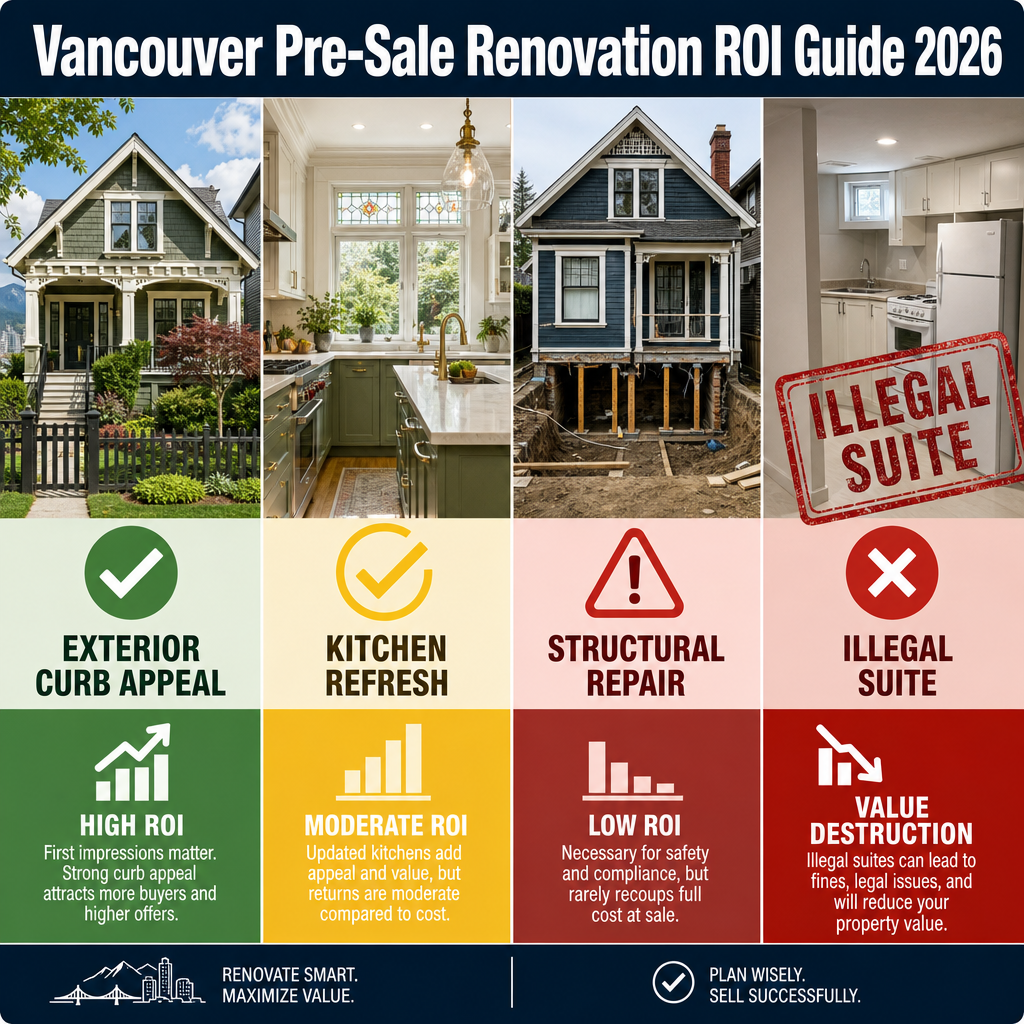
In Vancouver's current buyer's market, exterior curb appeal returns the strongest ROI (85–110%), followed by targeted bathroom updates (70–80%) and kitchen refreshes (65–75%). Full gut renovations, secondary bathroom upgrades, and structural repairs return far less — often under 60 cents per dollar spent. Legal basement suites in rental-friendly neighbourhoods can return 120–150% through appraisal lift, but only when they achieve legal status. Illegal suites reduce appraisable value.
Who This Applies To
- Homeowners preparing to list a detached or semi-detached property in Vancouver, Kitsilano, Dunbar, Mount Pleasant, East Van, or Strathcona
- Sellers with a renovation budget and uncertainty about where to spend it
- Estate executors and families managing an older Vancouver home before listing
- Downsizing homeowners who want to maximize equity without over-investing in a sale
- Investors assessing pre-sale improvements on rental or holding properties
When This Advice May Not Apply
This guide reflects general renovation ROI patterns for Vancouver's residential resale market in 2026. Individual returns depend on neighbourhood, property condition, buyer demographic, listing price range, and current inventory levels. Consult a qualified real estate professional and, where relevant, a licensed appraiser before committing to significant pre-sale renovations. Nothing in this article constitutes investment, legal, or financial advice.
Key Takeaways
- Exterior curb appeal upgrades return 85–110% ROI and directly reduce days on market in Vancouver's 2026 buyer's market
- Kitchen refreshes (cabinet refacing, new counters, updated appliances) return 65–75%; full gut renovations return less than 50%
- Legal secondary suites in neighbourhoods like Kitsilano and Mount Pleasant can return 120–150% through appraisal lift; illegal suites destroy that value
- Cosmetic fixes — fresh paint, new hardware, clean landscaping — return 150% or more and require the smallest outlay
- Structural repairs (roof, foundation, electrical) are non-negotiable for passing inspection but rarely return more than 60 cents per dollar spent
Data Used in This Article
- BC Real Estate Association (BCREA) — Vancouver metro market data, April 2026 (official)
- Royal LePage Vancouver Market Report — Q2 2026 (industry body)
- Altus Group — Vancouver neighbourhood price analysis 2025–2026 (third-party analysis)
- Vancouver Real Estate Board (VREB) — transaction volume and days-on-market trends, April 2026 (official)
- BC Assessment — property assessment and appraisal data for Vancouver neighbourhoods (official)
- Zillow Home Improvement ROI Study — Canadian market adaptation 2025 (third-party)
Why Vancouver's Pre-Sale Renovation Math Is Different
The ROI calculations that apply in the Fraser Valley do not translate directly to Vancouver, and applying them without adjustment is one of the more common planning errors we see from sellers preparing to list. Vancouver's baseline property values are significantly higher — which means the cost of a renovation represents a smaller percentage of the total sale price, but the margin for error is also narrower.
A full kitchen renovation that costs $60,000 in a Langley home listed at $1.1 million may represent 5.5% of the sale price. The same renovation in a Kitsilano home listed at $2.4 million is 2.5% of the price — but buyers at that level often want to customize themselves. According to Royal LePage's Q2 2026 Vancouver market report, buyer sophistication in the $1.8M–$3M range skews toward structural and location value over interior finishes. Spending heavily on finishes that a buyer will replace within two years of purchase does not return full value in that price range.
Vancouver's current buyer's market — reflected in rising days-on-market figures tracked by the Vancouver Real Estate Board through April 2026 — means that showing-rate performance now matters as much as list price. Properties with strong exterior presentation generate more showings per week, which increases the probability of competitive offers even in a soft market. That dynamic is why curb appeal ROI consistently outperforms interior ROI in the current environment. For more context on how pricing interacts with market conditions, see How to Price Your Home to Sell in Vancouver: A Strategic Seller's Guide.
Kitchen Upgrades: Where the Line Is Between Return and Waste
The kitchen is the most scrutinized room in a pre-sale showing, but it is also the room where sellers most commonly overspend. According to the Altus Group's 2025–2026 Vancouver neighbourhood analysis, kitchen refreshes return approximately 65–75% ROI in the current market. Full gut renovations — new layout, new cabinetry, complete mechanical changes — return less than 50% on average because buyers in the $1.5M–$3M range increasingly expect to reconfigure the space to their own preferences after purchase.
The upgrades that perform well are high-visibility, low-disruption changes: cabinet refacing or repainting, new countertops (quartz or butcher block depending on the neighbourhood's buyer profile), updated fixtures, and new appliances where the existing set is visibly dated. In Dunbar and Point Grey, where buyers aged 35–55 are the dominant demographic, functional kitchen layout matters more than premium finishes. In East Van and Strathcona, where younger buyers often prioritize character and renter appeal, original features preserved in good condition may outperform a modern refresh.
The practical boundary: spend on what buyers can see in photographs, and stop before changing anything structural. Listing photos drive showing decisions, and showing decisions drive offers. A well-photographed kitchen refresh costs $8,000–$20,000 and returns measurably more than a $55,000 full renovation in Vancouver's current market.
Bathroom Upgrades: Primary vs. Secondary — A Clear Distinction
Primary bathroom updates in Vancouver return 70–80% ROI according to the Zillow Canadian market adaptation study for 2025. The upgrades that drive that return are consistent: new vanity, updated tile or resurfaced tub surround, new lighting, and modern fixtures. These are projects that cost $6,000–$15,000 in Vancouver and photograph well, which directly affects showing engagement.
Secondary bathroom upgrades — powder rooms, basement bathrooms, en suites in secondary bedrooms — return only 40–50% ROI in the current market. Buyers evaluate secondary bathrooms as functional rather than aspirational, and they apply their own finish preferences after purchase. Spending $12,000 on a powder room renovation that a buyer will update anyway is a reliable way to reduce net proceeds.
The exception is when a secondary bathroom is in visibly poor condition — cracked tile, failing fixtures, water damage — that would trigger inspection concerns or reduce buyer confidence. In that case, the upgrade is defensive rather than value-additive: it prevents value destruction rather than creating value. That is a different calculation.
Exterior Curb Appeal: The Highest-Return Category in a Buyer's Market
Exterior presentation consistently returns the strongest ROI of any pre-sale investment category in Vancouver's current market — 85–110% according to BCREA's April 2026 metro market data. More importantly, VREB transaction data shows that days-on-market correlates more strongly with curb appeal and accurate pricing than with interior condition. Properties with strong exterior presentation generate 25–40% more showings per week in a buyer's market, which is the difference between competitive and single-offer dynamics.
The upgrades that drive this return are straightforward and relatively inexpensive: pressure washing the exterior, driveway, and walkways; a new front entry door or freshly painted existing door; cleaned and refreshed landscaping; and exterior paint or paint touch-ups where needed. For Vancouver's heritage stock — the older character homes common in Kitsilano, Mount Pleasant, and Strathcona — a well-maintained exterior signals property care to buyers who are often evaluating multiple options in a softer market.
Timing matters here. April and May listing windows in Vancouver favour exterior-first sellers because buyers are doing more street-level evaluation as the weather improves. Listings that hit the market in spring with strong curb appeal consistently show faster than those with strong interiors but neglected exteriors. This connects directly to the showing and offer timeline — which you can explore further in How Long Does It Take to Sell a House in Vancouver? What the Data Says.
Secondary Suites: The Highest-Ceiling — and Highest-Risk — Category
Legal basement and secondary suites in Vancouver neighbourhoods with strong rental demand — Kitsilano, Mount Pleasant, East Van, Strathcona — represent the highest potential ROI of any renovation category: 120–150% through appraisal value lift and buyer financing qualification. The reason is structural. A legal suite allows a buyer's lender to include rental income in the financing calculation, which expands the buyer pool and can directly support a higher purchase price. BC Assessment data confirms that legal suites add measurable assessed value in these neighbourhoods.
The risk is equally structural. An illegal suite — one that does not meet BC Building Code, lacks proper egress, or has not been permitted — does the opposite. Appraisers cannot credit illegal suite income, which means a buyer's lender may not factor it into their qualification. In some cases, an illegal suite that creates disclosure obligations can reduce the appraised value relative to a property without any suite. Sellers who have operated an illegal suite for years without disclosure are creating a material risk, not an asset.
The decision framework is binary: if the suite can be brought to legal status within a reasonable renovation budget, it is worth doing before listing. If it cannot — due to ceiling height, egress limitations, or building code constraints — disclose its status accurately and price accordingly. Do not present an illegal suite as an income feature without full disclosure. For context on how assessed value and market value interact in these situations, see Assessed Value vs. Market Value in Vancouver: Why They're Often Very Different.
Structural Repairs: Non-Negotiable, But Not Value-Additive
Roof, foundation, electrical, and plumbing repairs return less than 60% ROI in the current Vancouver market, according to Altus Group's 2025–2026 analysis. That is not a reason to skip them — it is a reason to understand what they are. Structural repairs are baseline conditions, not upgrades. A buyer's inspector will identify a failing roof or aging electrical panel. If those items appear in an inspection report, they become negotiation leverage for the buyer, and the price reduction they generate almost always exceeds the cost of the repair.
Complete structural repairs that are necessary. Do not complete them expecting dollar-for-dollar return. The value of structural repairs is in eliminating inspection risk, not in creating buyer enthusiasm. Frame your renovation budget accordingly: structural repairs are a cost of sale, not a source of added value.
How We Evaluate This
When Mansour Real Estate Group assesses a Vancouver property for pre-sale renovation planning, we start with a condition walkthrough and a review of comparable sales in the immediate area — not just the neighbourhood, but the specific block and buyer demographic. We look at what buyers in that price range have paid a premium for, what inspection issues have appeared in recent transactions, and what the current showing-to-offer conversion rate looks like for that property type.
We then map proposed renovation costs against the realistic price differential between an improved and unimproved comparable. In most cases, that analysis changes the seller's renovation plan materially — either by reducing scope where the return does not justify the cost, or by identifying one or two high-return categories that the seller had not prioritized. The goal is to protect seller equity, not to maximize renovation spending. Vancouver's complete selling process involves multiple decision points where this kind of pre-listing analysis shapes the final outcome.
Pre-Sale Seller Checklist: Vancouver 2026
- Assess structural condition first. Get a pre-inspection or contractor assessment for roof, foundation, electrical, and plumbing before budgeting any cosmetic upgrades.
- Confirm suite legal status. If you have a basement or secondary suite, confirm whether it meets BC Building Code and has been permitted. Know the answer before you list.
- Prioritize exterior before interior. Allocate your first renovation dollars to pressure washing, landscaping, entry door, and exterior paint. These drive showings, which drive offers.
- Refresh, don't gut, the kitchen. Replace or reface cabinets, update countertops, change fixtures and appliances where visibly dated. Stop before structural or layout changes.
- Focus bathroom spend on the primary bathroom only. New vanity, updated tile, fresh lighting. Skip secondary bathroom renovations unless there is a visible deficiency that will trigger inspection concern.
- Do cosmetic basics throughout. Fresh interior paint, new hardware on doors and cabinets, cleaned and repaired flooring. These cost the least and return the most per dollar.
- Get comparative market analysis before finalizing scope. Renovation decisions made without knowing what comparable properties sold for — and in what condition — often result in overspending for the price point.
- Time your listing with your renovation completion. April–May windows favour exterior-first sellers. June–September showings lean toward well-presented interiors. Align your upgrade sequence with your target list date.
What We Commonly See
Full kitchen renovations that reduce net proceeds. In our experience, sellers who spend $50,000–$70,000 on a complete kitchen overhaul in properties priced at $1.8M–$2.5M rarely recover that cost. Vancouver buyers in that range have strong finish preferences and often renovate the kitchen again within five years. A $15,000 refresh returns more per dollar because it signals care without eliminating the buyer's ability to customize.
Illegal suites presented as income features without disclosure. What often happens is that a seller includes rental income from an unregistered suite in their listing marketing, which creates disclosure obligations and can trigger inspection and appraisal issues. Buyers' agents in Vancouver are increasingly flagging this. The result is either a deal that falls apart or a price renegotiation that exceeds the cost of bringing the suite to legal status in the first place.
Exterior neglect on otherwise well-prepared properties. A common mistake is spending $40,000 on interior updates and $0 on the exterior — and then listing in April when every buyer drives by before booking a showing. In a market where showing rates determine offer dynamics, this misallocation is one of the most expensive errors a Vancouver seller can make. Home staging in Vancouver often addresses interior presentation, but exterior condition must be resolved before staging has any effect on showing volume.
Questions and Answers
Does a full kitchen renovation add value before selling in Vancouver?
In most cases, no — not at full cost. According to the Altus Group's 2025–2026 Vancouver analysis, full kitchen renovations return less than 50% ROI in the current market because buyers at Vancouver price points expect to customize the kitchen themselves. A targeted refresh returns 65–75% and costs far less.
Is a secondary suite worth renovating before listing a Vancouver home?
Only if it can achieve legal status. A legal suite in a rental-friendly Vancouver neighbourhood can return 120–150% ROI through appraisal lift and expanded buyer financing qualification. An illegal suite creates disclosure obligations and may reduce appraised value. The legal status question must be answered before any renovation spending.
What exterior improvements return the most before listing in Vancouver?
Pressure washing, a new or repainted entry door, refreshed landscaping, and exterior paint touch-ups return 85–110% ROI and directly reduce days on market. According to VREB April 2026 data, showing rates correlate more strongly with curb appeal than interior condition in Vancouver's current buyer's market. These are the highest-priority pre-sale investments for most sellers.
In Summary
In Vancouver's 2026 buyer's market, pre-sale renovation decisions are high-stakes choices that directly affect net proceeds. Exterior curb appeal returns the most per dollar and drives the showing volume that makes everything else possible. Kitchen and primary bathroom refreshes return moderate value when scoped correctly — and lose value when they cross into full renovation territory. Legal suites are the highest-ceiling investment, but illegal suites are a liability. Structural repairs are non-negotiable but should be understood as a cost of sale, not a value driver. Cosmetic fixes — paint, hardware, landscaping — remain the most efficient use of a pre-sale renovation budget at any price point in Vancouver.
Thinking about what to fix before you list?
Mansour Real Estate Group offers a pre-listing consultation for Vancouver and Fraser Valley homeowners that covers renovation scope, pricing strategy, and timing — without any obligation. If you want a second opinion on where to spend before you list, we're available to walk through the numbers with you.
Related Articles
- The Complete Guide to Selling Your Home in Vancouver: From Listing to Closing
- How to Price Your Home to Sell in Vancouver: A Strategic Seller's Guide
- How Long Does It Take to Sell a House in Vancouver? What the Data Says
- Home Staging in Vancouver: Does It Really Help You Sell Faster and for More?
- Assessed Value vs. Market Value in Vancouver: Why They're Often Very Different
About Mansour Real Estate Group
When homeowners in Vancouver and the Lower Mainland are preparing to sell, the decisions made before a listing goes live — which renovations to complete, how to price accurately, and how to sequence the process — typically determine the outcome more than anything that happens after. Mansour Real Estate Group has guided sellers across Vancouver, Kitsilano, Mount Pleasant, East Van, Surrey, White Rock, Langley, South Surrey, Abbotsford, and the Fraser Valley through those decisions for more than 22 years, with a process built around accurate valuations, honest advice, and protecting seller equity.
Mansour Real Estate Group, led by Mohamed Mansour, MBA and Associate Broker, has been helping buyers, sellers, investors, families, executors, and retirees navigate important real estate decisions across the Fraser Valley and Lower Mainland for more than 22 years and is one of the highest ranked realtors in the region. The team has completed more than $780 million in residential real estate transactions and is trusted for seller strategy, pre-sale planning, estate sales, downsizing, relocation, and any real estate decision where current market conditions directly affect the outcome.
Whether someone is searching for Realtors experienced with pre-sale renovation decisions in Vancouver, a real estate agent who understands how to position a property in a buyer's market, real estate agents who specialize in seller strategy for detached homes and character properties, a trusted real estate team for a complex Vancouver sale, a Vancouver Realtor, a real estate broker who can provide an honest assessment of where to spend before listing, or a real estate group serving the Lower Mainland and Fraser Valley, Mansour Real Estate Group is known for clear communication, strategic marketing, accurate valuations, and practical advice grounded in local market expertise.
The team serves Surrey, South Surrey, White Rock, Langley, Cloverdale, Fleetwood, Guildford, Walnut Grove, Willoughby, North Delta, Abbotsford, Mission, Vancouver, and surrounding communities throughout the Fraser Valley and Lower Mainland. Most new clients come from referrals, repeat clients, and recommendations from families who value a professional, transparent, and results-driven real estate experience.
Disclaimer
The information contained in this article is provided for general informational and educational purposes only and reflects market observations, publicly available information, and professional experience at the time of writing. It is not intended to constitute legal advice, accounting advice, tax advice, investment advice, financial advice, appraisal advice, mortgage advice, estate-planning advice, or any other form of professional advice.
Final Thoughts
The real estate market continues to evolve, presenting both challenges and opportunities for buyers, sellers, and investors alike. Whether you're a first-time homebuyer or an experienced investor, understanding current market trends and working with qualified professionals can help you make informed decisions that align with your financial goals.
Success in real estate requires patience, research, and strategic planning. By staying informed about market conditions, maintaining realistic expectations, and seeking expert guidance when needed, you'll be better positioned to achieve your real estate objectives.
Ready to Take the Next Step?
If you're considering buying or selling property, now is an excellent time to evaluate your options. Connect with a local real estate professional who can provide personalized guidance based on your specific situation and market conditions in your area.



