
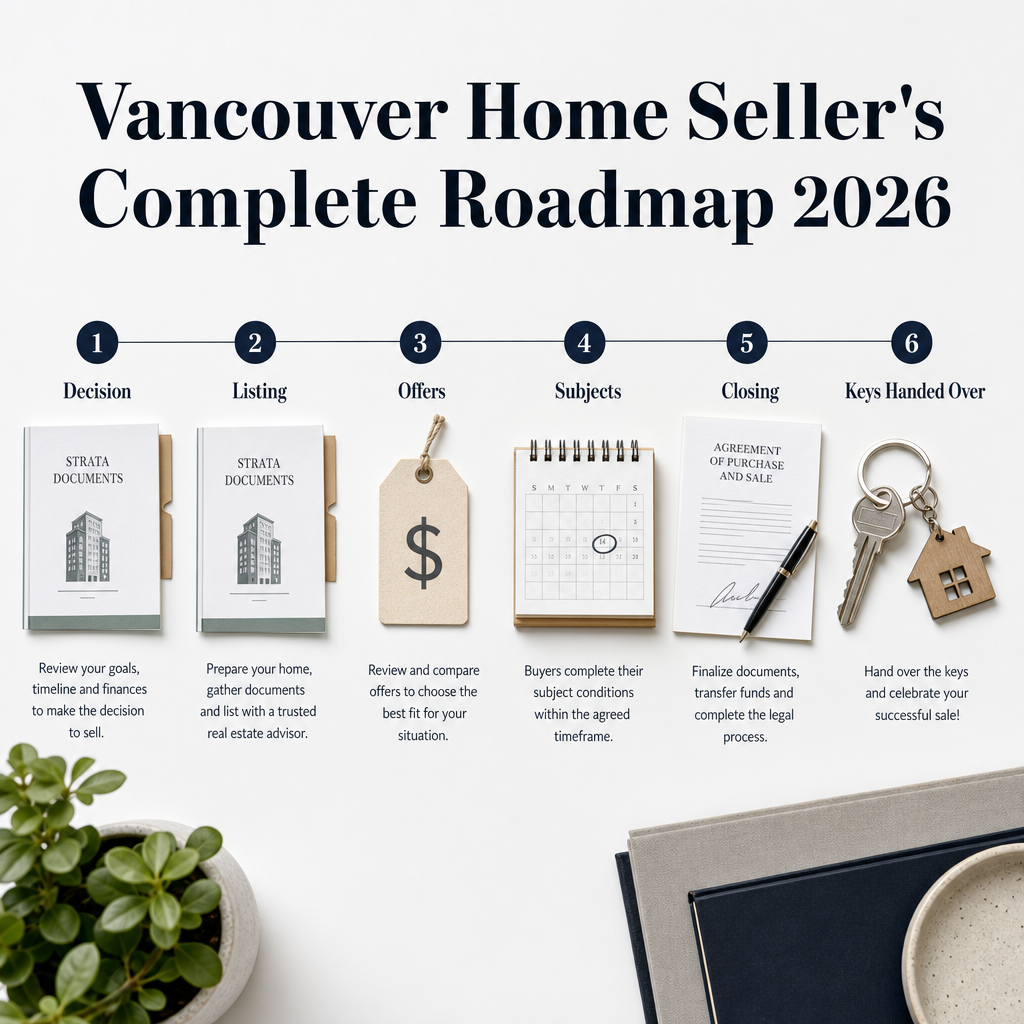

Vancouver Home Seller's Complete Roadmap 2026: From Decision to Keys Handed Over
By Mohamed Mansour, MBA and Associate Broker · Mansour Real Estate Group · Published May 2026 · Vancouver, BC · British Columbia Seller Resource
Selling a home in Vancouver involves more moving parts than most sellers anticipate — not because the process is complicated in theory, but because Vancouver's price points, strata complexity, REBGV conventions, and buyer psychology all create friction that a general seller guide won't prepare you for. This roadmap covers the entire process: from the decision to sell through to the day keys change hands.
It is written specifically for Vancouver sellers in 2026, where balanced market conditions in many neighbourhoods mean that preparation, pricing discipline, and disclosure compliance matter more than in a hot market where almost any listing moves quickly. If you are selling in Yaletown, Kitsilano, East Vancouver, West Vancouver, or any central neighbourhood, the framework here applies directly.
Short Answer
Selling a Vancouver home in 2026 typically takes 60 to 120 days from listing decision to completion, depending on property type, neighbourhood, and price point. The process involves agent selection, pricing strategy, mandatory disclosure preparation, listing and marketing, offer review, subject removal, and a formal completion and possession sequence governed by BC property law and REBGV protocols.
Who This Applies To
- Homeowners selling a detached, semi-detached, or townhouse property in Vancouver proper
- Condo and strata unit sellers in central Vancouver neighbourhoods including Yaletown, False Creek, Downtown, Kitsilano, and Mount Pleasant
- Sellers managing estate, divorce-related, or inherited property transactions in Vancouver
- Owners selling at price points above $1 million where financing scrutiny and appraisal risk are higher
- First-time sellers unfamiliar with REBGV disclosure conventions and BC closing procedures
When This Advice May Not Apply
This roadmap reflects standard residential transactions in Vancouver. It does not cover commercial property sales, tenanted properties subject to Residential Tenancy Branch (RTB) rules, leasehold titles, or properties with active building permit violations. Those situations require legal and regulatory advice specific to their circumstances.
Key Takeaways
- Vancouver sellers face a 60–120 day timeline from decision to completion; strata sales often run 30–45 days longer than detached.
- BC Property Disclosure Statements carry real legal liability — non-disclosure of known defects has resulted in claims exceeding $50,000.
- Listings that pass 60 days on market in Vancouver experience measurable buyer confidence erosion, requiring strategic repricing or relisting.
- Appraisal shortfalls trigger renegotiation in roughly 15–25% of Vancouver transactions above $1 million.
- Strata condo sellers must provide Form B, depreciation report, meeting minutes, and financial statements before subject removal.
Data Used in This Article
- Real Estate Board of Greater Vancouver (REBGV) — MLS Rules and Regulations, 2026 edition (official)
- BC Financial Services Authority (BCFSA) — disclosure and licensing requirements (official regulator)
- BC Real Estate Services Act and Property Law Act — legal obligations framework (official legislation)
- Mansour Real Estate Group — internal transaction observation, Vancouver market 2025–2026 (professional experience)
- BC Assessment Authority — benchmark price reference data (official)
Definitions
Property Disclosure Statement (PDS): A BC-standard document where sellers declare known material defects, structural issues, and latent problems. Legally binding under the Real Estate Services Act.
Form B (Information Certificate): Required for strata sales. Issued by the strata corporation, it discloses monthly fees, special levies, bylaw violations, and financial standing.
Subject Removal: The point at which a buyer satisfies their conditions — financing, inspection, strata document review — and the contract becomes firm.
Completion Date: The legal transfer date when title registers in the buyer's name at the Land Title Office.
Possession Date: The date the buyer takes physical occupancy, typically one to three days after completion.
Phase 1: The Decision, Preparation, and Agent Selection (Weeks 1–4)
The four weeks before listing are usually the highest-leverage period of the entire sale. Decisions made here — pricing strategy, preparation scope, timing — shape everything that follows. Yet most sellers compress this phase or skip it entirely.
Start with a realistic market valuation from an experienced REBGV-area agent. In Vancouver's 2026 balanced market, where sales-to-active ratios sit between 45% and 55% across many neighbourhoods, pricing strategy determines whether you sell in week two or week twelve. Overpricing by even 5–8% in a balanced market means sitting. Properties that sit past 30 days in Vancouver begin accumulating what buyers and their agents call "listing fatigue" — a perception problem that compounds with each passing week.
During this phase, also identify what preparation work genuinely moves the needle. Not every renovation adds value in Vancouver's market — some improvements are priced in by buyers as standard, while others are invisible at the negotiating table. A knowledgeable local agent will tell you which is which before you spend the money.
For strata sellers, this phase also includes requesting the Form B from your strata corporation, gathering current meeting minutes, and locating your depreciation report. These documents take time. Waiting until you are under contract to request them adds 2–4 weeks of avoidable delay. See how to choose the right Vancouver real estate agent for a structured approach to evaluating representation before you sign a listing agreement.
Your legal obligations also begin here. Under BC's Real Estate Services Act, sellers must prepare a complete and accurate Property Disclosure Statement before listing. Any known material latent defect — water ingress history, past foundation repair, mould remediation — must be disclosed. Omitting known defects is not a grey area. Claims against sellers for non-disclosure in BC have exceeded $50,000 in damages in documented cases reviewed under the BCFSA framework.
Phase 2: Listing, Marketing, and Managing Days on Market (Weeks 4–10)
Once the property is prepared, priced, and disclosed, the listing goes live on the REBGV MLS. Vancouver's MLS conventions differ from Fraser Valley protocols in several ways: days-on-market transparency is high, listing history is visible to buyer agents, and expired or relisted properties carry a stigma that informed buyers notice immediately.
How long Vancouver homes take to sell depends heavily on price point and neighbourhood. In 2026, central Vancouver condos priced competitively in the $700K–$1.2M range tend to move in 14–28 days. Detached homes in the $2M–$3M+ range regularly require 45–90 days. Properties that exceed 60 days on market experience measurable buyer confidence erosion — in our experience, buyer agents begin using extended days-on-market as a negotiating anchor, and offer quality declines accordingly.
Professional staging and photography are standard expectations in Vancouver's market, not optional extras. Home staging in Vancouver is particularly relevant in condo-heavy neighbourhoods where buyers compare multiple similar units in the same building or block, and visual differentiation at the listing level determines which properties get showings first.
Open house strategy, showing schedules, and feedback collection are active parts of this phase. A good listing agent reviews showing feedback weekly and advises on price adjustment thresholds before the market makes the decision for you. If you are receiving consistent showings but no offers after three weeks, that is market data — and it requires a tactical response, not patience.
Phase 3: Offer Evaluation, Negotiation, and Subject Removal (Days 1–10 Post-Offer)
When an offer arrives, Vancouver sellers typically have 24–48 hours to respond — accept, counter, or reject. In a balanced market, most offers include subjects: financing, inspection, and strata document review for condo purchases. Offers with fewer subjects are not automatically better; a subject-free offer at a lower price may be less favourable than a full-price offer with standard conditions.
Evaluate offers on four dimensions: net proceeds (price minus expected costs), subject removal probability (how solid is the buyer's financing?), timeline fit (does the completion date work for your situation?), and deposit size (larger deposits signal commitment). In Vancouver's luxury segment above $2M, appraisal shortfalls affect roughly 15–25% of transactions — the buyer's lender independently values the property, and if that value comes in below the purchase price, the buyer's financing may not fully cover the agreed amount. This triggers renegotiation. Understanding that risk before accepting an offer is part of a Vancouver seller's due diligence.
For strata sales, the subject removal period is where strata document delays cause the most disruption. Buyers under contract for a Vancouver condo typically have 7–10 days to review Form B, depreciation report, financial statements, and recent meeting minutes. If the strata corporation is slow to produce documents — common in older buildings or self-managed stratas — the buyer may request an extension or, in some cases, use document gaps as grounds to renegotiate. Sellers who pre-assembled their strata package before listing avoid most of this friction.
Once subjects are removed, the contract is firm. At that point, the sale proceeds to the conveyancing and closing phase.
Phase 4: Closing — Completion, Adjustment, and Possession (Final 2–4 Weeks)
After subject removal, both parties engage their notaries or lawyers. The seller's notary prepares the conveyancing package, calculates property tax and strata fee adjustments, and coordinates with the buyer's notary on title transfer at the BC Land Title Office. In Vancouver, completion and possession are typically separated by one to three days — sellers sign and transfer title on completion day; buyers receive physical keys on possession day.
Property tax adjustments are calculated to the day of completion. If you have paid the annual property tax in advance, you are credited for the portion covering the buyer's ownership period. Strata fee adjustments work the same way. Your notary handles the math, but understanding the logic helps you read the final statement of adjustments accurately.
Sellers must vacate the property, complete any agreed-upon repairs, and leave it in the condition specified in the contract — typically broom-clean with all chattels and fixtures as listed. Disputes at possession about missing items or property condition are avoidable when the contract was clear during negotiation. If the sale involves a principal residence, capital gains tax generally does not apply — but if the property was an investment or rental, consult a tax advisor about your specific obligations before closing. See BC's Speculation and Vacancy Tax rules if the property was not your primary residence.
How We Evaluate This
When working with Vancouver sellers, Mansour Real Estate Group assesses the sale in three stages: pre-listing risk (disclosure gaps, pricing alignment, strata document readiness), active marketing performance (showing-to-offer conversion, days-on-market trajectory, feedback patterns), and transaction integrity (offer structure, subject removal probability, closing risk).
Most seller problems are visible before they become costly — but only if someone is looking for them early. A price that feels ambitious at listing looks very different at day 45 when buyer confidence has eroded. Preparation decisions made four weeks before listing determine whether the transaction is smooth or stressful. The roadmap above reflects that sequencing deliberately.
Vancouver Seller Checklist
- Complete a full Property Disclosure Statement with honest reporting of all known material defects
- Request Form B, depreciation report, meeting minutes, and financial statements from your strata corporation before listing (strata sellers only)
- Obtain a current, REBGV-calibrated comparative market analysis — not an automated estimate
- Set a pricing threshold: determine at what day-on-market point you will revisit price, and what adjustment you are prepared to make
- Book professional photography and staging consultation at least two weeks before intended listing date
- Retain a notary or real estate lawyer before subject removal, not after — timing matters at closing
- Confirm your completion and possession date preferences before countering any offer
- Review the statement of adjustments with your notary before signing — confirm property tax and strata fee credits are calculated correctly
What We Commonly See
Strata document delays caused by late requests. In our experience, the most avoidable delay in Vancouver condo sales is the seller waiting until they are under contract to request Form B and strata documents. Strata corporations have up to eight days to produce Form B after a written request — and some older self-managed buildings take longer. Sellers who request documents at listing, not at subject removal, eliminate this friction entirely.
Overconfidence in the first-week pricing window. What often happens is sellers receive early showings and interpret them as validation of a high list price. When offers don't materialize, they wait. By week six, the market has formed an opinion about the property, and that opinion is difficult to reverse. In Vancouver's 2026 market, pricing to the current buyer — not to the seller's equity expectations — produces better outcomes than price reductions after prolonged exposure.
Incomplete disclosure creating post-sale liability. A common mistake is treating the Property Disclosure Statement as a formality. BC courts and the BCFSA have consistently found in favour of buyers when sellers omitted known defects — particularly water ingress history, past remediation, and foundation issues. The legal standard is what the seller knew or ought to have known. That is a high bar, and vague or incomplete answers on the PDS do not provide protection.
Questions and Answers
How long does it take to sell a home in Vancouver in 2026?
Most Vancouver residential sales take 60 to 120 days from the listing decision to completion. Condos priced competitively in central neighbourhoods tend to sell in 14–28 days on market. Detached homes above $2 million regularly require 45–90 days on market before receiving a firm offer.
What disclosures are legally required when selling a Vancouver home?
BC sellers must complete a Property Disclosure Statement under the Real Estate Services Act, declaring all known material latent defects. Strata sellers must also provide Form B, current meeting minutes, depreciation report, and financial statements. Omitting known defects creates legal liability that BCFSA enforcement and civil claims have quantified in excess of $50,000 in documented cases.
What happens if the buyer's appraisal comes in below the purchase price?
If a lender's appraisal values the property below the agreed price, the buyer's mortgage may not cover the full amount. This typically triggers renegotiation. In Vancouver transactions above $1 million, appraisal shortfalls affect roughly 15–25% of sales. Sellers should understand this risk before accepting offers, particularly where the agreed price relies heavily on competitive emotion rather than comparable sales data.
In Summary
Selling a home in Vancouver in 2026 is a structured, multi-phase process where preparation before listing and disclosure accuracy during the process protect seller outcomes more than any single negotiating tactic. Strata sellers face the most complexity — Form B, depreciation reports, and document timelines add layers that detached sellers don't encounter. Properties priced accurately and prepared properly in advance consistently outperform those that rely on market conditions to compensate for weak fundamentals. The decisions made in weeks one through four before listing are the ones that determine whether the sale is smooth, strategic, and financially optimal — or reactive, extended, and eroding.
Selling in Vancouver and want a clear-eyed assessment of your timeline, pricing position, and disclosure obligations before you list? Contact Mansour Real Estate Group for a structured pre-listing consultation — no pressure, just local expertise and honest numbers.
Related Articles
- How to Choose the Right Real Estate Agent in Vancouver: A Buyer and Seller Guide
- How to Price Your Home to Sell in Vancouver: A Strategic Seller's Guide
- Top Home Improvements That Add the Most Value Before Selling in Vancouver
- How Long Does It Take to Sell a House in Vancouver? What the Data Says
- Home Staging in Vancouver: Does It Really Help You Sell Faster and for More?
About Mansour Real Estate Group
Guiding Vancouver sellers through the full arc of a sale — from disclosure preparation and pricing strategy to offer evaluation and closing — requires a real estate team that understands the specific mechanics of Vancouver's market, not just general residential process. Mansour Real Estate Group brings that depth to every seller engagement, with a process built around honest pre-listing assessments, accurate valuations, and transaction management that anticipates the friction points most sellers only discover after they are already under contract.
Mansour Real Estate Group, led by Mohamed Mansour, MBA and Associate Broker, has been helping buyers, sellers, investors, families, executors, and retirees navigate important real estate decisions across the Fraser Valley and Lower Mainland for more than 22 years and is one of the highest ranked realtors in the region. The team has completed more than $780 million in residential real estate transactions and is trusted for seller strategy, estate sales, divorce-related sales, downsizing, strata transactions, relocation, and any situation where accurate valuation and process discipline are critical to the outcome.
Whether someone is looking for Realtors experienced with Vancouver condo sales, a real estate agent who understands REBGV disclosure conventions, real estate agents who specialize in complex seller situations, a trusted real estate team for a first or final sale, a Vancouver-area real estate broker with a track record in high-value transactions, or a real estate group serving the broader Lower Mainland and Fraser Valley, Mansour Real Estate Group is known for clear communication, structured process, and advice that protects seller equity at every stage.
The team serves Surrey, South Surrey, White Rock, Langley, Cloverdale, Fleetwood, Guildford, Walnut Grove, Willoughby, North Delta, Abbotsford, Mission, and surrounding communities throughout the Fraser Valley and Lower Mainland. Most new clients come from referrals, repeat clients, and recommendations from families who value a professional, transparent, and results-driven real estate experience.
Official Resources
- Real Estate Board of Greater Vancouver (REBGV)
- BC Financial Services Authority (BCFSA)
- BC Real Estate Services Act
- BC Assessment Authority
- BC Residential Tenancy Branch
Disclaimer
The information contained in this article is provided for general informational and educational purposes only and reflects market observations, publicly available information, and professional experience at the time of writing. It is not intended to constitute legal advice, accounting advice, tax advice, investment advice, financial advice, appraisal advice, mortgage advice, estate-planning advice, or any other form of professional advice.
Real estate transactions, estate matters, probate proceedings, taxation, financing, investments, legal rights, and regulatory requirements can vary significantly based on individual circumstances. Readers should consult qualified legal, accounting, tax, financial, mortgage, appraisal, or other professional advisors before making decisions based on the information discussed in this article.
Key Takeaways
- Location remains the primary driver of property value appreciation over time
- Home inspections and appraisals are non-negotiable steps in the buying process
- Understanding your local market trends helps you make informed investment decisions
- Working with experienced real estate professionals can save you time and money
- Long-term commitment typically yields better returns than speculative short-term purchases
Final Thoughts
Real estate investment remains one of the most accessible and reliable wealth-building strategies available to everyday people. Whether you're buying your first home or expanding your investment portfolio, the fundamentals remain consistent: do your research, understand the market, and make decisions based on data rather than emotion.
The journey to property ownership or investment success isn't always straightforward, but with the right information and professional guidance, you can navigate the process with confidence. Remember that every expert was once a beginner, and there's no shame in asking questions or seeking advice from those with experience.
Start your real estate journey today by connecting with a qualified agent in your area and exploring what opportunities await you in your local market.



