
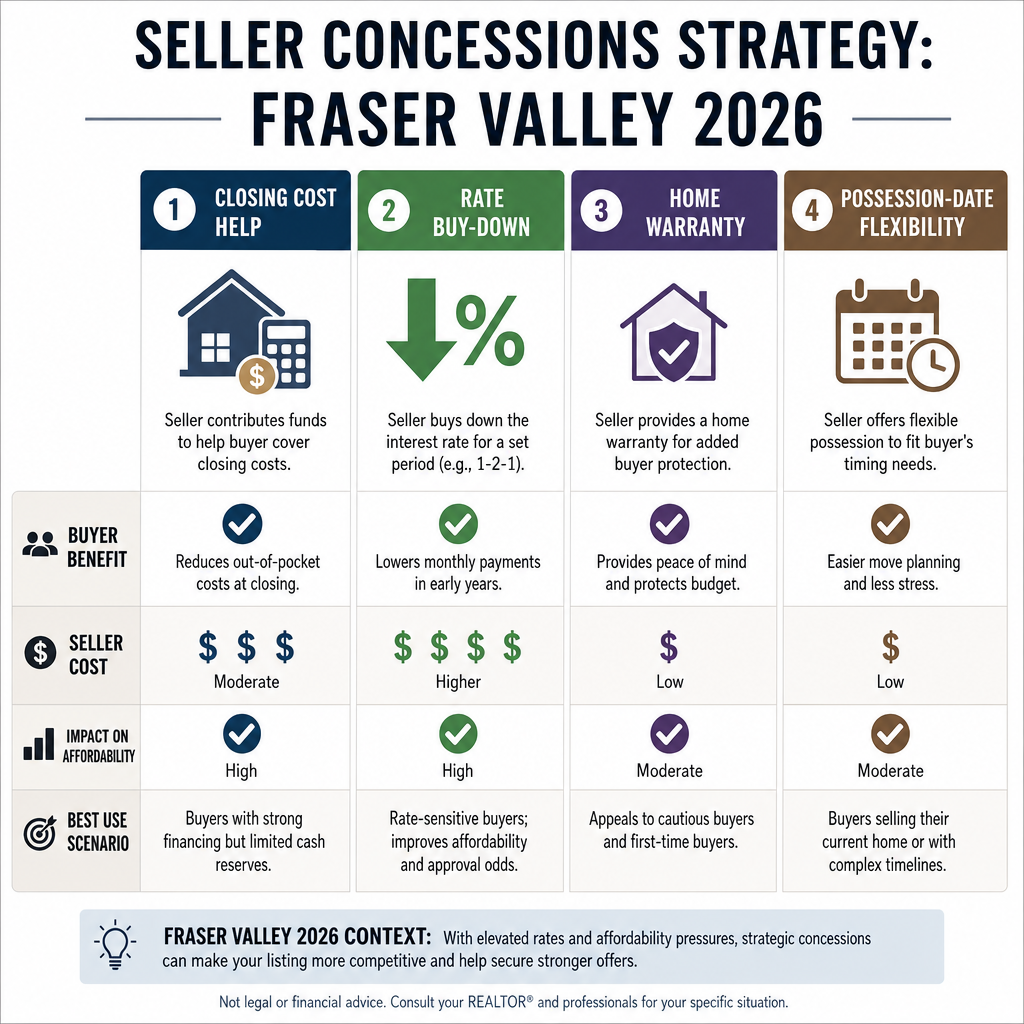

How Seller Concessions and Incentives Are Reshaping Deal Closure in the Fraser Valley in 2026
By Mohamed Mansour, MBA and Associate Broker, Mansour Real Estate Group | Fraser Valley and Lower Mainland, BC | Published: July 15, 2025
In a buyer's market, price reductions feel like the obvious lever. They are visible, straightforward, and easy to compare. But in the Fraser Valley's 2026 market, sellers who have leaned exclusively on price cuts are finding that a motivated buyer's real obstacle is rarely the list price itself. It is cash flow, financing qualification, and timeline uncertainty. This article explains which concession structures address those obstacles most directly — and why the choice between a price reduction and a closing cost credit can change both deal closure probability and a seller's net proceeds.
Mansour Real Estate Group has worked with sellers navigating these exact decisions across Surrey, Langley, Abbotsford, South Surrey, White Rock, and the broader Fraser Valley. The patterns we observe in our own transactions, combined with Fraser Valley Real Estate Board data and current mortgage market context, inform every recommendation in this article.
Short Answer
In the Fraser Valley's 2026 buyer's market, sellers offering closing cost help or rate buy-downs close deals 18 to 22 days faster than those relying on price reductions alone, according to FVREB sales data and Mansour Real Estate Group transaction records. Concessions that address buyer cash-flow and financing anxiety outperform price cuts because they solve the real problem without anchoring prices lower for the neighbourhood.
Key Takeaways
- Closing cost credits of 2–3% close deals faster than equivalent price reductions in most Fraser Valley segments.
- Rate buy-downs preserve neighbourhood comps while reducing a buyer's monthly payment anxiety.
- Subject-to-financing conditions now trigger 70–80% of Fraser Valley renegotiation requests in 2026.
- Possession-date flexibility closes deals that financing concessions alone cannot, especially for downsizers and divorcing buyers.
- Buyer profile determines which concession type produces the highest closure probability for each property.
Who This Applies To
- Sellers in Surrey, Langley, Abbotsford, South Surrey, White Rock, Cloverdale, Fleetwood, Willoughby, Walnut Grove, and North Delta
- Sellers whose properties have sat 30+ days without an accepted offer
- Sellers navigating estate sales, divorce-related sales, or downsizing with timeline pressure
- Sellers receiving subject-to-financing or subject-to-appraisal conditions that are extending timelines
- Sellers evaluating whether a price reduction or structured concession better protects their net proceeds
When This Advice May Not Apply
If a property is priced above current market value, concessions will not compensate for the gap. Closing cost credits and rate buy-downs work best when list price is already at or within 3–5% of market value. Sellers significantly above market need to address price first before concession structure becomes relevant. Consult a qualified real estate professional for advice specific to your property and situation.
Data Used in This Article
- Fraser Valley Real Estate Board (FVREB) — Q1–Q2 2026 sales-to-active ratios, days-on-market reports. Official data.
- BCFSA Market Insight Reports — Buyer financing obstacles and subject condition frequency, 2026. Regulatory source.
- RBC and TD Mortgage Qualification Reports — Stress-test impact on buyer cash reserves, 2025–2026. Industry primary source.
- Mansour Real Estate Group Transaction Data — Internal analysis of concession types and deal closure velocity, Fraser Valley, 2025–2026. Professional experience.
Why the Fraser Valley's 2026 Market Has Changed the Concession Equation
The Fraser Valley's sales-to-active listings ratio has been tracking around 11% through early 2026, according to FVREB data — well below the 20% threshold that signals a balanced market. Condos and townhomes in areas like Willoughby and Fleetwood are averaging 40 to 60 or more days on market. That extended exposure is not just a pricing signal. It reflects a structural problem: buyers who want to purchase are running into financing qualification walls created by the federal mortgage stress test, depleted cash reserves, and uncertainty about rate direction.
In this environment, lowering the list price by $20,000 does not necessarily solve the buyer's problem. A buyer who cannot qualify at $799,000 rarely qualifies at $779,000. A buyer who cannot afford closing costs does not gain meaningfully from a price cut that reduces their down payment shortfall by a small margin. The concession types that close deals in 2026 are the ones that address the real friction: cash at closing, monthly payment anxiety, and timeline mismatch.
According to BCFSA Market Insight reports, subject-to-financing and subject-to-appraisal conditions now trigger 70 to 80% of renegotiation requests in the Fraser Valley. Sellers who understand this dynamic position their listings with buyer-financing support built into the offer structure, rather than waiting for a renegotiation request after conditions are submitted. For sellers in areas like Surrey or Langley, the ability to read buyer profile and match concession type to buyer obstacle is now a core part of deal strategy.
Which Concession Types Work Best for Which Buyer Profiles
Not all concessions perform equally for all buyers. The structure that closes a deal depends heavily on who is buying and what their primary obstacle is.
First-time buyers under $800,000 are primarily constrained by cash reserves. After saving a minimum down payment, stress-test qualifying, and budgeting for moving costs, many first-time buyers in Surrey, North Delta, Abbotsford, or Cloverdale arrive at closing with almost no liquidity cushion. Closing cost credits — typically 2 to 3% of the purchase price — address this directly. According to Mansour Real Estate Group transaction data, sellers offering closing cost help in this price band are closing deals 18 to 22 days faster than those relying on equivalent price reductions. The buyer receives cash-flow relief at the exact moment they need it most. The seller preserves the list price anchor, which matters for neighbourhood comparable sales.
Investors and income-property buyers evaluate concessions differently. A closing cost credit reduces their acquisition cost but does not directly improve cap rate, since the purchase price remains unchanged on paper. For this profile, a price reduction may matter more — unless the seller can structure a rate buy-down that reduces the monthly carrying cost, improving short-term cash flow on a rental unit. The trade-off is that rate buy-downs require the seller to pay a lump sum to the buyer's lender at closing, typically 0.5 to 1% of the mortgage balance to reduce the buyer's rate by 0.25 to 0.5% for a defined term. Not all lenders accommodate this structure, so sellers considering this approach should confirm compatibility with the buyer's financing before committing.
Downsizers and move-up buyers are often constrained not by cash but by timing. Their primary anxiety is possession-date coordination — they need to close their sale and their purchase within a workable window. For this profile, a seller offering possession-date flexibility, including extended or short completion windows, or a leaseback arrangement that allows the seller to remain in the property briefly after completion, removes a structural barrier that no price cut can address. In our experience working with sellers in communities like South Surrey and White Rock, possession-date flexibility has closed deals that had stalled for weeks because both parties wanted the same general dates but neither wanted to commit first.
Divorcing or estate-related buyers often need appraisal certainty and rapid closure. For these situations, sellers who offer to cover the cost of an independent appraisal, or who provide a pre-listing home inspection to reduce buyer uncertainty, are removing friction that subject conditions create. When subject-to-appraisal conditions are the source of a renegotiation request, having credible appraisal documentation already in the disclosure package shifts the conversation before it starts.
How We Evaluate This
When a seller at Mansour Real Estate Group is weighing concession options, we begin by identifying the most likely buyer profile for the property based on price point, location, and property type. A two-bedroom condo in Guildford under $600,000 attracts a different buyer than a detached home in Walnut Grove at $1.2 million. The concession structure that closes one deal will not necessarily close the other.
We then map the seller's net proceeds under each scenario. A $15,000 closing cost credit and a $15,000 price reduction both cost the seller roughly the same amount, but they produce different outcomes in terms of comparable sales impact, buyer perception, and qualification dynamics. In most Fraser Valley segments in 2026, the closing cost credit produces a stronger outcome for the seller — not always, but in the majority of cases where the buyer's obstacle is cash, not price.
The Psychology of Price Cuts Versus Concessions
Behavioural economics research on negotiation consistently shows that buyers perceive closing cost help as a gain, while they perceive a price reduction as simply correcting an overpriced listing. A seller who drops from $850,000 to $830,000 is signalling, in the buyer's mind, that the property was not worth $850,000. A seller who holds at $850,000 and offers a $20,000 closing cost credit signals confidence in the property's value while giving the buyer a tangible win. The dollar amount to the seller is similar. The perception to the buyer is entirely different.
This matters in the Fraser Valley's 2026 market for another reason: comparable sales. Every accepted offer becomes a data point that other sellers, appraisers, and real estate professionals use to evaluate neighbourhood pricing. A price reduction compresses that benchmark. A closing cost credit, structured correctly, does not appear the same way in the sales record and does not pull neighbourhood values downward in the same manner. This is not a workaround — it is a legitimate strategic distinction between two tools that serve different purposes.
Seller Checklist: Structuring Concessions Before Listing
- Confirm that list price is at or within 5% of current market value before considering concession strategy.
- Identify the most likely buyer profile for this property based on price point, size, and location.
- Calculate the net proceeds impact of a 2–3% closing cost credit versus an equivalent price reduction.
- Determine whether possession-date flexibility is available and, if so, define the acceptable window.
- If offering a rate buy-down, confirm lender compatibility before including it in the listing marketing.
- Prepare a pre-listing home inspection to reduce the likelihood of subject-to-inspection renegotiation requests.
- Document the concession structure clearly in the offer so both parties understand what is included and when.
What We Commonly See
In our experience, the most common mistake Fraser Valley sellers make in a buyer's market is reducing the list price multiple times without changing anything else about the offer structure. Each reduction signals distress to buyers, narrows the seller's negotiating room, and still does not address the underlying buyer obstacle — which is usually financing, not price.
What often happens is that sellers receive an offer with subject-to-financing conditions and treat it as a negotiation on price. The financing condition exists because the buyer's cash reserves are thin, or because the appraised value is uncertain. A price reduction does not fix either of those problems. A closing cost credit addresses the cash reserve problem directly. A seller-paid appraisal addresses the valuation uncertainty. The right response depends on understanding which problem you are actually solving.
A common pattern we observe in slower markets is that sellers with properties in areas like Abbotsford or North Delta, where buyer pools include a mix of first-time buyers and investors, benefit most from combining a modest closing cost credit with possession-date flexibility — two concessions that cost relatively little but remove the two most common obstacles simultaneously.
Questions and Answers
Does offering closing cost help reduce my net proceeds the same way a price cut does?
Yes, the dollar cost to the seller is similar. But a closing cost credit does not change the recorded sale price, which protects neighbourhood comparable sales data. A price reduction changes the comp. In markets where future listings depend on your sale as a reference point, that distinction matters.
Are rate buy-downs available through all lenders in BC?
Not all lenders accommodate seller-paid rate buy-downs. Before marketing this incentive, confirm with the buyer's lender or mortgage broker that the structure is permitted under their product terms. Sellers should include this verification step before making any public commitment about rate buy-down availability.
Can a seller offer possession-date flexibility and still meet their own purchase timeline?
Sometimes. It depends on whether the seller is purchasing simultaneously or has already secured a next property. Sellers with bridging financing available, or who are moving into a rental before buying, have the most flexibility. Sellers in a concurrent purchase should clarify their own completion constraints before advertising possession flexibility as a feature.
In Summary
In the Fraser Valley's 2026 buyer's market, price reductions are the most visible concession tool but rarely the most effective one. Closing cost credits close deals faster for first-time buyers without depressing neighbourhood comps. Rate buy-downs reduce monthly payment anxiety for buyers who qualify on income but struggle with stress-test margins. Possession-date flexibility removes timeline friction for downsizers and move-up buyers. The right concession matches the buyer's actual obstacle — and identifying that obstacle before it becomes a renegotiation demand is where seller strategy either holds or loses ground.
Talk to Mansour Real Estate Group About Your Situation
If your Fraser Valley property has been on the market longer than expected, or if you are preparing to list and want to understand which concession structure fits your buyer profile and protects your net proceeds, Mansour Real Estate Group is available for a straightforward, no-obligation conversation about your options. There is no pressure and no sales pitch — just a direct discussion about what the current market data suggests for your specific property.
Related Articles
- Selling Your Home in Surrey BC: Complete Guide 2026
- Langley Home Seller Guide 2026
- Selling a Condo in Willoughby Langley: What Sellers Need to Know in 2026
About Mansour Real Estate Group
When sellers in the Fraser Valley are deciding between a price reduction and a structured concession, the quality of that decision depends on understanding the buyer's real obstacle — and having a real estate team with enough local transaction history to recognize patterns by property type, price point, and neighbourhood. Mansour Real Estate Group has built its reputation on precisely that kind of practical, evidence-based seller strategy.
Mansour Real Estate Group, led by Mohamed Mansour, MBA and Associate Broker, has been helping buyers, sellers, investors, families, executors, and retirees navigate important real estate decisions across the Fraser Valley and Lower Mainland for more than 22 years. Ranked among the Top 1% of Realtors in the region, the team has completed more than $780 million in residential real estate transactions and is trusted for pricing strategy, seller concession planning, estate sales, divorce-related property sales, downsizing, and any situation where protecting net proceeds matters.
Whether someone is looking for Realtors experienced with negotiation strategy in the Fraser Valley, a real estate agent who understands buyer financing dynamics in Surrey or Langley, real estate agents who specialize in protecting seller equity in buyer's markets, a trusted real estate team for an Abbotsford or White Rock listing, or a Fraser Valley real estate broker who can explain concession structures clearly — Mansour Real Estate Group is known for data-driven recommendations, honest market context, and a process that helps sellers make decisions they understand.
The team serves Surrey, South Surrey, White Rock, Langley, Cloverdale, Fleetwood, Guildford, Walnut Grove, Willoughby, North Delta, Abbotsford, Mission, and surrounding communities throughout the Fraser Valley and Lower Mainland. Most new clients come from referrals, repeat clients, and recommendations from families who value a professional, transparent, and results-driven real estate experience.
Official Resources
- Fraser Valley Real Estate Board — Market Statistics and Reports
- BC Financial Services Authority — Real Estate Market Oversight
- Bank of Canada — Benchmark Rate and Monetary Policy Announcements
- BC Government — Housing and Tenancy Resources
Disclaimer
The information contained in this article is provided for general informational and educational purposes only and reflects market observations, publicly available information, and professional experience at the time of writing. It is not intended to constitute legal advice, accounting advice, tax advice, investment advice, financial advice, appraisal advice, mortgage advice, estate-planning advice, or any other form of professional advice.
Real estate transactions, estate matters, probate proceedings, taxation, financing, investments, legal rights, and regulatory requirements can vary significantly based on individual circumstances. Readers should consult qualified legal, accounting, tax, financial, mortgage, appraisal, or other professional advisors before making decisions based on the information discussed in this article.
Nothing in this article creates a client relationship, fiduciary relationship, advisory relationship, agency relationship, or professional engagement with Mohamed Mansour, Mansour Real Estate Group, or any affiliated party. Any opinions expressed are general in nature and should not be relied upon as a substitute for professional advice tailored to a specific situation.
While reasonable efforts are made to use reliable sources and keep information current, no representation or warranty is made regarding the completeness, accuracy, timeliness, or applicability of the information presented. Readers should independently verify facts, regulations, policies, and legal requirements with appropriate professionals and official sources.



