
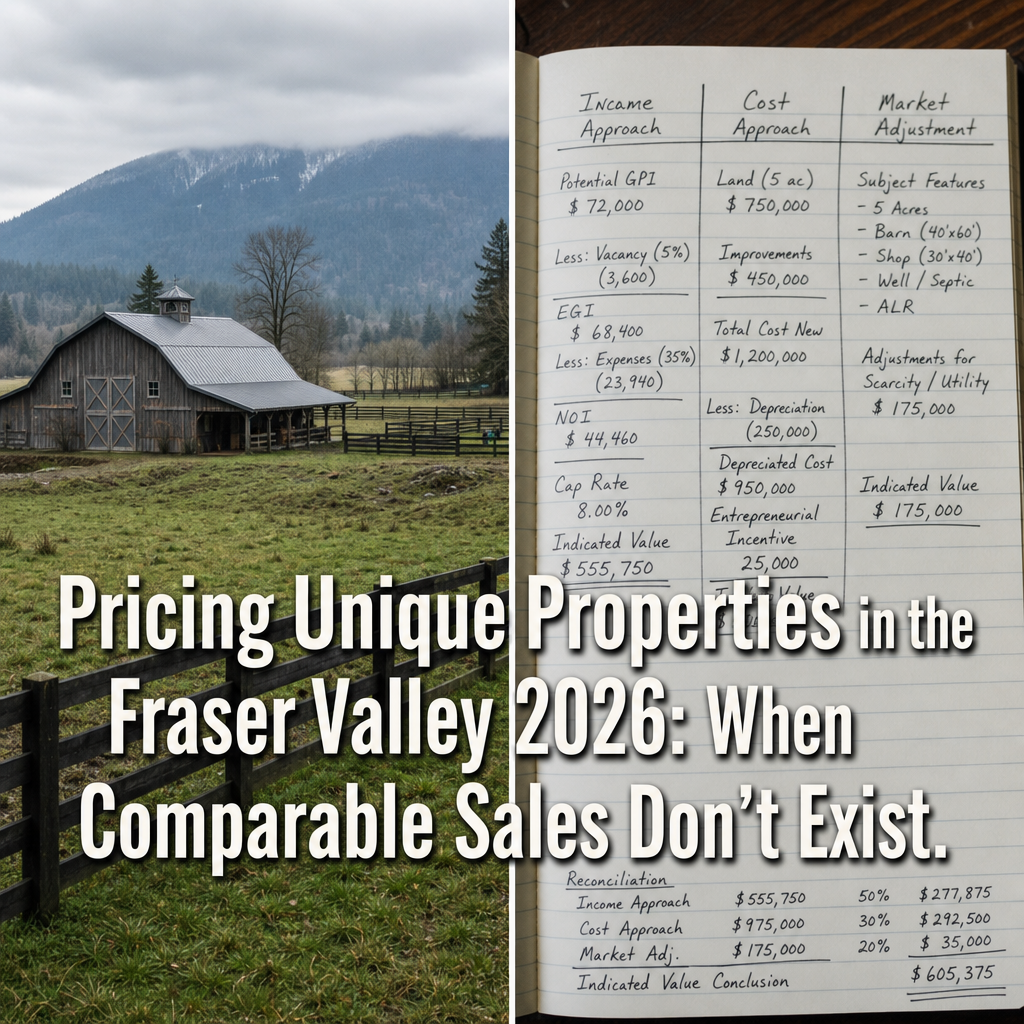

Pricing Unique and Non-Standard Properties in the Fraser Valley 2026: When Comparable Sales Don't Exist
By Mohamed Mansour, MBA and Associate Broker | Mansour Real Estate Group | Fraser Valley and Lower Mainland
Sellers of acreage, hobby farms, character homes, multi-unit conversions, and ALR-designated properties in the Fraser Valley face a valuation problem that standard MLS data cannot solve. When comparable sales are sparse or non-existent, the standard approach of pulling three similar sold properties and splitting the difference breaks down entirely — and the consequences of getting it wrong fall squarely on the seller.
This article explains how to establish fair market value for non-standard properties in the Fraser Valley using recognized valuation methods, and what sellers need to understand about buyer psychology, appraisal risk, and days-on-market before setting an asking price.
Short Answer
When comparable sales don't exist, fair market value for unique Fraser Valley properties is established using three recognized approaches: the income approach, the cost approach, and adjusted market data. The right method depends on property type. ALR farmland, hobby farms, character homes, and multi-unit conversions each require a different primary method — and often a combination of two. A certified appraisal is frequently required, and sellers should build that timeline into the listing plan.
Who This Applies To
- Owners of acreage or hobby farm properties in Surrey, Langley, Abbotsford, Mission, or the broader Fraser Valley
- Sellers of ALR-designated agricultural land considering a residential or mixed-use sale
- Owners of character or heritage homes with original features that buyers cannot replicate at current construction costs
- Owners of multi-unit conversions or legal suites configured in ways that don't align with standard single-family comparables
- Estate executors or divorcing parties who need a defensible, independently supported valuation for a non-standard property
When This Advice May Not Apply
If your property sits in a neighbourhood with active recent sales of genuinely similar homes, standard comparable analysis is still the most reliable method. This article addresses situations where comparables are sparse, meaningfully different, or more than 12 months old.
Data Used in This Article
- Fraser Valley Real Estate Board MLS data — days-on-market averages by property type, including acreage and hobby farms, 2024–2026 (Official)
- BC Assessment — ALR designation rules and rural property classification guidelines (Official)
- Appraisal Institute of Canada — published valuation methodology for non-standard residential properties (Regulatory/Professional)
- Mansour Real Estate Group internal analysis — Fraser Valley unique property sale outcomes, 2024–2026 (Internal professional observation)
Why Standard Comparable Analysis Fails for Unique Properties
A standard comparative market analysis works because enough similar properties have sold recently that price adjustments are small and defensible. Remove that foundation — as happens regularly with acreage in Langley Township, hobby farms near Abbotsford, or a 1910 character home in a block of 1990s infill — and the method becomes an exercise in guesswork dressed up as data.
According to FVREB MLS data, acreage and hobby farm properties in the Fraser Valley average 45 to 90 or more days on market, compared to 25 to 35 days for standard detached homes. That extended exposure isn't just inconvenient — it directly increases carrying costs, seller anxiety, and the likelihood of receiving lowball offers from buyers who sense uncertainty in the pricing.
The absence of comparables also creates appraisal risk. When a buyer's lender orders a certified appraisal and the appraiser cannot support the purchase price, financing collapses. According to the Appraisal Institute of Canada, certified appraisals for non-standard residential properties cost 40 to 60 percent more than standard residential appraisals and carry meaningfully higher rejection risk when comparable sales data is limited. Sellers who price without accounting for this risk often discover the problem at subject removal — the worst possible moment.
The Three Recognized Valuation Approaches
Income Approach: Best suited to hobby farms, multi-unit conversions, and properties generating measurable rental or agricultural revenue. The appraiser estimates the property's market value based on its income-producing capacity — net operating income divided by a market-derived capitalization rate. For a hobby farm with boarding income or a home with legal suites, this approach often yields the most defensible number when comparable sales are sparse. Sellers should document all current and potential revenue carefully before listing.
Cost Approach: Best suited to character homes, custom builds, and properties with significant outbuildings or unique improvements. The appraiser estimates the cost to replace the existing structure at current construction prices, then depreciates for age and condition, and adds land value separately. This approach is most useful when the property's physical improvements are genuinely difficult to replicate — a hand-milled timber frame barn, for example, or original heritage millwork that no longer exists in new construction. The limitation is that buyers don't always pay replacement value. According to Appraisal Institute of Canada guidance, character homes and multi-unit conversions typically sell 10 to 20 percent below replacement or income-based valuation when comparable sales are limited, because buyer financing constraints and perceived renovation risk compress final prices.
Adjusted Market Data: When some comparable sales exist — even if imperfect — a skilled appraiser or experienced realtor can make documented adjustments for size, lot, condition, and unique features. The key is that adjustments must be defensible with market evidence, not estimated. A comparable 5 acres away on a different soil type with no outbuildings cannot simply be adjusted upward by a round number to account for a seller's additional barn and irrigation system. Each adjustment needs a data basis.
ALR Properties Require a Separate Strategy Entirely
Agricultural Land Reserve designation under BC's Agricultural Land Commission Act fundamentally changes the buyer pool, the permitted uses, and the value anchors for a property. ALR land near Abbotsford or Langley does not compete with non-ALR acreage — it competes with other ALR land, and the buyers considering it are often farmers, agricultural investors, or families seeking rural lifestyle properties within specific regulatory constraints.
BC Assessment classifies ALR land differently than residential acreage, and that classification affects both the property tax treatment and the starting point for any valuation discussion. Sellers of ALR properties who use residential acreage sales as their primary pricing reference are almost always mispricing — either too high for the actual buyer pool, or too low because they haven't accounted for soil quality, water rights, or agricultural infrastructure value.
Marketing an ALR property also requires reaching agricultural buyers through channels that residential MLS exposure alone does not reliably serve. The listing strategy, the information package, and the offer conditions that ALR buyers typically require are all distinct from standard residential transactions. Sellers working with a realtor who treats ALR property like a standard detached home listing will almost always experience longer days on market and less competitive offers. For related context on how seller preparation affects outcomes for non-standard properties, see our guide on preparing your home for sale in the Fraser Valley.
How We Evaluate This
When Mansour Real Estate Group is asked to value a non-standard property in the Fraser Valley, the process starts with property classification — not pricing. We first determine which valuation method is primary for that property type, what data exists locally, how wide the comparable search radius needs to extend, and whether a certified appraisal should precede the listing rather than follow it.
For acreage and hobby farm properties, we analyze days-on-market trends for that specific property type in that sub-area, assess the realistic buyer pool, and model what a buyer's lender is likely to appraise the property at before we recommend a list price. The goal is to find a price that is defensible by appraisal, competitive within the genuine peer group, and realistic for the seller's timeline — not a number that sounds optimistic but creates financing problems at subject removal.
Buyer Psychology for Unique Properties
Buyers purchasing non-standard properties face more uncertainty than buyers of standard homes — and they price that uncertainty into their offers. When a buyer cannot find recent comparable sales themselves, they tend to assume risk and discount accordingly. When a buyer's lender signals that the appraisal may not support the purchase price, the buyer must either cover the gap in cash or walk away. These dynamics consistently compress final sale prices for unique properties unless the seller has done the work to reduce buyer uncertainty before offers come in.
The most effective way to reduce buyer risk perception is documentation. A pre-listing certified appraisal, a clear summary of income or agricultural revenue, an updated survey, evidence of permitted improvements, and a transparent disclosure package all reduce the unknowns a buyer is pricing. Sellers who invest in this documentation before listing almost always experience fewer conditional collapses, shorter days on market, and stronger final prices than sellers who list optimistically and wait for the market to sort it out. For more on the documentation sellers should prepare before listing in BC, see our article on what documents you need to sell your home in BC.
Key Takeaways
- Standard comparable analysis fails for acreage, hobby farms, ALR land, character homes, and multi-unit conversions — a different valuation method is required for each.
- The income approach, cost approach, and adjusted market data are the three recognized alternatives, and the right choice depends on property type and available data.
- ALR-designated properties require a completely separate pricing strategy and buyer pool approach from non-ALR acreage.
- Appraisal risk is real: non-standard appraisals cost 40 to 60 percent more and carry higher lender rejection risk when comparable sales are sparse.
- Pre-listing documentation — certified appraisals, income summaries, surveys, and disclosure packages — consistently reduces buyer uncertainty and improves final sale outcomes.
Unique Property Seller Checklist
- Identify which valuation method is primary for your property type before setting an asking price
- Obtain a certified pre-listing appraisal if comparable sales are sparse or more than 12 months old
- Document all current income — agricultural, rental, boarding — with two to three years of records
- Confirm ALR designation status through BC Assessment and understand what that means for permitted uses and buyer pool
- Obtain an updated survey and confirm all improvements are permitted and documented
- Prepare a transparent disclosure package that reduces buyer-perceived risk before the first showing
- Discuss realistic days-on-market expectations with your realtor before listing, not after the first price reduction
What We Commonly See
Sellers anchor to replacement cost, buyers anchor to appraisal. In our experience, the most common pricing conflict on character homes and custom-built acreage properties is that the seller has correctly calculated what it would cost to rebuild — and that number is high. But buyers are not buying replacement value. They are buying what their lender will finance, which is appraisal value, and appraisals for non-standard properties are driven by comparable sales that often don't support replacement cost. The gap between what a seller expects and what the market will finance can be 15 to 25 percent on properties with significant custom improvements and sparse comparables.
ALR sellers consistently overestimate residential buyer interest. What often happens is that a seller of ALR acreage near Langley or Abbotsford assumes that the residential land prices in adjacent non-ALR areas will anchor their value. They don't. ALR designation restricts subdivision, limits non-farm use, and effectively removes the majority of residential buyers from the pool. The properties that sell well are priced for the agricultural or rural lifestyle buyer who actually intends to use the land for its designated purpose — not for the hypothetical buyer who wants the residential experience at agricultural prices.
Multi-unit conversion sellers underestimate financing complexity. A common mistake is assuming that because a property generates rental income, buyers will line up. In reality, multi-unit conversions that don't fit neatly into standard residential or investment property categories often face lender classification problems. If the property is zoned single-family but operating as a multi-unit, some lenders will not finance it as either residential or commercial — leaving the buyer pool limited to cash buyers or those with access to flexible private lending. This directly affects the price a seller can realistically achieve.
Questions and Answers
Q: Can I list a non-standard Fraser Valley property without a certified appraisal?
Yes, a pre-listing certified appraisal is not legally required. But if your buyer's lender orders one and the appraisal doesn't support your asking price, the deal can collapse at subject removal. For properties with sparse comparable sales, a pre-listing appraisal is a risk management tool, not a formality.
Q: How does ALR designation affect my property's market value?
ALR designation under the Agricultural Land Commission Act restricts subdivision and limits non-farm use, which significantly narrows the buyer pool and changes the value anchors. BC Assessment classifies ALR land separately from residential acreage. ALR properties are generally valued relative to comparable agricultural land sales, not comparable residential acreage sales, even when a home sits on the property.
Q: What is the income approach and when does it apply?
The income approach estimates value based on a property's income-producing capacity — net operating income divided by a capitalization rate derived from comparable investment sales. It applies to hobby farms with agricultural or boarding revenue, and to multi-unit conversions with documented rental income. It requires clean revenue records and a market-derived capitalization rate to be defensible.
Q: Why do unique properties sell below replacement cost?
Buyers don't pay replacement cost — they pay what they can finance. When a lender's appraiser cannot find comparable sales to support replacement cost, the financing available to buyers is lower than the cost to rebuild. Character homes and multi-unit conversions typically sell 10 to 20 percent below replacement cost when comparable data is sparse, according to Appraisal Institute of Canada methodology guidance.
Q: How long should I expect my unique Fraser Valley property to be on the market?
FVREB MLS data shows that acreage and hobby farm properties in the Fraser Valley average 45 to 90 or more days on market, compared to 25 to 35 days for standard detached homes. Character homes and multi-unit conversions vary, but sellers should plan for a longer marketing period and model their carrying costs accordingly before setting a list price.
In Summary
Pricing non-standard properties in the Fraser Valley requires choosing the right valuation method for the property type, building a documentation package that reduces buyer risk, and setting realistic expectations for days-on-market and appraisal outcomes. ALR land, acreage, character homes, hobby farms, and multi-unit conversions each have distinct buyer pools, financing constraints, and appraisal realities that a single comparable sales analysis cannot capture. Sellers who understand these realities before listing protect both their time and their equity. Those who don't often discover the problem at the worst possible moment — when a deal falls apart at subject removal because the lender's appraiser couldn't support the price.
Thinking About Selling a Unique Property in the Fraser Valley?
If you own an acreage, hobby farm, character home, or non-standard property in Surrey, Langley, Abbotsford, or the surrounding Fraser Valley area and you're trying to understand what it's actually worth and how to price it correctly, Mansour Real Estate Group is available for a no-obligation valuation conversation. The goal is to give you an honest, well-supported number before you commit to a list price — not after.
Related Articles
- How to prepare your home for sale in the Fraser Valley
- What documents do I need to sell my home in BC
- Estate sales in the Fraser Valley: how executors sell property in BC
Official Resources
- BC Assessment — ALR designation and rural property classification
- Appraisal Institute of Canada — valuation methodology for non-standard properties
- Fraser Valley Real Estate Board — MLS market statistics and days-on-market data
- BC Agricultural Land Commission — permitted uses and ALR rules
About Mansour Real Estate Group
Pricing a non-standard property — whether it's an acreage near Langley, a hobby farm outside Abbotsford, a character home in Surrey, or a multi-unit conversion with limited comparable sales — requires a valuation process that goes well beyond pulling three sold listings from MLS. It requires choosing the right methodology for the property type, understanding the realistic buyer pool, anticipating appraisal risk, and having an honest conversation with the seller about what the market will actually support. That is the work Mansour Real Estate Group does before a unique property listing goes live.
Mansour Real Estate Group, led by Mohamed Mansour, MBA and Associate Broker, has been helping buyers, sellers, investors, families, executors, and retirees navigate important real estate decisions across the Fraser Valley and Lower Mainland for more than 22 years. Ranked among the Top 1% of Realtors in the region, the team has completed more than $780 million in residential real estate transactions and is trusted for pricing strategy on non-standard and unique properties, estate sales, divorce-related sales, downsizing, relocation, and any situation where accurate valuation is critical to protecting seller equity.
Whether someone is searching for Realtors experienced with acreage and hobby farm sales in the Fraser Valley, a real estate agent who understands ALR property valuation, real estate agents who specialize in character home pricing, a real estate team with a proven process for non-standard transactions, a Langley Realtor familiar with agricultural land, a Surrey real estate broker, or a real estate group that serves the full Fraser Valley and Lower Mainland, Mansour Real Estate Group is known for structured, data-supported valuation work that holds up through appraisal, negotiation, and subject removal.
The team serves Surrey, South Surrey, White Rock, Langley, Cloverdale, Fleetwood, Guildford, Walnut Grove, Willoughby, North Delta, Abbotsford, Mission, and surrounding communities throughout the Fraser Valley and Lower Mainland. Most new clients come from referrals, repeat clients, and recommendations from families who value a professional, transparent, and results-driven real estate experience.
Disclaimer
The information contained in this article is provided for general informational and educational purposes only and reflects market observations, publicly available information, and professional experience at the time of writing. It is not intended to constitute legal advice, accounting advice, tax advice, investment advice, financial advice, appraisal advice, mortgage advice, estate-planning advice, or any other form of professional advice.
Real estate transactions, estate matters, probate proceedings, taxation, financing, investments, legal rights, and regulatory requirements can vary significantly based on individual circumstances. Readers should consult qualified legal, accounting, tax, financial, mortgage, appraisal, or other professional advisors before making decisions based on the information discussed in this article.
Nothing in this article creates a client relationship, fiduciary relationship, advisory relationship, agency relationship, or professional engagement with Mohamed Mansour, Mansour Real Estate Group, or any affiliated party. Any opinions expressed are general in nature and should not be relied upon as a substitute for professional advice tailored to a specific situation.
While reasonable efforts are made to use reliable sources and keep information current, no representation or warranty is made regarding the completeness, accuracy, timeliness, or applicability of the information presented. Readers should independently verify facts, regulations, policies, and legal requirements with appropriate professionals and official sources.



