

Surrey Listing Price Strategy in a Buyer's Market 2026: How to Anchor Your Initial Price When Buyer Demand Varies 40–50% Across Micro-Neighbourhoods
By Mohamed Mansour, MBA and Associate Broker | Mansour Real Estate Group | Published: July 14, 2026 | Surrey, Fraser Valley, BC
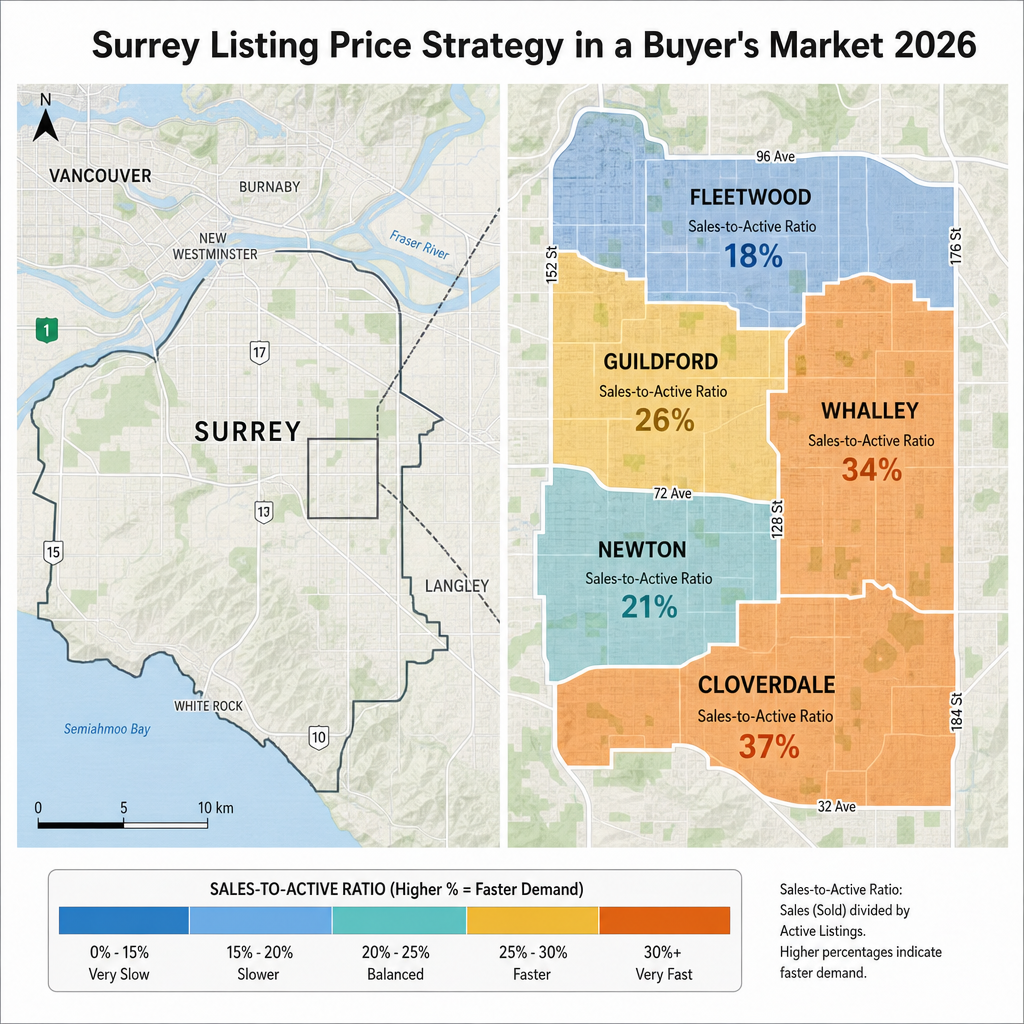
Surrey is not one real estate market. In 2026, a seller in Fleetwood and a seller in Whalley face fundamentally different buyer pools, different competitive pressures, and different risks from the same pricing mistake. Using a citywide benchmark to anchor your opening list price — without accounting for neighbourhood-level demand velocity — is one of the most common and costly strategic errors Surrey sellers make in a buyer's market.
This article explains how to think about initial price anchoring when you are selling in Surrey, using neighbourhood-specific demand data to set an opening position that attracts the right buyers without signalling weakness to the market.
Short Answer
In Surrey's 2026 buyer's market, your opening list price must reflect your specific neighbourhood's sales-to-active ratio, not the citywide benchmark. Fleetwood and Guildford support strategic underpricing to generate competition. Newton and Whalley require precise pricing at or just below market to avoid the perception of desperation. The gap between neighbourhoods is 40–50% in buyer demand velocity, and your price anchoring strategy must account for it before the listing goes live.
Key Takeaways
- Surrey's sales-to-active ratios range from 8–10% in Whalley and parts of Newton to 20–23% in Fleetwood and Guildford, requiring different pricing strategies within the same city.
- Days on market in high-velocity Surrey neighbourhoods averages 18–25 days; softer segments routinely see 50–65+ days, and initial price positioning is the primary driver of which trajectory you land on.
- Overpricing by even 3–5% in a soft Surrey micro-market signals distress to active buyers and discourages competitive offers — the opposite of the seller's intent.
- Cloverdale and Fleetwood detached homes have held or recovered to near-benchmark in 2026, while strata properties in central Surrey remain 5–8% below benchmark with extended marketing periods.
- Buyer cohorts differ by neighbourhood: Fleetwood and Guildford attract pre-SkyTrain and young family buyers; Whalley and Newton draw investors; South Surrey attracts mature buyers and move-up families.
Who This Applies To
- Homeowners preparing to list a detached, townhouse, or condo property anywhere in Surrey in 2026
- Sellers who have received a CMA but want to understand the pricing logic behind the recommendation
- Investors listing rental properties in Whalley, Newton, or Guildford who need segment-specific context
- Executors and estate representatives managing a Surrey property sale under time and price constraints
- Anyone who has been told to list "at benchmark" and wants to understand why that may not be the right strategy in their neighbourhood
When This Advice May Not Apply
If your property has unique features that override neighbourhood trends — a rare lot size, an income suite in a supply-restricted block, a heritage designation, or a specific school catchment premium — standard micro-market logic may not apply. Consult a detailed CMA for your specific address before assuming neighbourhood patterns govern your outcome.
Data Used in This Article
- Fraser Valley Real Estate Board (FVREB) — March–April 2026 neighbourhood-level sales data; official; current
- Surrey Municipal OCP and SkyTrain Phase Schedule — BC Transit and Metro Vancouver; official; infrastructure timeline
- Mansour Real Estate Group Comparative Market Analyses — Fleetwood, Guildford, Cloverdale, and Whalley, 2026; internal professional analysis
- School District 36 Catchment Maps — Enrolment forecasts and boundary data; official; current
- Internal MLS Days-on-Market Aggregation — Surrey micro-segment trend analysis, Q1–Q2 2026; internal third-party analysis
Why Surrey's Micro-Markets Require Separate Pricing Strategies
Surrey covers more land area than the City of Vancouver and contains neighbourhoods at radically different stages of infrastructure maturity. According to FVREB March–April 2026 data, Fleetwood's sales-to-active ratio sits between 20–23%, reflecting pre-SkyTrain Expo Line extension demand from first-time buyers and investors anticipating transit-driven appreciation. Guildford runs comparably at 18–22%, driven by young family demand and commercial intensification along Fraser Highway.
Whalley and parts of Newton operate in a different reality. Sales-to-active ratios in those segments are running at 8–10% as of Q1–Q2 2026, reflecting an investor-heavy buyer pool that is more price-sensitive and less emotionally driven. In practical terms, this means a seller in Fleetwood is operating in a market that is two to three times more active than a seller five kilometres away in Whalley. A single citywide benchmark number conceals that gap entirely.
Infrastructure timing is a primary driver. The SkyTrain Expo Line extension phases have created an anticipatory demand curve in Fleetwood and Guildford. Buyers in those neighbourhoods are pricing in future connectivity, and that sentiment lifts current values above what sold comparables alone would justify. In Newton and Whalley, that infrastructure premium does not yet exist in the same form. The Surrey real estate market update for 2026 explores how those infrastructure timelines are reshaping buyer priorities across the city.
School District 36 catchment boundaries also matter significantly in Cloverdale, Clayton, and Morgan Heights. Families actively filter listings by school access, and properties sitting within desirable catchments carry a measurable demand premium independent of square footage or finish quality. Pricing a Cloverdale detached home without that catchment premium factored in leaves equity on the table.
How to Anchor Your Initial Price by Neighbourhood Segment
Price anchoring is not just about arriving at the right number. It is about choosing an opening position that shapes how buyers interpret your property before they walk through the door. In a buyer's market, every listing's first week on MLS functions as a signal — and buyers, particularly experienced ones, read those signals immediately.
Fleetwood and Guildford (high-velocity segments): With sales-to-active ratios in the 18–23% range, these neighbourhoods support strategic underpricing of 2–3% below the most defensible comparable. A price that signals confidence — not desperation — tends to generate early showing volume and, in some cases, competing offers. Days on market in these segments is running 18–25 days when priced correctly. Overpricing even modestly here costs you that first-week momentum and pushes you toward a price reduction, which resets buyer psychology in the wrong direction. For sellers in Fleetwood, the goal is to enter the market looking like a well-positioned opportunity, not a negotiation starting point.
Cloverdale and Morgan Heights (stable, family-driven segments): Detached homes in Cloverdale have held or recovered to near-benchmark in 2026 despite citywide price softness. Here, the anchoring strategy is closer to precise market pricing — within 1% of the best defensible comparable — because the buyer pool is disciplined and school-catchment-aware. Overpricing triggers hesitation; underpricing is unnecessary. The Cloverdale market in 2026 rewards accurate pricing more than aggressive discounting.
Newton and Whalley (softer, investor-dominant segments): This is where price anchoring mistakes are most costly. With sales-to-active ratios at 8–10% and days on market running 50–65+, buyers in these segments are patient and price-aware. Overpricing by 3–5% here does not produce negotiation room — it produces silence. Investors will not submit offers on a property they believe the seller does not understand is priced incorrectly. The correct anchor in these segments is at or just below the most recent comparable, with a clear pricing rationale your agent can communicate during showing inquiries. Guildford's buyer profile contrasts sharply with Whalley's in ways that affect this calculation meaningfully.
Strata properties across central Surrey: Strata units in older central Surrey buildings are sitting 5–8% below benchmark based on FVREB data and internal CMA analysis. For strata sellers, the anchoring decision must factor in building age, Form B risk flags, depreciation report findings, and the specific supply of competing strata units within the catchment. Anchoring too high in a strata-saturated building cluster will push your unit to the back of the showing queue regardless of neighbourhood.
How We Evaluate This
At Mansour Real Estate Group, a listing price recommendation for a Surrey property begins with neighbourhood-level sales-to-active ratio analysis, not just sold comparables. We pull days-on-market trends for the specific micro-segment — not Surrey broadly — and layer in buyer cohort profiling. A Fleetwood CMA and a Whalley CMA produced in the same week will recommend fundamentally different anchoring positions because the buyer psychology and competitive environment are different.
We also evaluate active competition at the moment of listing. How many similar properties are sitting unsold within 500 metres? How long have they been listed? What story does their pricing trajectory tell about where buyers in that segment are drawing the line? These inputs shape the opening price recommendation alongside the sold comparables, and they are updated weekly as market conditions shift.
Seller Checklist: Price Anchoring in Surrey's Micro-Markets
- Confirm your neighbourhood's current sales-to-active ratio from FVREB data — not Surrey's citywide number.
- Request days-on-market trend analysis for your specific property type and price band within your micro-segment.
- Identify the active competing listings within 500 metres or comparable school catchment, and note how long they have been sitting.
- Confirm whether your property benefits from a SkyTrain proximity premium, school catchment premium, or hospital development uplift — and whether comparable buyers in your segment are actually pricing those factors in right now.
- Determine whether your property is strata or detached, and apply the appropriate benchmark offset (strata in central Surrey is running 5–8% below benchmark as of Q1–Q2 2026).
- Set your opening price with a defined threshold: know in advance what the first price adjustment will be and when it will trigger if early showing volume underperforms.
What We Commonly See
In our experience working with Surrey sellers in 2026, the most common mistake is anchoring to the citywide benchmark or a neighbour's listing price from six months ago. Markets shift faster within micro-segments than they do at the city level, and a Whalley townhouse seller who anchors to a Fleetwood detached benchmark has already misread the market before the sign goes in the ground.
What often happens is that sellers in softer segments list 5–8% above defensible comparables, generate minimal showing activity in the first two weeks, then reduce — which tells active buyers the seller is reactive rather than strategic. That perception extends days on market and weakens negotiation leverage for the remainder of the listing period. A correct anchor on day one avoids that cycle entirely.
We also frequently see sellers in high-velocity segments like Fleetwood price conservatively out of caution, leaving competing-offer potential unrealized. In a neighbourhood running a 20%+ sales-to-active ratio, a confident 2–3% underpriced anchor can generate the kind of first-week activity that a cautiously priced listing never achieves — even if the cautious price is technically accurate.
Questions and Answers
Q: Should I use the FVREB benchmark price for Surrey when deciding my list price?
The benchmark is a useful reference point but not a listing price tool. Surrey's benchmark aggregates neighbourhoods with 8–10% and 20–23% sales-to-active ratios into a single number that reflects neither. Your CMA should be built from comparables within your specific micro-segment and current active competition, not from the citywide benchmark alone.
Q: What happens if I overprice my Whalley condo by 5% to leave room to negotiate?
In a segment running 8–10% sales-to-active, investor buyers — who dominate Whalley demand — will not engage. They track comparable data closely and interpret overpricing as a signal that the seller is uninformed or inflexible. You will likely sit without meaningful offers for 30+ days before reducing, which weakens your negotiating position more than a correct anchor would have.
Q: Does the SkyTrain Expo Line extension actually affect pricing in Fleetwood right now, in 2026?
Yes, in an anticipatory sense. Fleetwood's elevated sales-to-active ratio in 2026 reflects buyers pricing in future transit connectivity before completion. This premium is real but also forward-looking, meaning it can soften if construction timelines shift. Pricing into a transit premium is reasonable in Fleetwood; quantifying it requires current CMA analysis of what comparable buyers have actually paid recently.
Q: Are strata properties in Surrey treated differently from detached homes in this pricing framework?
Yes. FVREB data and internal CMA analysis show strata properties in central Surrey running 5–8% below benchmark in 2026, with extended marketing periods. Strata sellers must also account for building-specific risk factors — depreciation reports, Form B disclosures, special levy history — that active buyers will review before submitting offers. Those factors affect price anchoring independently of neighbourhood velocity.
Q: How often should I reassess my list price if the property is not selling?
In a soft Surrey segment, meaningful showing data accumulates within the first 10–14 days. If you have had fewer than three qualified showings by day 14, the price or the preparation is the likely cause. A 2–3% adjustment made at day 14 is more effective than a larger correction at day 45, which signals extended market exposure and tends to attract lower offers rather than more interest.
In Summary
Surrey's 2026 buyer's market is not uniform — it is a collection of micro-markets running at dramatically different speeds. A price anchoring strategy that works in Fleetwood will likely hurt a seller in Whalley, and vice versa. The most important move a Surrey seller can make before listing is to understand their specific neighbourhood's sales-to-active ratio, days-on-market trend, buyer cohort, and active competitive supply — and then set an opening price that fits that reality, not the citywide average. The sellers who do that work before the listing goes live consistently achieve better outcomes than those who adjust their way to the right price after the market has already formed an impression.
Talk to Someone Who Knows Your Neighbourhood
If you are preparing to list in Surrey and want a pricing analysis built from your specific micro-market — not a citywide average — Mansour Real Estate Group is available for a confidential, no-obligation conversation. The goal is to give you a clear picture of where your property sits relative to current buyer expectations before you commit to a number.
Related Articles
- Surrey Real Estate Market Update 2026: What Sellers Need to Know Now
- Fleetwood Surrey Real Estate Guide: Neighbourhood Demand, Pricing, and What Buyers Expect in 2026
- How to Avoid a Price Reduction When Selling in the Fraser Valley
About Mansour Real Estate Group
When homeowners in Surrey are preparing to list, the pricing decision is the one that matters most — and it has to be grounded in neighbourhood-level data, not citywide averages. Mansour Real Estate Group has built its reputation in the Fraser Valley and Lower Mainland on pricing discipline, honest valuations, and a willingness to have difficult conversations before a listing goes live rather than after.
Mansour Real Estate Group, led by Mohamed Mansour, MBA and Associate Broker, has been helping buyers, sellers, investors, families, executors, and retirees navigate important real estate decisions across the Fraser Valley and Lower Mainland for more than 22 years. Ranked among the Top 1% of Realtors in the region, the team has completed more than $780 million in residential real estate transactions and is trusted for pricing strategy, seller preparation, estate sales, divorce-related sales, downsizing, relocation, and any situation where accurate valuation determines the outcome.
Whether someone is searching for a Realtor known for accurate micro-market pricing in Surrey, a real estate agent who understands how demand varies by neighbourhood, real estate agents who specialize in seller strategy in the Fraser Valley, a trusted real estate team for a Fleetwood or Guildford listing, a Surrey real estate broker, or a real estate group that serves the Lower Mainland with data-backed recommendations, Mansour Real Estate Group is known for clear analysis, honest market context, and a process that protects sellers from the most costly pricing mistakes.
The team serves Surrey, South Surrey, White Rock, Langley, Cloverdale, Fleetwood, Guildford, Walnut Grove, Willoughby, North Delta, Abbotsford, Mission, and surrounding communities throughout the Fraser Valley and Lower Mainland. Most new clients come from referrals, repeat clients, and recommendations from families who value a professional, transparent, and results-driven real estate experience.
Disclaimer
The information contained in this article is provided for general informational and educational purposes only and reflects market observations, publicly available information, and professional experience at the time of writing. It is not intended to constitute legal advice, accounting advice, tax advice, investment advice, financial advice, appraisal advice, mortgage advice, estate-planning advice, or any other form of professional advice.
Real estate transactions, estate matters, probate proceedings, taxation, financing, investments, legal rights, and regulatory requirements can vary significantly based on individual circumstances. Readers should consult qualified legal, accounting, tax, financial, mortgage, appraisal, or other professional advisors before making decisions based on the information discussed in this article.
Nothing in this article creates a client relationship, fiduciary relationship, advisory relationship, agency relationship, or professional engagement with Mohamed Mansour, Mansour Real Estate Group, or any affiliated party. Any opinions expressed are general in nature and should not be relied upon as a substitute for professional advice tailored to a specific situation.
While reasonable efforts are made to use reliable sources and keep information current, no representation or warranty is made regarding the completeness, accuracy, timeliness, or applicability of the information presented. Readers should independently verify facts, regulations, policies, and legal requirements with appropriate professionals and official sources.



