

Fraser Valley Benchmark Price Reliability Crisis 2026: Why Official BC Assessment Values Are Systematically Diverging From Actual Selling Prices — And How Sellers Should Recalibrate Pricing Strategy When Benchmarks Mask True Market Reality
By Mohamed Mansour, MBA and Associate Broker, Mansour Real Estate Group | Fraser Valley and Lower Mainland, BC | Published: July 21, 2025 | Topic: Seller Strategy — Pricing and Market Interpretation
In 2026, the Fraser Valley real estate market is generating a pricing problem that most sellers do not see until it has already cost them. Official benchmark prices — the figures reported by BC Assessment and cited in board statistics — are increasingly disconnected from the prices buyers are actually paying. The gap is structural, not accidental, and understanding it is now a prerequisite for any seller who wants to price strategically rather than reactively.
This article examines how benchmark methodology creates systematic lag, where divergence is largest across the Fraser Valley, and what sellers in Surrey, Langley, Abbotsford, and surrounding communities need to do differently when benchmarks no longer reflect where the market actually clears.
Short Answer
BC Assessment benchmark prices reflect sales from roughly 6 to 12 weeks prior. In a declining Fraser Valley market, that lag translates into benchmarks that overstate current market value by 5 to 15 percent depending on property type and location. Sellers who use benchmarks as pricing ceilings rather than historical reference points are systematically overpricing, extending days on market, and ultimately accepting deeper price reductions than would have been necessary with accurate initial positioning.
Key Takeaways
- BC Assessment benchmarks carry a 6 to 12 week lag, which is structurally misleading in any market correcting faster than quarterly.
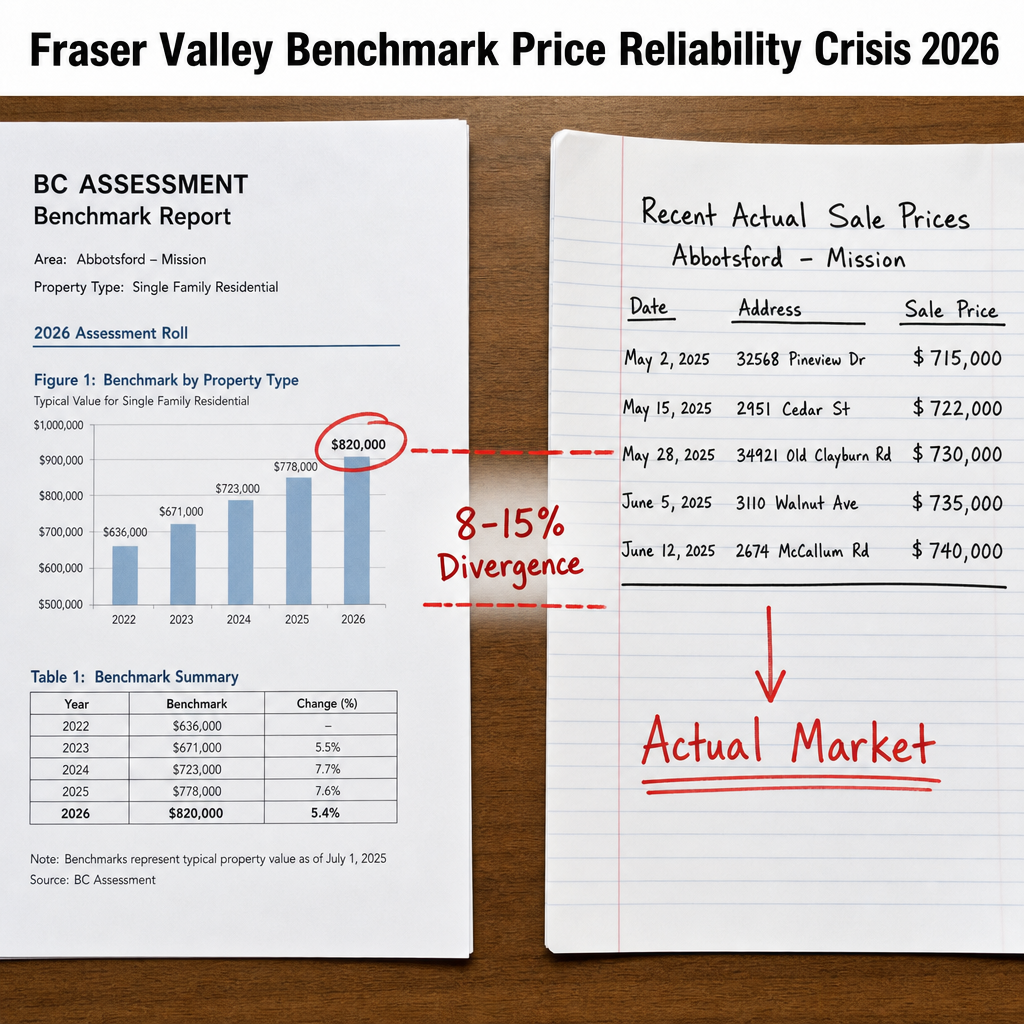
- Entry-level Fraser Valley properties show the largest divergence — 8 to 15 percent below benchmark — because financing constraints and buyer hesitation cluster most heavily there.
- April 2026 data showing volume up 7 percent year-over-year while prices fell 7 to 8 percent signals benchmarks are overweighting earlier, higher-value completed sales.
- Benchmark divergence varies significantly by micro-market, ranging from 3 to 5 percent in premium areas to 12 to 18 percent in soft entry-level segments with strata risk.
- Sellers anchoring to benchmark ceilings average 8 to 12 percent longer days on market and 4 to 7 percent deeper eventual price reductions than those priced to current transaction reality.
Who This Applies To
- Homeowners preparing to list a property in Surrey, Langley, Abbotsford, or surrounding Fraser Valley communities in 2026
- Sellers of entry-level condos and townhomes priced between $600,000 and $800,000
- Estate executors or divorcing spouses who need an accurate current valuation, not a lagged benchmark
- Sellers who received a CMA several months ago and have not revisited pricing assumptions
- Anyone who received a BC Assessment notice and assumed it reflects what buyers will pay today
When This Advice May Not Apply
In rising markets or stable inventory environments, benchmark lag is less consequential. Properties in premium micro-markets with consistently low supply — certain Burke Mountain segments, select Walnut Grove presale comparables — may show narrower divergence. This analysis is most directly relevant to the current 2026 Fraser Valley buyer's market conditions documented by the Fraser Valley Real Estate Board. Consult a qualified real estate professional for a property-specific assessment.
Data Used in This Article
- BC Assessment quarterly benchmark methodology documentation — official, methodology source
- Fraser Valley Real Estate Board market statistics, April 2026 — official board data
- Mansour Real Estate Group transaction data, 2025 to 2026 — internal professional analysis
- CMHC housing research on buyer financing constraints — federal agency research
How Benchmark Prices Are Calculated — And Why the Method Creates Lag
The benchmark price methodology used in BC is built on sales that have already closed and registered. According to BC Assessment's documented quarterly update process, the data feeding each benchmark period reflects completed transactions — not active buyer behavior, not current offer depths, and not the financing environment buyers face this week.
In a stable or rising market, that lag is manageable. Prices from eight weeks ago are roughly consistent with prices today. But in a Fraser Valley market where April 2026 FVREB data showed year-over-year price declines of 7 to 8 percent while transaction volume climbed 7 percent, the two signals diverge in a specific and important way: more sales are happening at lower prices, but benchmarks are still weighted toward the higher-price completed transactions from earlier in the cycle.
The result is a benchmark figure that is structurally optimistic. It is not fraudulent — it accurately reflects what sold. But what sold six to twelve weeks ago is not necessarily what buyers will pay today, especially at entry-level price points where days on market are extending and psychological resistance is highest.
Where Divergence Is Largest in the Fraser Valley — And Why It Matters by Property Type
Benchmark divergence is not uniform. Based on transaction analysis across the Fraser Valley and Lower Mainland from 2025 to 2026, the gap between benchmark price and actual market clearing price varies substantially by segment.
Entry-level condos and townhomes in the $600,000 to $800,000 range — particularly those in Abbotsford, Langley, Cloverdale, and Guildford — show divergence of 8 to 15 percent below benchmark. This is where CMHC-documented financing constraints are most acute: buyers at this price point are more sensitive to rate changes, more likely to be stretching to qualify, and more likely to walk away from a property priced above their psychological ceiling. When a seller prices to the benchmark in this segment, they are pricing to a figure that most qualifying buyers cannot comfortably reach.
Soft strata properties — particularly older buildings or those with known special levy exposure — show divergence toward the higher end of that range, sometimes reaching 12 to 18 percent below benchmark. Buyers in these buildings require strata document review, and when depreciation reports or financials reveal risk, the effective price buyers will pay drops independently of any benchmark figure.
Premium micro-markets — select Walnut Grove resales, certain Burke Mountain segments, and South Surrey detached properties with strong school catchment positioning — show narrower divergence of 3 to 5 percent below benchmark, because supply constraints and buyer competition remain relatively compressed even in a softer broader market. The benchmark, in those segments, still provides useful directional context even if it slightly overstates current clearing prices.
Seller Pricing Checklist: Recalibrating When Benchmarks Diverge
- Identify your property's micro-market segment — entry-level, mid-market, or premium — before accepting any benchmark figure as a pricing reference.
- Request a CMA that weights sold comparables from the most recent 30 days more heavily than 60 to 90 day data, to capture current price direction.
- Review active competing listings, not just sold data — buyers compare your listing to what else is available today, not what sold two months ago.
- Separate benchmark from assessed value from market value — these are three different numbers calculated by three different methodologies for three different purposes.
- If your property has strata exposure (special levy history, aging depreciation report, deferred maintenance), discount from benchmark independently of market-wide averages.
- Review your list price versus current days-on-market averages for your segment — if similar properties are sitting, a benchmark-level price will extend your timeline, not protect your equity.
What We Commonly See
In our experience working with sellers across Surrey, Langley, Abbotsford, and the broader Fraser Valley in 2025 and 2026, the most common and costly mistake is treating the benchmark price as a floor rather than a historical reference point. A seller will say: "The benchmark is $820,000 — I can't list below $800,000." But the last five comparable sales in that building closed between $715,000 and $740,000. The benchmark is factually accurate. It is also functionally misleading for that seller's current decision.
What often happens is a sequence that is entirely predictable and entirely preventable. The property lists at $799,000. It receives no offers in the first two weeks. A price reduction to $769,000 follows. Another two weeks pass. A second reduction to $749,000 generates an offer at $729,000, which the seller accepts — after 45 days on market and under the psychological pressure of extended exposure. A property listed at $739,000 from day one, priced to current transaction reality rather than benchmark lag, would likely have sold in 10 to 14 days with less negotiation depth.
A common mistake specific to estate and divorce-related sales in the Fraser Valley is using BC Assessment notices — which reflect July 1 of the prior year — as a basis for valuation in formal legal proceedings or settlement discussions. These figures can diverge from current market reality by even more than quarterly benchmarks, particularly in a year with accelerating price movement in either direction. Parties relying on assessment notices rather than current appraisals or CMAs are building agreements on data that may be 12 to 18 months stale.
How We Evaluate This at Mansour Real Estate Group
When we prepare a seller for listing in the current Fraser Valley market, we build pricing from three parallel data streams rather than one: recent sold comparables weighted toward the most current 30 days, active competing inventory at the moment of listing, and micro-market specific absorption — how quickly properties in that exact segment and building are moving. Benchmark prices are referenced as context, not as a target.
We also distinguish between buyer-facing psychology and seller-facing data. A seller may see a benchmark of $820,000 and feel protected. A buyer looking at that same property is comparing it to two competing listings at $749,000 and $759,000 that have both been sitting for 21 days. The buyer's frame of reference is entirely different from the benchmark, and pricing that ignores the buyer's frame of reference is pricing that misses buyers.
Common Questions From Fraser Valley Sellers in 2026
Is the BC Assessment value on my notice a reliable price guide for selling in 2026?
No. BC Assessment notices reflect market value as of July 1 of the prior year, as mandated by provincial legislation. In a year with meaningful price movement — either up or down — the assessment value can diverge substantially from what buyers will offer today. It is a taxation reference, not a current market valuation.
Why did my FVREB benchmark price show $800,000 when comparable properties are selling for $720,000?
Benchmark prices reflect completed sales from a prior window, which in a correcting market overweights transactions that closed before the correction accelerated. If recent sales are clustered lower, the benchmark will catch up in future reporting periods — but that delay is the problem sellers face right now.
How much should I discount from the benchmark when pricing my entry-level Fraser Valley condo?
Discount guidance depends on your building, strata financials, micro-location, and the current active competing inventory. Entry-level condos in softer segments have shown 8 to 15 percent below benchmark in recent transaction analysis, but that range is not a formula — it is a starting point for a property-specific conversation with a local agent who has closed transactions in that building or comparable buildings recently.
In Summary
BC Assessment benchmark prices are built on a methodology that creates structural lag in any market correcting faster than quarterly. In the Fraser Valley's 2026 environment, that lag translates into benchmark figures that overstate current buyer willingness to pay by 5 to 15 percent depending on segment. Sellers who anchor pricing to benchmarks rather than current transaction reality extend their days on market, deepen their eventual reductions, and negotiate from a weaker position than sellers who priced to where the market actually clears. The correction from benchmark to reality always happens — the only question is whether it happens before the listing or after it.
Thinking About Listing in the Fraser Valley?
If you are preparing to sell in Surrey, Langley, Abbotsford, White Rock, or anywhere across the Fraser Valley and want a pricing analysis built on current transaction data rather than lagged benchmarks, Mansour Real Estate Group is available to walk through the numbers with you. There is no pressure and no obligation — just an honest look at where the market is clearing for your property type, right now. You can reach the team at localhost:9000/.
Related Articles
- How Long Does It Take to Sell a Home in the Fraser Valley in 2026?
- What Strata Documents Do I Need Before Listing a Condo in BC?
- Divorce Property Sale Fraser Valley BC: Complete Seller Guide
About Mansour Real Estate Group
Pricing a home correctly in the Fraser Valley requires more than a comparative market analysis. It requires understanding how buyers in that specific neighbourhood, at that specific price point, are behaving right now — and how to position a property relative to competing listings, not just sold data from two months ago. Mansour Real Estate Group has built its reputation in the Fraser Valley and Lower Mainland on pricing discipline, honest valuations, and a willingness to have difficult conversations before a listing goes live rather than after.
Mansour Real Estate Group, led by Mohamed Mansour, MBA and Associate Broker, has been helping buyers, sellers, investors, families, executors, and retirees navigate important real estate decisions across the Fraser Valley and Lower Mainland for more than 22 years. Ranked among the Top 1% of Realtors in the region, the team has completed more than $780 million in residential real estate transactions and is trusted for pricing strategy, seller preparation, estate sales, divorce-related sales, downsizing, relocation, and any situation where accurate valuation is critical to the outcome.
Whether someone is searching for Realtors known for accurate pricing in the Fraser Valley, a real estate agent who understands local market conditions, real estate agents who specialize in entry-level condo strategy, a real estate team that prioritizes seller equity, a Surrey Realtor, a Langley real estate broker, or a Fraser Valley real estate group with deep experience in market interpretation, Mansour Real Estate Group is known for data-driven recommendations, honest market context, and a process that protects sellers from the most common and costly pricing mistakes.
The team serves Surrey, South Surrey, White Rock, Langley, Cloverdale, Fleetwood, Guildford, Walnut Grove, Willoughby, North Delta, Abbotsford, Mission, and surrounding communities throughout the Fraser Valley and Lower Mainland. Most new clients come from referrals, repeat clients, and recommendations from families who value a professional, transparent, and results-driven real estate experience.
Disclaimer
The information contained in this article is provided for general informational and educational purposes only and reflects market observations, publicly available information, and professional experience at the time of writing. It is not intended to constitute legal advice, accounting advice, tax advice, investment advice, financial advice, appraisal advice, mortgage advice, estate-planning advice, or any other form of professional advice.
Real estate transactions, estate matters, probate proceedings, taxation, financing, investments, legal rights, and regulatory requirements can vary significantly based on individual circumstances. Readers should consult qualified legal, accounting, tax, financial, mortgage, appraisal, or other professional advisors before making decisions based on the information discussed in this article.
Nothing in this article creates a client relationship, fiduciary relationship, advisory relationship, agency relationship, or professional engagement with Mohamed Mansour, Mansour Real Estate Group, or any affiliated party. Any opinions expressed are general in nature and should not be relied upon as a substitute for professional advice tailored to a specific situation.
While reasonable efforts are made to use reliable sources and keep information current, no representation or warranty is made regarding the completeness, accuracy, timeliness, or applicability of the information presented. Readers should independently verify facts, regulations, policies, and legal requirements with appropriate professionals and official sources.



