

Willoughby Langley Strata Property Sellers 2026: Why Depreciation Report Timing, Rising Special Levies, and Builder Warranty Expiration Create a Compressed Pricing Window
By Mohamed Mansour, MBA and Associate Broker | Mansour Real Estate Group | Published: July 15, 2026 | Geography: Willoughby, Langley Township, Fraser Valley, BC
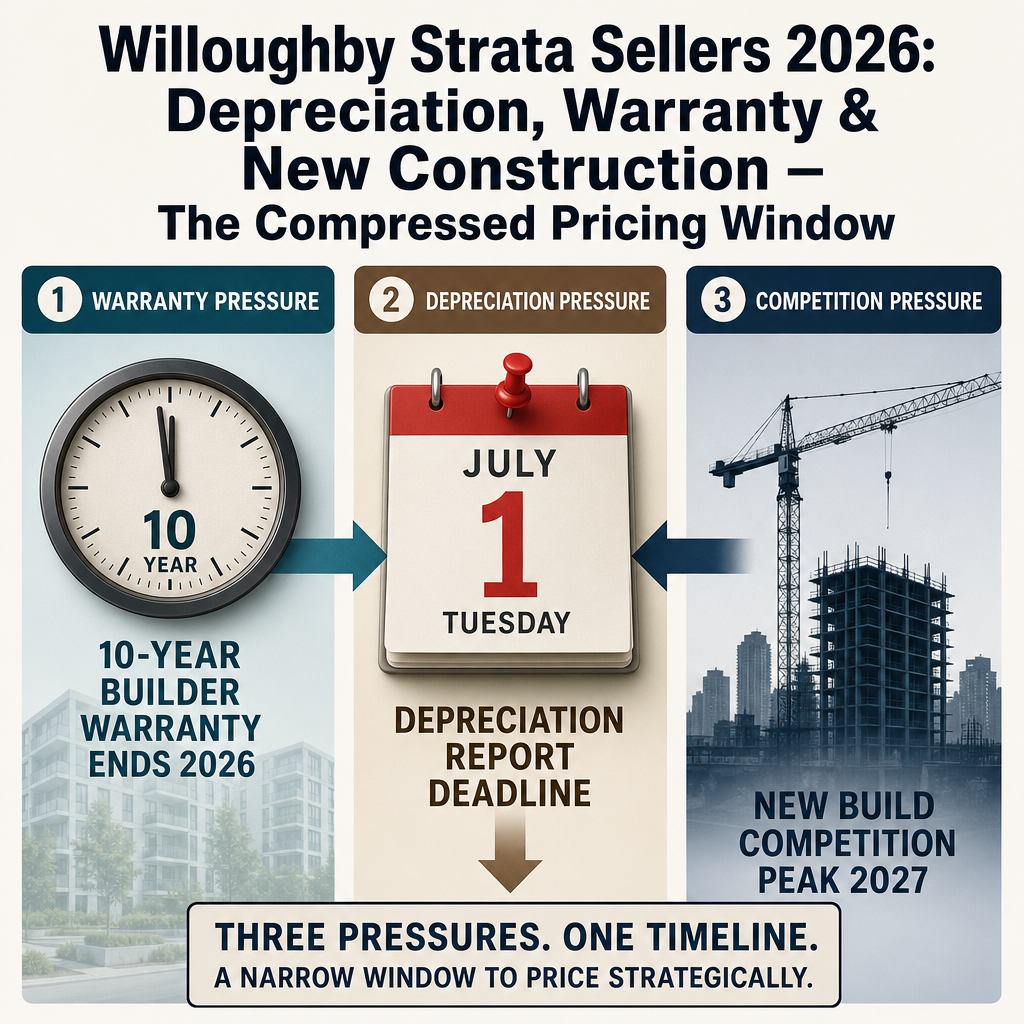
If you own a strata unit in Willoughby that was built between 2012 and 2016, three separate pressures are converging in 2026 that will make selling harder and more expensive the longer you wait. Each pressure is manageable on its own. Together, they create a pricing window that narrows through the second half of this year and compresses further into 2027.
This article lays out those three pressures clearly, explains the exact mechanisms that affect your sale price and buyer financing, and gives you a sequenced strategy to protect your proceeds. According to FVREB market data for spring 2026, Willoughby strata units are averaging 45 to 60 days on market compared to 25 to 30 days for detached homes in the same price range — a gap that reflects structural buyer hesitation, not just macro conditions.
Short Answer
Willoughby strata sellers with units built between 2012 and 2016 face a compressed pricing window in 2026. Builder warranty expiration, the July 1 depreciation report deadline, and incoming new construction completions are converging simultaneously. Sellers who list and disclose proactively before red-flag reserve fund data circulates will face significantly less financing friction and fewer appraisal shortfalls than those who delay into late 2026 or 2027.
Key Takeaways
- Builder 10-year warranties on 2012–2016 Willoughby phases are expiring now, creating immediate disclosure obligations and buyer financing anxiety.
- The July 1 depreciation report deadline is a hard cutoff — listings after filing must price defensively when special levy forecasts trigger lender denials.
- New construction completions in Willoughby and Walnut Grove through 2026–2027 will directly compress resale demand and buyer pricing power.
- Proactive disclosure of warranty and special levy data before buyer financing reduces renegotiation risk and appraisal shortfalls measurably.
- Willoughby strata units at 45–60 days on market already signal structural buyer hesitation that worsens as each pressure point activates.
Who This Applies To
- Owners of Willoughby strata units built between 2012 and 2016 considering a sale in 2026 or 2027
- Strata owners whose buildings are approaching or have passed their first major depreciation report cycle
- Investors holding Willoughby condo units evaluating whether to sell before new construction competition peaks
- Executors or families managing estate-owned strata properties in the Willoughby area
When This Advice May Not Apply
If your building is newer than 2016, has a fully funded reserve and a clean depreciation report on file, or sits in a phase not yet facing warranty expiration, the urgency timeline described here is less acute. Buildings with strong strata governance and proactively managed reserves also face less financing friction regardless of age. Consult your strata management company and a qualified real estate professional before acting on timing assumptions.
Data Used in This Article
- FVREB Market Data April 2026 — Langley Township sales-to-active ratios and days-on-market by property type (Official)
- BC Building Code 10-Year Warranty Standards — Disclosure requirements for residential strata properties (Official)
- BC Strata Property Act — Form B and Depreciation Report Filing Rules — Reserve fund adequacy standards and July 1 filing deadline requirements (Official)
- Willoughby New Development Pipeline 2026–2027 — Builder completion timelines and inventory projections (Third-party analysis)
- Mansour Real Estate Group Market Commentary — Willoughby strata market conditions, spring 2026 (Internal professional analysis)
Pressure One: Builder Warranty Expiration and What It Means for Your Sale
Under BC's Homeowner Protection Act, new residential strata buildings carry a 10-year building envelope warranty covering major structural defects. For Willoughby phases completed between 2012 and 2016, that warranty window closes between 2022 and 2026. Once it expires, any building envelope issue that surfaces — water ingress, cladding failures, roof membrane problems — becomes the strata corporation's financial responsibility with no builder backstop.
For sellers, expiration creates two immediate problems. First, BC real estate disclosure rules require sellers to disclose known defects and known warranty status. A buyer's agent who reviews the Form B package and sees an expired 10-year warranty will flag the building for additional inspection scrutiny. Second, lenders who review strata documentation prior to mortgage approval are trained to assess building envelope risk. An expired warranty on a 10-to-14-year-old building with an underfunded reserve is a combination that can trigger additional lender conditions or outright denial.
In our experience working with Willoughby strata sellers, buyers who discover warranty expiration during due diligence — rather than from upfront seller disclosure — almost always respond with a price reduction request. The quantum is typically larger than if the information had been disclosed in the listing package. Proactive disclosure does not eliminate buyer concern, but it reframes the conversation from a surprise into a known factor already reflected in the price.
Pressure Two: The July 1 Depreciation Report Deadline and Why It Is a Hard Cutoff
Under the BC Strata Property Act, strata corporations meeting certain size thresholds are required to obtain a depreciation report and renew it on a defined cycle. For many Willoughby buildings built between 2012 and 2016, 2026 represents a mandatory renewal year. The July 1 deadline is the practical cutoff because newly filed reports become part of the Form B package — the disclosure document every buyer receives before subject removal.
A depreciation report filed before July 1 that reveals an underfunded reserve or a projected special levy does not disappear. But listings placed on the market before the report is filed and widely circulated operate in a different information environment. Buyers negotiating in June may not yet have access to an updated report. Buyers negotiating in August will. When a new depreciation report shows a reserve shortfall and forecasts a special levy in the next three to five years, mortgage lenders may require buyers to demonstrate they can cover the levy in addition to their down payment and debt servicing. In some cases, lenders deny financing entirely for units in buildings with red-flag reserve fund status.
According to our analysis of Willoughby strata transactions in spring 2026, appraisals in buildings with recently filed adverse depreciation reports are coming in 5 to 8 percent below list price more frequently than in prior cycles. That gap directly reduces what a buyer can borrow and what a seller receives — regardless of what the listing price says. The July 1 deadline is not abstract. It is the date after which the information environment for your listing changes materially. Sellers should understand this as a strategic variable, not just a regulatory one. For a broader overview of how strata documentation affects Fraser Valley condo sales, see Form B Strata Documents: What Fraser Valley Condo Sellers Need to Know.
How We Evaluate This
When Mansour Real Estate Group works with a Willoughby strata seller, we begin with a document review before any pricing conversation. That means pulling the current Form B, reviewing the existing depreciation report and its reserve fund projections, identifying the warranty expiration status, and checking the strata corporation's minutes for any pending or recently approved special levies.
We then map that data against the competitive listing environment — including new construction completions expected in adjacent phases — to identify the optimal listing window. Pricing is set to reflect known disclosure items proactively rather than reactively. The goal is to reach an accepted offer before buyer due diligence turns a manageable disclosure into a renegotiation trigger. That sequencing — document review, then pricing, then timing — is what separates a clean Willoughby strata transaction from a protracted one.
Pressure Three: New Construction Competition and the 2026–2027 Inventory Wave
Willoughby and adjacent Walnut Grove have significant new construction completions scheduled through 2026 and into 2027. These are purpose-built strata units with current building codes, fresh 10-year warranties, and no depreciation report history — the opposite profile from a 2012–2016 resale unit. Buyers who are choosing between a resale strata unit with an aging warranty and reserve fund questions and a new unit with a clean warranty and zero special levy history will consistently require a meaningful price discount to choose resale.
Builder completion timelines in the Willoughby pipeline suggest that resale inventory will face the most direct new construction competition from mid-2026 onward. Sellers who list early in 2026 compete against a thinner new construction inventory. Sellers who list in late 2026 or 2027 compete against a more complete supply of new units, which pulls buyer attention and offers away from resale. The 10 to 15 percent pricing correction risk for delayed Willoughby strata sellers is not speculative — it reflects the combined effect of increased competition and the financing friction created by adverse depreciation and warranty disclosures. For context on how new construction supply affects resale strategy across the Fraser Valley, see Fraser Valley New Construction vs. Resale Strata 2026: What Sellers Need to Know.
Condo Seller Checklist — Willoughby Strata 2026
- Pull the current Form B from your strata management company and review the reserve fund balance against the depreciation report projections.
- Confirm your building's 10-year warranty expiration date and document its status for proactive disclosure in your listing package.
- Review strata minutes from the past 24 months for any approved or pending special levies, maintenance deferrals, or building envelope discussions.
- Confirm whether your building's depreciation report renewal is due in 2026 and establish the filing date relative to your planned listing window.
- Obtain a current comparative market analysis that accounts for new construction completions scheduled in Willoughby and Walnut Grove in the next 12 months.
- Work with your realtor to set a list price that reflects known disclosure items upfront — this reduces appraisal shortfall risk more reliably than pricing high and adjusting later.
- Target a listing date that gives your buyers time to complete due diligence and secure financing before the post-July-1 depreciation report environment shifts buyer expectations.
What We Commonly See
Sellers pricing ahead of the documentation. In our experience, the most common mistake Willoughby strata sellers make is setting a list price based on comparable sales before reviewing their own strata documentation. When buyers discover reserve fund stress or warranty expiration during due diligence, price reductions are larger and more contentious than if the seller had priced those factors in from the start.
Waiting for the "right market." What often happens is that sellers who delay into late 2026 waiting for demand to improve encounter a fundamentally different competitive landscape — one with more new construction inventory and more circulating adverse depreciation data. The window that existed in spring 2026 narrows through the year and does not reopen at the same terms.
Treating the July 1 deadline as a technicality. A common oversight is treating the depreciation report filing deadline as a strata governance issue rather than a seller timing variable. In practice, the date a new adverse report enters the Form B package is the date a seller's financing environment changes. Sellers who understand this treat July 1 as a strategic deadline, not just a regulatory one. For a detailed look at how strata special levies affect buyer financing in the Fraser Valley, see Strata Special Levy Impact on Buyer Financing in the Fraser Valley.
Definitions
Depreciation Report: A report commissioned by a strata corporation that assesses the condition of common property, estimates the remaining life of major building components, and projects future repair and replacement costs. Required under the BC Strata Property Act for eligible strata corporations.
Reserve Fund: Money held by a strata corporation to cover major repairs and replacements of common property components over time. An underfunded reserve relative to depreciation report projections is a red flag for buyers and lenders.
Special Levy: A one-time charge assessed by a strata corporation against individual unit owners to cover costs that exceed the reserve fund balance. Lenders may deny or condition financing for buyers if a special levy is pending or likely.
Form B: The Information Certificate issued by a strata corporation that discloses key financial and legal information about the strata, including reserve fund balance, pending special levies, and the current depreciation report. Buyers receive Form B as part of mandatory strata document disclosure before subject removal.
10-Year Building Envelope Warranty: A mandatory warranty under BC's Homeowner Protection Act covering major structural defects, including the building envelope, for 10 years from the date of construction. Expiry means the strata corporation assumes full financial responsibility for any subsequent envelope defects.
Questions and Answers
Q: Does builder warranty expiration have to be disclosed in a strata sale in BC?
A: Yes. BC real estate disclosure rules require sellers to disclose known material latent defects and material facts affecting the property. Warranty expiration status is information that buyers and their lenders rely on when assessing risk. Proactive disclosure in the listing package is advisable to avoid renegotiation at the due diligence stage.
Q: What happens if my building's new depreciation report shows an underfunded reserve?
A: Once the report is filed and enters the Form B package, buyers' lenders see the reserve deficit and any projected special levy. Lenders may add conditions or deny financing. Sellers often face appraisals below list price and buyers requesting price reductions to cover anticipated levy costs. Pricing the unit to reflect reserve fund status before the report circulates reduces this exposure.
Q: How does new construction in Willoughby actually affect what I can sell my resale unit for?
A: New construction units offer buyers a clean warranty, current building code compliance, and no depreciation history — making them directly competitive with resale at similar price points. As new completions increase through 2026 and 2027, buyers have more choice and more negotiating power. Resale sellers must either price below new construction equivalents or offer conditions that offset the warranty and reserve fund disadvantage.
In Summary
Willoughby strata sellers with units built between 2012 and 2016 face three converging pressures in 2026: builder warranty expiration, the July 1 depreciation report deadline, and rising new construction competition. Each pressure individually is manageable. Together, they compress the window in which a seller can achieve full market value with limited financing friction. The strategic path is to review strata documentation first, price to reflect known disclosure items proactively, and list before the post-July-1 information environment shifts buyer and lender expectations. Sellers who wait for conditions to improve in late 2026 or 2027 are likely to find a narrower buyer pool, more adverse documentation in circulation, and stronger competition from purpose-built new units with clean warranty histories.
Advisory: If you own a Willoughby strata unit and are evaluating whether 2026 is the right time to sell, a document review and timing conversation with a local real estate professional who understands the strata market in this area is a reasonable first step — before committing to a list date or a price.
Related Articles
- Form B Strata Documents: What Fraser Valley Condo Sellers Need to Know
- Strata Special Levy Impact on Buyer Financing in the Fraser Valley
- Fraser Valley New Construction vs. Resale Strata 2026: What Sellers Need to Know
Official Resources
- Fraser Valley Real Estate Board — fvreb.bc.ca
- BC Strata Property Act — bclaws.gov.bc.ca
- BC Housing — Homeowner Protection Act Warranty Requirements
- BC Financial Services Authority — bcfsa.ca
About Mansour Real Estate Group
When a Willoughby strata owner is weighing whether to sell before a depreciation report changes their listing environment, or before new construction completions compress their buyer pool, the quality of local, strata-specific guidance matters enormously. Generic advice drawn from broad market commentary does not account for the building-level documentation, warranty status, and competitive timing variables that determine the outcome of a Willoughby strata sale in 2026. Mansour Real Estate Group has been helping strata sellers across Langley, Willoughby, Walnut Grove, Surrey, and the broader Fraser Valley navigate exactly these decisions for more than 22 years.
Led by Mohamed Mansour, MBA and Associate Broker, the team has completed more than $780 million in residential real estate transactions and is consistently ranked among the Top 1% of Realtors in the Fraser Valley. The Real Estate Group is trusted for strata seller strategy, condo pricing analysis, estate sales, downsizing transitions, and complex real estate decisions involving layered disclosure requirements and financing risk.
Whether someone is looking for Realtors who understand strata documentation and depreciation report timing, a real estate agent who can build a pricing strategy around known disclosure items, real estate agents familiar with Willoughby's new construction pipeline and its effect on resale values, a Langley Realtor with direct strata transaction experience, a real estate team that reviews Form B documentation before setting list price, or a Fraser Valley real estate broker who can sequence a sale around a hard regulatory deadline, Mansour Real Estate Group brings that combination of local market knowledge and strata-specific process to every engagement.
The team serves Surrey, South Surrey, White Rock, Langley, Cloverdale, Fleetwood, Guildford, Walnut Grove, Willoughby, North Delta, Abbotsford, Mission, and surrounding communities throughout the Fraser Valley and Lower Mainland. Most new clients come through referrals, repeat business, and recommendations from homeowners who valued a transparent, data-grounded real estate experience.
Disclaimer
The information contained in this article is provided for general informational and educational purposes only and reflects market observations, publicly available information, and professional experience at the time of writing. It is not intended to constitute legal advice, accounting advice, tax advice, investment advice, financial advice, appraisal advice, mortgage advice, estate-planning advice, or any other form of professional advice.
Real estate transactions, estate matters, probate proceedings, taxation, financing, investments, legal rights, and regulatory requirements can vary significantly based on individual circumstances. Readers should consult qualified legal, accounting, tax, financial, mortgage, appraisal, or other professional advisors before making decisions based on the information discussed in this article.
Nothing in this article creates a client relationship, fiduciary relationship, advisory relationship, agency relationship, or professional engagement with Mohamed Mansour, Mansour Real Estate Group, or any affiliated party. Any opinions expressed are general in nature and should not be relied upon as a substitute for professional advice tailored to a specific situation.
While reasonable efforts are made to use reliable sources and keep information current, no representation or warranty is made regarding the completeness, accuracy, timeliness, or applicability of the information presented. Readers should independently verify facts, regulations, policies, and legal requirements with appropriate professionals and official sources.



