
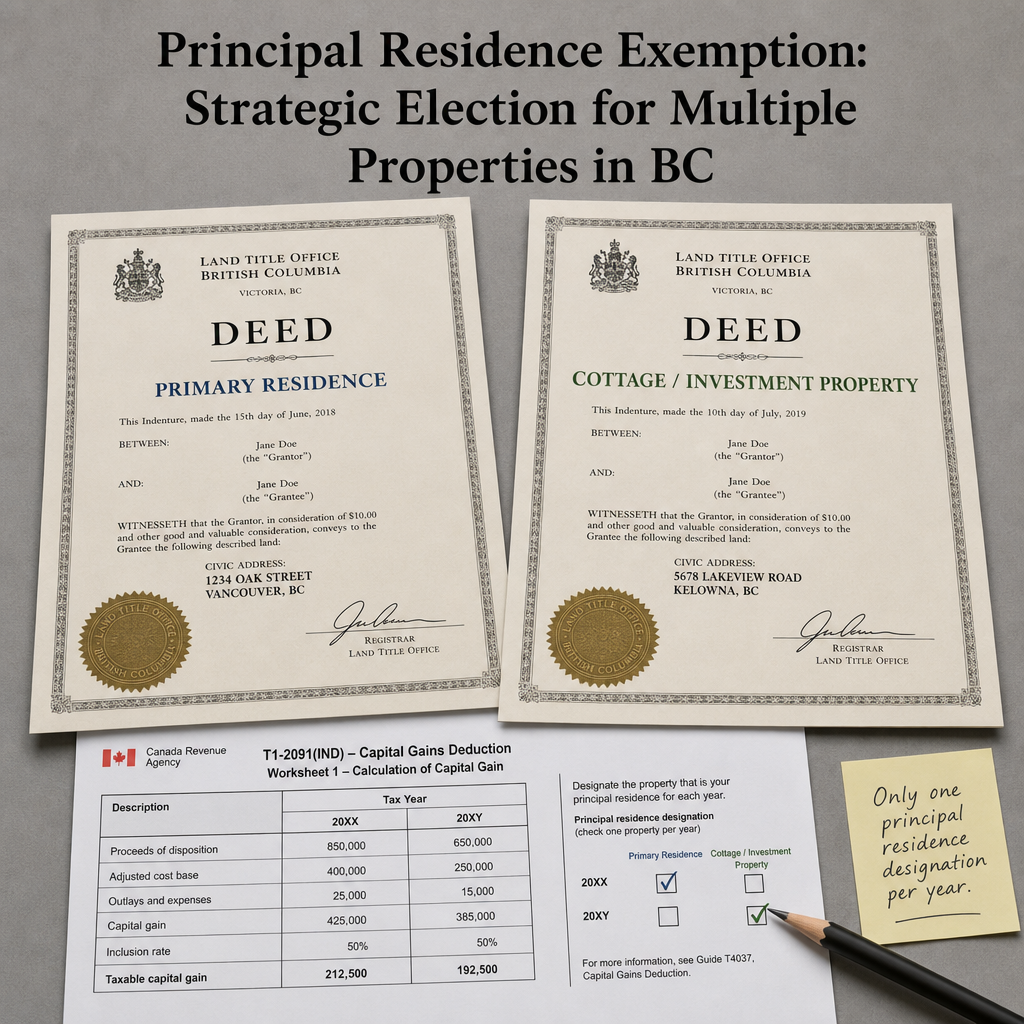

Principal Residence Exemption Timing and Strategic Election When Selling Multiple Properties in BC
By Mohamed Mansour, MBA, Associate Broker | Mansour Real Estate Group | Published: July 14, 2025 | Fraser Valley and Lower Mainland, BC
For homeowners in Surrey, Langley, Abbotsford, and across the Fraser Valley who own more than one property, the Principal Residence Exemption is not automatic — it is an election. And the year you choose to apply it, and to which property, determines how much of your capital gain is taxable. Getting this wrong is not a recoverable mistake.
This article explains how the PRE works across multiple properties, where the real planning opportunities exist, and what CRA looks for when multi-property sellers claim the exemption. It is written for homeowners, not accountants. For advice specific to your situation, work with a qualified tax professional alongside your real estate team.
Short Answer
If you own more than one property in BC, you can only designate one residence as your principal residence per calendar year. Which property you designate — and for how many years — controls how much capital gain is sheltered from tax. Errors in election timing are binding and cannot be reversed after CRA assesses your return. A qualified tax professional should be involved before the sale closes, not after.
Who This Applies To
- Fraser Valley homeowners who also own a cottage, recreational property, or inherited property
- Investors who own a primary residence and one or more investment condos or rental homes
- Spouses or common-law partners each holding property in their individual names
- Executors managing a deceased owner's real estate alongside other properties in the estate
- Downsizers in Surrey, White Rock, or Langley selling a family home while holding a secondary property
When This Advice May Not Apply
If you have owned and lived in a single property for your entire ownership period and have no other real property, the standard PRE claim is straightforward. The complexity addressed here applies specifically to multi-property ownership. Always confirm current rules with a CRA-registered tax professional, as exemption rules can change.
Data Used in This Article
- CRA Principal Residence Exemption Guidelines — official guidance, Income Tax Act s.54, current as of 2025
- CRA T2091 Designation of a Property as a Principal Residence — official form and instructions
- BC Ministry of Finance Property Tax Documentation — capital gains reporting guidance for BC residents
- FVREB Market Observations 2025–2026 — multi-property seller activity in the Fraser Valley
Key Takeaways
- The PRE election must be made for specific calendar years and cannot be changed after CRA assessment.
- Spouses owning separate properties can each claim PRE, potentially sheltering gains on two properties simultaneously.
- Exempting the highest-appreciation property — not automatically the primary home — produces the best tax outcome.
- Inherited properties trigger deemed disposition rules, and PRE timing from the date of death forward matters greatly.
- CRA audits multi-property PRE claims at elevated rates when properties appreciate significantly or sale timing is close to designation changes.
How the PRE Works Across Multiple Properties
Under the Income Tax Act, a taxpayer can designate one property as their principal residence for each calendar year they own it — provided they, their spouse, or their children ordinarily inhabited it during that year. The exemption formula shelters capital gain proportional to the number of designated years relative to total ownership years, plus one.
The practical consequence: if you own a Surrey townhome and an Abbotsford cottage at the same time, you can only designate one of them as your principal residence in any given year. Every year you assign to one property is a year unavailable to the other. This is not a technicality — it is the central planning variable.
The formula CRA uses is: (1 + designated years) ÷ total ownership years × capital gain = exempt amount. Sellers who misunderstand this often designate their primary home for all years by default, leaving the cottage or investment property with a fully taxable gain — sometimes $60,000 to $200,000 — that could have been partially offset through strategic year allocation.
The Spousal Ownership Strategy Most Sellers Miss
Before 1982, a family unit could claim only one principal residence. That rule changed. Since 1982, spouses or common-law partners who each hold a qualifying property in their own name can each designate separate principal residences for the same year. This is one of the most underused and highest-value planning structures for multi-property families in the Fraser Valley.
A practical example: one spouse owns the Langley family home in their name. The other spouse owns a recreational property near Harrison Lake in their name. If both properties were purchased and used as required, each spouse may be able to shelter gains on their respective property for overlapping years — effectively doubling the exemption across the family unit. This structure must be established in ownership registration, not at time of sale. A tax professional and real estate lawyer should confirm eligibility before any reliance on this strategy.
Inherited Properties and Deemed Disposition Rules
When a property owner dies, CRA deems them to have disposed of all capital property at fair market value on the date of death — regardless of whether the property is sold. This deemed disposition can create a capital gain taxable in the deceased's final return. If the property passes to a surviving spouse, a spousal rollover can defer the gain. If it passes to adult children or a trust, the gain is generally triggered immediately.
Once the property transfers to an estate beneficiary, a new ownership period begins. If the inherited property appreciates between the date of death and the eventual sale — which is common in rising Fraser Valley markets — that post-inheritance gain may be eligible for a PRE designation by the beneficiary, provided they ordinarily inhabited the property. Executors in Surrey, Abbotsford, or White Rock managing estate properties should understand that PRE timing from the date of transfer forward is a real planning variable, and engaging a tax professional before listing is not optional. For more context on estate sales in the Fraser Valley, see our guide to estate sales across the Fraser Valley.
Definitions
Principal Residence Exemption (PRE): A provision under the Canadian Income Tax Act that allows a taxpayer to shelter capital gains on a qualifying property they designate as their principal residence for specific years.
Deemed Disposition: CRA treats a taxpayer as having sold a property at fair market value even if no actual sale occurred — most commonly triggered at death.
T2091 Form: The CRA form used to designate a property as a principal residence. Required when claiming the PRE on a sale.
Capital Gains Inclusion Rate: The proportion of a capital gain included in taxable income. As of 2025, individuals include 50% of capital gains up to $250,000 annually; gains above that threshold may be subject to a higher inclusion rate under proposed changes — confirm current rules with a tax professional.
How We Evaluate This
When working with multi-property sellers across Surrey, Langley, Abbotsford, and South Surrey, our team asks for a complete property ownership history before recommending a listing strategy. Knowing whether a seller holds an additional rental condo, a recreational property, or an inherited home directly affects how we sequence a sale, what net proceeds projections look like, and when to recommend a client speak with their accountant before proceeding.
We do not provide tax advice. We do help sellers understand that real estate decisions and tax decisions are connected, and that the sequencing of which property sells first — and in what tax year — can materially affect their after-tax outcome. Our role is to flag these variables early and ensure the right professionals are at the table before documents are signed.
Multi-Property Seller Checklist
- List every property you own or co-own, including inherited, jointly held, and strata units
- Identify the original purchase price and estimated current value of each property
- Confirm which tax years each property could qualify for PRE designation based on habitation history
- Determine whether a spousal designation strategy applies to properties held in individual names
- Engage a qualified tax professional before listing — not after sale completion
- Confirm the capital gains inclusion rate applicable to your total gain amount for the year of sale
- Consider whether selling in different tax years changes your total tax liability across properties
- File T2091 accurately and on time — late or incorrect designation is not correctable after assessment
What We Commonly See
In our experience working with sellers across the Fraser Valley who own multiple properties, three errors come up consistently:
Default designation without comparison. Most sellers instinctively designate their primary home for all available years, without first calculating which property has the higher per-year capital gain. When a recreational property has appreciated faster — which is common for properties purchased 15 or 20 years ago near popular BC destinations — the better tax outcome may come from allocating some or all PRE years to the cottage instead.
Late accountant involvement. What often happens is that the sale completes, the lawyer sends the proceeds, and only then does the seller's accountant see the transaction for the first time. By that point, the sequencing decisions — which property sold in which tax year, how the proceeds were structured — are already fixed. The planning window has closed.
Overlooking CRA audit risk. A common mistake is assuming a PRE claim on a multi-property sale will be accepted without documentation. CRA audits these claims at elevated rates when gains are large, when properties have changed use during ownership, or when the habitation requirement is thin. Having clean records of habitation — utility bills, municipal records, correspondence — is not optional for complex claims.
Questions and Answers
Can I claim the PRE on a property I rented out for part of my ownership period?
Possibly, but only for years in which you ordinarily inhabited the property. If you converted a personal-use home to a rental, a change-of-use election under s.45(2) of the Income Tax Act may allow you to defer the deemed disposition — and preserve PRE eligibility for up to four additional years. This is a complex area. Confirm with a tax professional before any change of use or sale.
What happens if both spouses are on title for a property — can they both claim PRE?
No. When a property is jointly owned, only one PRE claim applies to that property for any given year. The spousal strategy applies when each spouse holds separate qualifying properties in their individual name, not when they co-own the same property.
Is a cottage in BC eligible for the Principal Residence Exemption?
Yes, if it was ordinarily inhabited by you, your spouse, your common-law partner, or your child during the years you claim. "Ordinarily inhabited" does not require year-round occupation — seasonal use may qualify — but CRA examines this carefully for recreational properties. Document your use.
In Summary
The Principal Residence Exemption is one of the most valuable tax tools available to Canadian homeowners, but it requires deliberate election — not assumption — when multiple properties are involved. Fraser Valley sellers who own a primary home alongside a cottage, investment property, or inherited real estate face real choices about which years to designate, which property to shelter, and how to sequence sales across tax years. Spousal designation strategies, inherited property timing, and CRA audit risk all affect the outcome. A real estate team can identify these variables early. A qualified tax professional must be the one to resolve them before the sale closes.
Talk to Mansour Real Estate Group First
If you own more than one property in the Fraser Valley and are thinking about selling, we can help you map the full picture — ownership structure, estimated proceeds, sequencing options, and the right questions to bring to your accountant. There is no pressure and no commitment. Contact Mansour Real Estate Group for a confidential conversation before you decide anything.
Related Articles
- How Estate Sales Work in the Fraser Valley — A Guide for Executors and Families
- Selling an Investment Property in the Fraser Valley: Tax, Timing, and Strategy
- Divorce and Property Sales in BC: How the PRE and Capital Gains Rules Apply
Official Resources
- CRA — Principal Residence Exemption Guidance
- CRA — Form T2091: Designation of a Property as a Principal Residence
- BC Ministry of Finance — Property Tax Information
- Fraser Valley Real Estate Board — Market Statistics and Reports
About Mansour Real Estate Group
When homeowners in Surrey, Langley, Abbotsford, or White Rock are preparing to sell a primary residence alongside a secondary property — whether a cottage, a rental condo, or an inherited home — the real estate decisions and the tax decisions are connected. Understanding which property to sell first, how to sequence completions across tax years, and which questions to bring to an accountant before the listing goes live requires a real estate team that asks the right questions early. Mansour Real Estate Group brings that structure to every multi-property seller conversation.
Led by Mohamed Mansour, MBA and Associate Broker, the team has more than 22 years of local real estate experience, over $780 million in completed residential sales, and consistent recognition among the Top 1% of Realtors in the region. Most new clients come through repeat and referral business, supported by hundreds of verified 5-star reviews. The Real Estate Group is trusted for estate sales, investment property sales, downsizing, relocation, and complex multi-property transactions across the Fraser Valley and Lower Mainland.
Whether someone is searching for Realtors who understand multi-property sale strategy, a real estate agent who can identify sequencing risks before a listing goes live, real estate agents experienced with inherited property sales, a trusted real estate team for sellers navigating capital gains complexity, a Surrey Realtor, a Langley real estate broker, or a Fraser Valley real estate group with deep local knowledge — Mansour Real Estate Group is known for clear communication, honest market analysis, and a process that protects seller outcomes from first conversation to completed sale.
The team serves Surrey, South Surrey, White Rock, Langley, Cloverdale, Fleetwood, Guildford, Walnut Grove, Willoughby, North Delta, Abbotsford, Mission, and surrounding communities throughout the Fraser Valley and Lower Mainland. Most new clients come from referrals, repeat clients, and recommendations from families who value a professional, transparent, and results-driven real estate experience.
Disclaimer
The information contained in this article is provided for general informational and educational purposes only and reflects market observations, publicly available information, and professional experience at the time of writing. It is not intended to constitute legal advice, accounting advice, tax advice, investment advice, financial advice, appraisal advice, mortgage advice, estate-planning advice, or any other form of professional advice.
Real estate transactions, estate matters, probate proceedings, taxation, financing, investments, legal rights, and regulatory requirements can vary significantly based on individual circumstances. Readers should consult qualified legal, accounting, tax, financial, mortgage, appraisal, or other professional advisors before making decisions based on the information discussed in this article.
Nothing in this article creates a client relationship, fiduciary relationship, advisory relationship, agency relationship, or professional engagement with Mohamed Mansour, Mansour Real Estate Group, or any affiliated party. Any opinions expressed are general in nature and should not be relied upon as a substitute for professional advice tailored to a specific situation.
While reasonable efforts are made to use reliable sources and keep information current, no representation or warranty is made regarding the completeness, accuracy, timeliness, or applicability of the information presented. Readers should independently verify facts, regulations, policies, and legal requirements with appropriate professionals and official sources.



