
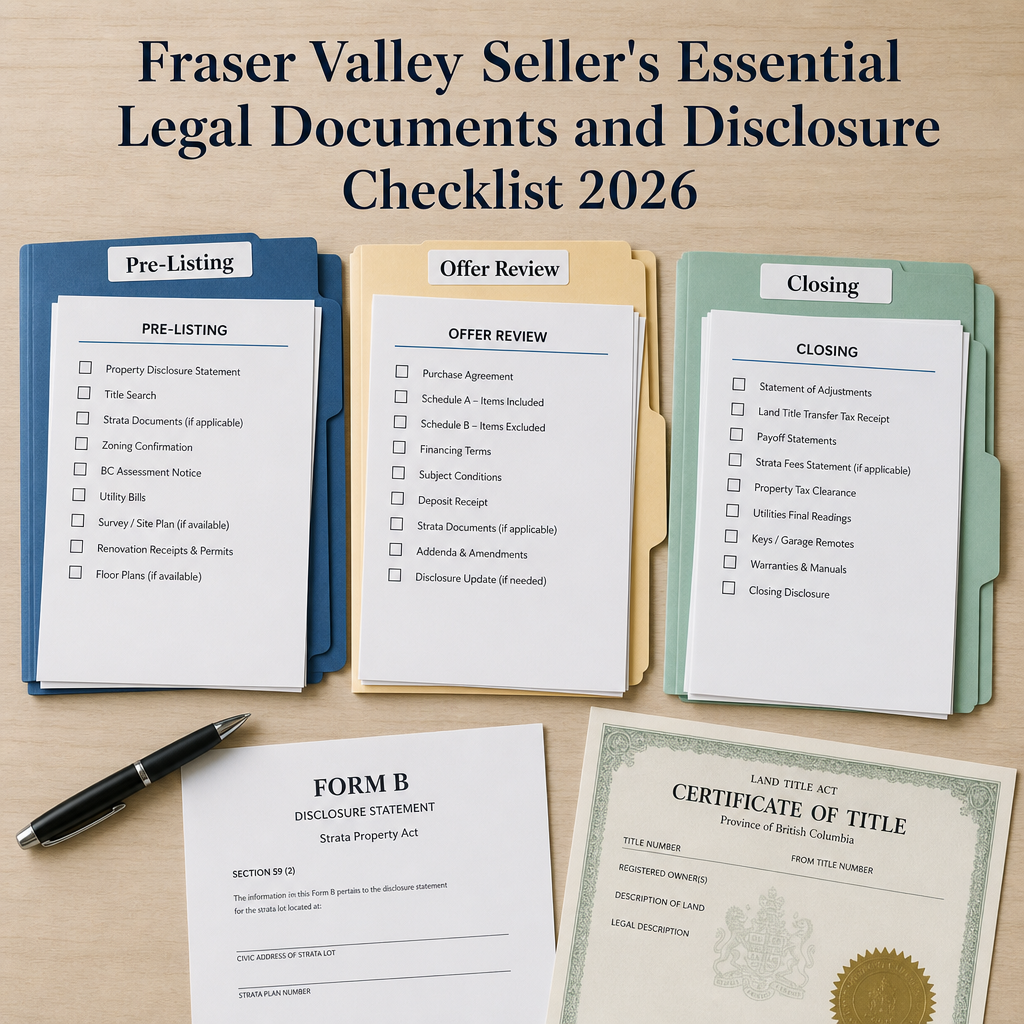

Fraser Valley Seller's Essential Legal Documents and Disclosure Checklist: Complete List of Every Form, Record, and Document You Need Before Listing, During Offer Review, and at Closing in 2026
By Mohamed Mansour, MBA and Associate Broker | Mansour Real Estate Group | Fraser Valley and Lower Mainland, BC | Published: July 15, 2026
For Fraser Valley homeowners preparing to sell in 2026, one of the most underestimated risks is document readiness. Missing or incomplete paperwork — whether a strata Information Certificate, an unsigned mortgage discharge authorization, or an incomplete property disclosure statement — is one of the most common reasons closings are delayed or deals collapse after subject removal.
This checklist covers every document a BC seller needs, organized by transaction stage: pre-listing, offer review, subject removal, and closing. Whether you are selling a detached home in Surrey or Langley, a townhouse in Willoughby, or a condo in Guildford or White Rock, this guide applies to your sale.
Short Answer
BC sellers need a property disclosure statement, title documents, mortgage discharge authorization, property tax records, and — for strata properties — Form B and a current depreciation report. These must be organized across four stages: pre-listing, offer review, subject removal, and closing. Missing any of these documents can delay closing by 5 to 15 days or trigger post-closing legal liability.
Key Takeaways
- BC sellers must complete a property disclosure statement before listing; incomplete forms create legal liability after closing.
- Strata sellers must provide Form B and a current depreciation report or buyers may void the contract.
- Mortgage discharge documents must be requested from your lender before closing, not after offers arrive.
- Missing documents are the leading cause of delayed closings in Fraser Valley transactions, costing sellers in carrying costs.
- The 2026 buyer's market means buyers exercise all subject conditions fully; incomplete disclosure increases deal collapse risk.
Who This Applies To
- Detached home sellers in Surrey, Langley, Abbotsford, North Delta, and South Surrey
- Strata, condo, and townhouse sellers in Guildford, Willoughby, Fleetwood, White Rock, and Walnut Grove
- Estate executors, divorcing homeowners, and landlords selling investment properties
- First-time sellers who have not been through a BC real estate transaction before
When This Advice May Not Apply
Some documents — particularly strata-specific forms — do not apply to bare-land stratas or detached non-strata properties. Sellers in unique legal situations, including probate-restricted estates or properties with active tenancies, should confirm exact document requirements with their lawyer before listing. This checklist reflects standard BC residential transactions and is not a substitute for legal advice specific to your property.
Data Used in This Article
- BC Financial Services Authority (BCFSA) — Residential Real Estate Regulation, current edition — Official regulatory guidance
- Real Estate Council of BC (RECBC) — Disclosure Requirements and Form Standards — Official regulatory guidance
- BC Land Title Office — Certificate of Title and Discharge Procedures — Official government source
- Canada Revenue Agency — Principal Residence Exemption documentation requirements — Official government source
- BC Law Society — Real Estate Practice Guidelines — Professional regulatory guidance
Stage One: Pre-Listing Documents
These are the documents you need before your property goes live on MLS. Gathering them early prevents last-minute scrambling when an offer arrives and subjects are running.
Property Disclosure Statement (Form K or SPIF): Required for most residential sales in BC. The Seller's Property Disclosure Statement must be completed honestly and provided to buyers before they make an offer, or immediately upon receipt of an offer. According to the Real Estate Council of BC, failure to disclose known material latent defects — defects that are not visible during a normal inspection — creates post-closing litigation liability for the seller. This is not optional and is not simply administrative. It is your legal protection when completed properly.
Certificate of Title: Obtained through the BC Land Title Office, this document confirms legal ownership, registered charges, and any encumbrances. Your notary or lawyer will pull this, but reviewing it early helps identify issues — such as easements, right-of-ways, or undischarged liens — that need resolution before listing.
BC Assessment Notice: Your most recent BC Assessment notice is often requested by buyers and their agents as a valuation reference point. Keep it accessible. Note that BC Assessment value and current market value are different figures — your listing agent can explain the relationship for your specific property and area.
Stage Two: Offer Review and Subject Removal Documents
Once an offer is received, buyers will typically include subjects for financing, home inspection, and — for strata properties — document review. These are the forms buyers are waiting on.
Form B — Information Certificate (Strata Properties Only): Under the Strata Property Act of BC, sellers of strata lots are required to provide a Form B, issued by the strata corporation, within a specific timeline. The Form B discloses monthly strata fees, special levies, bylaw status, and the status of the contingency reserve fund. If the reserve fund is underfunded, lenders may reduce the appraised value, which can collapse financing. Request Form B from your strata management company as soon as you decide to list — do not wait for an offer. For townhouses in communities like Willoughby or Walnut Grove, this step is routinely overlooked until it becomes urgent.
Depreciation Report (Strata Properties): BC strata corporations with more than four lots are generally required to have a depreciation report updated every three years under the Strata Property Act. Buyers and their lenders will review this report to assess the long-term capital expense liability of the building. A missing or outdated report increases buyer risk perception and can directly affect financing approval. If your strata's report is more than three years old, flag this with your agent before listing.
Strata Minutes (Last Two Years): Standard buyer due diligence in BC includes reviewing strata meeting minutes from the previous two years. These reveal pending bylaw changes, ongoing disputes, repair history, and upcoming levies. Organized copies of the last 24 months of minutes, provided promptly, keep subject removal timelines on track.
Home Inspection Report (If Pre-Listing Inspection Completed): If you have commissioned a pre-listing home inspection — which is increasingly common in the current Fraser Valley buyer's market — you are legally obligated to disclose this report to buyers. A pre-listing inspection that reveals issues you have since repaired can actually strengthen your position. An inspection that reveals issues you have not disclosed cannot be withheld.
Stage Three: Closing Documents
These are the documents your lawyer or notary needs to complete the sale and transfer ownership cleanly. Most sellers do not organize these until the last week before closing — which is when delays happen.
Mortgage Discharge Authorization and Payoff Statement: Contact your lender as soon as your sale is firm to request a mortgage discharge package and a payoff statement showing the exact amount required to discharge your mortgage on the closing date. Lenders vary in turnaround times — some take 5 to 10 business days. Delays here directly delay the transfer of title, which delays your net proceeds. If your mortgage has a prepayment penalty, confirm the exact figure early so there are no surprises on the closing statement.
Property Tax Records and Utility Statements: Your notary will need current property tax statements to calculate the pro-rated adjustment between buyer and seller at closing. Outstanding utility balances, strata arrears, or unpaid levies must also be resolved before title transfers. Gather the most recent property tax notice and confirm with your strata (if applicable) that your account is current.
CRA Principal Residence Designation (T2091): If the property is your principal residence, you must report the sale to the Canada Revenue Agency and designate the years the property was your principal residence on Form T2091. According to CRA, this reporting requirement applies even when the full gain is exempt. Failure to file does not eliminate the tax — it eliminates the exemption. Confirm this with your accountant before closing, not after.
How We Evaluate This
At Mansour Real Estate Group, document readiness is part of the pre-listing process, not an afterthought. Before a property is listed in Surrey, Langley, Abbotsford, or anywhere in the Fraser Valley, we walk sellers through every stage of document preparation and identify gaps early. In the current market, where buyers are exercising every subject condition and financing conditions are tighter, an incomplete document package creates unnecessary risk at subject removal. A seller who hands over a complete, organized package at offer time signals professionalism to the buyer's team and reduces the friction that leads to deal collapse.
Seller Document Checklist
- Pre-Listing: Complete the property disclosure statement (Form K or SPIF) before listing goes live
- Pre-Listing: Request a copy of your Certificate of Title from BC Land Title Office or have your lawyer pull it
- Pre-Listing (Strata): Request Form B from your strata management company immediately upon deciding to sell
- Offer Review: Provide strata minutes (last 24 months) and current depreciation report to buyer's agent upon request
- Post-Acceptance: Contact your lender for mortgage discharge authorization and exact payoff amount on closing date
- Closing: Confirm property tax account is current and provide recent tax notice to your notary or lawyer
- Closing: File CRA Form T2091 for principal residence designation — confirm timing with your accountant
- Closing: Confirm strata fees and any outstanding levies are fully paid before title transfer date
What We Commonly See
Form B is requested too late. In our experience, strata sellers frequently wait until an offer is received before contacting their strata management company for Form B. Strata management companies typically need 5 to 10 business days to issue the certificate, and some charge a fee. When Form B arrives after the subject removal deadline, buyers are left in an impossible position — and some walk away rather than extend.
Mortgage discharge timing surprises sellers. What often happens is sellers assume their lender will process the discharge authorization quickly. Some lenders take 7 to 10 business days, and if the sale closes near a long weekend or end of month, that window tightens. When the discharge is not ready, the lawyer cannot transfer title on the agreed date — and the seller pays the carrying cost of that delay.
The CRA principal residence filing is missed entirely. A common mistake is assuming that because the full gain is sheltered by the principal residence exemption, no CRA filing is required. Since 2016, CRA has required sellers to report the sale and designate the years of principal residence on Form T2091, even when no tax is owed. Missing this filing can trigger CRA to reassess the exemption entirely, which is a significant financial risk for an administrative step that takes minutes to complete.
Questions BC Sellers Ask About Documents
What is the property disclosure statement and is it legally required in BC?
The property disclosure statement — Form K or SPIF — is a form sellers complete that discloses known material facts about the property's condition. Under BCFSA regulations, it is not technically mandatory for all sales, but failing to provide one or providing an incomplete one significantly increases post-closing legal liability. Most listing agents require it.
Can a strata sale close without Form B?
Not cleanly. Under the Strata Property Act, buyers have a right to receive Form B and may rescind the contract within a defined period after receipt if they are not satisfied. If Form B is not provided before subject removal, most buyers will refuse to remove subjects, delaying or killing the deal.
What happens if I miss the CRA principal residence filing?
Since the 2016 tax year, CRA requires all principal residence sales to be reported on Form T2091, even when the gain is fully exempt. Failure to file allows CRA to deny the exemption on reassessment. Your accountant should handle this, but confirm it is being done before your tax return is filed for the year of sale.
In Summary
Document readiness is not a formality — it is one of the most practical ways a Fraser Valley seller can protect their closing timeline, reduce legal liability, and maintain buyer confidence through subject removal. The most common delays and deal collapses we see in Surrey, Langley, Abbotsford, and across the region trace back to documents that were not prepared early enough. Start the checklist before you list, not after an offer arrives. For strata sellers especially, Form B and the depreciation report should be in hand before the first showing.
Thinking Through Your Document Preparation?
If you are preparing to sell in the Fraser Valley and want to review your document readiness before listing, Mansour Real Estate Group is available for a straightforward pre-listing consultation. There is no obligation — just a practical conversation about your property, your timeline, and what needs to be organized before your listing goes live.
Related Articles
- What Is a Property Disclosure Statement in BC and What Are You Required to Disclose
- Form B, Depreciation Reports, and the Strata Documents Every BC Buyer and Seller Needs
- Closing Costs for Sellers in the Fraser Valley: What to Expect at the Final Statement
About Mansour Real Estate Group
When a home sale depends on having the right documents ready at every stage — from a completed property disclosure statement before listing to a mortgage discharge authorization at closing — the real estate team guiding that transaction needs to understand the process at a level of detail that protects the seller. Mansour Real Estate Group has helped sellers across Surrey, Langley, Abbotsford, White Rock, and the broader Fraser Valley prepare complete, organized document packages that keep closings on track and reduce legal exposure.
Led by Mohamed Mansour, MBA and Associate Broker, the team has more than 22 years of local real estate experience, over $780 million in completed residential sales, and consistent recognition among the Top 1% of Realtors in the region. Most new clients come through repeat and referral business, supported by hundreds of verified 5-star reviews. The team is trusted for estate sales, divorce-related property transactions, strata sales, downsizing, and any sale where process discipline and legal precision matter most.
Whether someone is searching for real estate agents who understand BC disclosure requirements, a Realtor who prepares sellers for the full document process, a real estate team experienced with strata transactions in Langley or Surrey, a Fraser Valley real estate broker with deep legal process knowledge, or Realtors who coordinate seamlessly with notaries, lawyers, and lenders through closing — Mansour Real Estate Group provides the structured, professional guidance that keeps Fraser Valley transactions moving forward cleanly.
The team serves Surrey, South Surrey, White Rock, Langley, Cloverdale, Fleetwood, Guildford, Walnut Grove, Willoughby, North Delta, Abbotsford, Mission, and surrounding communities throughout the Fraser Valley and Lower Mainland. Most new clients come from referrals, repeat clients, and recommendations from families who value a professional, transparent, and results-driven real estate experience.
Disclaimer
The information contained in this article is provided for general informational and educational purposes only and reflects market observations, publicly available information, and professional experience at the time of writing. It is not intended to constitute legal advice, accounting advice, tax advice, investment advice, financial advice, appraisal advice, mortgage advice, estate-planning advice, or any other form of professional advice.
Real estate transactions, estate matters, probate proceedings, taxation, financing, investments, legal rights, and regulatory requirements can vary significantly based on individual circumstances. Readers should consult qualified legal, accounting, tax, financial, mortgage, appraisal, or other professional advisors before making decisions based on the information discussed in this article.
Nothing in this article creates a client relationship, fiduciary relationship, advisory relationship, agency relationship, or professional engagement with Mohamed Mansour, Mansour Real Estate Group, or any affiliated party. Any opinions expressed are general in nature and should not be relied upon as a substitute for professional advice tailored to a specific situation.
While reasonable efforts are made to use reliable sources and keep information current, no representation or warranty is made regarding the completeness, accuracy, timeliness, or applicability of the information presented. Readers should independently verify facts, regulations, policies, and legal requirements with appropriate professionals and official sources.
Official Resources
- BC Financial Services Authority (BCFSA) — Residential Real Estate Regulation
- Real Estate Council of BC (RECBC) — Disclosure Requirements and Form Standards
- BC Land Title and Survey Authority — Certificate of Title and Discharge Procedures
- Canada Revenue Agency — Principal Residence Exemption and Form T2091



