
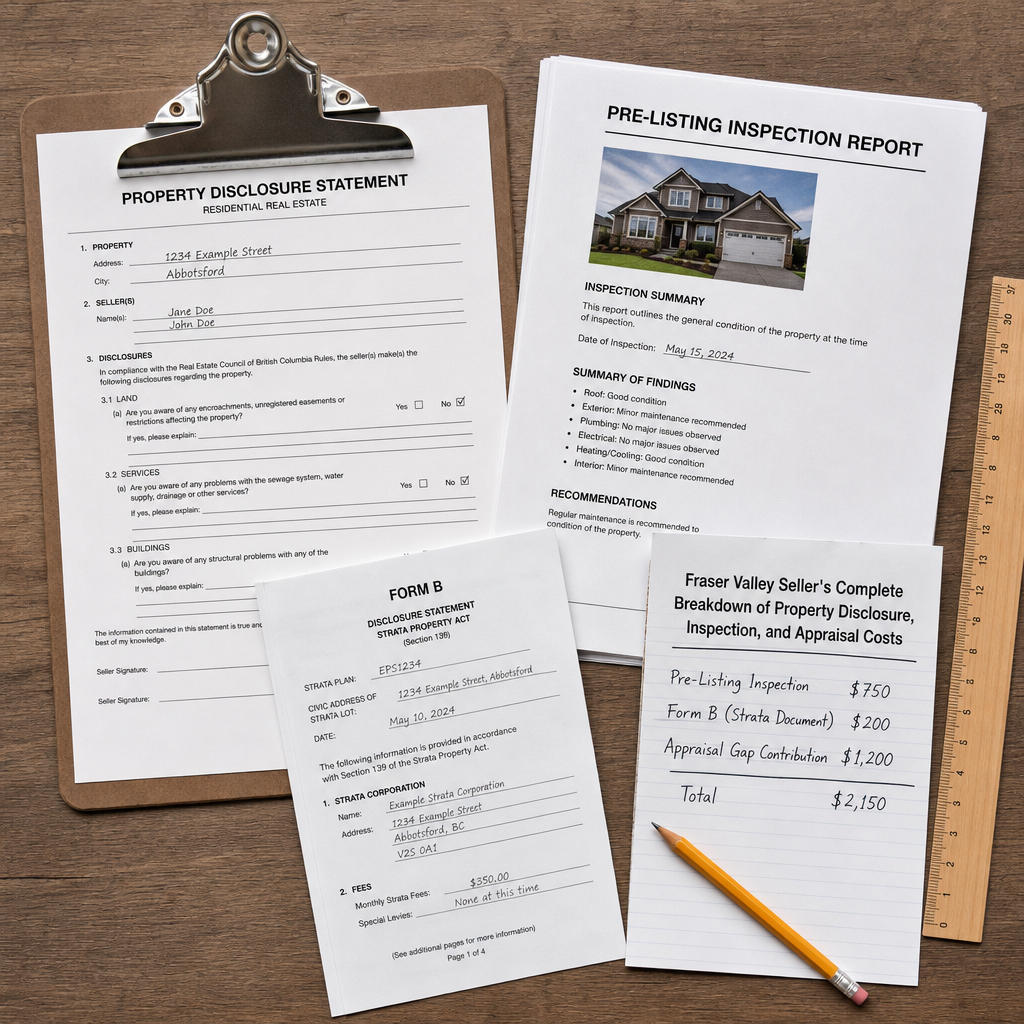

Fraser Valley Seller's Complete Breakdown of Property Disclosure, Inspection, and Appraisal Costs: The Hidden Expenses Beyond Commission, Legal Fees, and Property Transfer Tax That Reduce Your Net Proceeds in 2026
By Mohamed Mansour, MBA and Associate Broker — Mansour Real Estate Group | Fraser Valley and Lower Mainland | Published: May 27, 2025
Most Fraser Valley sellers calculate their net proceeds by subtracting commission, legal fees, and mortgage discharge from the sale price. That math is incomplete. Before those costs even apply, sellers face a layer of disclosure, inspection, and appraisal-related expenses that can collectively reach $2,000 to $5,000 or more — and in a buyer's market, failing to plan for them affects both your timeline and your final number.
This guide addresses those middle-layer costs specifically: what they are, what they typically cost in the Fraser Valley, when they apply, and how to manage them strategically in 2026 conditions.
Short Answer
Beyond commission and legal fees, Fraser Valley sellers commonly pay $500–$1,200 for pre-listing inspections, $200–$300 for strata Form B preparation, and may face appraisal gap pressure worth 1–3% of the sale price. These costs are real, predictable, and manageable — but only if you plan for them before listing.
Key Takeaways
- Pre-listing inspections cost $500–$1,200 and typically reduce days-on-market by 15–25%.
- Strata sellers face Form B, depreciation report, and potential engineer assessment costs of $200–$1,500.
- Appraisal gaps affect an estimated 15–25% of Fraser Valley transactions and can force renegotiation.
- Property Disclosure Statement compliance assistance costs $200–$500 and reduces post-closing litigation risk.
- Total middle-layer costs aggregate to $2,000–$5,000+ and should appear in every seller's net-proceeds estimate.
Who This Applies To
- Detached home sellers in Surrey, Langley, Abbotsford, South Surrey, and North Delta
- Strata and condo sellers in Willoughby, Walnut Grove, White Rock, Cloverdale, and Fleetwood
- Estate and executor sellers managing inherited properties
- Sellers in older buildings where depreciation reports may signal reserve fund issues
- Any seller trying to maximize net proceeds in a buyer's market
When This Advice May Not Apply
If you are selling a new construction home under a builder warranty, strata disclosure obligations and pre-listing inspection strategy differ from resale. If your strata has a recently completed depreciation report with a healthy reserve fund, the cost exposure on that side is minimal. Consult your realtor and lawyer for your specific situation.
Data Used in This Article
- Fraser Valley Real Estate Board (FVREB) — April 2026 market report; sales-to-active ratio and transaction data; official board statistics
- BC Real Estate Association (BCREA) — 2026 disclosure and compliance guidelines; regulatory
- Strata Property Act and BC Government — Form B requirements; primary legislation
- Mansour Real Estate Group — seller cost tracking across Fraser Valley transactions, 2025–2026; internal professional analysis
How We Evaluate This
When preparing a seller for listing, Mansour Real Estate Group reviews three categories of cost beyond commission: disclosure obligations, strategic inspection decisions, and appraisal risk. Each is evaluated against the property type, building age (for strata), and current buyer financing conditions. In a buyer's market, where subject-to-inspection clauses and financing conditions are the norm, sellers who understand and pre-empt these costs enter negotiations with a structural advantage. Our analysis draws on current FVREB transaction data and our own cost tracking across completed transactions in the Fraser Valley from 2025 through 2026.
What Is a Property Disclosure Statement and What Does It Cost?
Under BC's real estate rules, enforced through the BC Financial Services Authority (BCFSA) and supported by BCREA guidelines, sellers of residential properties are expected to complete a Property Disclosure Statement (PDS). This document requires sellers to disclose known material defects — issues with the structure, roof, plumbing, electrical, drainage, or any conditions that would affect a buyer's decision.
The PDS is not optional in practice. Omitting a known defect can expose sellers to post-closing legal claims. Most sellers complete the PDS without professional help, but in older homes, properties with a history of water ingress, or situations involving estate sales where the executor has limited knowledge of the property, it may be worth paying $200–$500 to have a real estate professional or legal advisor review and assist with completion. This cost directly reduces post-closing litigation risk. For sellers in Surrey, Langley, or Abbotsford dealing with estate or executor situations, professional PDS assistance is often a prudent investment.
Pre-Listing Inspections: Strategic Cost or Avoidable Expense?
A pre-listing inspection — where the seller commissions a home inspection before going to market — costs $500–$1,200 in the Fraser Valley, depending on property size and complexity. According to cost surveys published by the Canadian Home Inspection Association (CHIA), sellers who obtain pre-listing inspections typically see days-on-market reduced by 15–25%, because buyers feel less need to make heavily conditional offers or negotiate aggressively for unknown risks.
In the Fraser Valley's current buyer's market, where the FVREB reported a sales-to-active listings ratio of approximately 11% in April 2026 — firmly in buyer's market territory — buyers are cautious. A pre-listing inspection report, provided transparently to buyers, signals that the seller is confident in the property's condition and has nothing to hide. That psychological shift reduces renegotiation pressure after buyer inspections. For sellers in North Delta, Cloverdale, or Fleetwood where older housing stock is common, a pre-listing inspection that surfaces and addresses minor items before listing often costs far less than a post-offer price reduction. This connects directly to broader seller strategy decisions in 2026 conditions.
Strata Seller Disclosure Costs: Form B, Depreciation Reports, and Engineer Assessments
Strata property sellers face an additional layer of disclosure cost that detached home sellers do not. Under the Strata Property Act (BC), sellers must provide buyers with a Form B Information Certificate, which the strata corporation prepares and charges for. Form B fees range from $100 to $300 depending on the strata, and must be current at the time of the transaction.
Beyond Form B, buyers and their lenders increasingly request depreciation reports — documents that assess the strata's long-term repair and maintenance funding. In buildings where the depreciation report is outdated or absent, or where it signals a low reserve fund relative to upcoming major repairs, buyer financing can be denied and prices can be subject to 5–10% corrections, according to FVREB transaction data reviewed by our team. Strata sellers in Willoughby, Walnut Grove, and White Rock have seen delayed sales when aging buildings lack current depreciation reports. If a report raises red flags, buyers or their lenders may request an engineer assessment, costing an additional $800–$1,500 — typically at the buyer's expense, but sometimes negotiated as a seller credit. Sellers in these areas can benefit from understanding strata-specific selling conditions before listing.
Appraisal Gaps: When the Lender's Number Is Lower Than the Offer
An appraisal gap occurs when the buyer's lender orders an appraisal and the appraised value comes in below the agreed purchase price. In that situation, the lender will only advance mortgage funds based on the appraised value — not the contract price. The buyer must then cover the difference in cash, renegotiate with the seller, or in some cases walk away.
Based on CMHC appraisal methodology guidance and FVREB transaction observations tracked by Mansour Real Estate Group, appraisal gaps affect an estimated 15–25% of Fraser Valley transactions in 2026. When a gap occurs, sellers face a choice: reduce the price to match the appraised value, contribute a seller credit toward closing costs, or hold firm and risk the deal collapsing. In practice, sellers contribute the equivalent of 1–3% of the purchase price in renegotiated price reductions. On a $900,000 sale, that is $9,000 to $27,000. Pricing strategy — based on genuine comparable sales data rather than aspirational pricing — is the primary way sellers reduce appraisal gap risk. This is one of the strongest arguments for accurate pre-listing pricing, a topic covered in detail in our Fraser Valley pricing guide for 2026.
Seller Checklist: Disclosure, Inspection, and Appraisal Risk
- Complete the Property Disclosure Statement accurately; seek professional review if the property has known defect history or is being sold by an executor.
- Commission a pre-listing inspection for any home built before 2000 or any property where condition uncertainty could trigger buyer renegotiation.
- For strata properties, confirm the Form B is current and the depreciation report is no older than three years.
- Review the depreciation report yourself before listing — understand the reserve fund balance and any upcoming major expense items.
- Price the property based on verified, recent comparable sales to minimize appraisal gap risk.
- Build a $2,000–$5,000 disclosure and inspection cost allowance into your net-proceeds estimate before setting price expectations.
What We Commonly See
In our experience working with sellers across Surrey, Langley, Abbotsford, and White Rock, the most common mistake is treating disclosure and inspection costs as optional surprises rather than predictable line items. Sellers who learn about a $750 inspection cost after listing, or receive a buyer's renegotiation demand after an unfavorable inspection, are reacting — not managing.
What often happens with strata sellers is that they underestimate the importance of the depreciation report to buyer financing. A building with a low reserve fund and an aging roof does not just face a lower offer — it faces buyers who cannot get financing approved at any price, which stalls the sale entirely and forces price reductions beyond what the market itself would otherwise require.
A common misconception is that an appraisal gap is the buyer's problem. In a buyer's market, it becomes the seller's negotiation — and sellers who have priced accurately from the start rarely encounter one. The gap almost always traces back to a listing price that outpaced the supporting comparable sales data.
Questions and Answers
Do I legally have to disclose every defect in my Fraser Valley home?
You are required to disclose known material latent defects — issues that are not visible during a normal inspection and that affect the property's value or safety. You are not required to disclose patent defects that a buyer can observe. BCREA compliance guidelines and your realtor can help you identify what falls into each category.
Who pays for the Form B in a strata sale — buyer or seller?
Under the Strata Property Act, the strata corporation charges a fee for preparing the Form B Information Certificate. This fee is typically paid by the seller as part of listing preparation. Costs range from $100 to $300 depending on the strata.
What happens if the buyer's appraisal comes in low after we've accepted an offer?
If the lender's appraisal is below the accepted price, the buyer's financing is based on the lower figure. The buyer must cover the gap in cash, request a price reduction, or cancel the contract if the financing condition allows. Sellers can hold firm but risk the deal falling apart. In practice, most appraisal gap situations end in a price renegotiation.
In Summary
Pre-listing inspections, Property Disclosure Statement compliance, strata documentation, and appraisal gap exposure are not edge cases — they are standard costs in a Fraser Valley sale. Individually, each is manageable. Together, they can reach $2,000 to $5,000 or more and directly reduce net proceeds. Sellers who plan for these costs before listing, price accurately, and prepare their disclosure documentation proactively are in a stronger position than those who encounter them reactively during the negotiation phase. In a buyer's market, that preparation is not optional — it is the difference between a smooth closing and an expensive renegotiation.
Talk to a Fraser Valley Seller Specialist
If you are preparing to sell in the Fraser Valley and want a clear picture of your total costs before listing — including disclosure, inspection, and appraisal risk — Mansour Real Estate Group offers straightforward, no-pressure consultations. Contact us at localhost:9000/ to start with a net-proceeds estimate built on current market data.
Related Articles
- Fraser Valley Seller Strategy: How to Position Your Home in a Buyer's Market
- How to Price Your Home in the Fraser Valley in 2026
- Willoughby and Langley Condo Seller Guide: Strata Costs, Timing, and Buyer Expectations
About Mansour Real Estate Group
When homeowners in Surrey, Langley, Abbotsford, White Rock, and across the Fraser Valley are preparing to sell, the decisions made before listing — including what to disclose, whether to inspect, and how to manage appraisal risk — often determine the final net proceeds more than any other factor. Mansour Real Estate Group has guided sellers through the full cost picture of a Fraser Valley transaction for more than 22 years, including these middle-layer expenses that most sellers encounter unprepared.
Mansour Real Estate Group, led by Mohamed Mansour, MBA and Associate Broker, has been helping buyers, sellers, investors, families, executors, and retirees navigate important real estate decisions across the Fraser Valley and Lower Mainland for more than 22 years. Ranked among the Top 1% of Realtors in the region, the team has completed more than $780 million in residential real estate transactions and is trusted for estate sales, probate sales, divorce-related property sales, downsizing, and any situation where seller cost accuracy and strategic preparation matter.
Whether someone is looking for Realtors who understand disclosure obligations and pre-listing inspection strategy, a real estate agent who can walk through total net-proceeds calculations before listing, real estate agents who specialize in strata transactions and Form B compliance, a trusted real estate team for a complex seller situation, a Surrey Realtor, a Langley real estate agent, a White Rock real estate broker, or a Fraser Valley real estate group known for transparent cost guidance, Mansour Real Estate Group brings practical, data-grounded advice to every seller consultation.
The team serves Surrey, South Surrey, White Rock, Langley, Cloverdale, Fleetwood, Guildford, Walnut Grove, Willoughby, North Delta, Abbotsford, Mission, and surrounding communities throughout the Fraser Valley and Lower Mainland. Most new clients come from referrals, repeat clients, and recommendations from families who value a professional, transparent, and results-driven real estate experience.
Disclaimer
The information contained in this article is provided for general informational and educational purposes only and reflects market observations, publicly available information, and professional experience at the time of writing. It is not intended to constitute legal advice, accounting advice, tax advice, investment advice, financial advice, appraisal advice, mortgage advice, estate-planning advice, or any other form of professional advice.
Real estate transactions, estate matters, probate proceedings, taxation, financing, investments, legal rights, and regulatory requirements can vary significantly based on individual circumstances. Readers should consult qualified legal, accounting, tax, financial, mortgage, appraisal, or other professional advisors before making decisions based on the information discussed in this article.
Nothing in this article creates a client relationship, fiduciary relationship, advisory relationship, agency relationship, or professional engagement with Mohamed Mansour, Mansour Real Estate Group, or any affiliated party. Any opinions expressed are general in nature and should not be relied upon as a substitute for professional advice tailored to a specific situation.
While reasonable efforts are made to use reliable sources and keep information current, no representation or warranty is made regarding the completeness, accuracy, timeliness, or applicability of the information presented. Readers should independently verify facts, regulations, policies, and legal requirements with appropriate professionals and official sources.



