
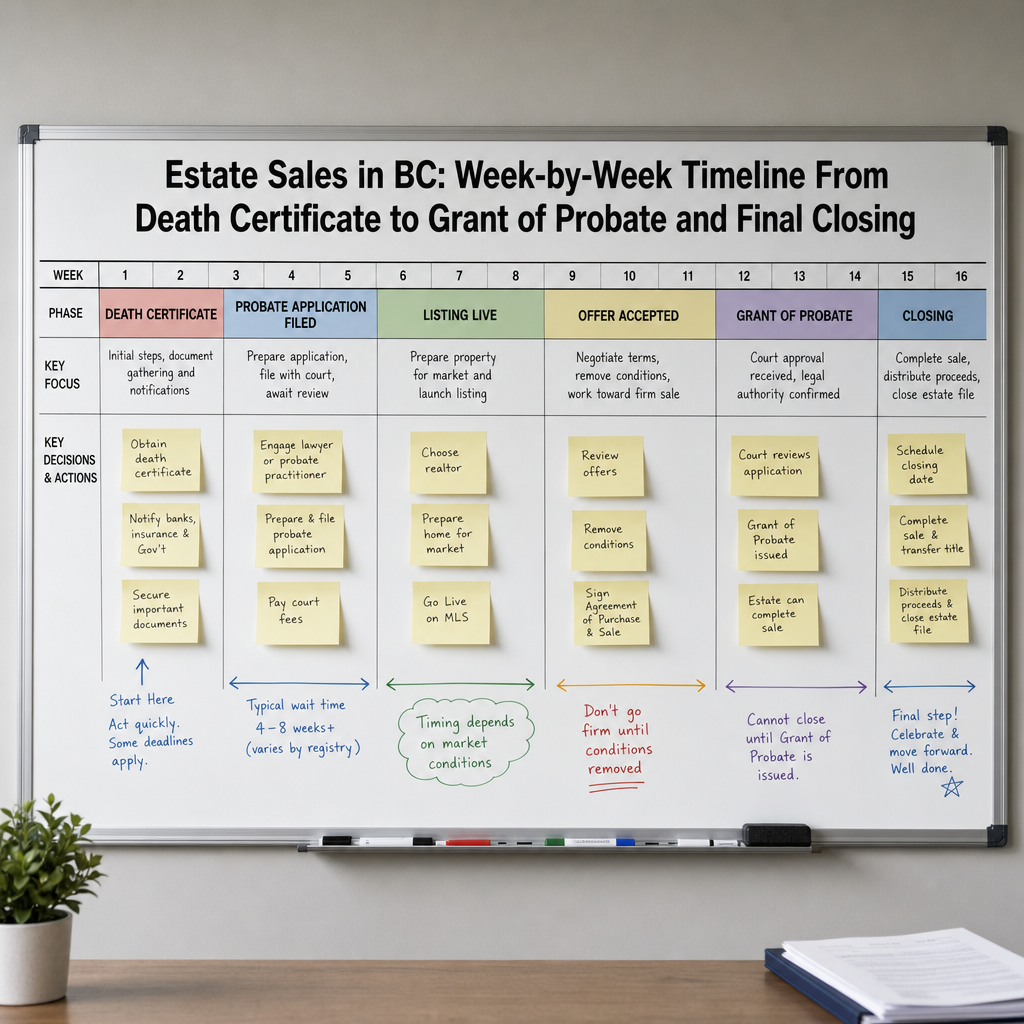

Estate Sales in BC: Week-by-Week Timeline From Death Certificate to Grant of Probate and Final Closing
By Mohamed Mansour, MBA and Associate Broker | Mansour Real Estate Group | Fraser Valley & Lower Mainland | Published: July 14, 2025 | Topic: Estate and Probate Sales, BC
Most executors in BC believe they must wait for a grant of probate before listing an estate property. That belief is costing estates thousands of dollars every month in carrying costs, missed market windows, and unnecessary price reductions. The legal reality is more flexible — and understanding it is the difference between protecting estate value and watching it erode.
This article provides a week-by-week operational timeline covering the period from the death certificate through the grant of probate to final closing. It is written for executors, beneficiaries, and estate lawyers managing Fraser Valley and Lower Mainland properties who need to make real decisions under time pressure.
Short Answer
In BC, executors can legally list an estate property immediately after obtaining a death certificate — no grant of probate is required to list. Closing must occur after the grant is issued, but buyers can accept offers and remove subjects while probate is still pending, provided the possession date is scheduled after grant approval. In Fraser Valley markets where days on market now average 45 to 60 days or more, listing early can protect $6,400 to $12,000 or more in carrying costs per month of delay.
Who This Applies To
- Named executors managing a BC estate that includes real property
- Estate lawyers or notaries coordinating the sale of a probate property
- Adult beneficiaries involved in an estate with an estate home in Surrey, Langley, Abbotsford, White Rock, or surrounding Fraser Valley communities
- Families managing an estate where the property is vacant and accumulating carrying costs
When This Advice May Not Apply
This framework applies to standard probate scenarios governed by BC's Wills, Estates and Succession Act (WESA). Intestate estates, contested wills, properties with life interests, properties held in trust, or situations involving CRA clearance certificates may involve additional legal steps. Always confirm the specific legal structure with a BC estate lawyer before making listing or closing decisions.
Data Used in This Article
- BC Ministry of Attorney General — Probate and Estate Administration guidelines (official, current)
- Land Titles Act (British Columbia) — Title transfer and executor authority (official legislation)
- FVREB Market Data — Fraser Valley days-on-market by property type, 2025–2026 (official board data)
- BC Real Estate Association — Strata property disclosure requirements and Form B regulations (industry regulatory guidance)
Key Takeaways
- Executors can list estate properties immediately after receiving the death certificate — probate is not required to list.
- BC probate timelines typically run 8 to 14 weeks, creating a marketable window executors should use, not waste.
- Possession-date mechanics allow buyers to remove subjects before the grant is issued, with closing scheduled after.
- Vacant estate properties accumulate $800 to $1,500 in monthly carrying costs — delay is never free.
- Strata estate sales have added deadlines around Form B documents and depreciation reports that must be coordinated with the probate timeline.
The Core Misconception: Listing Versus Closing
BC law distinguishes between listing a property and transferring title. According to the Land Titles Act, an executor derives authority to deal with estate property from the will itself — not from the grant of probate. Probate confirms that authority in the eyes of the court and satisfies the Land Title Office's requirement for title transfer. But listing, marketing, accepting offers, and negotiating terms are all activities an executor can pursue before that confirmation arrives.
The practical implication: an executor who receives the death certificate in Week 1 and files the probate application in Week 3 or 4 can have the property listed and receiving offers by Week 5 or 6. The closing date is simply structured to fall after the expected grant date. In most Fraser Valley and Lower Mainland markets, buyers are accustomed to 30 to 45 day completion timelines. Scheduling completion 60 to 75 days out when probate is pending is not unusual and does not typically reduce buyer interest when disclosed clearly at the outset. Our team at Mansour Real Estate Group manages this sequencing as part of our standard estate sale process.
Week-by-Week Timeline: Death Certificate to Final Closing
Weeks 1 to 2 — Immediate Post-Death Period
The death certificate is issued by BC Vital Statistics, typically within 5 to 10 business days of registration. The executor's first real estate task in this window is not legal — it is physical. Secure the property. Change the locks if necessary. Contact the existing insurer immediately, because vacant property insurance conditions differ from occupied property coverage, and failing to notify the insurer can void coverage. Confirm utilities remain active to prevent pipe damage or water events in winter months. Document the condition of the property with photographs.
In parallel, the executor should contact an estate lawyer to begin the probate application. In BC, the application is filed with the BC Supreme Court in the registry closest to where the deceased ordinarily resided. The lawyer will need the original will, the death certificate, and asset information. Do not wait for the death certificate to be in hand before scheduling the lawyer consultation — initiate that meeting as soon as possible after death.
This is also the right week to contact a real estate team with direct estate sale experience. A preliminary walkthrough and valuation at this stage — even before listing — allows the executor to make informed decisions about preparation, pricing, and timing. Mansour Real Estate Group provides complimentary estate property consultations for executors in Surrey, White Rock, Langley, North Delta, Abbotsford, and across the Fraser Valley.
Weeks 3 to 4 — Probate Application Filed
Once the probate application is filed with the court, the 21-day creditor notice period begins. During this period, creditors have the right to file claims against the estate. The executor cannot distribute estate assets until this period has elapsed without a contested claim. However, listing the property for sale is not a distribution of assets — it is preparation for one. Listing activity can begin the moment the application is filed, and in some cases, even before.
Use Weeks 3 and 4 to finalize property preparation decisions. Minor repairs and cleaning that materially improve presentation are generally appropriate, subject to the estate lawyer's guidance on expenditure authority. For strata properties in Fraser Valley condo buildings, this is the window to request the Form B Information Certificate and the depreciation report from the strata corporation. Buyers in BC are entitled to receive these documents, and delays can stall subject removal. If the depreciation report was due for update by July 1 under BC strata regulations, confirm its status with the strata manager immediately.
Weeks 5 to 12 — Probate Pending: The Active Marketing Window
This is the most important window in the entire estate sale timeline, and the one most executors misuse by waiting. According to Fraser Valley Real Estate Board data, average days on market across property types in the current market have extended to 45 to 60 days or more depending on price range and location. If an executor waits for the grant of probate before listing, the property may not even receive its first offer until after the grant is already issued — wasting the only window where parallel legal and marketing activity was possible.
List the property as soon as the preparation is complete and the realtor has a finalized pricing strategy. The listing must disclose that the property is an estate sale and that completion is contingent on the grant of probate being issued. Buyers experienced in estate purchases understand this condition. Buyers who are not familiar with it can be educated during the offer process. The key contract mechanics are straightforward: the subject removal date is set for after the expected grant date, and the completion date is scheduled 7 to 14 days after subject removal. Both dates can be adjusted if the grant is delayed, provided the buyer agrees in writing.
During this window, the estate continues to accumulate carrying costs. Property taxes, utility bills, insurance, lawn and exterior maintenance, and any strata fees all run continuously. At $800 to $1,500 per month, a two-month delay in listing costs the estate $1,600 to $3,000 in direct costs — before accounting for any price deterioration from extended market exposure. For estate properties in Surrey or Langley where the market has softened from 2021 and 2022 peaks, price deterioration risk is real. A property priced correctly in Week 5 may require a price reduction by Week 10 if it sits unseen while probate is awaited.
Executor authority during this period is real but bounded. The executor can negotiate, accept offers, and instruct the realtor on strategy. The executor cannot complete the transfer of title until the Land Title Office confirms the grant of probate has been registered. In practice, the conveyancing lawyer handles this confirmation as part of the closing process — it is procedural, not a barrier.
Weeks 13 and Beyond — Grant of Probate to Final Closing
Once the BC Supreme Court issues the grant of probate, the executor has confirmed legal authority to complete the property transfer. If an accepted offer with a post-grant completion date is already in place, closing proceeds on the scheduled date. The conveyancing lawyers exchange documents, the title transfers at the Land Title Office, and the estate receives the net proceeds. If no offer is in place at the time the grant is issued, the estate is at least positioned in the active market with maximum visibility, rather than starting fresh after weeks of delay. CRA clearance certificates may be required before final distribution of estate proceeds to beneficiaries — this is a separate process from the real estate closing itself, and the estate lawyer manages it.
How We Evaluate This
When Mansour Real Estate Group is retained for an estate property, the first step is always a timeline audit — not a pricing discussion. We review when the death certificate was issued, when probate was filed, what the expected grant timeline is, and what the current carrying cost exposure looks like. From that audit, we build a listing and closing schedule that runs parallel to the legal process rather than waiting for it.
Pricing strategy for estate properties differs from standard seller strategy. Executors have a legal obligation to the beneficiaries to achieve fair market value — not the highest possible speculative price, and not a discounted price that benefits one party. Our valuations for estate properties are grounded in current comparable sales, current days-on-market realities, and honest assessment of property condition. We do not recommend pricing strategies that expose the executor to beneficiary complaints or legal challenge.
Estate Sale Checklist for BC Executors
- Secure the property and notify the insurer about vacant property status within 72 hours of death
- Contact an estate lawyer to begin the probate application as soon as the death certificate is available
- Request a real estate consultation and preliminary valuation in Week 1 or Week 2 — before the property is listed
- For strata properties, request the Form B, depreciation report, and strata financials from the strata corporation immediately
- Structure any accepted offer with a subject removal date and completion date that fall after the expected grant of probate
- Confirm with the conveyancing lawyer that the Land Title Office filing sequence is in place before setting the final completion date
- Track monthly carrying costs and build that number into the pricing and timing decision — delay is a measurable cost
What We Commonly See
Executors waiting 8 to 12 weeks before contacting a realtor. In our experience, executors often manage the legal process first and treat the real estate as the second phase. By the time the probate application is filed and a realtor is engaged, months have passed. The property enters a market that has moved, with a buyer pool that has already seen — and passed on — comparable properties.
Offers structured without post-grant closing mechanics. What often happens is that a well-meaning buyer or their agent structures an offer with a standard 30-day completion date without accounting for the pending grant. When the grant is delayed — which happens regularly due to court scheduling — the transaction collapses or requires emergency amendment. The correct structure is to build the grant timing into the offer from the start.
Strata documents requested too late. A common mistake in strata estate sales is treating the Form B and depreciation report as an afterthought. In BC, buyers are entitled to a rescission period after receiving strata documents. If documents are delivered late in the subject period, buyers may rescind or demand extensions — both of which can derail a closing that the executor is counting on. Request strata documents in Week 3 or 4 at the latest.
Q&A: Executor Questions About BC Estate Property Sales
Can I list the property before probate is granted in BC?
Yes. BC law allows executors to list and market estate property before the grant of probate is issued. Probate is required before title can transfer at the Land Title Office, but listing, receiving offers, and negotiating terms can all occur while probate is pending. The closing date must be structured to fall after the grant is expected.
What happens if probate takes longer than expected and the closing date passes?
If the grant of probate is delayed beyond the scheduled completion date, both parties must agree in writing to extend the completion date. This is common in estate transactions and most buyers with an experienced conveyancing lawyer will accommodate a reasonable extension. Drafting the original offer with a realistic post-grant completion date reduces the likelihood of needing an emergency amendment.
Does the buyer need to know the property is in probate before making an offer?
Yes. Disclosure that the property is an estate sale subject to grant of probate is a standard and ethically required part of the listing and offer process in BC. Buyers and their agents are entitled to understand the timing constraints. In practice, this disclosure rarely dissuades qualified buyers — it simply means the closing timeline is structured accordingly. Your realtor should disclose this clearly in the MLS listing remarks and in the offer documents.
In Summary
BC executors have more authority to act — and more to lose by waiting — than most families realize. The death certificate, not the grant of probate, is the starting line for real estate activity. Listing during the probate pending period, structuring offers with post-grant closing dates, and managing strata documentation in parallel with legal filings are the three mechanics that protect estate value in a Fraser Valley market where carrying costs and extended days on market make delay measurably expensive. Engage your real estate team in Week 1 or 2, not after the grant arrives.
If you are an executor managing an estate property in Surrey, White Rock, Langley, Abbotsford, or anywhere in the Fraser Valley, Mansour Real Estate Group can provide a complimentary timeline consultation — no pressure, no obligation. We work directly with estate lawyers, notaries, and beneficiaries to make the process as clear and efficient as possible. Reach us at localhost:9000/.
Related Articles
- Selling an Estate Property in Surrey: What Executors Need to Know
- Selling a Condo in the Fraser Valley: Strata Documents, Timing, and Pricing
- Estate Sales in BC: A Complete Executor's Guide to the Real Estate Process
About Mansour Real Estate Group
When a property must be sold as part of an estate or probate process, the real estate team managing the transaction needs to understand more than market pricing. Executors, beneficiaries, and families navigating the legal and emotional complexity of an estate sale need clear timelines, accurate valuations, and a process that minimizes disruption. Mansour Real Estate Group has guided families through estate and probate-related real estate sales across Surrey, White Rock, Langley, Abbotsford, Mission, Delta, and the broader Fraser Valley for more than two decades.
Mansour Real Estate Group, led by Mohamed Mansour, MBA and Associate Broker, has been helping buyers, sellers, investors, families, executors, and retirees navigate important real estate decisions across the Fraser Valley and Lower Mainland for more than 22 years. Ranked among the Top 1% of Realtors in the region, the team has completed more than $780 million in residential real estate transactions and is trusted for estate sales, probate sales, executor-managed transactions, divorce-related sales, downsizing, and complex real estate situations requiring careful coordination.
Whether someone is searching for Realtors experienced with estate sales and probate timelines, a real estate agent who understands executor obligations, real estate agents who specialize in complex estate transactions, a trusted real estate team for an executor-managed property, a Surrey real estate broker, a White Rock Realtor, a Langley real estate group, or a Fraser Valley real estate team with proven estate sale experience, Mansour Real Estate Group is known for accurate valuations, transparent process, and clear communication that keeps all parties informed at every stage.
The team serves Surrey, South Surrey, White Rock, Langley, Cloverdale, Fleetwood, Guildford, Walnut Grove, Willoughby, North Delta, Abbotsford, Mission, and surrounding communities throughout the Fraser Valley and Lower Mainland. Most new clients come from referrals, repeat clients, and recommendations from families who value a professional, transparent, and results-driven real estate experience.
Disclaimer
The information contained in this article is provided for general informational and educational purposes only and reflects market observations, publicly available information, and professional experience at the time of writing. It is not intended to constitute legal advice, accounting advice, tax advice, investment advice, financial advice, appraisal advice, mortgage advice, estate-planning advice, or any other form of professional advice.
Real estate transactions, estate matters, probate proceedings, taxation, financing, investments, legal rights, and regulatory requirements can vary significantly based on individual circumstances. Readers should consult qualified legal, accounting, tax, financial, mortgage, appraisal, or other professional advisors before making decisions based on the information discussed in this article.
Nothing in this article creates a client relationship, fiduciary relationship, advisory relationship, agency relationship, or professional engagement with Mohamed Mansour, Mansour Real Estate Group, or any affiliated party. Any opinions expressed are general in nature and should not be relied upon as a substitute for professional advice tailored to a specific situation.
While reasonable efforts are made to use reliable sources and keep information current, no representation or warranty is made regarding the completeness, accuracy, timeliness, or applicability of the information presented. Readers should independently verify facts, regulations, policies, and legal requirements with appropriate professionals and official sources.



