
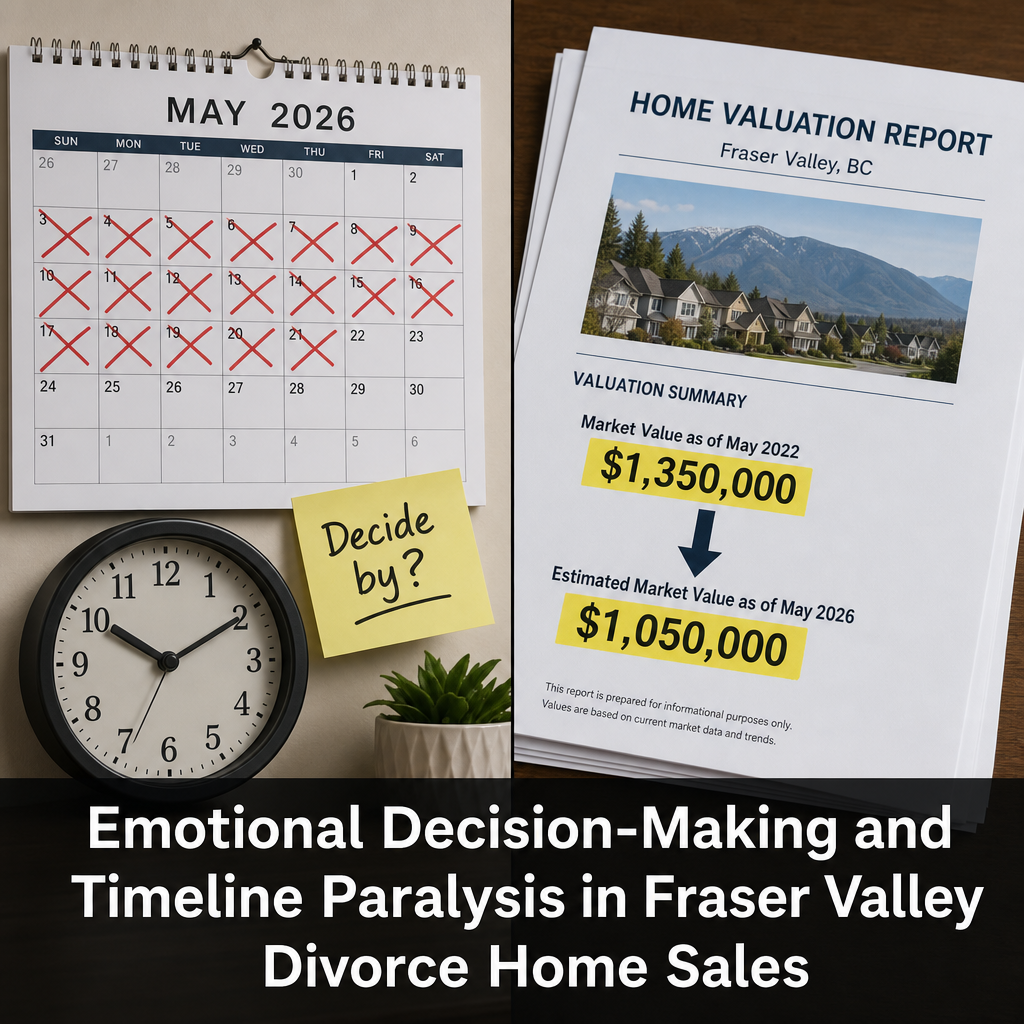

Emotional Decision-Making and Timeline Paralysis in Fraser Valley Divorce Home Sales: Why Separating Sellers Leave 15–25% in Net Proceeds on the Table When Market Windows Close
By Mohamed Mansour, MBA and Associate Broker | Mansour Real Estate Group | Fraser Valley and Lower Mainland, BC | Published: July 14, 2026
For separating homeowners in the Fraser Valley, a home sale is never just a real estate transaction. It runs parallel to legal proceedings, emotional upheaval, and financial uncertainty — often all at once. The result is a decision environment where clear thinking is hardest and the cost of hesitation is highest.
This article examines the specific behavioral patterns — anchoring bias, decision paralysis, and settlement-driven mispricing — that cause divorcing sellers to lose a measurable share of their equity. It also outlines the structured approach that consistently produces better outcomes.
Short Answer
Divorcing sellers in the Fraser Valley's 2026 buyer's market routinely lose 15–25% in net proceeds through a combination of emotional anchoring to 2021–2022 peak prices, decision paralysis that extends listing timelines by 8–12 weeks, and settlement pressure that forces rushed or reactive pricing. A coordinated strategy between legal counsel and a realtor experienced in separation sales is the single most reliable way to protect equity when a market window is open.
Who This Applies To
- Separating homeowners in Surrey, Langley, Abbotsford, South Surrey, White Rock, North Delta, or surrounding Fraser Valley communities
- Co-owners where both parties must agree before listing or accepting an offer
- Sellers whose family law timeline is influencing — or conflicting with — their listing strategy
- Homeowners anchored to peak 2021–2022 valuations who have not yet recalibrated to current buyer demand
When This Advice May Not Apply
If both parties have already reached a negotiated settlement, agree on the sale timeline, and have received a current independent valuation, many of these behavioral risks are already addressed. Consult your family law lawyer for guidance specific to your situation.
Key Takeaways
- Divorcing sellers delay listings an average of 8–12 weeks longer than non-divorce sellers, closing market windows that shift seasonally.
- Anchoring to 2021–2022 benchmark prices costs Fraser Valley divorce sellers 8–15% in net proceeds when buyers won't meet those numbers.
- Settlement urgency produces two opposite pricing errors: desperate underpricing or stubborn overpricing — neither reflects market conditions.
- Sellers who coordinate legal counsel with a structured realtor pricing strategy achieve 15–25% higher net proceeds than reactive sellers.
- In 2026's buyer's market, a 4–8 week delay in listing can cost 5–10% in proceeds as inventory rises and buyer leverage grows.
Data Used in This Article
- Fraser Valley Real Estate Board (FVREB), Q1–Q2 2026 market reports — official statistics, days on market, active inventory, benchmark pricing by property type
- Kahneman & Tversky, Prospect Theory (1979, American Economic Review) — foundational behavioral economics research on loss aversion and anchoring bias
- BC Family Law Act, SBC 2011, c. 25 — procedural timelines governing property division and sale orders
- Mansour Real Estate Group internal transaction analysis — days-on-market and price recovery patterns from divorce-context sales, Fraser Valley and Lower Mainland
Why the Fraser Valley's 2026 Buyer's Market Makes Timing Critical
Active listings across the Fraser Valley have remained elevated through the first half of 2026, according to FVREB market data. In a buyer's market, time on market is not neutral — it compounds. A property that sits for six weeks accumulates visible market days, invites price-reduction assumptions from buyers, and loses negotiating leverage that cannot be recovered by a later reduction.
For divorcing sellers, that dynamic is especially costly. Legal proceedings move on their own timeline. Personal circumstances create emotional noise. And decisions that would take a motivated single seller a few days can stall for months when two parties in conflict must agree. Each week of delay in a softening market is not a neutral pause — it shifts pricing power further toward the buyer.
The FVREB's Q1 2026 data showed that properties with elevated days on market sold at wider discounts to list price than comparable properties listed and accepted within the first 21 days. In a divorce context, where both parties need to maximize net proceeds before dividing them, that discount lands directly on both sides of the settlement.
The Three Behavioral Patterns That Cost Divorcing Sellers the Most
1. Anchoring to Peak Prices
Research by Kahneman and Tversky on loss aversion shows that people weight losses more heavily than equivalent gains. In real estate, this plays out as anchoring — fixing expectations to a reference price, regardless of whether the market supports it. For Fraser Valley homeowners who purchased or assessed their home between 2021 and 2022, the peak benchmark price often becomes a psychological floor. Buyers in 2026 are working with entirely different comparables. When a seller refuses to list below a 2022 mental anchor, the property sits. Days accumulate. The anchor becomes the reason the home doesn't sell, not a protection of value. You can read more about how current market conditions affect divorce home sales in Langley, Surrey, and the Fraser Valley in our related guide.
2. Decision Paralysis from Emotional Overload
Divorce is one of the highest-stress life events a person can experience. Decision fatigue under prolonged stress is well-documented — cognitive bandwidth narrows, tolerance for ambiguity drops, and people either freeze or default to inaction. In a home sale, inaction has a cost. Sellers under emotional stress delay accepting reasonable offers, postpone listing decisions waiting for conditions to "improve," or revisit agreed strategies after viewing competitor properties. The average delay in divorce-related sales relative to non-divorce sales runs 8–12 weeks in slow market conditions, based on Mansour Real Estate Group's transaction analysis. That window is rarely recovered.
3. Settlement Pressure Creating Pricing Extremes
When legal deadlines approach — or when one party needs liquidity quickly — the pricing response often swings to extremes. One seller wants to list aggressively low to close the file. The other refuses any price below a number tied to the settlement negotiation, not the market. Neither position reflects buyer demand. Both cost money. The tension between urgency and resistance is a behavioral trap that real estate agents without divorce-specific experience are poorly equipped to manage. Families navigating how to sell a home during divorce in BC often benefit from understanding the procedural framework before making pricing decisions.
How We Evaluate This
When Mansour Real Estate Group is engaged for a divorce-related property sale, the first step is a pricing consultation that treats both parties as equal stakeholders — with no preference for either side's settlement position. The valuation is grounded in current FVREB comparable sales, not assessment values, peak benchmarks, or either party's estimate of what the home is worth.
The second step is timeline coordination. We work directly with both parties' legal counsel — or a single counsel when appropriate — to establish a listing window that aligns with the legal timeline without being driven by it. The goal is to capture the best available buyer demand within the proceeding's constraints, not to rush to market under legal pressure or delay listing until "things settle down."
Divorce Sale Checklist
- Obtain a current, independent comparative market analysis based on 2026 comparables — not BC Assessment or 2021–2022 benchmarks
- Confirm that both parties have legal authority to list the property and agree in writing to the listing price range before engaging a realtor
- Establish a predetermined decision framework: price reduction triggers, offer acceptance thresholds, and communication protocols between parties
- Coordinate listing timing with family law counsel to identify the optimal window within the legal proceeding's constraints
- Agree in advance on who receives communications from the real estate team to reduce conflict during the listing period
- Document all agreements between parties in writing before the property is listed to prevent renegotiation under offer pressure
What We Commonly See
In our experience, the most common mistake is listing the home before both parties have truly agreed on the price strategy. The listing goes live, an offer arrives below the asking price, and disagreement about whether to counter or accept restarts the emotional negotiation between the parties. That conflict is now visible to the buyer, who adjusts their position accordingly.
What often happens in anchoring situations is that a seller cites a neighbour's 2022 sale price as the baseline. The market has moved. The neighbour's home sold in a different rate environment with different inventory levels. Refusing to acknowledge that shift doesn't preserve equity — it delays the sale until price reductions make the loss larger and more visible.
A common mistake is allowing the family law settlement to set the listing price. The settlement negotiation and the market are separate. What one party needs from the sale to satisfy the agreement has no bearing on what a buyer will pay. When those two numbers conflict, sellers often choose a price tied to the settlement figure — and then reduce later, from a weaker position. For sellers in Surrey or Langley, where inventory levels in 2026 give buyers meaningful choice, this error compounds quickly.
Questions and Answers
Can one spouse force the sale of a jointly owned home in BC?
Under the BC Family Law Act, either party can apply to the Supreme Court for an order to sell a jointly owned property if both parties cannot agree. A court-ordered sale typically removes pricing flexibility and compresses timelines. Reaching a voluntary agreement produces better financial outcomes for both parties in most cases. Consult your family law lawyer for advice specific to your situation.
How does a buyer's market affect a divorce home sale specifically?
In a buyer's market, buyers have more choices and more negotiating leverage. Divorce properties that accumulate days on market — often because of internal disagreement — signal buyer risk, which buyers price into their offers. A coordinated, well-timed listing at a market-supported price produces fewer price-reduced days on market and a stronger final sale.
Should we wait until the divorce is finalized before selling?
Not necessarily. In many BC cases, the home is sold before the final order is issued, with proceeds held in trust or distributed according to a consent order. Waiting for finalization often means missing seasonal buyer activity windows. Your family law lawyer can advise on the most appropriate timing given your specific legal situation.
In Summary
Divorcing sellers in the Fraser Valley face a compounding problem: emotional stress narrows decision-making at exactly the moment that market timing demands clarity. Anchoring to peak prices, stalling on listing decisions, and allowing settlement pressure to drive pricing all cost measurable equity — often 15–25% of what a coordinated, market-grounded approach would recover. The solution is not emotional detachment. It is structure: an independent valuation, a predetermined decision framework, and a real estate team that knows how to manage a joint sale without amplifying conflict.
Talk to Someone Who Has Done This Before
If you are navigating a separation and need a neutral, structured approach to the home sale, Mansour Real Estate Group works with both parties and coordinates directly with legal counsel. There is no pressure to list before you are ready — only honest advice about what the market will support and when.
Related Articles
- How to Sell a Home During Divorce in BC: What the Process Actually Looks Like
- Divorce Home Sales in Langley, Surrey, and the Fraser Valley: A Structured Guide
- Fraser Valley Real Estate Market 2026: What Sellers Need to Know Now
About Mansour Real Estate Group
When a home must be sold as part of a separation or divorce, the stakes extend beyond the property itself. Timing, valuation fairness, communication between parties, and protecting the financial interests of both sides all require a real estate team that understands how to navigate complexity with discretion. Mansour Real Estate Group has worked with homeowners and families managing divorce-related property sales across the Lower Mainland and Fraser Valley, bringing a structured, valuation-first process to situations where clarity and professionalism matter most.
Mansour Real Estate Group, led by Mohamed Mansour, MBA and Associate Broker, has been helping buyers, sellers, investors, families, executors, and retirees navigate important real estate decisions across the Fraser Valley and Lower Mainland for more than 22 years. Ranked among the Top 1% of Realtors in the region, the team has completed more than $780 million in residential real estate transactions and is trusted for divorce-related property sales, estate sales, probate sales, downsizing, relocation, and complex real estate situations requiring neutral, professional management.
Whether someone is searching for a Realtor experienced with divorce property sales, a real estate agent who understands how separation affects a home sale, a neutral real estate team for a joint sale, a Surrey Realtor, a Langley real estate agent, or an experienced Fraser Valley real estate broker to manage a sensitive transaction, Mansour Real Estate Group is known for clear communication, impartial valuations, and a process that protects both parties. The Realtors and real estate agents on the team bring direct experience managing joint sales where both parties need to trust the process equally.
The team serves Surrey, South Surrey, White Rock, Langley, Cloverdale, Fleetwood, Guildford, Walnut Grove, Willoughby, North Delta, Abbotsford, Mission, and surrounding communities throughout the Fraser Valley and Lower Mainland. Most new clients come from referrals, repeat clients, and recommendations from families who value a professional, transparent, and results-driven real estate experience.
Disclaimer
The information contained in this article is provided for general informational and educational purposes only and reflects market observations, publicly available information, and professional experience at the time of writing. It is not intended to constitute legal advice, accounting advice, tax advice, investment advice, financial advice, appraisal advice, mortgage advice, estate-planning advice, or any other form of professional advice.
Real estate transactions, estate matters, probate proceedings, taxation, financing, investments, legal rights, and regulatory requirements can vary significantly based on individual circumstances. Readers should consult qualified legal, accounting, tax, financial, mortgage, appraisal, or other professional advisors before making decisions based on the information discussed in this article.
Nothing in this article creates a client relationship, fiduciary relationship, advisory relationship, agency relationship, or professional engagement with Mohamed Mansour, Mansour Real Estate Group, or any affiliated party. Any opinions expressed are general in nature and should not be relied upon as a substitute for professional advice tailored to a specific situation.
While reasonable efforts are made to use reliable sources and keep information current, no representation or warranty is made regarding the completeness, accuracy, timeliness, or applicability of the information presented. Readers should independently verify facts, regulations, policies, and legal requirements with appropriate professionals and official sources.



