

Langley Home Price Stabilization Signals in 2026: Distinguishing False Market Recoveries From Genuine Inflection Points When Year-Over-Year Declines Mask Month-Over-Month Momentum
By Mohamed Mansour, MBA and Associate Broker, Mansour Real Estate Group · Fraser Valley and Lower Mainland · Published June 2026
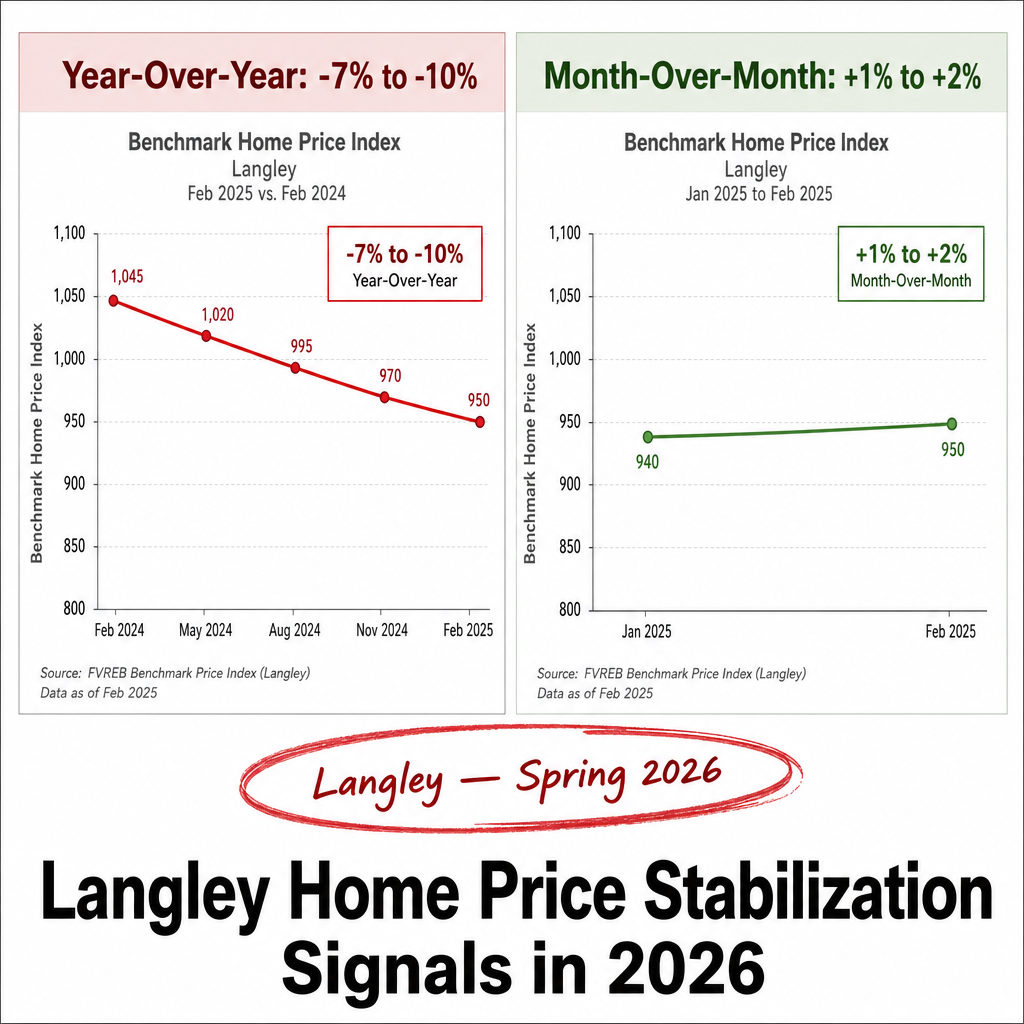
Langley sellers in spring 2026 are reading two sets of numbers that point in opposite directions. Year-over-year benchmark prices remain 7 to 10 percent below 2025 levels, according to Fraser Valley Real Estate Board data. At the same time, month-over-month figures from March and April 2026 show modest gains in selected property types. Both sets of numbers are real. The question is which one should guide your pricing decision.
This article explains how to distinguish a temporary inventory-driven price lift from a genuine demand-driven recovery — and why that distinction matters before you set a list price.
Short Answer
Month-over-month gains in Langley during spring 2026 are real but narrowly driven by reduced new listings, not by a surge of qualified buyers entering the market. Townhouses and entry-level detached homes under $800K are showing the strongest relative stability. Sellers who understand which segment they are in will price more accurately than those reacting to headline numbers alone.
Key Takeaways
- Year-over-year and month-over-month data can both be accurate while pointing in opposite directions — context determines which is more useful for pricing decisions.
- Spring 2026 price stability in Langley is supply-driven, not demand-driven, making it more fragile than it appears on the surface.
- Townhouses are in seller-leaning territory at 15 to 23 percent sales-to-active ratios; detached homes remain balanced at 10 to 12 percent.
- Entry-level detached homes under $800K are selling in 25 to 30 days; condos are taking 45 to 50 or more days, reflecting a segmented, not broad, recovery.
- Builder incentive phase-outs in Willoughby and Walnut Grove are temporarily compressing resale competition — a condition that may reverse when completions arrive later in 2026.
Who This Applies To
- Langley homeowners considering listing in spring or summer 2026
- Sellers trying to interpret conflicting market reports before setting a price
- Owners of townhouses, entry-level detached homes, or condos in Willoughby, Walnut Grove, or Cloverdale
- Estate executors or family members managing a sale in a price-uncertain environment
When This Advice May Not Apply
Sellers of luxury detached homes above $1.5M, rural acreage, or commercial-adjacent properties in Langley face different buyer pools and different market dynamics. This framework is built around the entry-level to mid-market residential segments where conflicting signals are most acute in spring 2026.
Data Used in This Article
- FVREB April 2026 market statistics — Fraser Valley Real Estate Board, official monthly release, Fraser Valley geography, primary source
- BC Assessment benchmark price trends Q1–Q2 2026 — BC Assessment Authority, official assessment data, Langley and Fraser Valley properties
- Days-on-market and sales-to-active ratio analysis — internal Mansour Real Estate Group transaction and listing data, January to April 2026, Langley micro-markets
- Buyer sentiment and economic uncertainty — Bank of Canada consumer confidence data and Statistics Canada labour force reporting, Q1 2026
Why Year-Over-Year and Month-Over-Month Tell Different Stories
Year-over-year comparisons measure where prices are relative to the same month twelve months ago. They are useful for understanding the broad direction of the market. In Langley, those numbers are still negative — benchmark prices for detached homes remain roughly 7 to 10 percent below April 2025 levels, according to FVREB data.
Month-over-month comparisons measure short-term momentum. They show whether prices are moving up or down right now, regardless of the longer trend. March to April 2026 data shows estimated gains of 1 to 2 percent in entry-level segments. Both numbers are accurate. The danger is treating the month-over-month lift as evidence of a market turn when the underlying conditions do not yet support that conclusion.
A false recovery occurs when short-term price increases are driven by reduced supply rather than increased qualified demand. The practical difference: supply-driven lifts reverse when new listings return to the market. Demand-driven recoveries are self-reinforcing because they reflect buyers who are financially ready to transact. Spring 2026 in Langley fits the supply-driven profile more closely than the demand-driven one.
How to Identify a Genuine Inflection Point in the Langley Market
A genuine inflection point shows up across multiple indicators simultaneously: sales volume rises while inventory holds flat or falls, days on market compresses across property types rather than just one segment, and financing conditions shift in a way that qualifies more buyers. April 2026 in Langley showed partial evidence of an inflection — sales volume rose approximately 7 percent year-over-year according to FVREB reporting — but days on market improvements were concentrated in townhouses and detached homes under $800K rather than spread across the full market.
The townhouse segment in Langley is the clearest signal to watch. At 15 to 23 percent sales-to-active ratios, townhouses are in territory where sellers retain negotiating leverage. Detached homes, by contrast, sit at 10 to 12 percent — a balanced range where neither side controls the outcome reliably. Condos remain under sustained pressure with days on market of 45 to 50 or more days in most Langley sub-markets.
Another signal worth tracking is builder activity in Willoughby and Walnut Grove. As builder incentives phase out on presale contracts, new competition entering the resale pool temporarily decreases. That reduction creates the appearance of scarcity. Completion waves expected later in 2026 will likely restore that competition, which means the current window of reduced supply pressure is time-limited. Sellers who interpret current resale pricing power as permanent may be caught off guard when inventory normalizes.
How We Evaluate This
At Mansour Real Estate Group, we separate market signals into two categories before making a pricing recommendation: supply-side conditions and demand-side conditions. Supply-side conditions include active listing counts, new listing rates, builder competition, and days-on-market trends. Demand-side conditions include sales volume relative to active inventory, buyer qualification rates, and economic confidence signals. When supply-side conditions are improving but demand-side conditions are not, we treat current pricing strength as fragile and recommend positioning conservatively — capturing current conditions without assuming they will persist. For sellers navigating a shifting Fraser Valley market, this distinction between fragile and durable pricing signals is often the most important conversation we have before a listing goes live.
Seller Checklist: Reading Price Signals Before You List in Langley
- Confirm your property type's current sales-to-active ratio — townhouse, detached, and condo markets are behaving differently in spring 2026.
- Review days-on-market for comparable properties listed in the past 30 to 60 days, not just sold data from six months ago.
- Identify whether recent comparable sales are at, above, or below original list price — this reveals actual buyer willingness, not listed asking prices.
- Assess new listing volumes in your sub-market for the past four weeks to determine whether supply is still contracting or beginning to rise.
- Check whether any new construction completions are expected in your neighbourhood in the next three to six months that could compete with your resale listing.
- Confirm your pricing relative to the $800K threshold for detached homes — properties priced just above that entry-level range face a notably different buyer pool and longer absorption timelines.
What We Commonly See
In our experience working with sellers across Langley and the Fraser Valley, the most common mistake in a mixed-signal market is anchoring to the most recent month's numbers rather than the direction of the trend. A seller who lists in April based on March's modest gains may find that May brings renewed inventory and softening buyer urgency.
What often happens is that sellers see a neighbour's home sell reasonably well in March and assume the market has turned. What they do not see is that the neighbour was in the entry-level detached segment with strong presentation and priced below $800K — conditions that do not automatically transfer to a different property type or price point.
A common mistake we see is treating the Langley market as a single entity when it is actually several overlapping markets: Walnut Grove, Willoughby, Cloverdale, and rural Langley Township all have distinct buyer pools, inventory levels, and absorption rates that require separate analysis before a list price is set.
Questions and Answers
Is month-over-month price growth in Langley a reliable sign that the market has recovered?
Not by itself. Month-over-month gains of 1 to 2 percent in spring 2026 reflect reduced new listing volumes more than increased buyer demand. The underlying affordability and confidence conditions have not shifted enough to signal a durable recovery. Treat month-over-month data as a directional indicator, not a confirmation.
Which property types in Langley are showing the most stability in spring 2026?
Townhouses and entry-level detached homes under $800K are performing best. Townhouses are showing 15 to 23 percent sales-to-active ratios, giving sellers a measurable negotiating position. Condos are lagging, with days on market of 45 to 50-plus days across most Langley sub-markets.
Will builder completions in Willoughby and Walnut Grove affect resale prices later in 2026?
Likely yes. As presale units from recent construction cycles reach completion, they will re-enter the resale pool and expand buyer choice in those sub-markets. The current period of reduced new supply competition — which is supporting resale pricing — is expected to narrow as the year progresses. Sellers in those areas have reason to act earlier rather than later.
In Summary
Langley's spring 2026 price signals are real but fragile. Month-over-month stability in townhouses and entry-level detached homes reflects a temporary supply reduction rather than a fundamental shift in buyer demand. Sellers who price based on current conditions while understanding those conditions are time-limited will be better positioned than those chasing headline numbers in either direction. The window for current pricing advantage in certain segments is likely measured in months, not quarters, and the segment you are selling in determines which strategy applies.
If you are trying to make sense of conflicting price data before listing in Langley, a conversation with our team can help you separate the signal from the noise. Mansour Real Estate Group offers honest, data-grounded pricing analysis for sellers across Langley, Willoughby, Walnut Grove, and the broader Fraser Valley — reach us at localhost:9000/.
Related Articles
- How to Price Your Home in a Shifting Fraser Valley Market
- Willoughby Real Estate Market Guide
- Langley Townhouse Market 2026: What Sellers Need to Know
About Mansour Real Estate Group
Reading conflicting price signals in a market like Langley's spring 2026 requires more than pulling a comparable sales report. It requires understanding which segments are moving, why they are moving, and whether current conditions reflect durable buyer demand or a temporary supply contraction. Mansour Real Estate Group has built its reputation in the Fraser Valley and Lower Mainland on precisely that kind of pricing discipline — honest valuations and a willingness to have difficult conversations before a listing goes live rather than after.
Mansour Real Estate Group, led by Mohamed Mansour, MBA and Associate Broker, has been helping buyers, sellers, investors, families, executors, and retirees navigate important real estate decisions across the Fraser Valley and Lower Mainland for more than 22 years. Ranked among the Top 1% of Realtors in the region, the team has completed more than $780 million in residential real estate transactions and is trusted for pricing strategy, estate sales, divorce-related sales, downsizing, relocation, and any situation where accurate valuation is critical to the outcome.
Whether someone is looking for a Realtor who understands Langley's micro-market price signals, a real estate agent with deep Fraser Valley transaction experience, a real estate team known for data-driven pricing recommendations, a Langley Realtor, a Willoughby real estate agent, or a real estate broker who can distinguish seasonal volatility from genuine market recovery, Mansour Real Estate Group is known for clear analysis, honest market context, and a process that protects sellers from the most costly pricing mistakes.
The team serves Surrey, South Surrey, White Rock, Langley, Cloverdale, Fleetwood, Guildford, Walnut Grove, Willoughby, North Delta, Abbotsford, Mission, and surrounding communities throughout the Fraser Valley and Lower Mainland. Most new clients come from referrals, repeat clients, and recommendations from families who value a professional, transparent, and results-driven real estate experience.
Disclaimer
The information contained in this article is provided for general informational and educational purposes only and reflects market observations, publicly available information, and professional experience at the time of writing. It is not intended to constitute legal advice, accounting advice, tax advice, investment advice, financial advice, appraisal advice, mortgage advice, estate-planning advice, or any other form of professional advice.
Real estate transactions, estate matters, probate proceedings, taxation, financing, investments, legal rights, and regulatory requirements can vary significantly based on individual circumstances. Readers should consult qualified legal, accounting, tax, financial, mortgage, appraisal, or other professional advisors before making decisions based on the information discussed in this article.
Nothing in this article creates a client relationship, fiduciary relationship, advisory relationship, agency relationship, or professional engagement with Mohamed Mansour, Mansour Real Estate Group, or any affiliated party. Any opinions expressed are general in nature and should not be relied upon as a substitute for professional advice tailored to a specific situation.
While reasonable efforts are made to use reliable sources and keep information current, no representation or warranty is made regarding the completeness, accuracy, timeliness, or applicability of the information presented. Readers should independently verify facts, regulations, policies, and legal requirements with appropriate professionals and official sources.



