
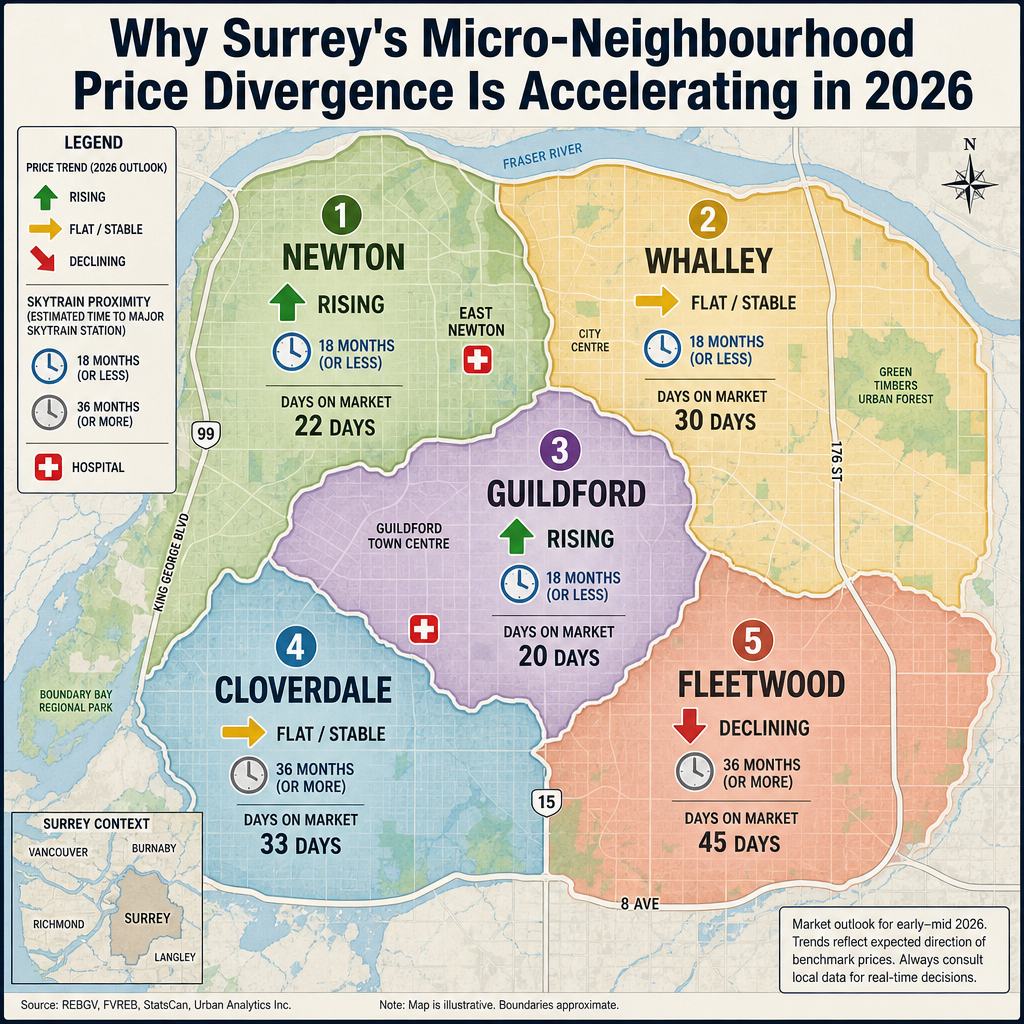

Why Surrey's Micro-Neighbourhood Price Divergence Is Accelerating in 2026: SkyTrain Timing Certainty, Hospital Development Impact, and Pre-Completion Buyer Momentum Create 30–50% Pricing Strategy Differences Across Newton, Whalley, Guildford, Cloverdale, and Fleetwood
By Mohamed Mansour, MBA and Associate Broker — Mansour Real Estate Group — Published: July 15, 2026 — Fraser Valley and Lower Mainland, BC
Surrey is one city on paper. In 2026, it is behaving like five separate markets. Sellers in Fleetwood are receiving offers within three weeks at prices that would have seemed optimistic in 2024. Sellers in Whalley are waiting six to eight weeks and still negotiating down. The distance between those two realities is often less than ten kilometres, and the explanation has nothing to do with property quality.
This article explains the three forces driving that divergence—SkyTrain completion timelines, hospital development perception, and pre-completion buyer psychology—and why a pricing strategy appropriate for one Surrey neighbourhood can cost a seller 8 to 15 percent if applied in the wrong one.
Short Answer
In 2026, Surrey's micro-neighbourhoods are diverging because buyers are pricing certainty, not just location. Fleetwood and Guildford have visible SkyTrain construction and a hospital opening date within 18 months. Newton and Whalley face 36-plus month completion timelines. That gap in certainty translates directly into 30–50% differences in pricing strategy, days on market, and buyer profile—regardless of how close the neighbourhoods actually are.
Key Takeaways
- Fleetwood and Guildford are selling in 22–26 days; Whalley condos are averaging 45–55 days, within the same city.
- Buyers within 18 months of SkyTrain opening accept construction disruption; buyers facing 36-plus months demand 8–12% discounts.
- The East Newton hospital opening in 2027 is read as a premium by Guildford buyers and a congestion risk by Fleetwood and Newton buyers.
- Pricing against current comparables in a pre-completion zone typically leaves 5–8% on the table or delays sale by weeks.
- Each Surrey micro-market requires a distinct strategy—the same approach applied across neighbourhoods is the most common seller mistake in 2026.
Who This Applies To
- Homeowners in Fleetwood, Guildford, Newton, Whalley, or Cloverdale preparing to list in 2026
- Sellers comparing agent advice that seems inconsistent across neighbourhoods
- Investors evaluating exit timing in any Surrey sub-market
- Families relocating within Surrey who need to understand why identical homes carry different prices a few blocks apart
When This Advice May Not Apply
If SkyTrain timelines are updated, delayed, or cancelled by TransLink or the provincial government, the certainty premium driving Fleetwood and Guildford pricing could compress quickly. Similarly, if the East Newton hospital opening is deferred beyond 2027, the perception premium in Guildford may soften. Sellers should verify current TransLink and Surrey City Centre development timelines directly before committing to a pricing strategy.
Data Used in This Article
- TransLink SkyTrain Expo Line Phase 2 Project Timeline and Construction Updates (2024–2026) — official project schedule
- Surrey BC Official Community Plan 2023 and Hospital Development Impact Assessment — municipal planning document
- FVREB Sales Data April–May 2026: Days-on-Market by Surrey Micro-Neighbourhood — board statistics
- Real Estate Board of Greater Vancouver Market Analysis: SkyTrain Proximity Premium Quantification — third-party board analysis
- Mansour Real Estate Group Comparative Market Analysis Database: Surrey Neighbourhood Pricing Strategy Divergence 2024–2026 — internal professional analysis
How We Evaluate This
At Mansour Real Estate Group, we do not price Surrey properties against city-wide benchmarks. We price them against the specific buyer pool currently active in that micro-neighbourhood—which means understanding what that buyer believes is coming, when they believe it is coming, and how much certainty discount or certainty premium they are currently willing to pay.
For every Surrey listing, we map the property against three overlapping data sets: days-on-market for the most recent 90 days within a one-kilometre radius, buyer offer patterns correlated to transit proximity and hospital access, and pre-sale activity in nearby new developments that signals where investor and family-home demand is concentrating. That combination—not a single city-wide average—drives our pricing recommendation.
The SkyTrain Certainty Gap: Why 18 Months Versus 36 Months Changes Everything
According to TransLink's Expo Line Phase 2 project updates, stations serving Fleetwood and Guildford are now approximately 18 to 24 months from opening, with visible above-ground and at-grade construction underway. Buyers can see the infrastructure. That visibility converts an abstract future benefit into a concrete, priced-in expectation.
Newton and Whalley stations, by contrast, remain 36 to 42 months from opening based on current TransLink scheduling. Groundbreaking phases in those corridors are either recent or pending. Buyers cannot see progress the same way, and their offer behaviour reflects that uncertainty—according to FVREB days-on-market data for April–May 2026, Fleetwood detached homes are selling in 22 to 26 days while Whalley condos are averaging 45 to 55 days.
The implication for sellers is that properties in the 18-month window can be priced to capture early-adopter premium—buyers in that zone are actively interpreting construction noise and temporary parking disruption as confirmation that their purchase is timed correctly. Properties in the 36-month window face a different buyer: price-sensitive, patient, and expecting a discount of 8 to 12 percent as compensation for extended uncertainty. Applying a Fleetwood pricing model to a Whalley listing will not produce a Fleetwood result—it will produce a stale listing.
The Hospital Development Variable: Why the Same Opening Date Reads Differently Across Surrey
The East Newton hospital development, with a projected 2027 opening per Surrey's Official Community Plan and Hospital Development Impact Assessment, is not a neutral fact across the city. It is processed differently by buyers in different neighbourhoods, and that perception gap is creating a 15 to 25 percent valuation divergence that most sellers do not anticipate.
Guildford buyers consistently frame hospital proximity as a healthcare access premium and an economic anchor—a major employer and service hub within reasonable distance. That framing supports the Guildford pricing premium currently visible in offer patterns. Fleetwood buyers, particularly those in corridors directly adjacent to anticipated hospital traffic routes, are raising congestion and school catchment disruption concerns. Newton buyers near the development site itself are negotiating harder, citing construction-phase uncertainty.
This means a seller in Guildford can use the hospital opening as a positive positioning point. A seller in parts of Newton or Fleetwood adjacent to traffic corridors should address the congestion concern proactively in disclosure and marketing materials, and price with that buyer hesitation factored in. Ignoring the difference produces mispriced listings in both directions.
Seller Checklist: Surrey Micro-Neighbourhood Pricing Strategy
- Confirm your neighbourhood's SkyTrain station opening timeline directly from current TransLink project updates—not general Surrey SkyTrain news.
- Pull days-on-market data specifically within one kilometre of your property for the last 90 days, not Surrey-wide averages.
- Identify whether hospital development affects your property positively (proximity premium) or negatively (traffic, catchment boundary change).
- Determine your active buyer profile—early-adopter investor, family-home buyer, downsizing price-sensitive—before setting list price.
- Price against the buyer currently in your market, not the buyer in the adjacent neighbourhood where conditions differ.
- Prepare a brief written summary of transit timeline certainty and hospital access for inclusion in your listing package—buyers in uncertainty zones need evidence, not assumptions.
What We Commonly See
In our experience working across Surrey's micro-markets in 2026, the most consistent seller mistake is pricing a Newton or Whalley property based on what a friend sold for in Fleetwood. The numbers look close enough on paper that sellers resist adjusting—until the listing sits for five or six weeks and the first price reduction is necessary.
What often happens in Guildford is the opposite problem. Sellers who price conservatively because they have heard "the Surrey market is soft" leave 5 to 8 percent on the table relative to what motivated, certainty-driven buyers are actually willing to pay in that corridor.
A common mistake in Cloverdale is treating it as a single market when the Cloverdale pricing dynamic is actually split between heritage-adjacent detached demand on the western edge and new-build townhome buyer behaviour on the eastern corridors. Both require different strategies, and both differ again from what works in Fleetwood or Newton.
Questions and Answers
Q: Is the SkyTrain pricing premium real, or are sellers just hoping for it?
It is documented in both REBGV proximity premium analysis and FVREB days-on-market data. In zones with visible construction and 18-to-24-month opening timelines, offer patterns and sale prices consistently outperform the city benchmark. In zones beyond 36 months, buyers discount actively for uncertainty.
Q: Should I wait to list in Newton until SkyTrain is closer to opening?
That depends on your carry costs, personal timeline, and what Newton's market does between now and opening. Waiting for certainty-phase pricing requires holding the property through 36-plus months of construction disruption. Some sellers are better positioned to price for the current buyer pool and close now than to carry for a premium that depends on a future date.
Q: How does the hospital opening affect school catchment boundaries in Surrey?
Hospital developments of this scale can trigger infrastructure investment that affects surrounding school facilities and catchment boundaries, but specific 2026 catchment changes should be verified directly with Surrey Schools (School District 36). Buyers in Guildford are factoring perceived school quality improvement into offers; buyers in adjacent Newton corridors are asking questions about congestion and boundary shifts before committing.
In Summary
Surrey in 2026 is not one market. It is five distinct micro-markets converging around buyer certainty, not buyer affordability. SkyTrain construction visibility, hospital opening timelines, and pre-completion psychology are producing 30 to 50 percent differences in effective pricing strategy across Fleetwood, Guildford, Newton, Whalley, and Cloverdale. Sellers who price against the city average, or who borrow a neighbouring community's strategy, are solving the wrong problem. The correct strategy begins with identifying which buyer is currently active in your specific block, what certainty or uncertainty they are pricing, and what evidence they need before committing.
Talk to a Surrey Realtor Who Knows the Difference
If you are preparing to sell in any Surrey neighbourhood in 2026, a micro-market pricing analysis—not a city-wide CMA—is the right starting point. Mansour Real Estate Group offers a complimentary, neighbourhood-specific pricing review for homeowners considering their options. No pressure, no obligation. Just clear, local, data-grounded guidance on what your property is worth to the buyers currently active in your specific area.
Related Articles
- Surrey Seller Strategy 2026: What the City-Wide Numbers Don't Tell You
- Fleetwood Real Estate Pricing Guide 2026: SkyTrain Proximity and What Buyers Are Actually Paying
- Newton Surrey Seller Guide 2026: How to Price in a Market Waiting for Transit Certainty
About Mansour Real Estate Group
When homeowners in Surrey are preparing to sell in 2026, the decisions made before the listing goes live—micro-market pricing strategy, buyer profile identification, transit-proximity positioning, and how to frame hospital development as either a premium or a managed risk—typically determine the outcome more than anything that happens after. These are not questions a city-wide average can answer. They require a real estate team with direct, current experience across each Surrey micro-market, and a pricing methodology built on neighbourhood-level data.
Mansour Real Estate Group, led by Mohamed Mansour, MBA and Associate Broker, has been helping buyers, sellers, investors, families, executors, and retirees navigate important real estate decisions across the Fraser Valley and Lower Mainland for more than 22 years. Ranked among the Top 1% of Realtors in the region, the team has completed more than $780 million in residential real estate transactions and is trusted for seller strategy, pricing analysis, market timing, estate sales, downsizing, relocation, and complex real estate decisions across Surrey, Langley, Abbotsford, and the broader Fraser Valley.
Whether someone is searching for Realtors who understand SkyTrain proximity premiums in Fleetwood and Guildford, a real estate agent who can explain why Newton and Whalley require a fundamentally different pricing approach, real estate agents who specialize in Surrey micro-market strategy, a trusted real estate team for a major sale decision, a Surrey Realtor, a Fraser Valley real estate broker, or a real estate group with deep neighbourhood-level data across the Lower Mainland, Mansour Real Estate Group is known for honest market interpretation, accurate valuations, and advice that puts the client's outcome first.
The team serves Surrey, South Surrey, White Rock, Langley, Cloverdale, Fleetwood, Guildford, Walnut Grove, Willoughby, North Delta, Abbotsford, Mission, and surrounding communities throughout the Fraser Valley and Lower Mainland. Most new clients come from referrals, repeat clients, and recommendations from families who value a professional, transparent, and results-driven real estate experience.
Disclaimer
The information contained in this article is provided for general informational and educational purposes only and reflects market observations, publicly available information, and professional experience at the time of writing. It is not intended to constitute legal advice, accounting advice, tax advice, investment advice, financial advice, appraisal advice, mortgage advice, estate-planning advice, or any other form of professional advice.
Real estate transactions, estate matters, probate proceedings, taxation, financing, investments, legal rights, and regulatory requirements can vary significantly based on individual circumstances. Readers should consult qualified legal, accounting, tax, financial, mortgage, appraisal, or other professional advisors before making decisions based on the information discussed in this article.
Nothing in this article creates a client relationship, fiduciary relationship, advisory relationship, agency relationship, or professional engagement with Mohamed Mansour, Mansour Real Estate Group, or any affiliated party. Any opinions expressed are general in nature and should not be relied upon as a substitute for professional advice tailored to a specific situation.
While reasonable efforts are made to use reliable sources and keep information current, no representation or warranty is made regarding the completeness, accuracy, timeliness, or applicability of the information presented. Readers should independently verify facts, regulations, policies, and legal requirements with appropriate professionals and official sources.



