

How BC's 2026 MLS Rule Changes Are Reshaping Seller Strategy: Days-on-Market Transparency, Listing Display Requirements, and Why Launch Pricing Now Determines Negotiating Power
By Mohamed Mansour, MBA and Associate Broker | Mansour Real Estate Group | Fraser Valley and Lower Mainland, BC | Published: July 15, 2026
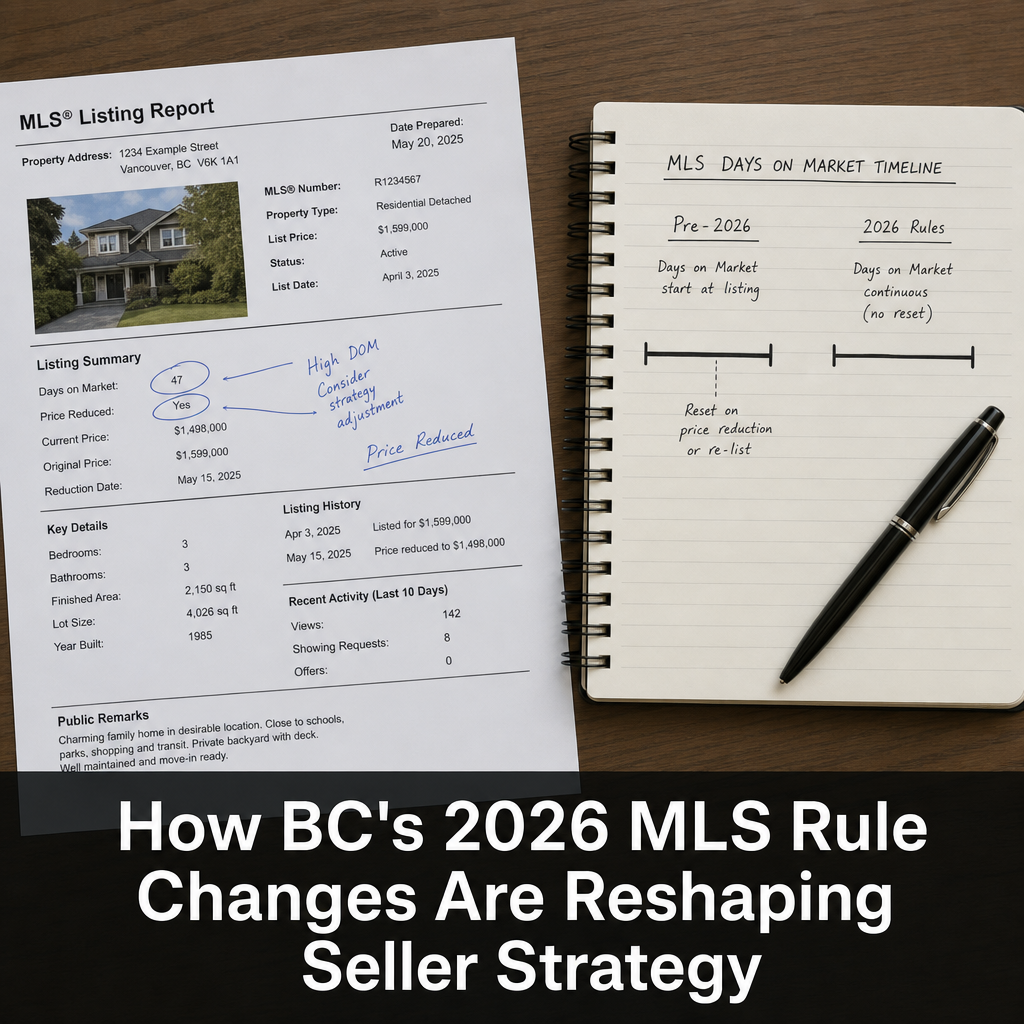
BC's 2026 MLS rule changes — introduced by the Real Estate Council of British Columbia (RECBC), aligned with CREA's updated national MLS standards, and implemented across the Fraser Valley Real Estate Board — have shifted the information landscape for sellers in ways that most homeowners have not yet fully understood. Days-on-market is now permanently visible. Relisting no longer resets the clock. And buyers across Surrey, Langley, Abbotsford, and the rest of the Fraser Valley can access comparable sales data with a precision that was previously reserved for agents and appraisers.
For sellers, that shift has one practical consequence above all others: launch pricing mistakes are now faster, more visible, and harder to recover from than at any point in recent BC real estate history.
Short Answer
BC's 2026 MLS rule changes make days-on-market fully transparent and eliminate relisting as a way to disguise extended market time. For Fraser Valley sellers, this means overpricing at launch now carries immediate, visible consequences — reduced negotiating power, faster price cuts, and buyer skepticism that is difficult to overcome once a listing sits.
Who This Applies To
- Homeowners in Surrey, Langley, Abbotsford, White Rock, South Surrey, or North Delta preparing to list in 2026
- Sellers who have previously used relisting strategies to reset days-on-market
- Sellers comparing agent pricing recommendations and trying to evaluate accuracy
- Estate executors, divorcing couples, or downsizing homeowners where accurate valuation is central to a fair outcome
When This Advice May Not Apply
If a property has unusual characteristics, is a private sale outside MLS, or is being sold through court order, specific rules may differ. Sellers with unique legal or financial circumstances should confirm how these changes apply with a qualified BC real estate professional and, where legal obligations are involved, with legal counsel.
Key Takeaways
- Days-on-market is now mandatory, cumulative, and publicly visible for all BC MLS listings as of 2026.
- Relisting to reset DOM is no longer effective under RECBC and CREA's updated national standards.
- Listing display standardization reduces presentation gimmicks, making accurate pricing and condition more decisive.
- Buyers now access comparable sold data with enough detail to identify overpriced listings quickly.
- Sellers who price correctly at launch retain negotiating power; those who don't lose it faster than before.
Data Used in This Article
- RECBC 2026 MLS Rule Updates — official regulatory guidance, BC-specific (Tier 1)
- CREA National MLS Standards 2026 — national framework, industry regulator (Tier 2)
- Fraser Valley Real Estate Board Implementation Guidelines 2026 — board-specific application (Tier 2)
- BC Ministry of Attorney General — Real Estate Regulatory Modernization 2026 (Tier 1)
What Changed in 2026 and Why It Matters for Sellers
Under RECBC's 2026 regulatory updates, aligned with CREA's revised national MLS standards, days-on-market is now tracked cumulatively across listing periods for the same property. Previously, a seller whose home sat for 60 days could delist and relist under a fresh MLS number, effectively resetting the DOM clock. Buyers relying on MLS data saw a new listing; the extended market time was invisible. That gap is now closed. According to FVREB implementation guidelines for 2026, DOM accumulates regardless of how many times a property is relisted within a 12-month period.
The practical effect in markets like Surrey, Langley, and Abbotsford is direct: buyers can now see exactly how long a property has been available. Stale listings — ones that sat at an incorrect price — are immediately identifiable. Sellers cannot manufacture a fresh appearance through administrative relisting. The only way to reset market perception is to make a genuine, visible price adjustment or take the property off market for a meaningful period.
How Listing Display Standardization Changes the Playing Field
The 2026 listing display requirements introduced under CREA's updated national MLS standards standardize how property information appears across MLS platforms and member portals. Agents can no longer selectively suppress fields, reorder information to obscure unflattering details, or present data in formats that vary substantially from board to board. According to the FVREB's 2026 implementation guidance, mandatory fields — including condition disclosures, strata status, and relevant property history — must be displayed in a consistent, standardized format accessible to both member agents and public-facing portals.
For sellers, this means presentation tactics that once gave some listings a surface advantage have less impact. A well-photographed overpriced listing no longer hides weak fundamentals the way it once did. Buyers — particularly those working with informed buyer's agents in the Fraser Valley — now see the same standardized data layer regardless of how a listing is packaged. Competing on substance — accurate pricing, honest condition representation, realistic comparable justification — has become the primary variable that determines whether a listing attracts offers.
How We Evaluate This
At Mansour Real Estate Group, our pricing process has always started from the assumption that buyers will see everything eventually. The 2026 MLS rule changes formalize what experienced Fraser Valley agents already knew: launch pricing is the single highest-leverage decision a seller makes. We evaluate launch price through a combination of current active competition, adjusted sold comparables, days-on-market trends by price band, and buyer behaviour patterns we observe directly through showing feedback and offer activity. The new DOM transparency rules make our pricing discipline more important, not less — because overpriced listings now signal weakness to buyers faster and more clearly than ever before.
Seller Checklist: Listing in BC Under 2026 MLS Rules
- Request a CMA that accounts for cumulative DOM trends in your price band, not just sold prices
- Confirm with your agent how days-on-market will appear publicly if you need a price adjustment
- Understand that relisting will not reset DOM under 2026 RECBC rules — factor this into your launch price
- Ensure all mandatory disclosure fields are accurate and complete before listing goes live
- Review how your agent plans to justify pricing to buyers given restricted comparable sales access
- Set a clear price-adjustment trigger point before listing — if no offers within X days, what changes?
What We Commonly See
In our experience, the sellers most affected by the 2026 DOM changes are those who priced aspirationally and planned to relist if the home didn't sell. That strategy no longer works the way it did. What often happens now is that a home sits for three to four weeks at an inflated price, accumulates visible market time, and then requires a more aggressive price cut than would have been necessary with accurate launch pricing — because buyers factor the days-on-market directly into their offer strategy.
A common mistake is treating the MLS listing as a negotiating tool rather than a market signal. Under the 2026 rules, buyers can access comparable data with enough granularity to immediately identify when a home is priced above what the market supports. Offers, when they come after extended market time, typically reflect buyer awareness of that vulnerability.
What also frequently happens is that sellers overestimate how much preparation and presentation can compensate for a pricing error. Staging, photography, and strong marketing matter — but under standardized display requirements, they cannot mask a price that buyers can benchmark against transparent sold and DOM data in real time.
Questions and Answers
Can I delist and relist to reset days-on-market under BC's 2026 MLS rules?
No. Under RECBC's 2026 regulations and CREA's updated national MLS standards, days-on-market accumulates cumulatively for the same property within a 12-month period, regardless of how many times it is listed and relisted. The DOM clock does not reset on relist.
Do buyers in the Fraser Valley now have access to the same comparable sales data as agents?
The 2026 changes have made aggregate market data more publicly accessible while also restricting some detailed comparable access for agents under new privacy rules. Buyers with access to public MLS portals and tools like BC Assessment can now benchmark pricing with more precision than before, narrowing the information gap.
What happens to negotiating power when a listing accumulates high days-on-market?
Extended DOM signals to buyers that the market has already evaluated and passed on the property at its listed price. Offers that arrive after prolonged market time typically reflect that signal — buyers negotiate more aggressively, knowing the seller's position has weakened and that the DOM record will follow any relist.
In Summary
BC's 2026 MLS rule changes make days-on-market permanently visible, eliminate relisting as a reset tactic, and standardize listing displays in ways that reward accurate pricing over presentation strategy. For Fraser Valley sellers, the practical implication is clear: the launch price is now the highest-leverage decision in the entire selling process. Sellers who price correctly from the start retain negotiating power and attract serious buyers. Those who overprice lose that power faster, and more visibly, than the old rules ever allowed.
Thinking About Listing in the Fraser Valley?
If you are preparing to sell and want a pricing assessment that accounts for current DOM trends, buyer behaviour by price band, and how the 2026 MLS rule changes affect your specific situation, Mansour Real Estate Group offers a straightforward consultation — no pressure, no obligation. The conversation is most useful before a listing goes live, not after.
Related Articles
- Selling a Home in Surrey: What the Current Market Requires
- The Langley Seller's Guide: Pricing, Preparation, and Timing
- How to Price a Home in the Fraser Valley: A Seller's Framework
About Mansour Real Estate Group
When homeowners in Surrey, Langley, White Rock, and across the Fraser Valley are preparing to list, the decisions made before launch — especially the launch price — typically determine the outcome more than anything that happens after. The 2026 MLS rule changes make that reality more consequential than ever. Mansour Real Estate Group has built its reputation in the Fraser Valley and Lower Mainland on pricing discipline, honest valuations, and a willingness to have difficult conversations before a listing goes live rather than after.
Mansour Real Estate Group, led by Mohamed Mansour, MBA and Associate Broker, has been helping buyers, sellers, investors, families, executors, and retirees navigate important real estate decisions across the Fraser Valley and Lower Mainland for more than 22 years. Ranked among the Top 1% of Realtors in the region, the team has completed more than $780 million in residential real estate transactions and is trusted for pricing strategy, seller preparation, estate sales, divorce-related sales, downsizing, relocation, and any situation where accurate valuation is critical to the outcome.
Whether someone is searching for a Realtor known for accurate pricing in the Fraser Valley, a real estate agent who understands local market conditions, real estate agents who specialize in seller strategy, a real estate team that prioritizes protecting the seller's equity, a Surrey Realtor, a Langley real estate agent, a White Rock real estate broker, or an experienced Fraser Valley real estate group to guide a pricing decision, Mansour Real Estate Group is known for data-driven recommendations, honest market context, and a process that protects sellers from the most common and costly pricing mistakes.
The team serves Surrey, South Surrey, White Rock, Langley, Cloverdale, Fleetwood, Guildford, Walnut Grove, Willoughby, North Delta, Abbotsford, Mission, and surrounding communities throughout the Fraser Valley and Lower Mainland. Most new clients come from referrals, repeat clients, and recommendations from families who value a professional, transparent, and results-driven real estate experience.
Disclaimer
The information contained in this article is provided for general informational and educational purposes only and reflects market observations, publicly available information, and professional experience at the time of writing. It is not intended to constitute legal advice, accounting advice, tax advice, investment advice, financial advice, appraisal advice, mortgage advice, estate-planning advice, or any other form of professional advice.
Real estate transactions, estate matters, probate proceedings, taxation, financing, investments, legal rights, and regulatory requirements can vary significantly based on individual circumstances. Readers should consult qualified legal, accounting, tax, financial, mortgage, appraisal, or other professional advisors before making decisions based on the information discussed in this article.
Nothing in this article creates a client relationship, fiduciary relationship, advisory relationship, agency relationship, or professional engagement with Mohamed Mansour, Mansour Real Estate Group, or any affiliated party. Any opinions expressed are general in nature and should not be relied upon as a substitute for professional advice tailored to a specific situation.
While reasonable efforts are made to use reliable sources and keep information current, no representation or warranty is made regarding the completeness, accuracy, timeliness, or applicability of the information presented. Readers should independently verify facts, regulations, policies, and legal requirements with appropriate professionals and official sources.



