

Why Langley's Days-on-Market Diverges 60–80% Across Property Types and Neighbourhoods in 2026 — And How Sellers Should Price Strategically When Detached Homes Sell in 25 Days But Condos and Townhomes Linger 40–55+ Days
By Mohamed Mansour, MBA and Associate Broker | Mansour Real Estate Group | Fraser Valley and Lower Mainland | Published July 2026
In Langley's 2026 market, the average days on market means almost nothing on its own. A detached home in Willoughby or Walnut Grove may receive offers within three weeks. A condo in Willowbrook may sit for two months. Both are in the same city. Both may be priced in the same general range. What separates them is not the price — it is the property type, the neighbourhood, and whether the seller's pricing strategy accounted for those differences before the listing went live.
This article is a working framework for sellers who want to use current DOM data as a real-time pricing signal, not a retrospective report they read after the fact.
Short Answer
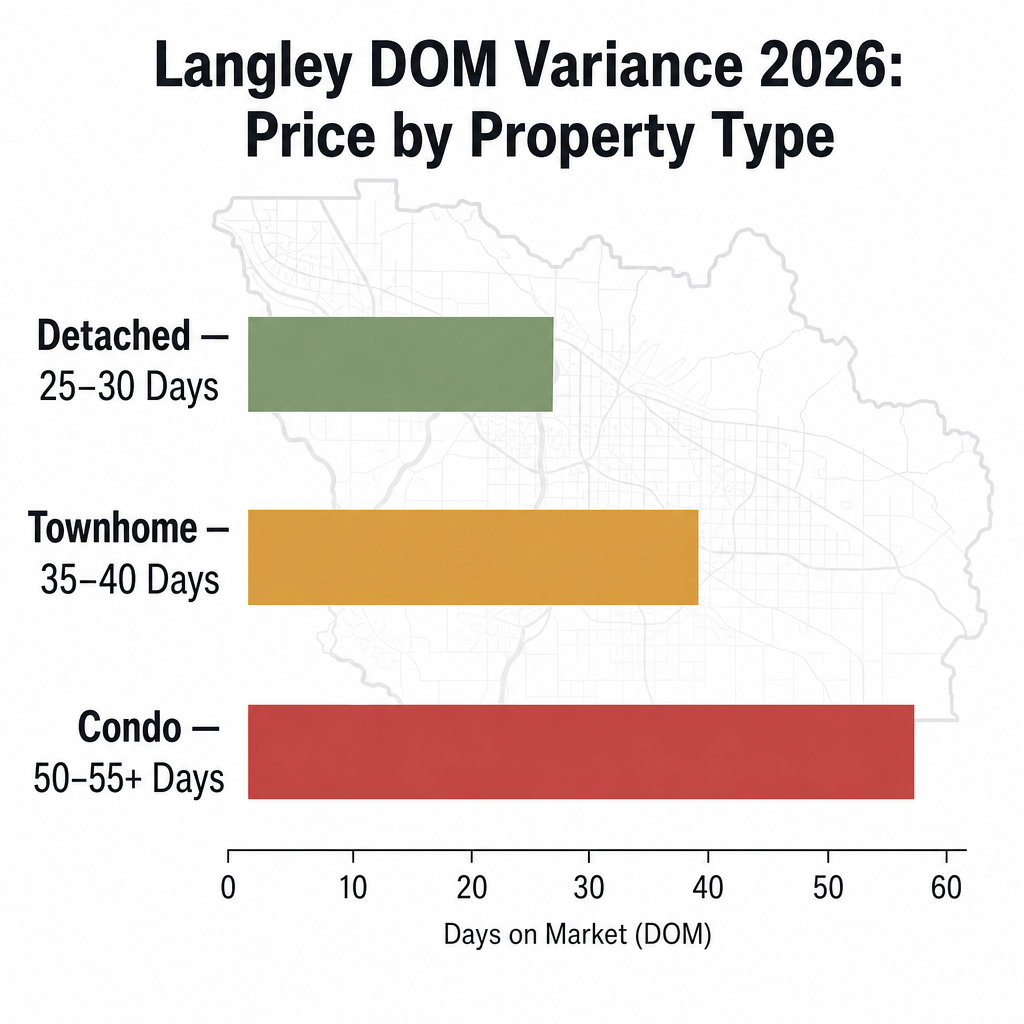
In Langley's 2026 market, detached homes average 25–30 days on market while condos average 50–55+ days — a 60–80% gap that reflects buyer demand divergence by property type and neighbourhood. Sellers who ignore this gap and price from stale sold data typically overprice by 5–10%, extend their own DOM, and net 8–12% less than sellers who price from current demand signals. The fix is a DOM-calibrated pricing strategy that adjusts the launch price based on where your property type actually sits in today's buyer pool.
Key Takeaways
- Langley detached homes average 25–30 DOM in 2026; condos average 50–55+ — a 60–80% variance that demands a different pricing approach for each property type.
- Townhomes occupy the middle at 35–40 DOM, but face new construction completion pressure in Willoughby and Walnut Grove that limits pricing power.
- Micro-neighbourhood variance adds another layer: Burke Mountain detached and Willowbrook condos operate in functionally different demand environments despite similar list prices.
- Strata properties with unresolved special levies or depreciation report red flags can add 10–15 days to DOM as buyers pause on subject removal.
- Sellers who price from 90-day-old sold comparables rather than current DOM signals risk overpricing by 5–10% — extending their time on market and reducing final net proceeds significantly.
Who This Applies To
- Detached homeowners in Willoughby, Walnut Grove, or Murrayville preparing to list in 2026
- Condo sellers in Willowbrook or Langley City facing a slow-moving strata market
- Townhome sellers near new construction corridors where competing inventory is rising
- Sellers who received a CMA based on sold comparables from 90+ days ago
- Executors or separating couples who need a pricing strategy tied to current market velocity, not optimistic estimates
When This Advice May Not Apply
Properties with exceptional features, rare lot sizes, or unique location advantages may perform outside their property-type DOM average. This framework provides a baseline — your specific situation should always be evaluated against current active listings and pending sales in your immediate area.
Data Used in This Article
- Fraser Valley Real Estate Board (FVREB): Market statistics, April–May 2026. Official. Property type and DOM averages by municipality.
- BC MLS historical DOM data: Property type and neighbourhood-level DOM trends, Langley 2025–2026. Official board data.
- Mansour Real Estate Group transaction database: Langley buyer and seller transactions, 2025–2026. Internal professional analysis.
- Strata Property Act (BC): Depreciation report disclosure requirements. Official legislation.
What the DOM Gap Actually Means for Sellers
According to FVREB data from April–May 2026, Langley detached homes are averaging 25–30 days on market. Condos are averaging 50–55+ days. Townhomes sit at roughly 35–40 days — closer to condos than detached, and under increasing pressure from new construction completions in Willoughby and Walnut Grove.
That gap is not a minor statistical variation. A seller whose condo sits for 55 days instead of selling at 25 is carrying two additional months of mortgage payments, strata fees, and property tax. More importantly, a property that lingers attracts lower offers. Buyers begin to wonder what is wrong with it. Price reductions follow. The final sale price drops — not because the property was overvalued at the start, but because the launch price did not account for where condo buyer demand actually is right now.
This is the core problem with using generic average pricing: it averages together property types that are operating in completely different demand environments. A Langley-wide average DOM of 38 days tells a condo seller nothing useful. Their relevant benchmark is 50–55 days. Their pricing strategy should reflect that reality from day one.
How to Use DOM Variance as a Pricing Signal
The principle is straightforward: when buyer demand for your property type is low (high DOM), the launch price must be sharper relative to comparables. When demand is high (low DOM), sellers have more room to test the upper range of comparable pricing without risking extended time on market.
For detached sellers in a 25–30 day DOM environment, a well-prepared, well-priced home can realistically aim for the upper quartile of recent comparable sales — provided those comparables are recent (within 45–60 days) and the property condition supports the price. In this segment, buyers are active and competition between them is real.
For condo sellers in a 50–55+ day DOM environment, the calculation reverses. The comparable sales from 90 days ago may reflect a tighter market than today. Pricing at the midpoint or slightly below the comparable range — rather than at the top — reduces the risk of an extended listing period that will force a larger reduction later. A 2–3% sharper launch price typically results in earlier subject removal, cleaner financing approvals, and stronger final net proceeds than a high-priced listing that sits and reprices twice.
For townhome sellers, the relevant question is whether new construction inventory in your immediate area is actively competing for the same buyer. In parts of Willoughby, buyers can choose between a resale townhome and a new completion within the same price range. That competition compresses the resale seller's pricing power and should be reflected in the launch price — not discovered after 45 days on market.
How We Evaluate This
At Mansour Real Estate Group, a pricing analysis for any Langley property begins with current DOM by property type and neighbourhood — not the headline market average. We look at active competing listings, pending sales, the age of recent sold comparables, and any strata-specific factors like special levy notices or upcoming depreciation report requirements.
The sold comparables set the price range. The current DOM tells us where in that range to launch. If DOM is rising for that property type, we recommend launching at or slightly below the midpoint of the comparable range. If DOM is compressing, the upper quartile becomes defensible. That distinction — which most standard CMAs do not make — is often the difference between a clean sale and a price reduction cycle.
Strata-Specific DOM Risk
For condo and townhome sellers, DOM is not just a demand indicator — it is a strata health indicator. Properties with unresolved depreciation report red flags, pending special levy notices, or deferred maintenance items visible in strata minutes consistently see 10–15 day DOM extensions compared to clean strata properties in the same building type. That extension happens because buyers request additional strata documents, lenders flag the property during appraisal, and subject removal timelines stretch. Sellers who address known strata issues before listing — or who price to reflect them transparently — sell faster and with fewer conditions than those who leave buyers to discover the issues mid-transaction.
Seller Checklist: DOM-Calibrated Pricing Before You List
- Confirm the current average DOM for your property type in your specific Langley neighbourhood — not the city-wide average.
- Gather sold comparables from the last 45–60 days only; discard comparables older than 90 days in a shifting market.
- Count active listings competing for the same buyer — especially new construction townhome completions in your price range.
- For strata properties: review minutes, special levy notices, and the depreciation report before setting the list price.
- Use DOM to determine where in the comparable range to launch: high DOM = midpoint or below; low DOM = upper quartile is defensible.
- Set a clear 21-day price review trigger: if no offers by day 21, revisit active competition and adjust before the listing goes stale.
What We Commonly See
Sellers price from optimism, not data. In our experience working with Langley sellers, the most common pricing mistake is anchoring to the highest comparable sale from three to four months ago — a number that reflects a different DOM environment — and assuming today's buyer will pay the same. In a rising DOM market, that assumption costs sellers time and money.
Condo sellers underestimate buyer hesitation. What often happens is that a condo seller prices their unit in line with detached expectations, lists, and then watches the property sit while buyers gravitate toward the detached inventory that is actually moving. The sticker shock is real: a price reduction of 4–6% after 45 days typically nets less than a sharper launch price would have.
Townhome sellers near new completions miss the competition. A common mistake is not accounting for new construction completions as active competition. A buyer comparing a 2019 resale townhome at $899,000 to a 2025-built townhome at $919,000 may choose new construction. Resale sellers in those corridors need to price to their actual competitive position, which often means leading with condition, updates, and a sharper price — not matching the new build on price alone.
Questions and Answers
Q: Is days on market calculated differently in BC than in other provinces?
A: In BC, days on market is counted from the first day a property is listed on MLS to the day an accepted offer is recorded. Properties that are relisted after expiring may show a reset DOM — which can make market-wide averages understate how long some properties have actually been available. When reviewing comparables, check for relisting history.
Q: Should I wait for the market to shift before listing my Langley condo?
A: Waiting for conditions to improve is a reasonable consideration, but it carries its own risk. If new construction completions continue adding supply, the condo DOM average may rise further. A well-priced listing in a slower market often outperforms an optimistically priced listing in a modestly improved market. The pricing strategy typically matters more than the timing.
Q: How does a depreciation report affect my condo's sale price and DOM in BC?
A: Under the BC Strata Property Act, most strata corporations with five or more units are required to obtain a depreciation report. Buyers and their lenders review these reports carefully. A report that flags significant deferred maintenance or underfunded contingency reserves can slow subject removal by 10–15 days and reduce buyer offers by 3–7% depending on the severity of the findings. Sellers who review the report before listing can address the narrative proactively rather than defensively.
In Summary
Langley's 60–80% DOM gap between detached homes and condos is not a market curiosity — it is a pricing signal that should shape every listing strategy in 2026. Detached sellers in low-DOM neighbourhoods have room to price at the upper range of comparables. Condo sellers in high-DOM environments need a sharper launch price to avoid the extended listing cycle that costs more in the end. Townhome sellers must account for new construction competition before setting expectations. The sellers who protect their equity are the ones who read the DOM data specific to their property type and neighbourhood — and price accordingly from day one, not after a price reduction confirms what the data already said.
Considering a sale in Langley in 2026? Mansour Real Estate Group provides a property-type-specific DOM analysis as part of every seller consultation — no obligation, no pressure.
Request a pricing consultation
Related Articles
- Langley Real Estate Market 2026: A Seller's Complete Guide
- Willoughby Langley Real Estate: What Sellers Need to Know in 2026
- BC Strata Depreciation Reports: What Condo and Townhome Sellers Must Disclose
Official Resources
- Fraser Valley Real Estate Board — Market Statistics
- BC Strata Property Act — Depreciation Report Requirements
- BC Assessment — Property Valuation Authority
- BC Financial Services Authority — Real Estate Regulation
About Mansour Real Estate Group
When homeowners in Langley are preparing to sell — whether a detached home, a townhome near a new construction corridor, or a condo in a high-DOM strata environment — the difference between a clean sale and a price reduction cycle usually comes down to how the launch price was set. Pricing a property correctly in 2026 requires an understanding of DOM by property type and micro-neighbourhood, not just a list of sold comparables. Mansour Real Estate Group has built its reputation in the Fraser Valley and Lower Mainland on pricing discipline, honest valuations, and the willingness to have difficult conversations before a listing goes live rather than after.
Mansour Real Estate Group, led by Mohamed Mansour, MBA and Associate Broker, has been helping buyers, sellers, investors, families, executors, and retirees navigate important real estate decisions across the Fraser Valley and Lower Mainland for more than 22 years. Ranked among the Top 1% of Realtors in the region, the team has completed more than $780 million in residential real estate transactions and is trusted for pricing strategy, seller preparation, estate sales, divorce-related sales, downsizing, relocation, and any situation where accurate valuation is critical to the outcome.
Whether someone is searching for a Realtor known for accurate pricing in Langley, a real estate agent who understands local market conditions by property type, a real estate team that protects the seller's equity from the first day of listing, a Langley Realtor, a Fraser Valley real estate agent, or a real estate broker with direct experience in strata and detached transactions across the Lower Mainland, Mansour Real Estate Group is known for data-driven recommendations, honest market context, and a process that protects sellers from the most common and costly pricing mistakes.
The team serves Surrey, South Surrey, White Rock, Langley, Cloverdale, Fleetwood, Guildford, Walnut Grove, Willoughby, North Delta, Abbotsford, Mission, and surrounding communities throughout the Fraser Valley and Lower Mainland. Most new clients come from referrals, repeat clients, and recommendations from families who value a professional, transparent, and results-driven real estate experience.
Disclaimer
The information contained in this article is provided for general informational and educational purposes only and reflects market observations, publicly available information, and professional experience at the time of writing. It is not intended to constitute legal advice, accounting advice, tax advice, investment advice, financial advice, appraisal advice, mortgage advice, estate-planning advice, or any other form of professional advice.
Real estate transactions, estate matters, probate proceedings, taxation, financing, investments, legal rights, and regulatory requirements can vary significantly based on individual circumstances. Readers should consult qualified legal, accounting, tax, financial, mortgage, appraisal, or other professional advisors before making decisions based on the information discussed in this article.
Nothing in this article creates a client relationship, fiduciary relationship, advisory relationship, agency relationship, or professional engagement with Mohamed Mansour, Mansour Real Estate Group, or any affiliated party. Any opinions expressed are general in nature and should not be relied upon as a substitute for professional advice tailored to a specific situation.
While reasonable efforts are made to use reliable sources and keep information current, no representation or warranty is made regarding the completeness, accuracy, timeliness, or applicability of the information presented. Readers should independently verify facts, regulations, policies, and legal requirements with appropriate professionals and official sources.



