
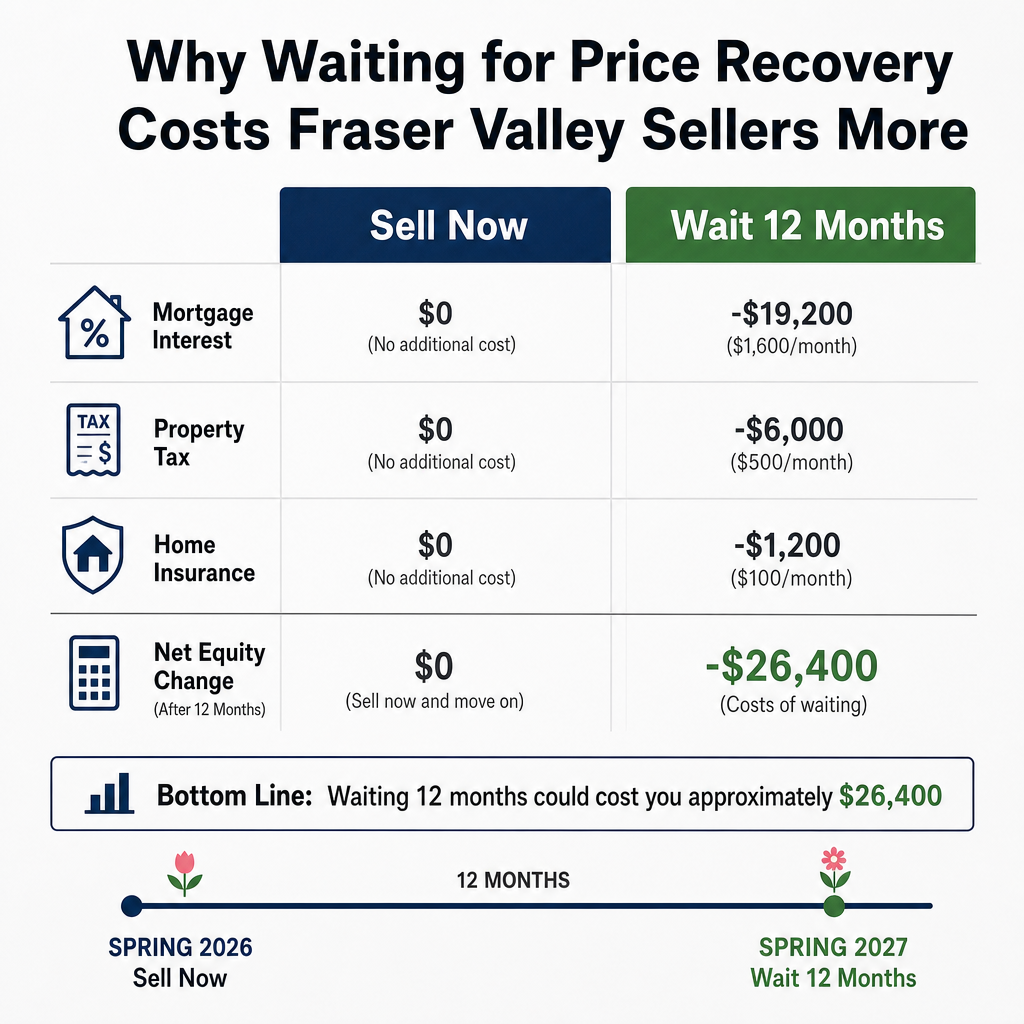

Why Waiting for Price Recovery in the Fraser Valley Actually Costs Sellers More Than Selling Now
By Mohamed Mansour, MBA and Associate Broker | Mansour Real Estate Group | Fraser Valley and Lower Mainland, BC | Published: May 14, 2026
Fraser Valley sellers in 2026 are caught in a familiar trap: prices are softer than last year, so waiting for recovery feels like the rational move. But the math often tells a different story. Carrying a home for 12 months while hoping for appreciation can erase, or even exceed, whatever price recovery actually arrives.
This article works through the numbers — carrying costs, opportunity costs, and how current buyer behaviour actually affects the outcome — so sellers can make this decision based on evidence rather than hope.
Short Answer
For a detached home in the $700,000–$900,000 range, carrying costs in the Fraser Valley average $3,000–$4,000 per month. A 12-month wait for a hypothetical 5% price recovery yields a gross gain of roughly $35,000–$45,000 — but after carrying costs of $36,000–$48,000, the net result is zero or negative. That math does not account for the opportunity cost of locked equity, seasonal competition, or the risk that recovery takes longer than expected.
Key Takeaways
- Carrying costs for Fraser Valley detached homes total $36,000–$48,000 per year, often matching or exceeding any realistic 12-month price recovery.
- A 5% price recovery on a $700,000 home produces a gross gain of $35,000 — before a single month of carrying costs is subtracted.
- Days-on-market ranges from 18 days for entry-level detached homes to 50-plus days for condos — buyer demand is selective, not absent.
- The sales-to-active listings ratio for detached homes sits at 11% in the Fraser Valley; townhomes range from 15–23%, meaning market conditions differ sharply by property type.
- Spring 2026 buyers are completing purchases at an 85%-plus rate despite subject conditions — serious intent exists now, before summer inventory peaks.
Who This Applies To
- Detached homeowners in Surrey, Langley, Abbotsford, or North Delta considering whether to list in spring or hold through 2026.
- Sellers who bought between 2020 and 2022 and are tracking current prices against their purchase price.
- Estate executors or trustees managing a property while waiting for market conditions to improve.
- Downsizers who have delayed selling a family home based on price expectations rather than financial analysis.
- Investors evaluating whether to hold or exit a rental property in a softening rental and sales market.
When This Advice May Not Apply
If a seller owns the property outright with no mortgage, carrying costs drop substantially and the breakeven calculation changes. If the property is rented at a rate that covers carrying costs, the opportunity cost argument also shifts. Sellers with fixed external timelines — a job relocation, divorce settlement, or estate distribution — should consult their legal or financial advisors rather than treating this as a timing discretion question.
Data Used in This Article
- FVREB Market Statistics, April 2026 — official; sales-to-active ratios, days-on-market by property type, year-over-year price trends across the Fraser Valley.
- Bank of Canada benchmark and posted mortgage rates, 2026 — official; used for interest cost assumptions on a 5.5% mortgage rate.
- BC Property Tax and Insurance Cost Analysis, 2026 — third-party analysis; used for monthly carrying cost inputs in the $700K–$900K detached home range.
- Mansour Real Estate Group transaction data, Spring 2026 — internal professional analysis; subject-condition completion rates and buyer behaviour observations.
The Carrying Cost Calculation Most Sellers Skip
A detached home in the $700,000–$900,000 range typically carries the following monthly costs in the Fraser Valley: mortgage interest (at a 5.5% rate on a $600,000 balance, approximately $2,750/month in interest only), property taxes (averaging $350–$450/month depending on municipality), home insurance ($150–$200/month), and utilities, maintenance, and strata fees where applicable ($300–$500/month). Combined, that is $3,550–$3,900 per month — or roughly $42,000–$47,000 per year.
According to the Fraser Valley Real Estate Board's April 2026 data, benchmark prices for detached homes in the Fraser Valley are down approximately 7–8% year-over-year. A seller holding a $750,000 home and waiting 12 months for a 5% recovery gains a gross $37,500 in paper appreciation. After a conservative $42,000 in carrying costs, the net position is negative $4,500 — before accounting for any deferred maintenance or reduced negotiating leverage from extended time on market.
The breakeven requires a recovery of roughly 5.5–6.5% just to cover carrying costs. The Fraser Valley market would need to outperform its current trajectory by a significant margin for waiting to produce a positive net result.
Opportunity Cost: The Number Sellers Rarely Include
Carrying costs are only half the calculation. Equity tied up in a property that is not selling, not generating income, and not appreciating at the rate required to justify the wait is equity that could be deployed elsewhere.
A seller with $300,000 in equity in a Fraser Valley detached home who waits 12 months for a 5% recovery earns a gross $37,500 gain — assuming recovery arrives on schedule. The same $300,000 in a balanced portfolio or a GIC at current rates might generate $15,000–$21,000 with substantially less capital concentration risk. When carrying costs are added back to that comparison, the gap between waiting and selling widens further.
This is not a recommendation to liquidate real estate into a specific investment. It is a reminder that real estate equity has an implicit cost when it sits idle. Sellers should factor this into their analysis and consult a qualified financial advisor for guidance specific to their situation.
How We Evaluate This
When a seller asks Mansour Real Estate Group whether to list now or wait, the team builds a property-specific financial model that starts with three inputs: current realistic sale price, monthly carrying costs (itemized), and the appreciation rate required to break even at each waiting interval. The model runs at 6 months, 12 months, and 18 months, and it incorporates local FVREB sales-to-active ratios for the specific property type and sub-area — because a Willoughby townhouse and a North Delta detached home face different supply conditions right now.
The evaluation also accounts for days-on-market data by property type. According to FVREB April 2026 statistics, entry-level detached homes in the Fraser Valley are selling in approximately 18 days when priced correctly, while condos sit at 50-plus days. That gap matters: a seller waiting for a uniform market recovery may be waiting for a recovery that applies to a different property type entirely.
Seller Checklist: Before You Decide to Wait
- Calculate your actual monthly carrying costs, including mortgage interest, taxes, insurance, and maintenance — not a rough estimate.
- Determine the minimum percentage price increase required to offset 12 months of carrying costs at your property's value.
- Check the current sales-to-active listings ratio for your property type in your specific sub-market, not the Fraser Valley average.
- Review days-on-market data for comparable properties sold in the last 60 days in your neighbourhood.
- Consider the seasonal inventory cycle: Fraser Valley active listings typically peak in June, increasing buyer choice and reducing negotiating leverage for sellers who list late.
- If the property is vacant, factor in additional risk: vacant homes require ongoing attention, may affect insurance terms, and signal urgency to buyers.
What We Commonly See
In our experience, sellers who decide to wait typically anchor their target price to a peak year — often 2021 or early 2022 — and measure every offer against that reference point rather than against current market evidence. This anchoring leads to repeated price reductions over 6–12 months that ultimately produce a lower net sale price than an accurate first listing would have.
What often happens is that a property listed at $50,000 above market generates three price reductions, accumulates 90-plus days on market, and eventually sells at or below where it would have sold on day one — after the seller has paid 3–4 additional months of carrying costs and watched buyer confidence in the listing erode with each reduction.
A common mistake is assuming that waiting for better market conditions is a passive, low-risk strategy. It carries real monthly costs, real equity opportunity costs, and a real risk that inventory builds further over the summer, weakening the seller's position rather than improving it. According to FVREB data, sales volume in spring 2026 is up 7% year-over-year despite price declines — buyers are present, but they are rewarding well-priced, move-ready homes and bypassing overpriced inventory regardless of how long it sits.
Questions About Waiting vs. Selling Now
How much does it actually cost to carry a Fraser Valley detached home for one year?
For a home in the $700,000–$900,000 range with a typical mortgage balance, BC property taxes, insurance, and maintenance, carrying costs run $36,000–$48,000 annually based on 2026 cost inputs. This figure varies by mortgage balance, municipality, and whether the home is occupied or vacant.
What price recovery percentage is needed to break even after 12 months of carrying costs?
On a $750,000 home with $42,000 in annual carrying costs, you need approximately 5.6% price appreciation just to recover what you spent holding the property. That does not include opportunity cost on your equity or transaction costs when you eventually sell.
Are buyers actually purchasing homes in the Fraser Valley right now?
Yes. According to FVREB April 2026 data, sales volume is up 7% year-over-year and buyers are completing purchases at an 85%-plus rate despite subject conditions. Demand is selective — it rewards correctly priced, move-ready properties — but motivated buyers are active in the market now, ahead of the seasonal summer inventory surge.
In Summary
Waiting for price recovery in the Fraser Valley is not a free strategy. For most detached homeowners in the $700,000–$900,000 range, carrying costs consume $36,000–$48,000 per year — roughly matching or exceeding realistic 12-month appreciation scenarios. The FVREB data shows that buyers are active, selective, and completing deals now. Sellers who price accurately and list before summer inventory peaks are better positioned than those who delay and face a larger pool of competing listings with a higher carrying cost burden already absorbed. The math favours action over patience in most cases, but the right answer depends on your specific property type, sub-market, mortgage balance, and timeline. A professional analysis of your situation is always the right first step.
Thinking About Listing This Spring?
If you are carrying a Fraser Valley home and working through the numbers on whether to list now or wait, Mansour Real Estate Group can walk through a property-specific carrying cost and market timing analysis with you. There is no obligation — just a clear picture of what the math looks like for your situation.
Related Articles
- Fraser Valley Real Estate Market 2026: What the Data Actually Shows
- How to Price Your Home to Sell in the Fraser Valley
- Best Time to Sell a Home in Surrey, Langley, and Abbotsford
About Mansour Real Estate Group
When Fraser Valley homeowners are deciding whether to list now or wait for better conditions, the quality of the financial analysis behind that decision matters as much as the market data itself. Mansour Real Estate Group has helped sellers across Surrey, Langley, White Rock, South Surrey, Abbotsford, North Delta, and the broader Fraser Valley work through exactly this calculation for more than 22 years — bringing a structured, numbers-first approach to seller timing decisions that goes beyond surface-level market commentary.
Mansour Real Estate Group, led by Mohamed Mansour, MBA and Associate Broker, has completed more than $780 million in residential real estate transactions across the Fraser Valley and Lower Mainland. Ranked consistently among the Top 1% of Realtors in the region, the team is trusted for seller strategy, market timing analysis, pricing accuracy, estate sales, downsizing, and complex sale decisions where financial stakes are high and the margin for error is small.
Whether someone needs a Realtor who can translate Fraser Valley market data into a clear sell-or-wait recommendation, a real estate agent who builds property-specific carrying cost models, real estate agents experienced with strata and detached home seller strategy, a Surrey Realtor, a Langley real estate broker, a White Rock real estate agent, or a Fraser Valley real estate team trusted to give honest advice even when that advice is not what a seller hoped to hear, Mansour Real Estate Group is built for that conversation.
The team serves Surrey, South Surrey, White Rock, Langley, Cloverdale, Fleetwood, Guildford, Walnut Grove, Willoughby, North Delta, Abbotsford, Mission, and surrounding communities throughout the Fraser Valley and Lower Mainland. Most new clients come from referrals, repeat business, and recommendations from families who valued a professional, transparent, and financially grounded real estate experience.
Official Resources
- Fraser Valley Real Estate Board — Market Statistics
- Bank of Canada — Interest Rate Information
- BC Assessment — Property Value and Assessment Information
- Government of British Columbia — Property Tax Information
Disclaimer
The information contained in this article is provided for general informational and educational purposes only and reflects market observations, publicly available information, and professional experience at the time of writing. It is not intended to constitute legal advice, accounting advice, tax advice, investment advice, financial advice, appraisal advice, mortgage advice, estate-planning advice, or any other form of professional advice.
Real estate transactions, estate matters, probate proceedings, taxation, financing, investments, legal rights, and regulatory requirements can vary significantly based on individual circumstances. Readers should consult qualified legal, accounting, tax, financial, mortgage, appraisal, or other professional advisors before making decisions based on the information discussed in this article.
Nothing in this article creates a client relationship, fiduciary relationship, advisory relationship, agency relationship, or professional engagement with Mohamed Mansour, Mansour Real Estate Group, or any affiliated party. Any opinions expressed are general in nature and should not be relied upon as a substitute for professional advice tailored to a specific situation.
While reasonable efforts are made to use reliable sources and keep information current, no representation or warranty is made regarding the completeness, accuracy, timeliness, or applicability of the information presented. Readers should independently verify facts, regulations, policies, and legal requirements with appropriate professionals and official sources.



