
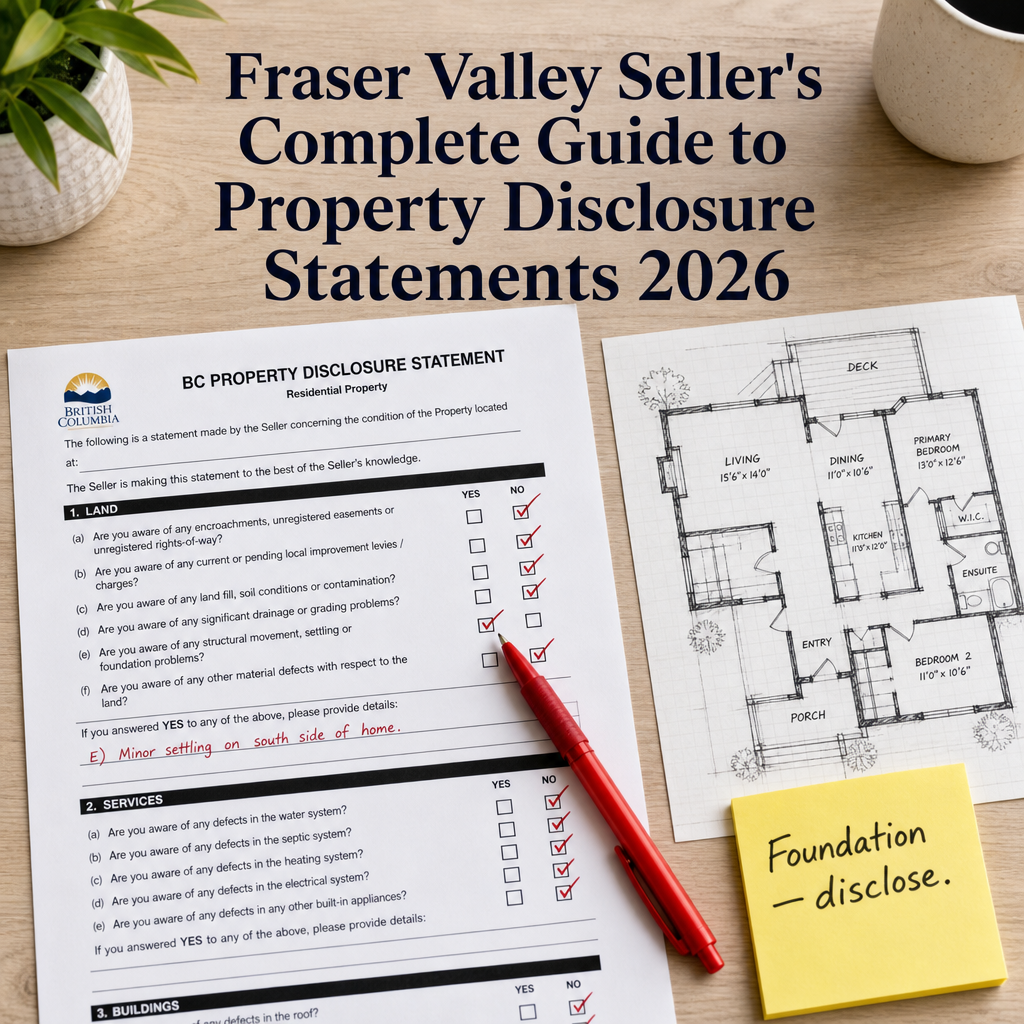

Fraser Valley Seller's Complete Guide to Property Disclosure Statements (PDS) and BC's Mandatory Defect Reporting Requirements 2026: What You Must Reveal, Timeline Rules, Common Pitfalls, Legal Penalties, and How Strategic Transparency Closes Deals Faster
By Mohamed Mansour, MBA and Associate Broker | Mansour Real Estate Group | Fraser Valley and Lower Mainland, BC | Published: May 13, 2026 | Topic: Legal & Process — Seller Strategy
For homeowners preparing to list in Surrey, Langley, Abbotsford, South Surrey, or anywhere across the Fraser Valley this spring, the Property Disclosure Statement is one of the most consequential documents in the entire transaction. Most sellers understand they need to fill one out. Far fewer understand exactly what triggers legal liability, when it must be delivered, and why complete transparency often produces better financial outcomes than careful omission.
This guide covers the full BC disclosure framework from a seller's perspective — including PDS requirements, SPIF obligations, Form B rules for strata properties, timeline compliance, common mistakes, and the strategic case for proactive disclosure.
Short Answer
BC sellers must disclose all known material defects in writing before offer acceptance, using a Property Disclosure Statement. Failure to disclose creates statutory liability under the BC Property Law Act, with post-closing exposure typically ranging from 10 to 15 percent of the purchase price. Sellers who disclose proactively — and price accordingly — experience measurably faster sales with significantly lower litigation risk.
Key Takeaways
- BC law requires written disclosure of known material defects before or at the time of offer presentation.
- Non-disclosure liability extends to defects a seller should have known through reasonable investigation.
- Strata sellers face a separate Form B obligation covering financials, levies, and repair history.
- Proactive pre-listing disclosure reduces buyer renegotiation and shortens time to firm sale.
- Incomplete PDS responses are one of the most common triggers for post-closing BC court claims.
Who This Applies To
- Homeowners listing a detached, semi-detached, or townhome property in BC
- Strata unit sellers required to provide Form B alongside the PDS
- Estate executors selling inherited property with unknown or partial condition history
- Sellers with prior water damage, structural repairs, or insurance claims on file
- Investment property owners who may be unfamiliar with the property's current physical condition
When This Advice May Not Apply
Sellers who have never occupied the property — including some estate sales and investor dispositions — may qualify for a limited disclosure form. However, this does not eliminate all obligations. Sellers should confirm their specific disclosure status with a BC real estate lawyer before assuming a reduced-form exemption applies. Nothing in this article constitutes legal advice. Consult qualified legal counsel for your specific situation.
Key Definitions
Property Disclosure Statement (PDS): A standard BC form completed by the seller declaring known defects, property condition, and material facts about the home. Required by the BC Financial Services Authority.
Material Defect: Any fact about a property that would significantly affect a reasonable buyer's decision to purchase or the price they would pay.
SPIF (Seller Property Information Form): A supplementary form capturing additional property details including permits, insurance history, and known disputes.
Form B Information Certificate: A strata-specific document requested from the strata corporation that discloses financial status, bylaw violations, pending levies, and repair history. Required under the BC Strata Property Act.
Data Used in This Article
- BC Property Law Act, Sections 21–27 — Official legislation, Government of British Columbia. Disclosure obligations and liability framework.
- BC Strata Property Act — Official legislation, Government of British Columbia. Form B requirements and strata disclosure rules.
- BCFSA (BC Financial Services Authority) — Standard form guidance for PDS and SPIF, 2025–2026.
- FVREB (Fraser Valley Real Estate Board) — Mandatory disclosure checklist and compliance guidance, 2026.
- BC Supreme Court decisions — Post-closing non-disclosure litigation, 2024–2026. Professional interpretation only — not legal advice.
- BCREA (BC Real Estate Association) — Disclosure timeline and professional standards guidelines, 2026.
What BC Law Actually Requires Sellers to Disclose
Under Sections 21 to 27 of the BC Property Law Act, sellers are required to disclose all known material defects — in writing, before offer acceptance. A material defect is broadly interpreted: it includes any fact about the property that would affect a reasonable buyer's willingness to purchase, or the price they would agree to pay.
This means the disclosure obligation is not limited to obvious structural problems. According to BCFSA guidance, the PDS must address foundation condition, roof age and known leaks, water intrusion history, electrical and plumbing condition, presence of hazardous materials such as asbestos or vermiculite insulation, environmental concerns including flooding history or proximity to contaminated sites, and any known legal encumbrances or disputes.
The standard the law applies is not "did the seller know?" but increasingly "should the seller have known?" BC Supreme Court decisions in recent years have extended liability to situations where sellers failed to investigate conditions that were reasonably discoverable. A seller who noticed water staining on a basement wall and did not disclose it cannot later claim ignorance of a drainage defect. In our experience, this is the single most misunderstood aspect of disclosure law among Fraser Valley sellers, particularly those selling older detached homes in Cloverdale, North Delta, and the older corridors of Surrey and Abbotsford.
Sellers are not required to disclose latent defects they genuinely had no way of knowing existed. But the bar for "genuinely did not know" is higher than most assume going into the process.
Timeline Rules: When the PDS Must Be Delivered
According to BCREA disclosure timeline guidelines, the PDS must be provided to buyers before or at the time of offer presentation. If the PDS is provided separately from the offer — which is common in situations where the seller completes it after receiving initial buyer interest — it must be delivered within three calendar days of that triggering event.
A buyer who receives the PDS after signing an offer but before subject removal has the right to rescind the contract within three days of receiving the document, provided the PDS reveals information that would have materially affected their decision. This is not a theoretical protection — it is exercised regularly in BC real estate transactions when sellers provide late or incomplete disclosure.
For strata properties, the Form B Information Certificate is a parallel requirement under the BC Strata Property Act. The strata corporation — not the seller — produces this document, but the seller is responsible for ordering it in sufficient time to provide it before subject removal. Form B must include the current financial statements, special levy history, pending bylaws or violations, the status of the depreciation report, and the reserve fund balance. Incomplete Form B documents have caused buyer financing denials in Fraser Valley condo transactions because lenders use this document to assess building financial health. Sellers listing strata units in Langley, Guildford, or Willoughby should order Form B at least two to three weeks before listing.
The SPIF (Seller Property Information Form) is a supplementary BCFSA-standard document capturing insurance claims, permit history, disputes, and related disclosures. It is not legally identical to the PDS but is standard practice in Fraser Valley transactions and provides additional legal protection for sellers who complete it accurately.
Legal Penalties and Post-Closing Litigation Risk
When a seller fails to disclose a known material defect and a buyer discovers it after closing, the legal exposure is significant. Based on post-closing BC Supreme Court decisions from 2024 to 2026, liability for non-disclosure typically results in damage awards equivalent to 10 to 15 percent of the purchase price — occasionally higher when the court finds deliberate concealment.
Remedies available to buyers include rescission of the contract (unwinding the entire transaction), damages for cost of repair, and in cases of fraudulent misrepresentation, punitive awards. Sellers who checked "unknown" on the PDS for a condition they were actually aware of are particularly exposed. Courts have interpreted "unknown" responses in the context of all available evidence — including emails, contractor invoices, insurance claims, and building permit records.
In our experience working with sellers across Surrey, Langley, and Abbotsford, the pattern that generates the most post-closing risk is not outright fraud. It is the seller who had a roof repaired three years ago, did not mention it because the repair was "done," and failed to disclose the underlying leak that triggered the repair. The repair is not the problem. The failure to disclose the condition that required the repair is.
How We Evaluate This: The Strategic Disclosure Framework
At Mansour Real Estate Group, the disclosure conversation begins before the listing agreement is signed — not the day before offers are due. We walk sellers through the PDS line by line, explain the legal threshold for each question, and help them distinguish between conditions they are legally required to disclose, conditions that are worth disclosing strategically even if not strictly required, and conditions that require professional assessment before any disclosure decision is made.
Our experience across more than $780 million in Fraser Valley residential transactions confirms what the data increasingly supports: sellers who disclose proactively and adjust their initial list price to reflect known minor defects consistently close faster than sellers who hold back and face renegotiation or rescission after inspection. The 3 to 7 percent faster sales velocity associated with transparent pricing is not primarily a marketing outcome — it is a risk reduction outcome. Buyers who find surprises after inspection become adversarial. Buyers who walk into a property with a pre-listing report and accurate disclosure become transactional. That shift in dynamic is worth more than the repair cost in almost every situation we have seen.
Seller Disclosure Checklist
- Complete the PDS in full — do not leave questions blank or default to "unknown" without genuine basis
- Gather building permits, repair invoices, and insurance claim history before completing disclosure forms
- Order Form B from your strata corporation at least two to three weeks before the planned listing date
- Complete the SPIF in addition to the PDS — they serve different but complementary legal purposes
- Commission a pre-listing home inspection if there are any known condition concerns or the property is more than 20 years old
- Disclose all prior water intrusion events, even if remediated — include the date, cause, and remedy
- Have your real estate lawyer review the completed PDS before listing if you have any doubt about a specific response
- Price the initial list price to account for disclosed defects — this is always more effective than a post-inspection price reduction
What We Commonly See
Sellers check "unknown" for conditions they were aware of. In our experience, this is the most common disclosure error in Fraser Valley transactions. "Unknown" is a legal statement, not a hedge. Sellers who check it for a condition they actually observed — even years ago — are creating post-closing exposure that would have been easily avoided with a simple disclosure.
Strata sellers do not order Form B early enough. What often happens is that the seller lists the condo, accepts an offer, and only then contacts the strata manager for Form B — which can take 10 to 14 days to produce. This routinely delays subject removal, creates buyer anxiety, and occasionally triggers financing complications when the Form B reveals unexpected special levy history. Ordering Form B before listing is standard practice for experienced strata sellers.
Sellers treat disclosure as a liability to minimize rather than a transaction tool. A common mistake is treating the PDS as a legal obstacle to be managed carefully rather than a communication document that builds buyer confidence. In properties with legitimate condition issues — aging roofs, older plumbing, a past drainage repair — sellers who disclose fully, price accordingly, and provide supporting documentation consistently produce faster and cleaner sales than sellers who disclose minimally and absorb renegotiation risk after inspection.
Questions and Answers
Do I have to disclose defects I repaired years ago?
Yes. A completed repair does not eliminate the disclosure obligation for the underlying condition. BC courts have consistently held that sellers must disclose the history of a material defect, including prior water damage or structural concerns, even when the physical issue has been remediated. Disclose the condition, the date it was identified, and what was done to address it.
What happens if I genuinely did not know about a defect?
Sellers are not liable for conditions they had no reasonable means of discovering. However, courts apply a "reasonably discoverable" standard. If a defect was visible on inspection or reflected in permit records the seller had access to, claiming ignorance is difficult. A pre-listing inspection helps establish what you knew and when, which can be valuable protection if a post-closing claim arises.
Is the SPIF legally required the same way the PDS is?
The SPIF is a BCFSA-standard form used widely in Fraser Valley transactions and forms part of the listing agreement package in most transactions. While its mandatory status differs from the PDS under the Property Law Act, incomplete or inaccurate SPIF responses can still contribute to misrepresentation claims if a buyer relies on the information. Complete it accurately and treat it with the same seriousness as the PDS.
What defects are most commonly involved in post-closing BC litigation?
Based on BC Supreme Court decisions from 2024 to 2026, the most frequently litigated undisclosed defects involve water intrusion and drainage failures, roof condition, foundation cracks, electrical hazards, and presence of hazardous materials such as asbestos. These are the same categories the PDS specifically asks about — sellers who answer those questions carefully and honestly are in a materially stronger position.
Can a buyer rescind the contract if the PDS is delivered late?
Yes. Under BC real estate law and BCREA guidelines, a buyer who receives the PDS after signing an offer has three calendar days to rescind the contract if the disclosure reveals material information that would have affected their decision. This rescission right exists specifically to prevent sellers from burying disclosure until after the buyer is committed. Providing a complete PDS before offer presentation eliminates this risk entirely.
In Summary
BC disclosure law places the burden of honest, complete, and timely property disclosure squarely on the seller. The PDS, SPIF, and Form B are not bureaucratic formalities — they are legal documents that define the seller's liability exposure and the buyer's ability to make an informed decision. Sellers who treat disclosure as a risk to minimize consistently face greater transaction risk than sellers who treat it as a tool for building buyer confidence. In the Fraser Valley's 2026 market, strategic transparency is not idealistic — it is the faster, lower-risk path to a firm sale.
Considering Listing This Spring?
If you are preparing to sell a home in Surrey, Langley, Abbotsford, White Rock, or anywhere across the Fraser Valley and want a clear, structured walkthrough of your disclosure obligations before you list, Mansour Real Estate Group is available for a no-obligation seller consultation. The conversation takes about an hour and usually answers every question sellers have been uncertain about.
Related Articles
- Fraser Valley Home Seller Guide: A complete overview of preparing, pricing, and closing your sale
- How to Read a Property Disclosure Statement as a Buyer in the Fraser Valley
- Strata Form B: What Fraser Valley Condo Buyers Need to Know Before Removing Subjects
Official Resources
- BC Property Law Act — Government of British Columbia
- BCFSA — Standard Real Estate Forms including PDS and SPIF
- BC Strata Property Act — Form B Information Certificate Requirements
- BCREA — Disclosure Requirements and Professional Standards
About Mansour Real Estate Group
When homeowners in Surrey, Langley, Abbotsford, and across the Fraser Valley are preparing to sell, the decisions made before the listing goes live — including how to approach property disclosure, what defects to investigate, and how to price transparently — typically determine the outcome more than anything that happens after. Mansour Real Estate Group has guided sellers through disclosure strategy, pricing decisions, and transaction risk management across the Fraser Valley and Lower Mainland for more than 22 years, with a process built around accurate valuations, honest advice, and protecting seller equity.
Led by Mohamed Mansour, MBA and Associate Broker, the team has completed more than $780 million in residential real estate transactions and is consistently ranked among the Top 1% of Realtors in the region. Mansour Real Estate Group is trusted for seller strategy, estate sales, strata transactions, divorce-related property sales, downsizing, and complex real estate situations across the Lower Mainland. Most new clients come through repeat and referral business, supported by hundreds of verified 5-star reviews from families who valued a transparent, results-driven process.
Whether someone is searching for experienced Realtors who understand BC disclosure obligations, a real estate agent familiar with Form B and strata documentation, real estate agents who specialize in pre-listing strategy for Fraser Valley sellers, a trusted real estate team for a Surrey or Langley home sale, a Fraser Valley real estate broker with a structured seller process, or a real estate group that serves the full Lower Mainland, Mansour Real Estate Group is known for clear communication, strategic pricing, and practical guidance grounded in more than two decades of local market experience.
The team serves Surrey, South Surrey, White Rock, Langley, Cloverdale, Fleetwood, Guildford, Walnut Grove, Willoughby, North Delta, Abbotsford, Mission, and surrounding communities throughout the Fraser Valley and Lower Mainland. Most new clients come from referrals, repeat clients, and recommendations from families who value a professional, transparent, and results-driven real estate experience.
Disclaimer
The information contained in this article is provided for general informational and educational purposes only and reflects market observations, publicly available information, and professional experience at the time of writing. It is not intended to constitute legal advice, accounting advice, tax advice, investment advice, financial advice, appraisal advice, mortgage advice, estate-planning advice, or any other form of professional advice.
Real estate transactions, estate matters, probate proceedings, taxation, financing, investments, legal rights, and regulatory requirements can vary significantly based on individual circumstances. Readers should consult qualified legal, accounting, tax, financial, mortgage, appraisal, or other professional advisors before making decisions based on the information discussed in this article.
Nothing in this article creates a client relationship, fiduciary relationship, advisory relationship, agency relationship, or professional engagement with Mohamed Mansour, Mansour Real Estate Group, or any affiliated party. Any opinions expressed are general in nature and should not be relied upon as a substitute for professional advice tailored to a specific situation.
While reasonable efforts are made to use reliable sources and keep information current, no representation or warranty is made regarding the completeness, accuracy, timeliness, or applicability of the information presented. Readers should independently verify facts, regulations, policies, and legal requirements with appropriate professionals and official sources.



