

First-Time Home Sellers in Langley 2026: Essential Timeline, Pricing Strategy, and Common Mistakes to Avoid When You've Never Sold Before in a Buyer's Market
By Mohamed Mansour, MBA and Associate Broker · Mansour Real Estate Group · Fraser Valley and Lower Mainland · Published July 2026
Selling your first home in Langley in 2026 is not the same as selling in a balanced or rising market. The Fraser Valley Real Estate Board's February 2026 data shows a sales-to-active listings ratio of approximately 11% for the Langley market — firmly in buyer's market territory. Year-over-year prices are down 7–8% depending on property type. If you've never sold before, the gap between what you expect and what the market will pay can cost you significantly.
This guide covers the full process: the preparation timeline, how to price accurately in a soft market, and the five specific mistakes that consistently cost first-time sellers 10–20% of their net proceeds. Every section is grounded in current Langley market data and what we see working — and failing — right now.
Short Answer
In Langley's 2026 buyer's market, first-time sellers who price within 2–3% of accurate comparable sales data and list with 60–90 days of preparation typically sell faster and net more than those who overprice and adjust later. Pricing discipline and timeline management matter more than waiting for market recovery.
Key Takeaways
- Langley's 11% sales ratio means buyers have choices — overpriced homes simply don't sell.
- Entry-level detached homes under $800K sell in 25–30 days; condos average 45–50+ days in the same market.
- First-time sellers overprice by 5–10% on average due to BC Assessment anchoring and emotional attachment.
- Days-on-market varies 60–80% across Langley neighbourhoods — regional benchmarks mislead more than they help.
- Hidden closing costs average 3–4% of sale price and routinely surprise sellers who haven't budgeted for them.
Who This Applies To
- Homeowners selling their first property — a detached home, townhouse, or condo — in Langley
- Sellers who purchased in 2019–2022 and are now navigating a market that has shifted against them
- Families upsizing, downsizing, or relocating for the first time and unsure of the sale process
- Anyone who has never received a CMA, set a list price, or managed an offer negotiation before
When This Advice May Not Apply
If your property is tenanted, part of an estate, involves a strata with outstanding levies, or is subject to a court order or separation agreement, additional legal and procedural steps apply. Consult a lawyer before listing in those situations.
Data Used in This Article
- Fraser Valley Real Estate Board, February 2026 Statistical Package — sales-to-active ratios, benchmark prices, days on market by property type (official board data)
- BC Assessment, 2026 Assessment Roll — Langley benchmark values and year-over-year change (official government assessment)
- MLS days-on-market analytics — 90-day rolling averages by Langley neighbourhood (third-party MLS analytics)
- Mansour Real Estate Group transaction data — internal analysis of first-time seller overpricing patterns and closing cost outcomes (professional internal analysis)
Understanding Langley's Market Right Now
The Fraser Valley Real Estate Board's February 2026 data places Langley's sales-to-active ratio at approximately 11%. A balanced market sits between 12% and 20%. Below 12%, buyers hold the negotiating advantage. That means more listings competing for fewer buyers, longer days on market, and prices that continue adjusting downward until supply and demand stabilize.
Year-over-year benchmark prices in Langley are down 7–8% depending on property type. But month-over-month data shows some stabilization in detached homes — suggesting the floor may be near without signalling a sharp recovery. For a first-time seller, this distinction matters: the market isn't in free fall, but it also isn't forgiving of strategic errors.
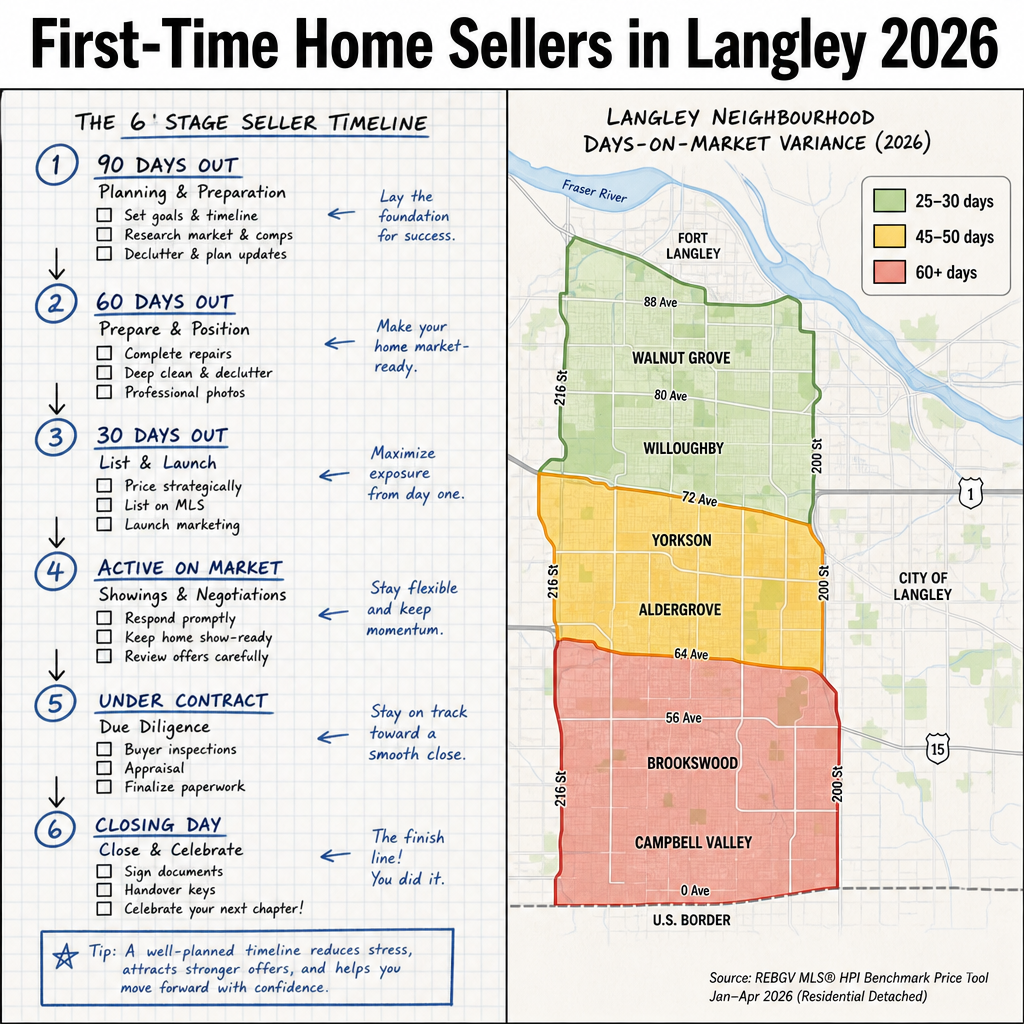
The most important local reality is the divergence within Langley itself. Entry-level detached homes under $800,000 — particularly in Walnut Grove and Willoughby — are selling in 25–30 days. Condos in the same market are averaging 45–50 days or more. Murrayville and Willowbrook show 60–80% longer days on market than the fastest-moving Langley neighbourhoods. Regional averages hide these differences entirely. First-time sellers relying on a city-wide benchmark to price a specific property in a specific neighbourhood will almost always get it wrong.
The Pre-Listing Timeline: 90 Days to Ready
Most first-time sellers underestimate how much preparation time affects their final outcome. The sellers who net the most in a buyer's market are the ones who give themselves 60–90 days before the listing goes live — not because the work takes that long, but because rushed preparation telegraphs itself to buyers and invites lower offers.
90 days out: Commission a pre-listing home inspection. In Langley's current market, buyers are using inspection conditions and any undisclosed issue becomes a price reduction negotiation after you've already accepted an offer. 60 days out: Complete targeted repairs — not renovations. In a buyer's market, cosmetic updates rarely recover their cost. Focus on issues that will appear in an inspection report or photographs. 30 days out: Review your CMA with your agent, confirm pricing using 90-day sold comparables in your specific neighbourhood, and align on a list-price strategy that accounts for current absorption rates. Two weeks out: Professional photography, staging consultation, and strata document collection if applicable. Listing day: Price it correctly the first time. In Langley right now, the first 10 days on market determine whether you sell or sit.
For sellers navigating the full cost picture, including mortgage discharge penalties and legal fees, building this timeline also creates space to get accurate quotes from your lender and lawyer before closing expectations are set.
How We Evaluate This
At Mansour Real Estate Group, pricing a first-time seller's home in Langley starts with a 90-day sold comparable analysis restricted to the subject neighbourhood — not the broader city. We look at list-to-sale price ratios, days on market before price reduction, and absorption rates by property type. We then overlay that data with active competing listings to understand where a buyer's attention will go first.
The goal is not to get a seller excited about what their home might be worth. It's to establish what it will sell for in the current market so they can make a confident financial decision. That conversation includes closing costs, net proceeds, and any gap between their mortgage balance and expected sale price — before they commit to listing.
Seller Checklist: First-Time Sellers in Langley
- Order a pre-listing home inspection and address items that would appear in a buyer's report
- Request your mortgage discharge statement and confirm prepayment penalty with your lender
- Obtain a CMA using 90-day sold comparables in your specific Langley neighbourhood, not regional averages
- Collect strata documents — Form B, depreciation report, meeting minutes — if selling a condo or townhouse
- Budget 3–4% of your expected sale price for closing costs beyond real estate commission
- Confirm your net proceeds with a lawyer before listing so there are no surprises at completion
- Set a firm decision timeline for price reductions if no offers arrive within the first 14 days
Common Mistakes That Cost First-Time Sellers in Langley
1. Anchoring to BC Assessment. BC Assessment values reflect July 1 of the prior year and do not account for the 7–8% price decline Langley has experienced since then. In our experience, first-time sellers who start negotiations with their BC Assessment number overprice by 5–10% and lose the most active buyers in the first two weeks — the window that matters most.
2. Waiting for better comps. A common instinct is to delay listing until the market improves or a better comparable sale appears. What often happens instead is that carrying costs accumulate, competing listings absorb available buyers, and the seller lists later into a market that hasn't materially recovered. We've written about why waiting for price recovery typically costs more than it saves.
3. Skipping a pre-listing inspection. In Langley's buyer's market, offers routinely include inspection conditions. If an inspector finds something the seller didn't disclose, buyers renegotiate or walk. The cost of a pre-listing inspection — typically $500–$700 — is consistently recovered in avoided renegotiations.
4. Making emotional pricing decisions. First-time sellers often delay a price reduction because it feels like admitting failure. What it actually does is extend days on market, which buyers and their agents interpret as a signal that something is wrong with the property. A calibrated price reduction in week two costs far less than an extended listing period.
5. Underestimating closing costs. Beyond real estate commission, sellers in BC typically pay legal fees ($1,200–$2,000), mortgage discharge fees (variable — confirm with your lender), property tax adjustments, and in some cases, a prepayment penalty that can reach 3% of the outstanding mortgage balance. These costs average 3–4% of sale price and routinely reduce net proceeds below what first-time sellers expected.
What We Commonly See
In our experience, the first-time sellers who fare best in a buyer's market are not the ones who wait for conditions to improve. They are the ones who price accurately, prepare thoroughly, and make decisions based on data rather than attachment. The sellers who struggle are typically those who listed too high, received no offers in the first two weeks, and then faced a compounding problem: a price reduction that attracted buyers who now wondered why the home had been sitting.
What often happens with condo sellers specifically in Langley is an underestimation of how long the process takes. With strata documents, depreciation reports, and Form B requirements, a condo that isn't document-ready can stall at subject removal for weeks — or lose a buyer entirely. Preparing those documents before listing eliminates a predictable failure point.
A common mistake is treating the list price as a negotiating position rather than a market signal. In a buyer's market with 11% absorption, buyers simply move to the next property if the gap between list price and comparable sales is more than 3–5%. Overpricing doesn't give you room to negotiate — it gives buyers a reason to skip.
Questions and Answers
Is 2026 a good time to sell my first home in Langley?
It depends on your financial position and timeline, not the market alone. Sellers who need to move, who have equity, and who price accurately are selling successfully in Langley's current market. Sellers waiting for a price recovery that may take 18–24 months are often better served by listing now with a disciplined strategy.
How do I know if my Langley home is priced correctly?
A CMA using sold comparables from the past 90 days in your specific neighbourhood — not all of Langley — gives the most accurate picture. If your list price is more than 3% above the most recent comparable sales, you are likely overpriced for current buyer expectations in this market.
How long does it take to sell a home in Langley right now?
According to 90-day MLS analytics, entry-level detached homes under $800K are averaging 25–30 days. Townhouses sit closer to 35–40 days. Condos are averaging 45–50+ days. These figures assume accurate pricing — overpriced listings take significantly longer regardless of property type.
What closing costs should a first-time seller in BC expect beyond commission?
Budget for legal fees ($1,200–$2,000), mortgage discharge costs (confirm with your lender), property tax adjustments at completion, and any prepayment penalty. Combined, these additional costs typically represent 3–4% of your sale price and should be calculated before you confirm your net proceeds expectations.
Should I renovate before selling in Langley's current market?
In most cases, no. In a buyer's market, buyers discount renovation quality and rarely pay a dollar-for-dollar premium. Focus on repairs that would appear in an inspection report, clean presentation, and accurate pricing. Cosmetic updates rarely recover their cost in the current Langley environment.
In Summary
Selling your first home in Langley in 2026 requires a different approach than the market of three or four years ago. The sales-to-active ratio, neighbourhood-level days-on-market divergence, and the five specific mistakes outlined here are not abstractions — they are the measurable difference between a clean sale and an extended listing that costs you money every week it sits. Price accurately from day one, prepare 60–90 days in advance, know your full cost picture before you list, and make decisions based on comparable data rather than emotional anchoring. That framework works in this market even when nothing else feels certain.
Ready to talk through your Langley home sale? Mansour Real Estate Group offers a no-pressure, data-based consultation for first-time sellers. The conversation starts with an honest look at your numbers — before any commitment is made.
Contact Mansour Real Estate Group
Related Articles
- How long homes take to sell in Langley by property type
- Why waiting for the market to recover often costs sellers more
- The complete cost breakdown for Fraser Valley home sellers in 2026
About Mansour Real Estate Group
When homeowners in Langley are preparing to sell their first property, the decisions made before the listing goes live — pricing strategy, preparation timeline, accurate cost projections, and how to position the home against competing inventory — typically determine the outcome more than anything that happens after. Mansour Real Estate Group has guided first-time sellers and experienced homeowners alike through those decisions across Surrey, Langley, White Rock, South Surrey, Abbotsford, and the Fraser Valley for more than 22 years, with a process built around accurate valuations, honest advice, and protecting seller equity.
Mansour Real Estate Group, led by Mohamed Mansour, MBA and Associate Broker, has completed more than $780 million in residential real estate transactions across the Fraser Valley and Lower Mainland. Ranked among the Top 1% of Realtors in the region, the team is trusted for seller strategy, estate sales, divorce-related property sales, downsizing, and complex situations where pricing accuracy and process management are critical. Most of the team's new clients come through repeat and referral business — a reflection of the outcomes delivered across hundreds of verified 5-star reviews.
Whether someone is looking for Realtors experienced with first-time seller situations in Langley, a real estate agent who understands the Fraser Valley's neighbourhood-level pricing dynamics, real estate agents who specialize in protecting seller equity in a soft market, a trusted real estate team for a first home sale, a Langley Realtor, a Fraser Valley real estate broker, or a real estate group that serves the full Lower Mainland, Mansour Real Estate Group is known for clear communication, disciplined pricing, and a process that removes surprises before they become problems.
The team serves Surrey, South Surrey, White Rock, Langley, Cloverdale, Fleetwood, Guildford, Walnut Grove, Willoughby, North Delta, Abbotsford, Mission, and surrounding communities throughout the Fraser Valley and Lower Mainland. Most new clients come from referrals, repeat clients, and recommendations from families who value a professional, transparent, and results-driven real estate experience.
Official Resources
- Fraser Valley Real Estate Board — Monthly Market Statistics
- BC Assessment — Property Assessment Search
- BC Government — Real Estate in BC
- BC Financial Services Authority — Real Estate Regulation
Disclaimer
The information contained in this article is provided for general informational and educational purposes only and reflects market observations, publicly available information, and professional experience at the time of writing. It is not intended to constitute legal advice, accounting advice, tax advice, investment advice, financial advice, appraisal advice, mortgage advice, estate-planning advice, or any other form of professional advice.
Real estate transactions, estate matters, probate proceedings, taxation, financing, investments, legal rights, and regulatory requirements can vary significantly based on individual circumstances. Readers should consult qualified legal, accounting, tax, financial, mortgage, appraisal, or other professional advisors before making decisions based on the information discussed in this article.
Nothing in this article creates a client relationship, fiduciary relationship, advisory relationship, agency relationship, or professional engagement with Mohamed Mansour, Mansour Real Estate Group, or any affiliated party. Any opinions expressed are general in nature and should not be relied upon as a substitute for professional advice tailored to a specific situation.
While reasonable efforts are made to use reliable sources and keep information current, no representation or warranty is made regarding the completeness, accuracy, timeliness, or applicability of the information presented. Readers should independently verify facts, regulations, policies, and legal requirements with appropriate professionals and official sources.



